Admin
-
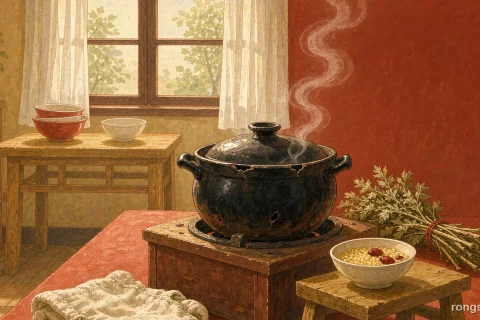
The Clay Pot My Mother-in-Law Carried: A Chinese Life Story
Lin Wei gives birth in a county town, and on the third day her mother-in-law arrives from the village with a grain sack and a chipped clay pot, ready to run the kitchen for a month. The confinement month brings four soups a day, a window that must stay shut, and quiet war over hair washing and too many layers on the baby. Then one night Lin Wei sees the older woman soaking her swollen hands under the lamp, and learns what her mother-in-law is really afraid of.
-
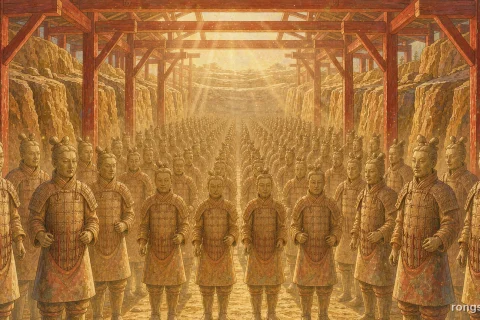
Qin Shi Huang: The Emperor Who Gave China Its Name
Born in a foreign capital while his father lived there as a hostage, Ying Zheng became King of Qin at twelve, took power in his own hands at twenty-one, and by thirty-eight had destroyed the last of the six rival states. He invented the word emperor, cut the realm into commanderies, and ordered the roads, the writing and the weights made one. He died on a tour in 210 BC, and the empire he built lasted three years. This is his story.
-
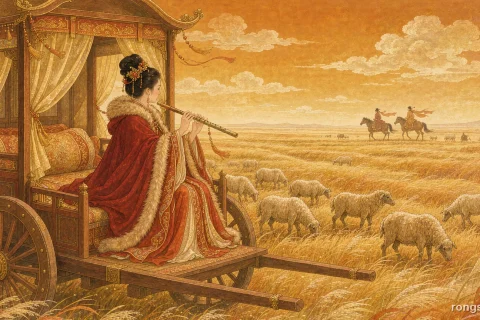
Cai Wenji: The Poet Who Came Home Without Her Sons
In 195 Cai Wenji, the daughter of the great Han scholar Cai Yong, was carried off by raiders and taken north to the steppe. She lived there twelve years and bore two sons. In 207 Cao Cao bought her back with gold, and she had to leave the children behind. She came home, married again, and one day walked barefoot into the Chancellor hall to save her second husband life. This is her story.
-
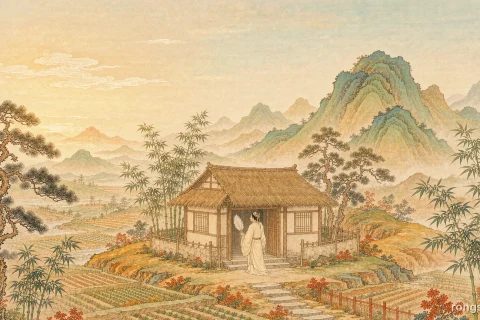
Zhuge Liang: The Sleeping Dragon Who Woke for One Man
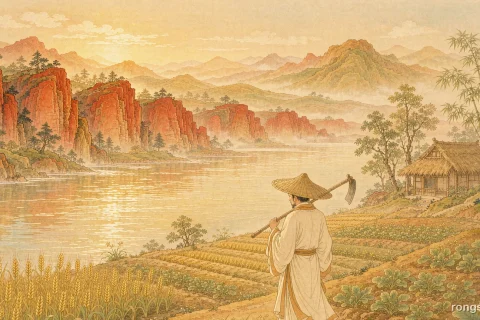
A farmer of twenty-six laid out the future of a divided empire for a general who had nothing. It was the last time in his life he was an unknown man. For the next twenty-seven years Zhuge Liang kept that conversation, through a broken alliance, a deathbed promise, five marches through the mountains, and an army camp on the Wuzhang Plains where he read every punishment case himself until he worked himself to death. This is his story.
-
Su Shi: The Poet They Exiled Three Times
In 1079 Su Shi was arrested on a charge of mocking the government in his poems. He spent one hundred and three days in prison, expecting to die. He was not executed. He was sent to Huangzhou instead, and then, over the next twenty years, exiled farther and farther south, until he reached an island in the far south of the empire. He wrote his finest work on the way down. This is his story.
-
Huo Qubing: The Teenage General Who Never Lost a Battle
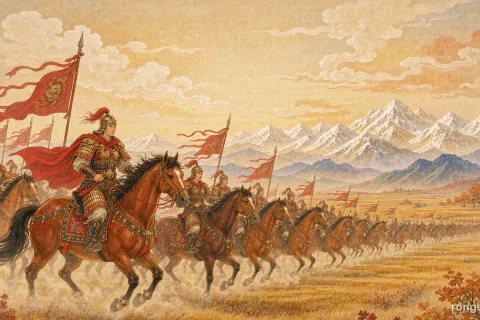
In 119 BC a Han cavalry column rode north for more than a thousand miles. The man leading it was twenty-one years old. Before he turned twenty-four he had driven the Xiongnu out of the Hexi Corridor, performed a sacrifice to heaven on a sacred enemy mountain, and became Grand Marshal of the Han armies. Then he died, and the histories recorded it in a single word. This is his story.
-
The Sealed Library at Dunhuang: A Chinese History Story
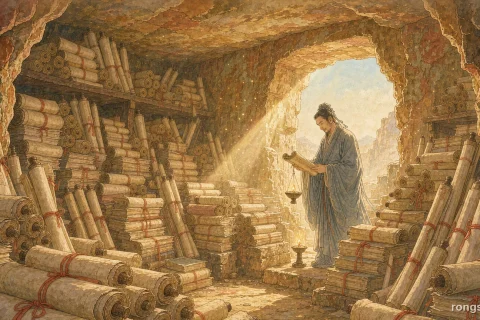
In the summer of 1900 a Taoist priest had sand cleared from the caves at Dunhuang, and the wall at the end of a passage turned out to be hollow. Behind it was a room about three metres across, packed to the ceiling with cloth-wrapped bundles: fifty thousand manuscripts, laid up in the dark since the eleventh century. He reported the find up the chain. Nobody came for seven years. Then the buyers arrived, and the cave began to empty.
-
The Envoy Who Would Not Kneel: A Chinese History Story
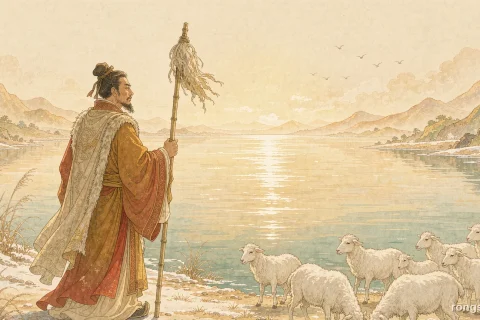
In 100 BCE a Han envoy named Su Wu drove a knife into his own chest rather than be questioned in a Xiongnu tent. They saved him. When he still would not kneel, they sent him north to a cold lake to herd rams, and told him he could go home when the rams bore lambs. He kept the envoy’s staff in his hands for nineteen years, until the yak hair had all fallen off it.
-
The Pole at the South Gate: A Chinese History Story
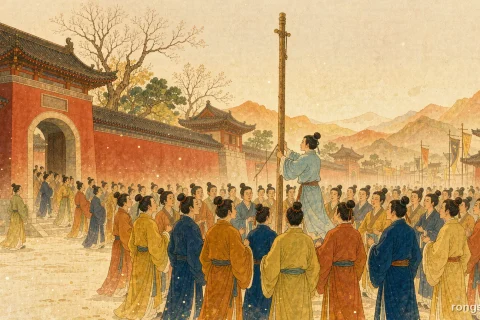
In 338 BCE the man who had remade the state of Qin reached a frontier post and asked for a bed. The innkeeper wanted his papers, because the law of Lord Shang said that anyone who sheltered a traveller without checking his papers answered for it himself. He had none. He sighed, and went on. Twenty years earlier he had set a pole outside the south gate of the market and paid a man fifty jin to carry it across the square, so that the country would believe what he said next.
-
Seven Voyages, Then Silence: A Chinese History Story
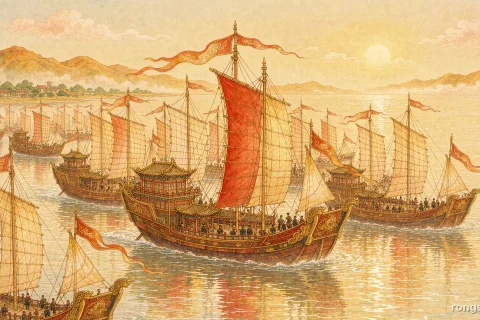
In 1405 a fleet of more than two hundred ships and twenty seven thousand men sailed out of Fujian under a eunuch admiral named Zheng He. Over twenty eight years it went to Calicut, Hormuz and the coast of Africa, took a pirate chief alive, brought a giraffe home as a qilin, and set up one stone in Ceylon inscribed in three languages. Then the emperor who sent it died, the records were hidden or burned, and the ships rotted in the harbour at Liujiagang.