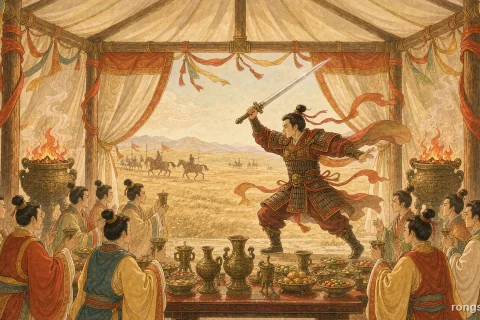
In 100 BCE, inside the tent of the Xiongnu ruler, a Chinese envoy put his hand on his own knife.
His name was Su Wu.
Beside him stood Wei Lü, a Chinese who had gone over to the Xiongnu and had been told to interrogate him.
Su Wu turned to the men who had come out with him and said one thing. To submit to questioning and disgrace the commission he carried, he said, was worse than dying. Alive, he would have no face to go home.
Then he drew the knife and drove it into himself.
Wei Lü was so startled that he threw his arms round him and shouted for a rider to fetch a doctor.
When the doctor came he dug a pit in the ground and laid a bed of charcoal in it, charcoal with smoke but no flame. Su Wu was laid face down over the pit, and the doctor trod on his back to make the blood come out.
He had stopped breathing for a long while before it started again.
His full name was Su Wu, his style Ziqing, and he came from Duling, near the capital.
His father Su Jian had ridden with the general Wei Qing against the Xiongnu and had been made a marquis for it. That is how the boy got into the palace guard, and from there into the imperial stables.
To see how a Han envoy came to be lying in a Xiongnu tent with a knife in him, go back one year.
The Year He Was Sent
It was the first year of Tianhan, in the reign of Emperor Wu of Han. In the Western calendar, 100 BCE.
For decades Han and the Xiongnu had fought, and for decades each had held the other’s envoys. The Xiongnu had detained Guo Ji, Lu Chongguo and a dozen other Han missions. When Xiongnu envoys reached Han, Han detained them in the same way, to keep the count even.
That year a new Xiongnu ruler came to power, and he was afraid that Han would attack while he was still settling in. So he said something soft. The Han emperor, he said, is of my father’s generation.
And he sent all the Han envoys home.
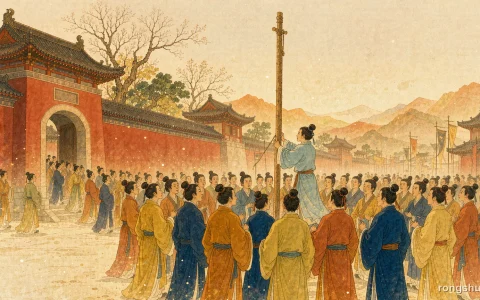
Emperor Wu thought the gesture worth an answer. He sent Su Wu, as a general of the palace, to escort back the Xiongnu envoys who had been held in Han, and to carry a handsome gift with him.
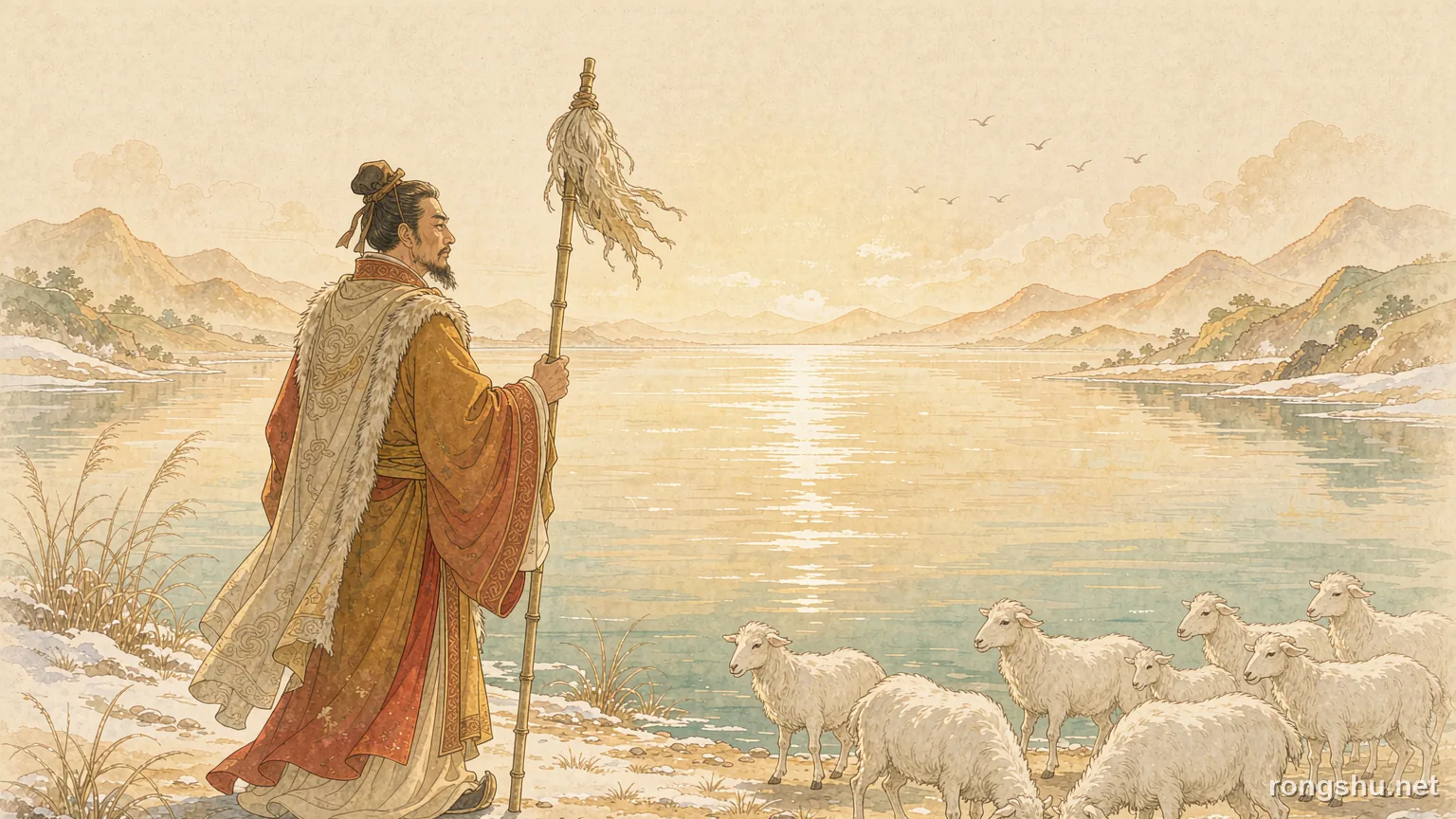
The tally Su Wu carried was the badge of a Han envoy: a bamboo staff with a tuft of yak hair bound at the top.
The mission was a little over a hundred men. His deputy was Zhang Sheng. The officer below him was Chang Hui. The rest were scouts and soldiers.
When they reached the Xiongnu, something was off. The ruler accepted the gifts, and grew more arrogant.
He had been about to send them home.
And then it went wrong.
Snow in the Pit
Among the Xiongnu there was a man named Yu Chang, who had come out of Han long before in the following of Wei Lü, and a prince named Gou. The two of them plotted together to seize the ruler’s mother and take her over to Han.
Yu Chang had known Zhang Sheng in Han.
He came to see him privately. I hear the Han emperor detests Wei Lü, he said. I can lay an ambush with crossbows and kill him for Han. My mother and my brother are still in Han. I hope the court will look after them.
Zhang Sheng agreed, and gave him goods.
A month or so later the ruler went out hunting, leaving only his mother and the younger men of the family at home. Yu Chang and more than seventy others were to move. One of them ran in the night and gave them away.
The ruler’s sons turned out with soldiers. The prince Gou and his people were killed, and Yu Chang was taken alive.
The ruler put Wei Lü in charge of the case. Zhang Sheng heard of it, was afraid that what he had said would come out, and told Su Wu.
Su Wu said: it has gone this far, and it will reach me. To be disgraced and then die would be to fail my country twice over.
He meant to kill himself. Zhang Sheng and Chang Hui held him back.
Yu Chang did name Zhang Sheng.
The ruler was furious, and called his nobles to decide whether the Han envoys should be killed. An officer named Zuo Yizhi said: if a man plots against the ruler himself, what worse can be done to him? Better to make them all submit.
So Wei Lü was sent to bring Su Wu in for questioning. And that is where the story started.
Su Wu lived. The ruler respected what he had done, and had men look in on him morning and evening.
When he was stronger they came to talk him round. It happened on the day the case was decided. Wei Lü cut Yu Chang down with a sword, then raised the blade at Zhang Sheng, and Zhang Sheng asked to surrender.
Wei Lü turned to Su Wu. Your deputy is guilty, he said. The chief envoy answers with him.
Su Wu said: I was not in the plot, and I am not his kin. There is nothing to answer for.
Wei Lü raised the sword again and made as if to cut.
Su Wu did not move.
Then Wei Lü tried another way, and used himself as the argument. I went over to the Xiongnu, he said, and I was given a royal title, tens of thousands under me, horses by the hillside. Wealth like that. Surrender today, and tomorrow it is yours. As it is, you will feed the grass with your body, and who will ever know?
Su Wu cursed him for it.
What he said was this. When the men of Nanyue killed a Han envoy, their land was made into nine commanderies. When the king of Dayuan killed one, his head was hung under the palace gate. When Korea killed one, it was destroyed at once. Only the Xiongnu have not yet had their turn.
Wei Lü saw that it was hopeless and reported as much. The ruler wanted Su Wu more than ever, and had him put in a great pit in the ground with no food and no water.
Then it snowed.
Su Wu lay in the pit and swallowed snow together with the felt of his coat, and did not die.
The Xiongnu thought it was a miracle.
So they sent him to the Northern Sea, to herd sheep.
They gave him rams. What the ruler said was this: when the rams give milk, you may go home.
Rams on the Lake
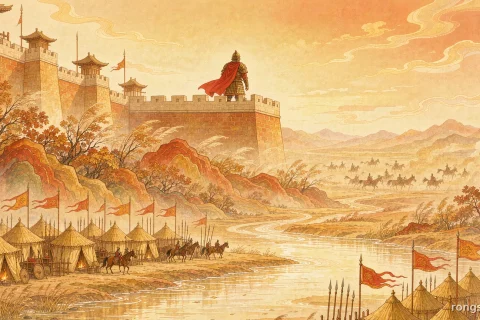
The Northern Sea is Lake Baikal.
It freezes for months. In the middle of winter the air there runs far below freezing, and there is nothing between a man and the wind.
No grain came. Su Wu dug up the stores that field mice keep in their burrows, and ate those.
He always had the tally in his hand. He held it when he slept and when he woke.
In time the yak hair fell out, strand by strand, until there was nothing on the bamboo but the bamboo.
After five or six years the ruler’s younger brother came to hunt by the lake. Su Wu could knot nets, spin cord and true a crossbow, and the prince liked him, and gave him clothes and food.
Three years or so after that the prince fell ill. Before he died he gave Su Wu horses and cattle, a clay wine jar, and a felt tent.
The prince died, and his people moved away.
That winter men of the Dingling came and stole the animals. Su Wu had nothing again.
Li Ling Came
The year after Su Wu was sent out, a Han general named Li Ling surrendered to the Xiongnu.
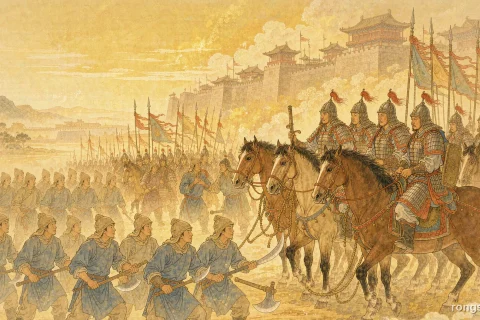
Li Ling was the grandson of Li Guang, the old general the Xiongnu had called the Flying General. He had taken five thousand infantry deep into Xiongnu country, been surrounded by eighty thousand horse, fought until the arrows were gone and the swords were blunted, and then, with no help coming, given himself up rather than die. He was the most talked about man in Han.
A long time after, the ruler sent Li Ling to the lake.
Li Ling set out wine and music for him.
He began with the friendship between them. Then he told Su Wu about his family. His elder brother Su Jia, steadying the emperor’s carriage on a step, had broken the shaft, been accused of gross disrespect, and killed himself with his sword. His younger brother Su Xian, sent to arrest a fugitive and failing to find him, had taken poison. His mother was dead. His wife was young, and he had heard that she had married again.
And then he spoke of himself. When I surrendered, he said, I was like a man out of his mind with what I had done to Han. You do not want to surrender, and your suffering is worse than mine. The emperor is old. The laws change from one day to the next. Whole families of ministers are wiped out for nothing. You do not know from one hour to the next whether you are safe. For whose sake are you doing this?
Su Wu said: my father and I had no merit of our own. Everything we had came from the emperor. For years I have wanted nothing but a chance to lay down my life. A subject serving his lord is a son serving his father. A son does not resent dying for his father. Say no more.
Li Ling drank with him for several days, and then said: Ziqing, listen to me, once.
Su Wu said: I have thought of myself as a dead man for a long time. If you must force me to surrender, then let me die in front of you today, here, and let that be the end of the drinking.
Li Ling looked at him a long moment, and sighed. Ah, he said. A man of honour. The crime of Li Ling and Wei Lü reaches to heaven.
He wept, and the tears wet the front of his coat. He said goodbye and went away.
He could not bring himself to give Su Wu anything with his own hands. He had his wife take him several dozen head of cattle and sheep.
Later Li Ling came back to the lake with news. On the frontier they had taken a prisoner from Yunzhong, and the man said that every official and commoner below the governor was wearing white. The emperor was dead.
Su Wu turned to the south and wept, and wept until he brought up blood, and for months he mourned every morning and evening.
For a reader who knows the classical world this story has a familiar shape, and the resemblance is not a coincidence of temperament. It belongs to an idea.
Marcus Atilius Regulus was a Roman consul taken prisoner by Carthage in the first Punic war. Carthage sent him home to negotiate a peace and an exchange of prisoners, on his word that he would return. Regulus went before the Senate and argued against both, because he judged each of them bad for Rome, and then, though his family and his friends begged him to stay, he went back to Carthage and to the death everyone expected, because he had given his word. Horace made him a model of a man who cannot be moved. The point of the Roman story, as the Romans told it, is the point of this one. An envoy is not a private person. He carries something that is not his, and he answers for it and not for his own life.
What is genuinely different here is the paperwork and the length. In the ancient world an envoy was usually a hostage with better manners, and the safe conduct of ambassadors as a rule of law is a much later invention than either story. Han and the Xiongnu held each other’s missions for decades at a time as a matter of course. The tally, that bamboo staff with a tuft of hair at the top, was the only thing that told the world, and the man himself, what he was. Su Wu held it for nineteen years after the tuft had fallen off. That is the whole of the story, and it is enough.
A Letter on a Goose
Some years after Emperor Zhao came to the throne, the Xiongnu and Han made peace and married into each other’s houses.
Han asked for its people back. The Xiongnu said Su Wu was dead.
Then a Han mission came again, and Chang Hui, who had been held all this time, got hold of his guard, went at night to see the Han envoys, and told them what to say.
The next day the envoy put it to the Xiongnu ruler as a fact. The Han emperor, he said, was hunting in the Shanglin park and shot a wild goose. On its leg there was a piece of silk with a message, and the message said that Su Wu and his men were alive by a marsh.
The ruler looked at the men on either side of him, and was startled, and apologised to the envoys. Su Wu, he said, is indeed alive.
In the spring of 81 BCE Su Wu reached Chang’an.
He had gone out with more than a hundred men. He came back with eight others. Nine in all.
The History of Han has one line for it. Su Wu was kept among the Xiongnu for nineteen years. He went out in his strength, and when he came back his hair and his beard were white.
One of his first acts on returning was to take a set of offerings to the tomb park of Emperor Wu, the man who had sent him out.
The court made him a minister for foreign peoples, and gave him two million in coin, two hundred acres of public land, and a house.
Su Wu lived past eighty and died in 60 BCE. The emperor Xuan later had portraits of eleven of his most deserving ministers painted in the Qilin Pavilion, and Su Wu was one of them.
There is still a tomb for him in Wugong county in Shaanxi.
Where the tally went, the histories do not say. What is left is that one line in the History of Han.