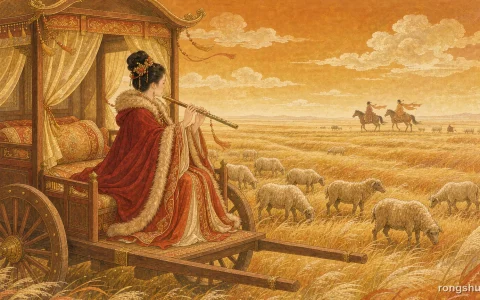
In 210 BC a long convoy of carriages halted at the Shaqiu platform, in the north of what is now Hebei.
Inside one of the carriages was a dead man.
He was the emperor of the realm.
He had been travelling on an inspection tour, and on the road he had fallen ill.
Riding with him were his chancellor, Li Si, a palace eunuch named Zhao Gao, and his youngest son, Hu Hai.
The three of them talked it over and decided not to announce the death.
It was the seventh month, and the heat was fierce.
A body could not be kept. The smell grew heavier day by day.
They bought a cartload of salted fish and drove it behind the imperial carriage, so that the smell of the fish would cover the smell of the emperor.
Along the road, documents were issued as usual. Meals were carried in as usual. Officials bowed at the curtain and asked after the emperor as usual.
Then the convoy turned around, took a wide detour, and went on as if the tour were still under way, heading back toward the capital at Xianyang.
At the same time, a sealed letter went north to the frontier commander Fu Su.
It said that the crown prince was unfilial and the general Meng Tian disloyal, and that both were ordered to die.
The letter was a forgery.
By the time the convoy reached Xianyang, the empire had a different master.
A Boy in Handan
In the first month of 259 BC, a boy was born in Handan, the capital of the state of Zhao.
His family name was Ying and his given name was Zheng.
At that time his father, Yiren, was living in Zhao as a hostage.
Yiren was a prince of Qin, but his mother was out of favour and he had many brothers, so he had been sent away to Zhao, where he lived poorly.
A merchant from Wey named Lu Buwei was doing business in Handan. He took an interest in Yiren, and said that this was a rare piece of goods worth hoarding.
Worth hoarding, in this case, meant holding on to the man and selling him later at a great price.
Lu Buwei gave Yiren five hundred pieces of gold to spend on guests and contacts. He took another five hundred and went to Qin himself with fine treasures.
He worked the connections for Yiren until the prince was adopted by Lady Huayang, the favourite of the Qin heir, as her own son.
Later Yiren escaped from Handan back to Qin, changed his name to Zichu, and became the heir.
In 247 BC Zichu took the throne. Three years later he was dead.
That year Ying Zheng was twelve.
He became King of Qin. Lu Buwei ran the government and was honoured as a second father.
There is another account of this boy that has to be stated clearly.
The Records of the Grand Historian, in the memoir of Lu Buwei, says that Lu Buwei gave the Qin heir a concubine who was already pregnant, and that the child born of her was the future First Emperor.
By that account, the First Emperor was in fact the son of Lu Buwei.
But that passage sits in the memoir. Elsewhere, in the basic annals of the First Emperor, the same historian writes plainly that the boy was the son of King Zhuangxiang.
Most scholars since have held that the pregnancy story does not hold up, and that it was invented by people at court.
The question has been argued for two thousand years and no one has produced proof either way.
So it can be told as one version among others. It cannot be told as settled fact.
The Soldiers at Qinian Palace
Ying Zheng grew up in the palace and came at last to the age when a king takes power into his own hands.
At that point there were two powers around the throne.
One was Lu Buwei. The other was the household of the queen mother.
The queen mother, Zhao Ji, had once been a concubine of Lu Buwei. Afraid of exposure, Lu Buwei brought another man into the palace to keep her company. His name was Lao Ai.
Lao Ai was made a marquis and gathered a great household of retainers. In strength he stood second only to Lu Buwei.
In 238 BC, when Ying Zheng was twenty-one, he went to the Qinian Palace at Yong to take the cap of manhood and assume personal rule.
That was the year Lao Ai moved.
He stole the king seals and the seals of the queen mother, called out troops, and marched on the Qinian Palace.
Ying Zheng was ready. He had placed three thousand picked soldiers inside.
The fight was over quickly. Lao Ai fled alone and was caught soon after.
The punishment was severe. Lao Ai was torn apart by chariots, his followers were executed, and the queen mother was sent away and kept under guard.
The next year Ying Zheng stripped Lu Buwei of his post as chancellor and banished him to Shu.
Lu Buwei understood that he would not be coming back, and drank poison.
From that year onward, the twenty-one year old King of Qin held real power in his own hand.
There was one more matter at court in those years.
Qin had long relied on foreign advisers, and the Qin nobility resented them.
After a case of espionage, Ying Zheng issued an order expelling every foreign adviser from the state.
Li Si, himself a man from outside Qin, was on the list.
He wrote a memorial against the expulsion, and counted the matter out: Qin had grown strong not through Qin men alone. Shang Yang was from Wey. Zhang Yi was from Wei. Fan Ju was from Chu.
Ying Zheng read it, cancelled the order, and restored Li Si to office.
By then Qin was already a formidable state.
Its system had been set up more than a century earlier by Shang Yang. Households were registered. Rewards in war followed measured merit. Officials were appointed by the ruler, not born to the post. The system had no softness in it. It had rules, and it applied them.
Qin had the soldiers, and now it had the men to use them.
Ten Years, Six Kingdoms
The opportunity came, and he began by cutting into Han.
In 230 BC the Qin general Nei Shi Teng attacked Han and took King An prisoner. Han was finished.
In 228 BC Wang Jian broke into Handan and took the King of Zhao.
Zhao still had one great general, Li Mu. Qin could not beat him in the field, so it used a rumour instead. The King of Zhao believed the slander and had Li Mu killed. Three months later Handan fell.
Ying Zheng had grown up in Handan and had known the coldness of the people of Zhao. After the city fell he went back to the place of his birth and dealt with the families who had once wronged his mother’s house.
In 225 BC Wang Ben attacked Wei, cut open the Yellow River and the old canal, and let the water into Daliang. After three months the walls collapsed and Wei was finished.
In 223 BC Wang Jian took six hundred thousand men against Chu, and Chu was finished.
In 222 BC Wang Ben took Liaodong, and Yan was finished.
In 221 BC Wang Ben came down out of Yan and attacked Qi, and took King Jian prisoner.
From the fall of Han to the fall of Qi was exactly ten years.
In those ten years the armies, the walled cities and the ancestral temples of the six states went out one after another.
That year Ying Zheng was thirty-eight. He had finished the wars of the realm.
The Word Emperor
With the fighting done, the next task was to set new rules for the whole realm.
The first thing he did was to give himself a new title.
He judged that the old word, king, was not enough.
He said that his virtue covered the Three August Ones and his deeds surpassed the Five Emperors.
So he took one character from each: huang from the Three August Ones, di from the Five Emperors. Together they made huangdi.
He was the first man to use the two characters as a title, so he called himself the First Emperor. His heirs would be Second, Third, on down to the ten thousandth generation.
The word huangdi was used in China for more than two thousand years afterwards.
What he set down was two things: there would be one emperor in the realm, and the word of the emperor would be the rule.
The second thing he did was to cut the realm into pieces and send officials to govern them.
Some men advised him to follow the old way and hand out land to his sons and his ministers, the way the Zhou had done.
Li Si said no. The Zhou had enfeoffed hundreds of lords, and for centuries afterwards those lords had fought each other; the fighting came out of the enfeoffment.
Ying Zheng took Li Si’s advice.
He divided the realm into thirty-six commanderies. Below each commandery were counties. The officials came from the court, served a few years, and were moved on. Nothing was hereditary.
As the territory grew, the number of commanderies rose past forty.
That system of commanderies and counties is still in use today, under different names and in different layers.
The third thing he did was to standardize writing, carriage tracks, weights and measures, and money.
One ruler, one scale, one coin, one script.
The fourth thing he did was to open the roads and cut his words into stone.
He built imperial highways fifty paces wide, with a pine tree planted every three zhang, running out from Xianyang in every direction.
He went out on inspection tours again and again, and wherever he went he had a stone raised on some mountain with his merits carved into it.
A few of those stones survive. The calligraphy on them is by Li Si.
He attacked the Xiongnu in the north and joined the old walls of the former states into one longer wall.
In the south he attacked the Yue peoples and cut the Lingqu Canal, linking the Yangtze river system to the Pearl River system.
Some of these works paid off over centuries. Others cost the labour of a million people.
The histories record that the corvee labour under Qin was heavy and the punishments were harsh.
In 213 BC Li Si sent up a memorial arguing that scholars were using the old books to attack the present government, and asking for the books to be burned.
Apart from works on medicine, divination and farming, the copies of the Classic of Poetry, the Classic of Documents and the writings of the various schools held by private families were collected and burned.
The next year he ordered an investigation of the diviners and scholars around him. More than four hundred and sixty people were implicated, and were buried alive.
In later books the two events are joined into one phrase: burning the books and burying the scholars.
Some scholars have argued that those buried were mainly the diviners who had deceived him, and not all of them were Confucians. That argument has never been settled either.
That same year he began to search for a way to live forever.
He believed the diviners who told him he could become one of the immortals, and stopped calling himself by the imperial we.
He wanted the place where he slept to be secret, and made it a capital offence to reveal where he was.
He sent an expedition led by a man named Xu Fu, with several thousand young boys and girls, out to sea to find the islands of the immortals and the drug of deathlessness.
Xu Fu never came back.
In 210 BC he set out on his fifth inspection tour, and his last.
The Last Journey
He went out from Xianyang and travelled east until he reached the sea.
In five tours he had gone east to the coast, south to Yunmeng, north to Jieshi.
He is said to have shot a great fish in the sea.
At Pingyuan Crossing he fell ill.
He had a letter drawn up to send to the crown prince Fu Su, telling him to come back to Xianyang and take charge of the funeral.
The letter was written and sealed. It stayed in the hands of Zhao Gao.
It was never sent.
At the Shaqiu platform, in the carriage, he died. He was forty-nine.
And then came the scene at the beginning.
Zhao Gao talked Li Si around, and they altered the letter.
Fu Su received it in the north and wept. Meng Tian urged him to send back and verify it. He did not.
He said: a father orders a son to die, and the son asks nothing more.
He took his own sword.
Meng Tian refused to die. He was put in prison first, and later forced to die there.
The convoy came back to Xianyang, and Hu Hai took the throne as the Second Emperor.
The First Emperor had held a unified realm for eleven years. The empire he built by hand came apart three years after his death.
Today, if you leave Xi’an and drive east, you come to a mountain.
It is not a mountain. It is a tomb, and it is called the Lishan tomb.
East of the mound lies Pit Number One.
In 1974 a few farmers were digging a well and turned up fragments of pottery.
They dug further, and found an army.
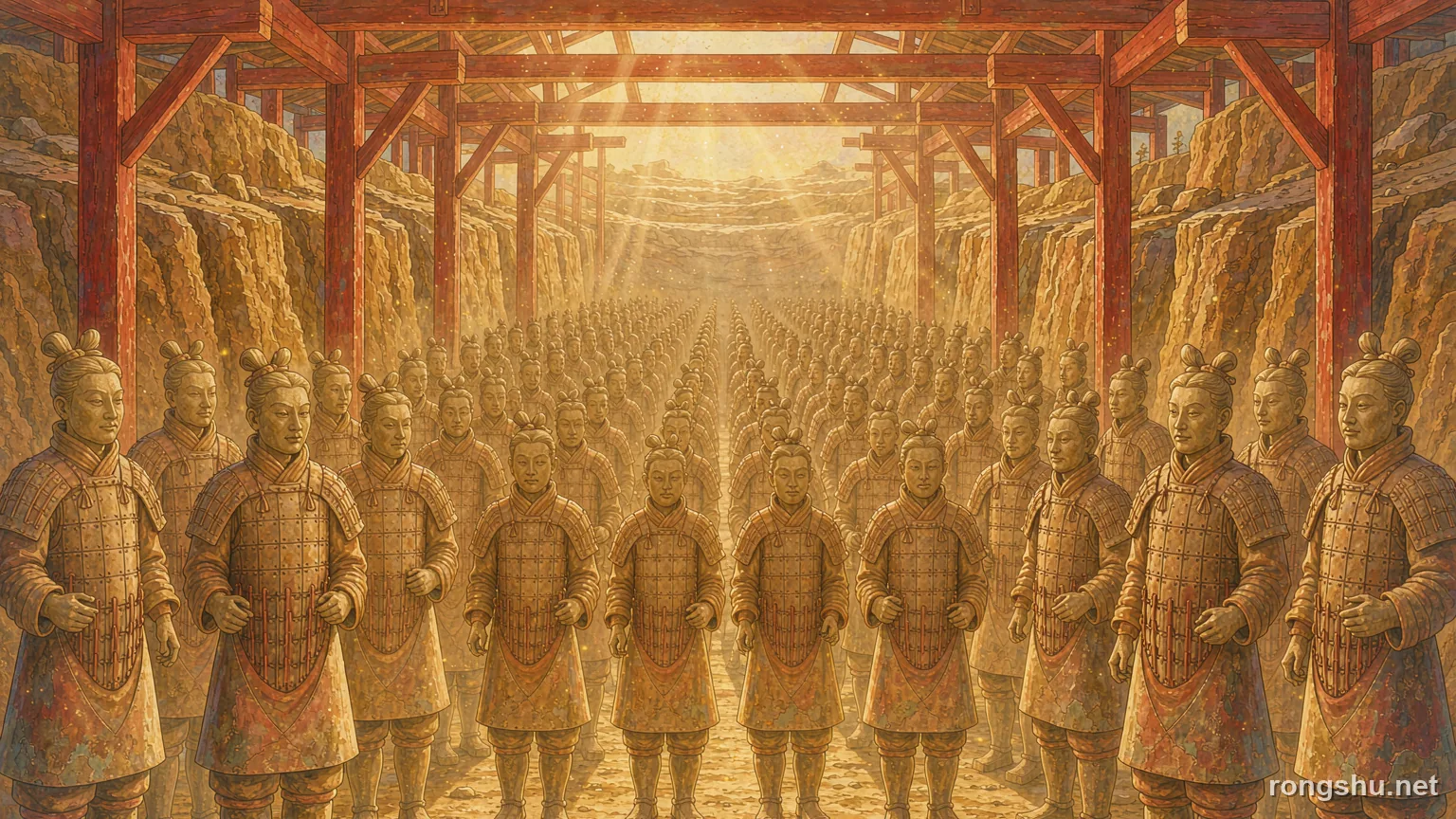
Pit Number One holds more than six thousand figures, drawn up as a battle formation.
At the front stand three ranks of crossbowmen without armour. Behind them are infantry, chariots and cavalry.
There are three pits in all, and more than eight thousand figures between them.
When they were found, many were toppled and broken. They had been painted, and the paint flaked away as soon as it met the air.
They stand in their rows, faces turned to the east.
The men who come to look at them tend to think of the same question. The empire that was meant to last ten thousand generations lasted two.
A man who wanted his name carried down forever left behind an army that does not speak.