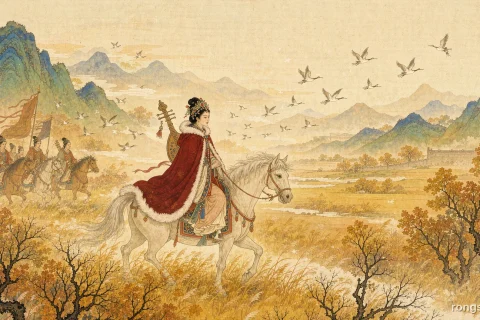
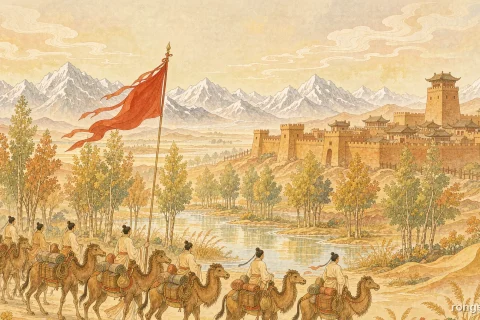
In the spring of 119 BC, a column of Han cavalry rode out of the frontier and kept going north for more than a thousand miles.
The man leading them was twenty-one years old.
His name was Huo Qubing.
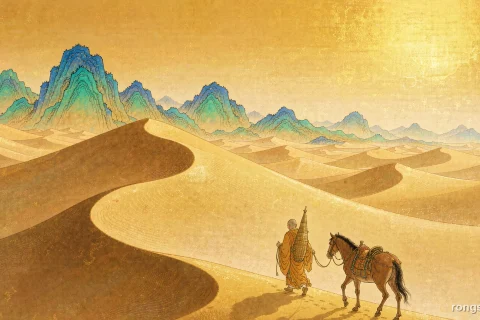
He crossed desert. He crossed mountain passes. He came at last to a mountain called Langjuxu.
There he had a platform of earth raised. He turned to face south, and he performed for the Han emperor the rite of sacrifice to heaven.
It was the first time in Chinese history that this rite had been carried into the heartland of the Xiongnu.
That year he was twenty-one.
Two years later he was dead.
How he died, the histories do not say.
The Records of the Grand Historian give his death a single word: died.
Whose Son He Was
We have to begin with his birth, because in this story birth was the one thing he could never walk around.
Huo Qubing was born out of wedlock.
His mother was Wei Shaoer, a slave woman in the household of the Marquis of Pingyang. His father was Huo Zhongru, a minor clerk in the county of Pingyang.
Huo Zhongru had come to the marquis house on business. He and Wei Shaoer began to see each other, and a child was born.
Then his term of service ended, and he went home. He married somebody else. He never came back.
That whole side of the family was simply cut off.
The Records say that when Huo Qubing grew up he learned the truth about his father, and never found the time to ask about it.
His fate hung on his mother side of the family instead.
Wei Shaoer had a younger sister, Wei Zifu. Wei Zifu went into the palace and became empress to Emperor Wu of Han.
Wei Shaoer also had a younger brother, Wei Qing. Wei Qing began as a groom who held other men horses, and rose to be the Grand General.
An aunt who was empress. An uncle who was the Grand General.
And a boy born out of wedlock, suddenly growing up under the eye of the emperor.
Those were the years when Han was fighting the Xiongnu harder than ever. Ever since the first Han emperor was surrounded on Mount Baideng, the court had sent women and treasure north for more than sixty years, buying quiet on the border. Under Emperor Wu the tide turned. Now Han wanted to fight.
In years like that, a boy who could ride and shoot was needed.
The Records say that he was good with horse and bow from childhood, that the emperor was fond of him, and that he was made an attendant at court.
An attendant at court means the man who stands close to the emperor.
That is where his life turned.
Eight Hundred Horsemen
In 123 BC, Emperor Wu sent Wei Qing into the desert south of the Gobi.
Huo Qubing went with his uncle.
His title was Colonel of the Flying Cavalry.
Seventeen years old, riding to war for the first time, and already an officer.
The main army moved by the book. Grain first, baggage first, scouts out front, never a step without orders.
He found it too slow.
He took eight hundred horsemen away from the main force and rode north for several hundred li.
Eight hundred men, each with one day of dry food on his saddle.
Nobody knew where they had gone. Nobody knew when they would come back.
The Records wrote down only four words about it: he left the main army.
He left it behind and kept going forward.
What the Records describe in full is the way he came back.
He brought back more than two thousand heads, and an uncle of the Xiongnu chanyu himself.
Eight hundred men, deep inside enemy land, and a fight like that.
By the rules of the time, killing more than you lost was called exceeding the count. He exceeded it by a great deal.
The emperor was delighted. He made the boy Marquis of Champion.
Champion means the bravest of the whole army.
Seventeen years old, and made a marquis by a single battle.
In the whole history of Han, it happened once.
The emperor later tried to teach him the old military books, the Art of War and the lessons of Wu Qi.
He said that what mattered was the plan you made on the ground, and that there was no need to study the methods of dead men.
A boy still in his teens, saying that to an emperor.
The Hexi Corridor
Two years later, in the spring of 121 BC, the emperor sent out troops again.
This time Huo Qubing was nineteen.
He was made General of the Flying Cavalry, given ten thousand riders, and sent out from the west.
What he wanted was a long strip of land in the northwest, north of the Qilian Mountains, west of the Yellow River. Today it is called the Hexi Corridor.
It joins the Chinese heartland to the western regions.
Whoever holds it can pinch shut the gate between east and west.
Huo Qubing went to take it.
In six days he fought through five small kingdoms. He crossed more than a thousand li past Mount Yanzhi. He killed the Xiongnu kings of Zhe Lan and Lu Hou, and out of one camp he took back a golden idol, the image the Xiongnu used in their own sacrifices to heaven.
In summer he went again.
That time he pushed deep under the Qilian Mountains and broke the right wing of the Xiongnu apart.
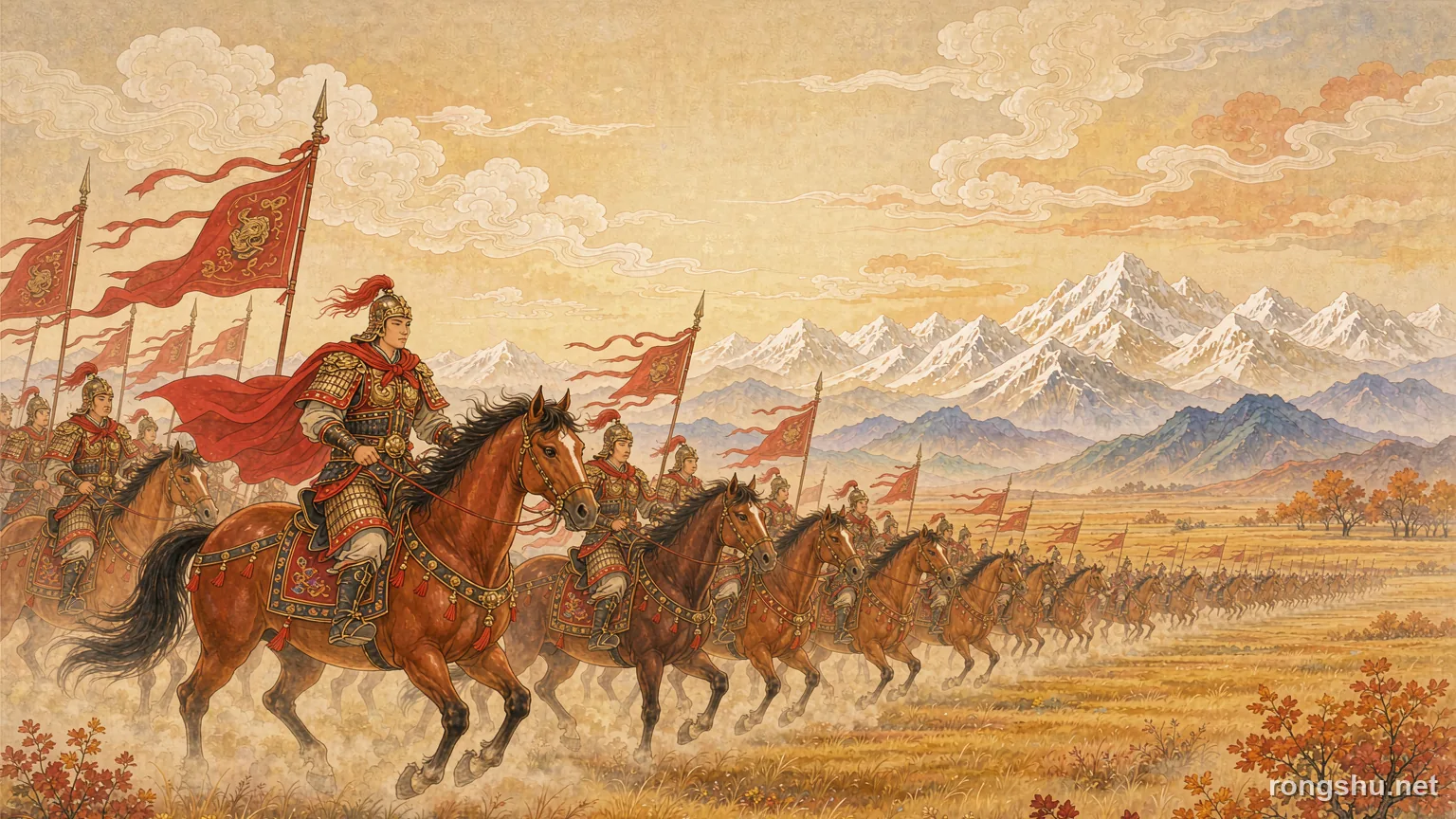
In autumn the Xiongnu king Hunxie came south with more than forty thousand of his people to surrender to Han.
It was a dangerous bargain.
On the road south, the column began to come apart.
Some of them had not wanted to surrender. Some of them wanted to run.
Forty thousand people and horses crowded onto one road. Those in front pressed south. Those behind turned north. The dust rose so thick that nothing could be seen.
Huo Qubing rode straight into the middle of that camp.
He killed the men who had begun the mutiny. The rest held.
Only then did King Hunxie lead his people across into Han territory.
From that day the Hexi Corridor belonged to Han.
Later the Xiongnu made a song about losing it:
We have lost the Qilian Mountains, so our herds cannot breed.
We have lost Mount Yanzhi, so our women have no colour left.
A song that was written down and kept for two thousand years.
For Huo Qubing, that was the fullest year of his life.
Nineteen years old, leading an army on his own for the first time, and he opened a corridor.
The emperor set up four commanderies along it: Wuwei, Zhangye, Jiuquan, Dunhuang.
Four names that are still on the map today.
The Rite on the Mountain
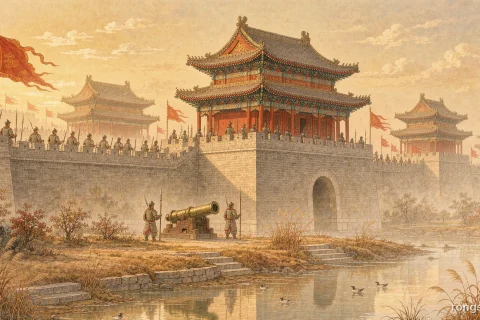
In 119 BC, Emperor Wu launched the largest attack Han had ever made on the Xiongnu.
Wei Qing and Huo Qubing each took fifty thousand horsemen out through the passes.
Huo Qubing went north from Dai Commandery.
He did not carry much grain.
His method was to eat the grain the Xiongnu had stored, to break apart the Xiongnu camps, and to feed his horses on what he took from the enemy.
It was a new way of fighting. An ordinary army lives on its supply road, one camp at a time. He kept no supply road at all. He drove straight into the deep grassland and lived off the war itself.
The way he led, the Records say, was this: few words, a shut mouth, and once he had decided, he went. He would drive into the middle of enemy country. He would take a whole army down a road nobody had ridden before.
The Records also give another side of him.
The emperor sent his own cooks out after him, with dozens of wagons of food. When the campaign ended, good rice and good meat were still on those wagons, and he left them to be thrown away. And among his soldiers there were men going hungry.
A young hero on one side. This on the other.
The men who wrote him down did not cover it and did not argue it away. They wrote the merit as merit, and the fault as fault.
He rode north more than two thousand li and crossed the great desert.
What came against him was the Wise King of the Left, the Xiongnu left wing.
When the battle ended, that army was broken, and more than seventy thousand of them were gone.
Huo Qubing did not stop.
He kept riding north, all the way to the mountain called Langjuxu.
There he raised an altar and made sacrifice to heaven.
The wind on that mountain was strong. The platform of earth was new, and the soil was still loose.
Twenty-one years earlier, nobody would have guessed that a rite like this would be performed by a boy born out of wedlock.
North of the mountain, on Guyan, he raised a second altar and made sacrifice to the earth.
Then he turned the army south.
It was the farthest Han soldiers had ever gone. It was the first time they had carried the rites of the Chinese heartland onto a sacred mountain of the Xiongnu.
After that battle the main Xiongnu force withdrew even farther north.
And on the Han side, nobody questioned any longer whether a man in his early twenties could be trusted with great things.
The emperor made him Grand Marshal, and set him beside his uncle Wei Qing to command the armies of the empire together.
He was twenty-one.
The emperor once offered to build him a house.
He answered with one line: while the Xiongnu are not destroyed, what use is a home.
Those words were passed down for two thousand years and came to rest on the lips of soldiers.
But in those same two years, he also did a thing that people have argued about for a thousand years.
After the northern campaign, a young officer under his command, Li Gan, blamed Wei Qing for the death of his father, the famous general Li Guang. He struck Wei Qing and wounded him.
Huo Qubing found out.
Later, on a hunt, he drew his bow and shot Li Gan dead.
The emperor buried the matter. He told the court that Li Gan had been killed by a deer.
A Grand Marshal in his early twenties had done this, and the emperor covered it for him.
Later writers gave him his credit and gave him his blame, and not one of them cleaned it up.
The Year He Died
In 117 BC, Huo Qubing died.
The Records give it one word: died.
They do not say of what. No illness, no wound.
A man who two years before had taken an army across two thousand li of desert was gone.
The emperor was grief-stricken.
He brought armoured troops from five frontier commanderies, in black armour, and lined them from the capital all the way out to his own tomb at Maoling, to see the young man off.
A long black line of soldiers, from the city to the emperor burial ground.
The tomb of Huo Qubing was built in the shape of the Qilian Mountains.
Because his work had been done under those mountains.
He was twenty-three when he died.
On one campaign he had passed through Pingyang, and there he met his father, Huo Zhongru, for the first time.
The governor of the commandery came out to meet him, carrying his bow for him into the post station. Huo Qubing sent for the old man.
When they met, he knelt and said: only today do I know that I am your son.
Huo Zhongru bowed his head to the ground and said that an old servant being able to entrust his life to the general was the work of heaven.
Huo Qubing bought his father land and a house and servants, and left.
On the way back he passed Pingyang again, and took his half brother west to the capital.
That boy was named Huo Guang.
Many years later Huo Guang became the regent beside Emperor Zhao of Han, and held power for twenty years. The elder brother had lived only to twenty-three. The younger one carried that road onward.
Huo Qubing also had a son, named Huo Shan.
The boy was very small when his father died.
The emperor kept him close and meant for him to inherit the title of Marquis of Champion when he grew up.
Huo Shan also died young, and left no children behind him.
And the line of the Marquis of Champion came to an end.
The emperor never had another general like him.
He had many commanders. Not one of them rode a horse the way Huo Qubing did, straight into the deepest part of the grassland.
Today, beside the Maoling tomb in Shaanxi, that grave is still there.
The mound is heaped into the shape of the Qilian Mountains. In two thousand years it has not flattened.
In front of it stands a group of stone carvings. The most famous shows a war horse with its head lifted, and under its hooves a warrior lying on his back.
The lines in the stone are coarse and hard, like strength cut directly out of rock.
Two thousand years have passed. The stone is still standing in wind and rain, corners and edges intact.
People who pass by stop and look for a while.
Most of them remember two things. One line about a home that was not worth having while the enemy remained. And one number.
Twenty three years.