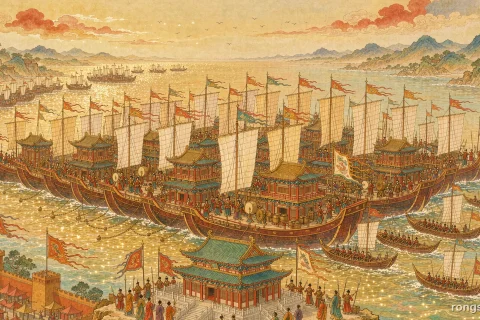
In the fifth year of Yongle, a small boat came out towards the fleet off the coast of Palembang.
The men in it carried a white flag and said they had come to surrender.
Palembang, in what is now Sumatra, sits at the gate between the South China Sea and the Indian Ocean. The pirate who held that gate was named Chen Zuyi, a man from Guangdong with five thousand followers and twenty ships, and every merchant who passed that way paid him.
This time he sent word that he had given in.
Zheng He understood.
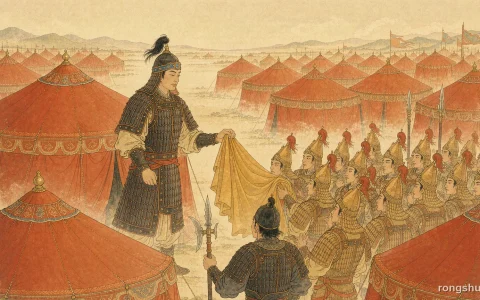
A force of five thousand does not announce its surrender with one small boat. Chen Zuyi wanted to come close. If his men could lay their boats alongside the great ships, climb aboard in the dark and take the flagship, the two hundred ships behind it would come apart.
Zheng He accepted the surrender.
He spread the fleet out and left a gap in it, and waited.
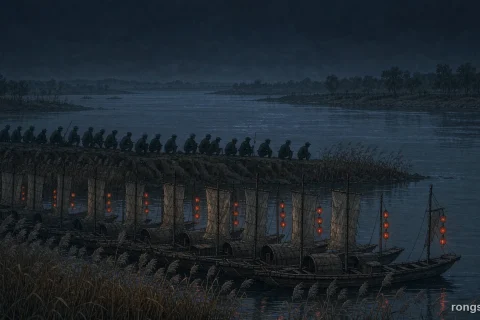
That night Chen Zuyi brought his boats in. As his men began to climb, the warships closed from every side.
Five thousand were caught inside the ring. Chen Zuyi was taken alive and sent back to Nanjing, and later executed in Beijing.
This happened on the way home from the first voyage.
To see how a fleet came to be there at all, go back to the beginning.
A Boy From Yunnan
Zheng He was not born with that name.
His family name was Ma. He came from Kunyang in Yunnan, which is now Jinning outside Kunming, and his people were Muslim. Both his father and his grandfather had made the pilgrimage to Mecca, and the neighbours called them hajji.
In 1382 Ming armies took Yunnan. That year a boy of eleven was seized by the soldiers and taken into the palace as a eunuch, and afterwards posted to the household of the Prince of Yan, Zhu Di.
He grew up inside that house.
In 1399 Zhu Di rose against his own nephew, the Jianwen Emperor, and fought him for four years. The war has its own name. The boy from Yunnan, now a man, went on campaign with him and was noticed for what he did in the fighting in Hebei. In 1402 Zhu Di took Nanjing and made himself emperor, and the following year he gave his servant the surname Zheng.
From then on he was Zheng He.
Two Hundred Ships
Zhu Di wanted a fleet at sea.
Why, the histories give three answers.
The first is standing. He had just taken the throne from a nephew, and he needed the world to acknowledge him as the rightful Son of Heaven. Sending a great fleet out to grant titles, distribute gifts and open relations was the quickest way to get it.
The second is trade. A play written at the time summed up the errand in four words: make peace with foreign lands, and fetch treasure. The ships carried out silk, porcelain, iron and copper coin. They brought back spices, gems, ivory and rhinoceros horn.
The third is a manhunt. The official History of Ming says it plainly: the Yongle Emperor suspected that the deposed Jianwen Emperor had fled overseas, and wanted to trace him. When Nanjing fell the young emperor had vanished. No living man, no body. It was the one thing Zhu Di could never put down.
The first two rest on documents. The third is what the official history says. How much of each is true, nobody can now sort out. What is certain is that the ships sailed.
In the third year of Yongle, which is 1405, in the sixth month, Zheng He was sent to the Western Ocean.
The Western Ocean, in the usage of that day, meant the Indian Ocean.
The first leg was not at sea at all. The fleet assembled at Longjiang in Nanjing, went down the Yangtze to Liujiagang near Taicang, and then moved south to Changle in Fujian, to wait for the wind.
The north east monsoon came in winter. The fleet left through the Wumen mouth of the Min river and stood out to sea.
How many ships were there?
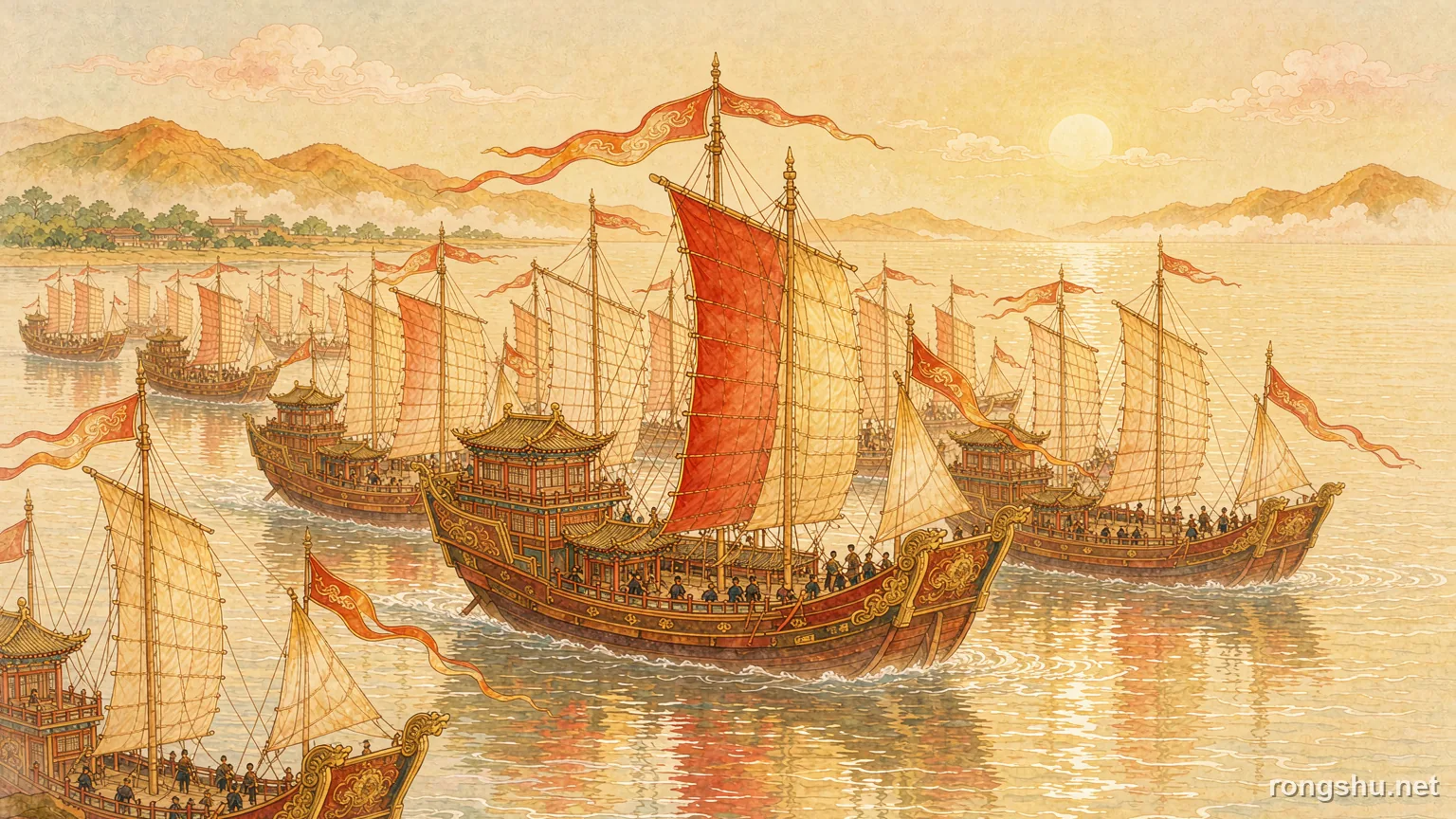
The History of Ming records sixty two great treasure ships, forty four zhang long and eighteen wide. Converted, that is over a hundred and thirty metres, longer than a modern destroyer. The number is still argued over. Some hold that the History inflated it. Others have worked out that a wooden hull of those proportions could not have put to sea at all.
What can be stated is the scale. More than two hundred ships, sorted into command vessels, warships, horse transports, grain ships and water ships. Twenty seven thousand men: sailors, soldiers, doctors, interpreters, craftsmen, and at least one barber.
The Rules of the Sea
The fleet followed an old road.
Out of Fujian to Champa, in the south of what is now Vietnam; south past Java, Palembang and Siam; on to Malacca; through Sumatra; then a turn to the west, into the Indian Ocean.
Ceylon is Sri Lanka today, and Cochin lies on the south west coast of India. For the first three voyages the far point was Calicut. There Zheng He had a stone set up, which said that this country lay far from China, that its people were peaceable, and that the stone was cut to last ten thousand generations.
From the fourth voyage the fleet went further. Hormuz, at the mouth of the Persian Gulf, was the crossroads where east and west traded. Beyond it lay the Arabian Sea, the Red Sea, and the coast of Africa.
On that road, Malacca mattered most.
Before 1400 the name barely appears in anybody’s records. On the first visit Zheng He agreed with the local ruler to keep a depot there, for storing goods, repairing ships and waiting for the wind.
Why there? Because Malacca sits in the seam of the monsoons. Ships coming from China had to pass, and ships coming back from the Indian Ocean had to pass, and both had to wait. So the fleet split up to trade in different ports, came back together at Malacca, and when the wind turned they all sailed home at once.
Over twenty years a small harbour turned into the great transfer port between east and west. In Malacca today there is still a well that local people call the Sanbao well, after the three treasures of the admiral.
To sail that road at all, three things were needed: a compass, a course book, and the stars.
The compass gave the direction. The course book was a running record, handed down and added to, of what bearing to steer and for how many watches between one landmark and the next. The stars gave the latitude. At night a man could hold a small wooden square at arm’s length, measure how high the Pole Star stood above the horizon, and work out how far north the ship had come.
Over decades those figures were written down one after another, and in the end they were drawn into a chart. The sailing chart of Zheng He survives. It marks mountains, islands, reefs and harbours, and at the end it carries four star diagrams, sheets that teach a navigator how to find his way at night.
Nor did every stop go smoothly.
On the third voyage the fleet reached Ceylon. The king there looked at the cargo in the holds and brought several thousand men to take it. Zheng He took his own troops around the king’s main force and went straight for the capital, and brought the king and his household back to Nanjing. Zhu Di did not kill him. He put another man on the throne, and let the captured king go home.
That episode is in the History of Ming.
A Giraffe Called Qilin
On the fourth voyage the fleet reached Africa.
In 1415 envoys from Malindi, in what is now Kenya, came back to China with the fleet. They brought a gift.
A giraffe.
Nobody in China had seen one. The neck, the thin legs, the patches, the two small horns on the head.
Somebody said: that is a qilin.
The qilin is a beast in the old Chinese books, a sign of good government, said to appear only when the ruler is virtuous and the world is at peace.
Zhu Di was delighted. In the eleventh month of that year he received the envoys in person at the Fengtian gate in Nanjing, and accepted the qilin, along with a zebra and an antelope. A court scholar named Shen Du wrote a hymn of praise for the auspicious qilin, and a court painter made a picture of it.
The picture survives.
Three other men went out with the fleet and came home to write books: Ma Huan, with the Overall Survey of the Ocean Shores; Fei Xin, with the Charming Scenery of the Star Raft; and Gong Zhen, with a record of the foreign countries of the Western Ocean. They wrote down the soil, the crops, the weather, the language, which rivers could be entered for fresh water, and which goods could be traded.
Those three books became the first hand evidence for what the coast of the Indian Ocean looked like in the fifteenth century.
There was one more thing about these exchanges. China gave away more than it received. The phrase used at the time means thick going out and thin coming in. Envoys who came to China with the fleet were housed and fed and rewarded at the treasury’s expense.
That is the strongest argument the men who opposed the voyages ever had. The whole enterprise lost money.
The fleet went out seven times.
The first from 1405 to 1407, the second from 1407 to 1409, the third from 1409 to 1411, the fourth from 1413 to 1415, the fifth from 1417 to 1419, the sixth from 1421 to 1422.
Twenty eight years in all. The ships reached more than thirty countries and regions, and went as far as the east coast of Africa. On the seventh voyage they reached Mecca.
After the Ships Stopped
In 1424 Zhu Di died.
His son Zhu Gaochi took the throne, and his first edict was that the treasure ships going to the Western Ocean were to stop, all of them.
Zhu Gaochi lasted less than a year. His son Zhu Zhanji succeeded him. The new emperor watched the embassies thin out, and in 1430 he sent Zheng He out one more time.
That was the seventh voyage.
Zheng He was close to sixty. Sixty one ships, twenty seven thousand men.
In 1433 the fleet turned for home from Africa. In the fourth month, at Calicut, Zheng He fell ill and died. He was a little past sixty.
In that climate a body could not be carried home. He was buried where he died. His officers brought back his hair and his boots and his cap, and the emperor had those buried south of Nanjing at Ox Head Mountain. A grave for the clothes is still there.
The fleet came back to Liujiagang and never went out again. The ships lay in the harbour and rotted, year after year, until the silt covered them.
Some decades later, in the Chenghua reign, an official mentioned the voyages to the emperor, and the emperor sent to the Ministry of War for the old sailing records.
The clerk of the carriage office, Liu Daxia, had hidden them. The minister looked for three days and could not find them. Liu Daxia said this. The eunuch Sanbao went to the Western Ocean and spent several hundred thousand taels, and lost ten thousand men, and came back with a few curiosities. What good did it do the state? That was bad government. If those papers still existed, they ought to be burned.
The story is in a book by a Ming official named Yan Congjian.
After that, China drew back from the sea, step by step. The bans on maritime trade came one after another, and a man who built a ship for the open ocean and sailed it was liable to death.
For an English reader, this is the part that is hardest to hold in the mind. In the same century, and with far less to spend, Portugal and Spain sent out three or four small ships at a time and changed the world. Columbus crossed the Atlantic in 1492 with three vessels and about ninety men. Vasco da Gama reached Calicut in 1498 with four ships and about a hundred and sixty men. Magellan set out in 1519 with five. Zheng He had sailed to Calicut ninety three years before da Gama, at the head of two hundred ships and twenty seven thousand men, and the country that sent him then burned its own records and forbade its people the sea.
That is not a story about who was better. It is a story about what a state decides to want. A fleet that goes out to be greeted is not the same instrument as a fleet that goes out to take. The Chinese court wanted recognition and curiosities, and when the man who wanted them died, so did the reason for the ships. Nobody in Nanjing had a commercial stake in Malacca or Calicut. There were no merchants with an interest in the route, no colonies to defend, no debt to service. So there was nothing to keep the fleet alive once the emperor lost interest.
The name of Zheng He lay buried for almost five hundred years.
In 1905 a reformer named Liang Qichao published an essay called The Great Chinese Navigator Zheng He. He set the voyages beside the European ones and told Chinese readers what they had: that Zheng He sailed before Columbus, before Vasco da Gama, before Magellan.
That year was exactly five hundred years after the first voyage.
In the national museum in Colombo there is still a stone that Zheng He set up. It carries three inscriptions, in Chinese, in Tamil and in Persian, and they say the same thing. He came to make an offering to a Buddhist shrine.
The stone is still standing.