In the seventh month of 1079, a group of officers from the Censorate walked into the office of the prefect of Huzhou, in the south of the empire.
They had come to arrest him.
The man they took away had held the post for three months. His name was Su Shi.
They stripped off his official robes on the spot, put him on a boat, and carried him toward the capital.
When the boat left Huzhou, the riverbank was crowded with people.
Ordinary people had come out to see him off. Some of them were crying.
He did not know whether this journey would end in his death.
On the road he thought several times about throwing himself into the water.
That is the case that history remembers as the Crow Terrace Poetry Case, named after the crows that nested in the courtyard of the Censorate.
He was forty-two years old.
The Brightest Name in the Capital
Su Shi was born in Meishan, in the province of Sichuan.
His father, Su Xun, was a famous writer of prose. His mother, née Cheng, taught him to read.
Su Xun had not cared much for books when he was young. He began to work hard at the age of twenty-seven. In the end this father was grouped with his two sons by later readers and called the Three Su.
He had one younger brother, Su Zhe.
The two names his father chose for them came from two parts of a carriage, one in front and one behind.
The brothers grew up together, studied together, and in time travelled to the capital to sit the examinations together.
In 1057 both of them passed.
The chief examiner that year was Ouyang Xiu, the leading literary figure of the age.
When Ouyang Xiu read the paper written by Su Shi, he thought it had been written by his own student, Zeng Gong. To avoid any appearance of favouritism, he moved it down from first place to second.
After the results were posted, Ouyang Xiu said of the young man that he was good at reading books and good at using them, and that in years to come his writing would stand alone in the world.
That year the name of Su Shi went through the whole capital.
Later he sat a second, harder examination, the special decree examination, and was placed in the third class. In the Northern Song, only one man before him had ever reached that mark.
A man still in his twenties stood in the full light of the literary world.
On that road he should have risen steadily through office and ended as a minister of state.
He did not.
Those were the years when Wang Anshi began his great reform of the empire.
Su Shi sent up a memorial saying that the new laws would do the country harm.
The reform party was not pleased with him.
So Su Shi asked to be posted away from the capital.
Over the following years he served as an official in Hangzhou, in Mizhou, in Xuzhou, and in Huzhou.
In Xuzhou the Yellow River broke its banks and the flood came to the city wall. Su Shi had a hut built on top of the wall and lived in it. He passed his own house without going in. He led the whole city in stopping the gaps and raising a long dike, and the city held.
In Mizhou, when locusts came, he organized the farmers to destroy them.
In Hangzhou he repaired the waterworks.
That was one side of his working life.
But in his poems he wrote other things as well.
One Hundred and Three Days
The men of the reform party combed through his poems and picked out lines they said mocked the government.
In 1079 they had him taken into the prison of the Censorate.
The courtyard of that office was planted with cypress, and crows sat in the trees the whole year round, so people called the place the Crow Terrace.
He was held there for one hundred and three days.
The men who questioned him made him explain, line by line, what each poem meant.
He had no way out, so he went back through the poems he had written and annotated them one by one.
Those confessions were written down and kept. They became a commentary on his own poetry, made by himself.
The cell was narrow and dark. In a poem he said that he looked up and could not see a single patch of sky.
He believed he was going to die.
He wrote two poems and asked a guard to pass them to his younger brother, Su Zhe. He meant them as his last words.
His brother sent up a memorial asking to give up his own official rank to buy his elder brother a pardon.
Many people worked to save him. Old officials who agreed with his politics spoke for him, and so did some men inside the reform party.
Even Wang Anshi, who had retired to Jinling, sent up a memorial. He said that there had never been a reign of sages in which a man of talent was put to death.
Wang Anshi and Su Shi had been on opposite sides of everything.
And still that was the line he sent.
In the end Emperor Shenzong did not kill him.
The sentence was this: reduced to the rank of deputy commander of the militia of Huangzhou, to reside in that district, and forbidden to sign any official document.
Go to Huangzhou. Hold an empty title. Do not meddle in anything.
One hundred and three days in prison ended. He left the capital and went south to Huangzhou.
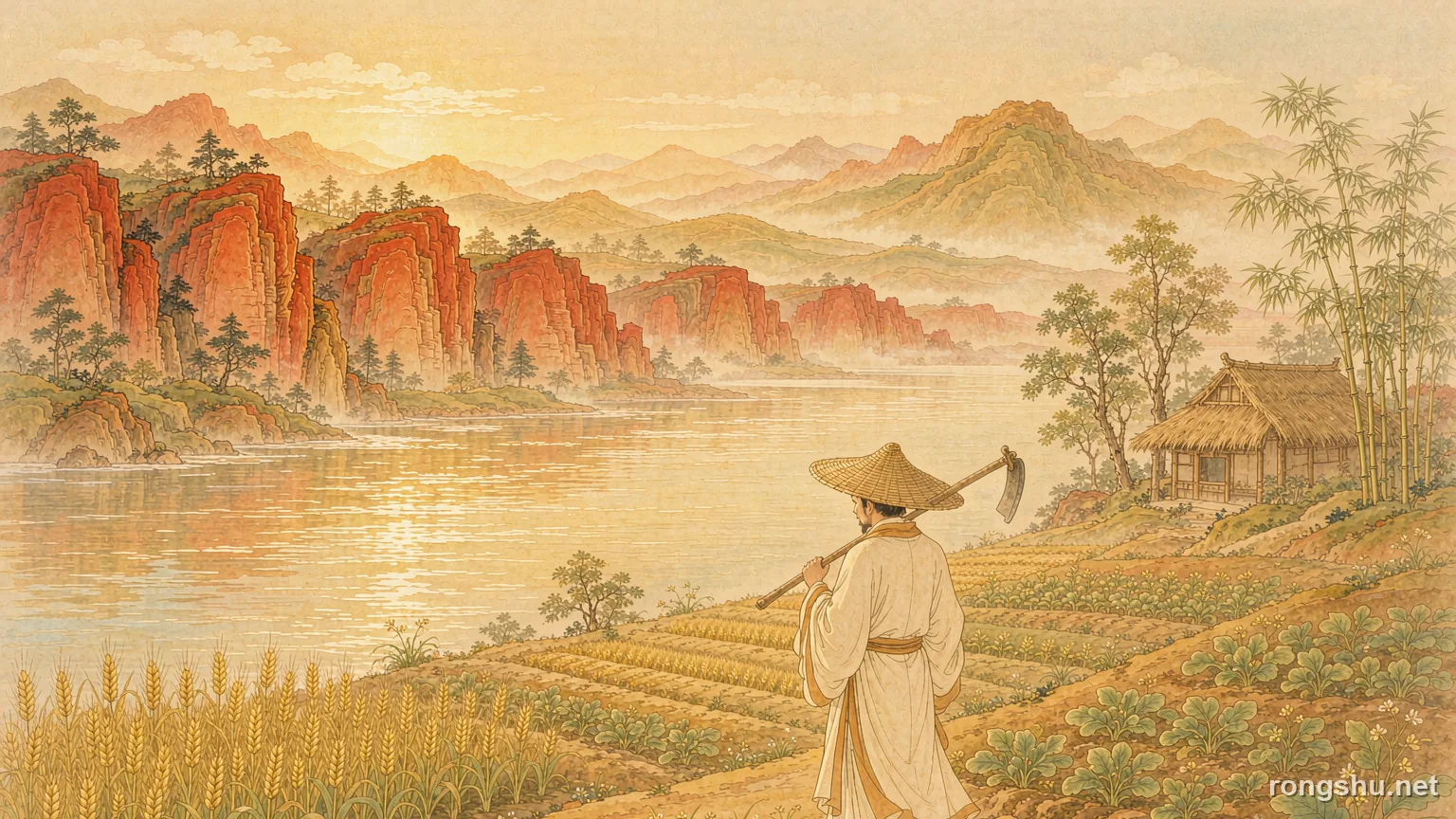
The Farmer of East Slope
Huangzhou is in Hubei, on the Yangtze.
There was no official residence waiting for him. His household of more than twenty people crowded into a riverside pavilion.
He had no salary, and the family soon ran out of grain.
Twenty people or more needed food every day, and clothes, and the money to keep studying.
All of that cost money, and he had none.
An old friend pleaded with the prefect of Huangzhou on his behalf. The prefect gave him an abandoned old army camp on the east side of the city.
The land sloped down from west to east, so the local people called it East Slope.
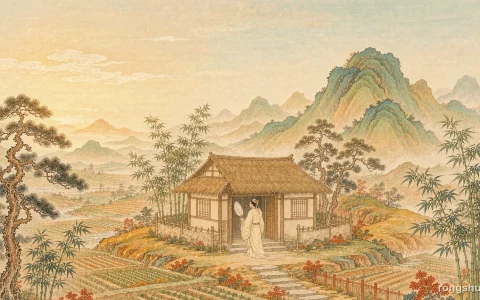
He took his family there and cleared it, and planted wheat and vegetables.
He built a few rooms on the slope and called the place Snow Hall.
And from then on he gave himself a new name: the Recluse of East Slope.
East Slope. It was just a piece of ground.
A man exiled to a poor district turned a patch of waste into his own name. He used that name for the rest of his life, and people have used it for a thousand years.
He worked out the accounts of that ground in a letter to a friend. How much wheat one field could give in a year. How long it would feed the family.
A great writer, sitting down to do the arithmetic of his own food.
His four years in Huangzhou were the fiercest writing years of his life.
He took a boat out below Red Cliff and wrote Remembering Red Cliff, and the two prose poems called the Red Cliff Rhapsodies.
He wrote the Cold Food Observance, a sheet of paper carrying two poems and barely a hundred characters. The brushwork leans and crowds as it goes on, as if the hand of the writer were shaking.
Later generations placed that single sheet behind Wang Xizhi and Yan Zhenqing and called it the third finest piece of running script in Chinese history.
He wrote: one straw cloak, and I let the rain of a lifetime fall on me.
He wrote: life is like a wayside inn, and I too am a traveller passing through.
You cannot take an inn with you. You are only a guest in it.
He wrote: who is afraid? There is no wind and no rain, and no clearing either.
A man just out of prison, close to running out of food, wrote lines like these.
Farther and Farther South
In 1085 Emperor Shenzong died. His young son Zhezong came to the throne and the Empress Dowager took charge, and the old party was called back.
Su Shi was recalled to the capital.
Within a year or two he rose from prefect of Dengzhou to the Hanlin Academy, and then to the Ministry of Rites.
That was the highest he ever stood.
And he soon found that the old party was dismantling the new laws all at once, too fast and too hard.
He sent up a memorial against it.
So the reform party hated him, and the old party could not hold him either.
Once again he asked to be posted away.
He went to Hangzhou a second time, and there he dredged West Lake. The mud they took out of the lake he piled into a long causeway.
That causeway is still called the Su Causeway.
Along it he had hibiscus and willows planted, and he hired men to grow water chestnut in the lake, and kept the money from the crop for the next dredging.
People of Hangzhou have walked on that causeway for nine hundred years.
At fifty-seven he was sent to Huizhou.
Huizhou is in Lingnan, in what is now Guangdong. In those days it was a place of miasma and fever.
There he learned to brew wine and to grow medicines, and he built himself a small house and named it White Crane Dwelling.
There he wrote: three hundred lychees a day, and I would not mind staying in Lingnan forever.
Somebody at court read that line and was displeased.
So he was exiled one more time.
The man who sent him down was named Zhang Dun. He had once been a close friend.
This time the place was Danzhou.
Danzhou is on the island of Hainan. Under the Song, banishment to Hainan was second only to the execution of an entire household.
He was sixty. A single small boat carried him across the sea.
Hainan was still a hard frontier then.
He wrote: here there is no meat to eat, no medicine when I am ill, no house to live in, no friends to visit, no charcoal in winter, no cold spring water in summer.
No meat, no medicine, no house, no friends.
So he built with his own hands, and with the local people he raised a house, gathered herbs, and made wine.
He became close to a local scholar named Li Ziyun, and in the courtyard of the Li family a room was built and named the Hall of Carried Wine. Later it was renamed the Dongpo Academy.
There he taught, and taught the young men of the island to read.
Students came from far away to find him. Some crossed the sea from other districts just to hear him speak for a few days.
For more than a hundred years, from the founding of the Song, Hainan had never produced a single man who passed the highest examination.
Soon after Su Shi sailed north again, a young man who had studied with him, Jiang Tangzuo, passed the provincial examination.
Su Shi wrote him a couplet. The sea has never cut the veins of the land, it said. From now on, Qiongzhou has broken the barren record.
He stayed on the island for three years.
Then the general amnesty came.
The Road Back
In 1100 the court proclaimed a general amnesty, and Su Shi was pardoned and allowed to go home.
He took a boat across the sea and travelled north.
The night he crossed, he wrote a poem. Nine times over I came near death in the southern wilds, and I do not resent it. This journey was the strangest of my life, and the finest.
On the road he fell ill.
He wrote to his brother about where he wished to be buried. He told him not to follow the usual customs.
In the seventh month of 1101 he reached Changzhou and took to his bed.
He called his sons to him and said: I have done no evil in my life, and I will not fall.
Then he died, quietly.
He was sixty-four.
He died in Changzhou and never went back to Meishan.
The next year his son Su Guo carried his coffin to Jiacheng in Henan and buried him south of Mount Song.
Ten years later his brother Su Zhe was buried beside him.
The two brothers, so often apart in life, were neighbours at last.
In his late years he painted a portrait of himself and wrote six lines of verse on it.
Two of those lines say everything about the life he had lived.
Ask what my life has accomplished, he wrote. Huangzhou. Huizhou. Danzhou.
Three places.
Every one of them was a place of exile.
What the world saw as three disasters, he counted as three achievements.
In two thousand years China exiled a great many writers. Only one of them turned the places of his exile into homes.
Today Huizhou has the house where he lived. Danzhou has the academy where he taught. Huangzhou has his East Slope.
Three cities, still calling him by name.