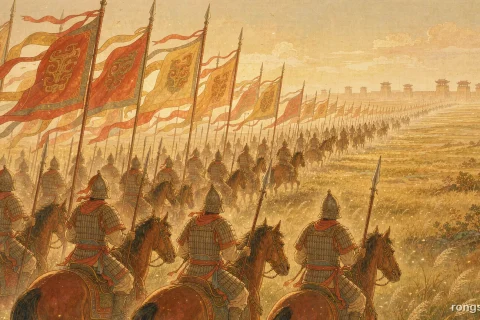
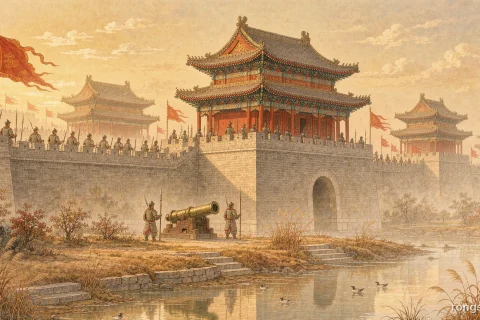
In the autumn of 234, on the Wuzhang Plains, the army of Shu camped on the south bank of the Wei River. Across the water stood the army of Wei.
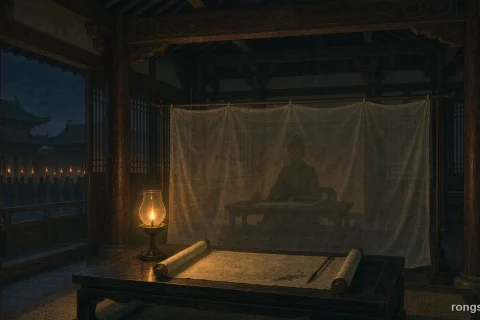
Inside the command tent lay a man of fifty-three.
He had not eaten properly for months. He had not slept properly either.
Sima Yi, the Wei commander, once sent an envoy to look at him. When the envoy came back, Sima Yi did not ask about troop numbers. He asked about something else.
How many hours does the Chancellor sleep each day?
He rises early and sleeps late. In the army, any punishment of twenty strokes or more, he insists on reading the case himself.
And how much does he eat?
Very little. Less than a few pints of grain a day.
Sima Yi heard that and said: this man is going to die.
He said it without knowing how long the other man had left.
He simply read the ending out of a general who slept a few hours and ate a few pints.
That autumn Zhuge Liang died in camp.
The Conversation at Longzhong
We have to go back twenty-seven years.
At the end of the Han dynasty the country had fallen apart. Zhuge Liang was born at Yangdu in Langya, in what is now Shandong, in the far east.
His father died when he was small.
His uncle took the family south and found shelter with the warlord Liu Biao in Jing Province.
Then the uncle died too, and Zhuge Liang settled at Longzhong, west of Xiangyang.
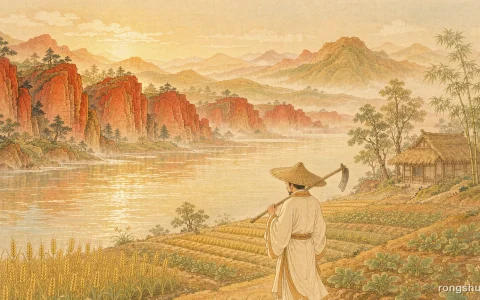
He built a few thatched rooms there. He farmed and he read.
He stayed ten years.
In those ten years he read in his own way. He took the broad shape of a book and did not bother with every line.
While he worked the fields, he was also learning the map of the empire, piece by piece.
He liked to sing a tune called the Song of Liangfu, a piece about strategy and about death. A young man in the fields, singing a song like that.
He used to compare himself to two men from long before: Guan Zhong and Yue Yi.
Guan Zhong had made the state of Qi supreme among the princes. Yue Yi had taken more than seventy walled cities for the state of Yan. Zhuge Liang said he was a man of that kind.
Most people at the time did not believe him.
Only a friend named Xu Shu said it was no boast.
Around Jing Province people gave these two friends nicknames. Zhuge Liang was called the Sleeping Dragon. The other one was called the Fledgling Phoenix.
A sleeping dragon is a dragon that has not yet woken.
At that time Liu Bei was living off the hospitality of others in Jing Province. He had very few soldiers and no territory of his own.
Xu Shu joined Liu Bei, and then recommended Zhuge Liang.
Liu Bei asked what kind of man he was.
Xu Shu said: this is a man you must go and invite yourself. You cannot summon him.
So Liu Bei went.
He did not find him the first time. He did not find him the second. The third time, he did.
That year Zhuge Liang was twenty-six.
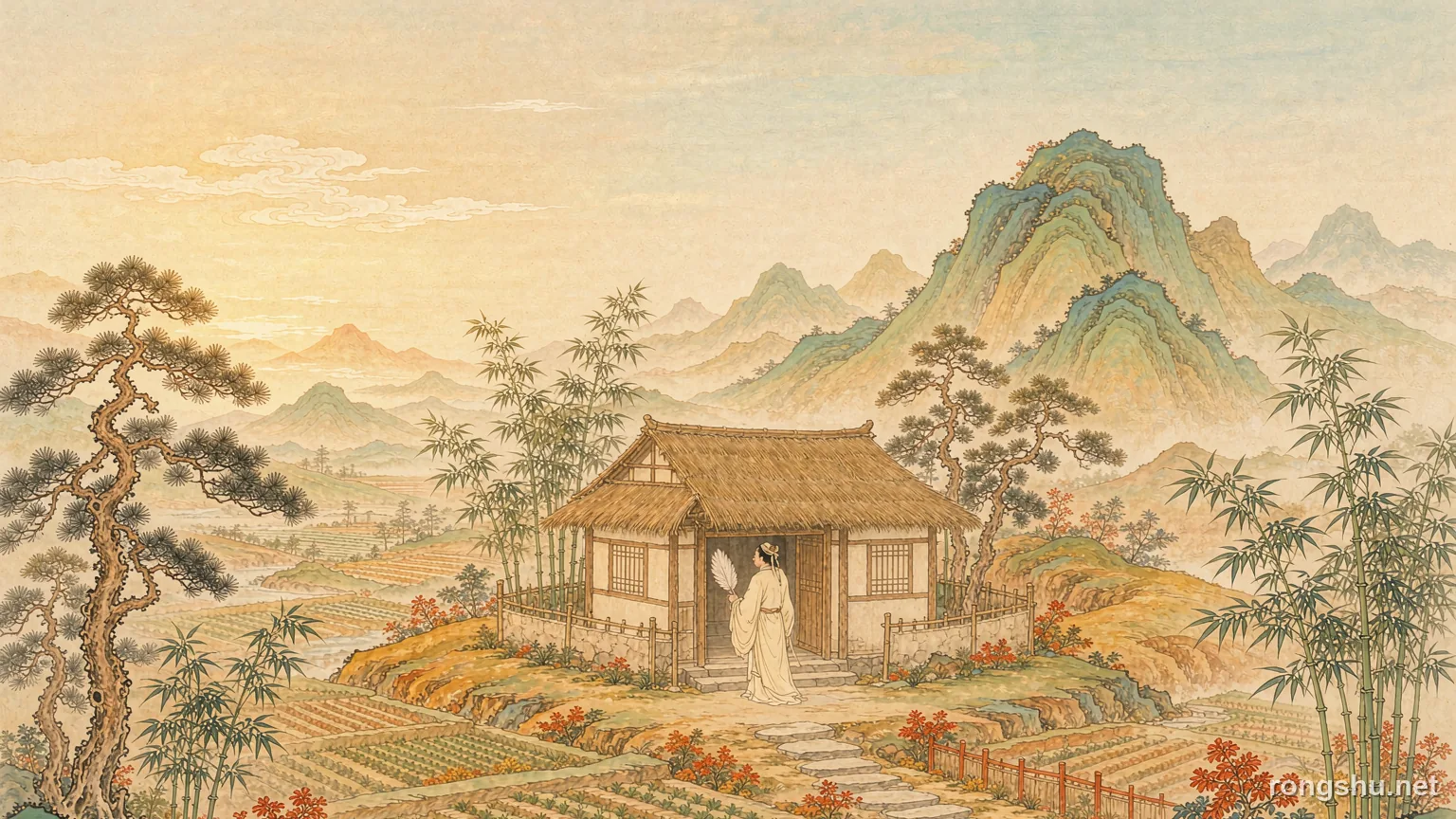
Inside a thatched hut, a young man with no official post laid out the state of the whole empire for a general who owned nothing but his name.
The empire had been broken for twenty years already. The Yellow Turban rebellion, Dong Zhuo seizing the capital, one warlord after another carving out a region, Cao Cao taking the young emperor into his own keeping. A farmer in his twenties put all of it on the table, piece by piece, and made it clear.
He said: the north already belongs to Cao Cao. You cannot beat him there, and you should not try to compete with him.
Sun Quan holds the lands east of the river. His family has held them for three generations. You can ally with him. You cannot take him.
What is left is Jing Province and Yi Province. One of them commands the Yangtze. The other is a natural storehouse.
Hold both. Make peace with the peoples to the west. Settle the south. Ally with Sun Quan. Put your own government in order.
And when the empire finally shifts, send one army out of Jing Province toward the central plains, and lead the armies of Yi Province yourself out through the Qin Mountains.
When that day comes, men will come to you on their own.
One conversation, and thirty years went inside it.
Liu Bei listened to the whole thing, and afterwards he said: with Kongming I am like a fish that has found water.
Kongming was Zhuge Liang courtesy name.
The Promise at Baidicheng
From that day Zhuge Liang walked out of Longzhong and never went back to farming.
He became Liu Bei adviser. He followed him south. When Cao Cao brought his armies down, Zhuge Liang crossed the river to see Sun Quan and stitched the two families into one line.
At Red Cliff, Cao Cao was driven back north.
Afterwards Liu Bei took Jing Province, then Yi Province, then Hanzhong.
In 221 he proclaimed himself emperor in Chengdu. The state was called Han. Zhuge Liang became Chancellor.
He had walked that road for more than ten years, and the plan from the thatched hut was being paid out line by line.
He was twenty-six when he left the hut. He was forty when Liu Bei took the throne.
Then Liu Bei did a very foolish thing.
Guan Yu, his sworn brother, was killed by the men of Wu.
Against all advice, Liu Bei raised the whole strength of the state and marched east to avenge him.
In 222 his camps were burned by Lu Xun at Yiling. His great army was almost wiped out.
That one battle drained the life out of Shu. A state barely two years old went back to where it started in a single night.
He fell back to Baidicheng and took to his bed.
The next year, knowing he was dying, Liu Bei called Zhuge Liang from Chengdu to his bedside.
In front of his own son, he said this to Zhuge Liang.
Your ability is ten times that of Cao Pi. You can keep this state safe and finish the great work. If my son can be helped, help him. If he has no ability, take the position yourself.
Zhuge Liang wept and answered: I will exhaust the strength of my arms and shoulders, and hold to loyalty, and continue until death.
Liu Bei told his son to treat the Chancellor as a father.
After that day Zhuge Liang was no longer an adviser.
He was the pillar of a state.
His heir Liu Shan was seventeen. Everything in Shu rested on one man.
That year he was forty-two.
A Letter to the Emperor
After Liu Bei died, trouble came up in the south of Shu.
Several commanderies in the south rose. The man leading them, Meng Huo, was respected among the local peoples.
In 225 Zhuge Liang took troops south himself.
About that campaign, a later history called the Spring and Autumn of the Han and Jin records one thing.
Zhuge Liang captured Meng Huo seven times and released him seven times.
Seven captures, seven releases, so that the south would submit in its heart and not only in name.
That book is a secondary history, not an official record. The Records of the Three Kingdoms do not contain this passage.
With the south settled, he held off on marching north for two years.
In 227 he left Chengdu and moved his base to Hanzhong.
Before he left, he wrote a memorial to Liu Shan. It is known as the Memorial on Sending Out the Troops.
In it he wrote: today the empire is divided in three, and Yi Province is worn out. This is truly a moment of danger to the life of the state.
He listed one man after another, saying who should be used at court, who should be guarded against, who could be trusted with great affairs.
He named Guo Youzhi, Fei Yi and Dong Yun as men fit for the inner offices.
He named Xiang Chong for military matters.
He said that he himself had once been a common farmer in the south, that Liu Bei had come to him three times, and that in the twenty years since, he had never forgotten that welcome.
And at the end he wrote: now I must go far away. As I write this, my tears fall, and I do not know what I am saying.
A man in his forties, putting the household and the state of a young ruler into one letter.
From that year he never set foot in Chengdu again.
Five Times Through the Mountains
The following spring he marched north the first time.
It began well. Three commanderies in the northwest came over to him.
Then the vanguard commander, Ma Su, disobeyed his orders and lost Jieting.
Jieting was the throat of the road into the central plains. Ma Su camped on the hill. The Wei general Zhang He cut off his water and broke him in a single fight.
The first northern campaign came apart there.
Zhuge Liang fell back to Hanzhong, and what he did next was to execute Ma Su.
The Records of the Three Kingdoms say that Ma Su was a younger man he had thought highly of. When the sentence was carried out, Zhuge Liang wept.
He wept, and then he replaced the dead man with someone else.
Over the next years he took his army out through the Qin Mountains again and again.
He did not win his battles with tricks.
There are only a few roads out of the mountains. Grain comes up from Shu. For every measure of grain delivered to the front, several measures are eaten up along the way.
He was walking a road that could be counted, and that was slow.
In 231 he marched out a fourth time and set an ambush at the Mumen Pass, and there the Wei general Zhang He was killed.
That same year Li Yan failed to deliver the grain on time and then lied about it. Zhuge Liang stripped him of his office.
In 234 he marched out a fifth time through the Xie Valley and set his camp on the Wuzhang Plains.
Sima Yi was opposite him.
Sima Yi would not come out and fight.
Zhuge Liang sent him a set of women clothes as an insult. Sima Yi still would not come out.
The two armies sat on opposite banks of the Wei River for a whole spring and summer.
Autumn at Wuzhang Plains
And then came the scene at the beginning.
Envoys came. Envoys went. Out of the daily habits of one man, Sima Yi read the ending.
Zhuge Liang was gravely ill in camp.
He was not killed. He worked himself to death.
People had warned him about this, back in Chengdu.
An official named Yang Yong had said to him: running a state has divisions of labour. Take farming. The servants plough, the maids cook, and the master does not do all of it himself. You sit there correcting ledgers every day until your head is wet with sweat. This is not the right way.
Zhuge Liang did not change.
He insisted on reading every case involving more than twenty strokes of the rod.
He insisted on going over every account.
He wrote to Liu Shan that the family had eight hundred mulberry trees and fifteen qing of thin farmland in Chengdu, enough to feed and clothe his children.
He said that when he died, he wanted no money left in the house.
When he died, there was in fact nothing extra in the house.
He treated a whole country as a load that one man could carry.
That was both the great thing about him and the thing that broke him.
In the autumn of 234 he died in camp on the Wuzhang Plains.
He was fifty-three.
He left instructions to be buried at Dingjun Mountain in Hanzhong. The grave was to follow the slope of the hill. The pit needed only to be big enough for a coffin. He was to be buried in ordinary clothes, with no grave goods.
A man who had held a state in his hands for eleven years asked for himself a very small grave.
Later, Chen Shou, who wrote the Records of the Three Kingdoms, edited a collection of his writings.
In the preface Chen Shou wrote that Zhuge Liang as Chancellor handled more business than could be counted, and that his rewards and punishments were clear, that a man was disciplined for his faults no matter how close he stood to power.
The people of Shu feared how strictly he governed, and trusted him at the same time.
After his death, the state of Shu lasted another twenty-nine years.
The men who held it up were almost all men he had trained himself.
Today Chengdu has a shrine to Zhuge Liang, the Temple of the Marquis of Wu.
Next to it is the tomb of Liu Bei.
By custom, a minister shrine should not stand beside an emperor tomb.
This one has stood there for more than a thousand years.
Visitors pay their respects to the Chancellor first, and go to see the emperor afterwards.
The poet Du Fu passed this way and wrote two lines.
Three visits troubled him for the plans of the empire. Two reigns drew on the heart of one old servant. He died before the work was done, and ever since, heroes have wept into their sleeves.
A thousand years have gone by. The thatched hut is long gone.
But the words are still there: I will exhaust the strength of my arms and shoulders, and hold to loyalty, and continue until death.
He said it, and he did it.