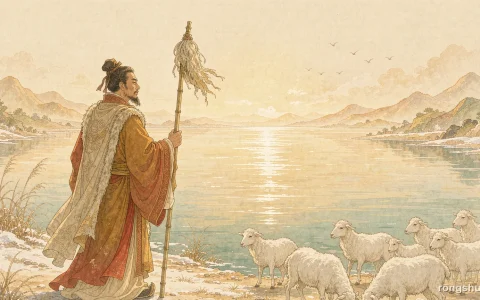
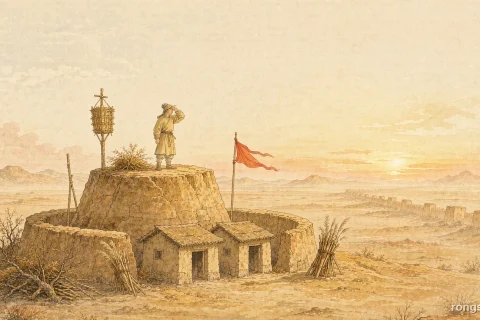
In the summer of 1900 a Taoist priest had sand cleared from the caves at Dunhuang.
The wind comes down off the Mingsha dunes and pours sand into the openings year after year. The lowest caves had been buried halfway up. The priest wanted them dug out, so that he could put up a few new statues and collect a little incense money.
His name was Wang Yuanlu. He came from Macheng in Hubei. He had been a soldier, then a Taoist, then a wanderer, and he had ended up at the Mogao caves, living in an old shrine that nobody else wanted.
Dunhuang sits at the far western end of the Hexi corridor. Beyond it lie the Jade Gate and the Yang Pass, and beyond those, the Western Regions.
In the Han and Tang dynasties this was the throat of the Silk Road. Caravans, monks, envoys and refugees all passed through this oasis.
The Mogao caves are cut into the eastern cliff of the Mingsha dunes. They were begun in the fourth century and carved for a thousand years, and the walls inside them are covered with painting and clay sculpture. The local name for the place is the Caves of a Thousand Buddhas.
By the last years of the Qing it had gone to ruin. No one managed it, no one burned incense, and the wind poured sand in every year.
Wang Yuanlu moved into a derelict shrine and made himself its keeper. He came to think of the place as his.
He was working on the passage of Cave 16 when something happened.
The Man Who Swept the Sand
The most repeated version of that day goes like this. A hired man clearing sand stopped to rest against the wall and lit a pipe. The smoke from the pipe did not rise. It was drawn sideways, into a crack in the wall.
So they knocked on the wall.
The wall was hollow.
That story was written down later, and nobody can now prove it. Wang Yuanlu told it differently. He said the sand was cleared to a certain depth, a crack opened along the north wall of the passage, and when he tapped it the tap came back as an echo.
Either way, there was a room on the other side.
He broke the wall open and looked in. The room was small, about three metres across.
It was full. Layer on layer, wrapped in white cloth, the bundles rose from the floor to the ceiling.
A Taoist priest had discovered that the derelict shrine he lived in held a room full of ancient books.
What he felt at that moment was never recorded. What other people have felt about him has never stopped being argued. Some call him the man who gave the country’s treasures away. Others say he was a poor priest in a poor place, pushed into a role he did not ask for, who reported what he had found and asked for help and got none.
In 1900 China had other things on its mind. It was the year of the Boxer war. Foreign armies were marching on Beijing, and the Empress Dowager was on the road to Xi’an. Out in the desert of the northwest, one Taoist priest was standing in front of a room full of paper, and nobody beyond the mountains knew.
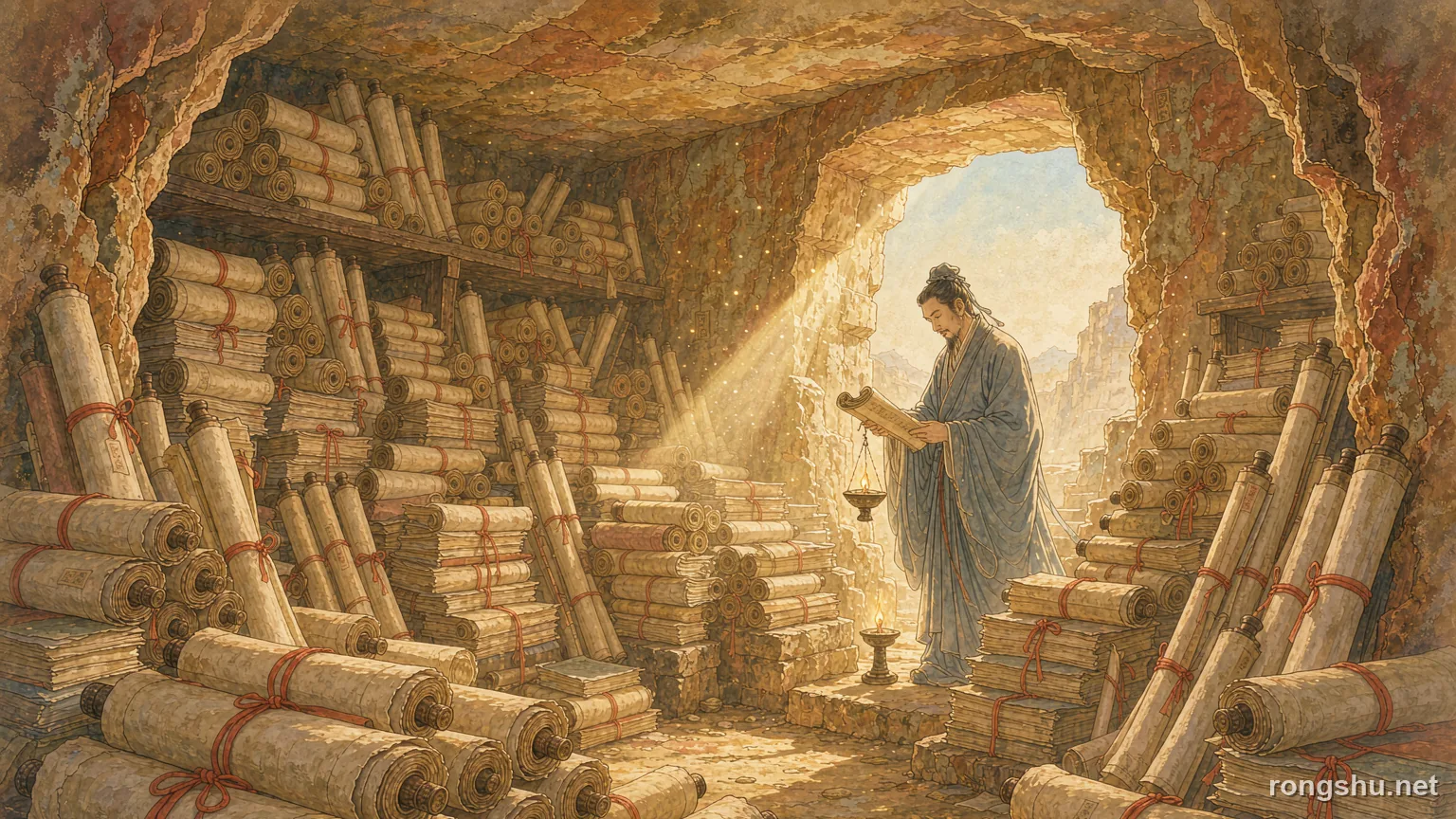
The Room Behind the Wall
The cave is numbered 17 today.
Its position is strange. It is not on the cliff face at all. It sits inside the north wall of the passage of Cave 16, like a hidden door opening off the corridor of a larger room.
Why would anyone seal a library into a wall and then brick it up?
Nobody has settled that. There are several answers, and they disagree.
The first is the flight answer. Sometime in the early eleventh century, it argues, an army of the Western Xia was closing on Dunhuang. The monks at Mogao could not carry the scrolls out in time, so they gathered them into this room, bricked it shut, and painted over the brick. They meant to come back for it. They never came back.
The second is the discard answer. This was a storeroom all along, it says, for old and worn material: sutras read to pieces, spoiled copies, contracts that had expired. When it filled up, it was sealed.
The third is the rebuilding answer. The room was a library once, and when the cave beside it was altered, the books were moved into this side chamber.
All three have supporters. None has won.
One thing is common to all of them. When the door closed, it stayed closed for nine hundred years.
What Was in the Cave
Start with the number. The counts differ, but scholars generally say that more than fifty thousand items came out of the cave. Manuscripts, silk paintings, paper paintings, embroideries, ink rubbings, and a few ritual objects.
Then the dates. The oldest reach back to the fourth century. The newest belong to the early eleventh. Seven hundred years in one room.
Then the contents, which are the real surprise.
Most of it is Buddhist. But beside the Buddhist sutras there are Taoist scriptures, Manichaean writings, and documents of the Church of the East. In a frontier shrine in the far northwest, several religions had been shelved together.
There are government papers. Accounts and household registers from Shazhou and Guazhou. Contracts. Lawsuits. Inventories of army farms. And the correspondence of the Guiyi Army, which ruled this corner of the world for a century and a half after the Tang pulled out. Whole stretches of Tang and Five Dynasties history that the standard chronicles skip are lying in this paper.
There are transformation texts, bianwen, half spoken and half sung, the scripts of popular storytelling. The roots of Chinese vernacular fiction are visible in them for the first time.
There is the Yun Yao Ji, the earliest surviving collection of ci song lyrics, older than the famous Huajian Ji.
There are silk paintings and embroideries. Bodhisattvas, guardian kings, and the donors who paid for them, painted on silk, the colour gone and the line still there. Some scrolls are wrapped in embroidered cloth, with the ties still attached.
The copyists changed, generation after generation. The handwriting moves from Tang regular script to Five Dynasties running script, like a history of calligraphy laid out flat.
Any one of these things would be worth a room of its own in a museum.
There is a hand drawn map of the whole sky, counted among the oldest star charts in the world.
There are Tang dynasty rubbings of the Wenquan Ming and the Huadu Monastery stele, the earliest rubbings of their kind known to survive.
The most famous single object is a scroll of the Diamond Sutra dated to the ninth year of Xiantong, which is 868 CE. It opens with a woodblock frontispiece showing the Buddha teaching in the Jetavana garden, and it is the oldest dated printed book in the world. It was printed, not copied. It carries a year on it, and that year pins down the early history of printing in China.
The writing in the cave is not only Chinese. There is Tibetan, Uighur, Sogdian, Khotanese, Sanskrit, Tocharian. A language that has died out completely may be lying in that pile of paper.
Wang Yuanlu could not read, or could barely read. He had no way to judge what the scrolls were worth.
But he could see that they were not ordinary. So he reported them, level by level, up the chain.
He told the magistrate of Dunhuang, Wang Zonghan. The magistrate came, looked, and took a few scrolls away. He reported further. Around 1903 the education commissioner of Gansu, Ye Changchi, heard of the find and got hold of some scrolls and paintings himself.
Ye Changchi knew what he was looking at. He told the province to move the whole cave to Lanzhou, for safekeeping.
Nobody would pay for the transport.
The provincial office replied that the road was long and the silver was too much and that it could wait.
It waited seven years.
Two Men From Far Away
In 1906 the British archaeologist Aurel Stein set out from India on his second expedition into Central Asia.
He was a Hungarian Jew who had become a British subject and worked for British India. He read several languages well. He did not read Chinese.
In March 1907 he reached Dunhuang.
He had been in this country before. On his first expedition, in 1901, he had already passed through and heard rumours about a cave of old books, and had not known quite what to make of them. This time he came looking.
He went first to see the wall paintings at Mogao. Then he asked about the cave. He found a man called Jiang Xiaowan, a Chinese secretary who understood both the language and the way officials thought, and took him on as interpreter and go between.
Wang Yuanlu refused at first. He was a Taoist. He could not read most of what was in the room. But he understood that it was the property of the shrine.
It took several visits for the conversation to change. Stein stopped talking about archaeology. He began to talk about repairs.
He offered money for the upkeep of the caves. He kept saying it: a donation, for the buildings. That was a language Wang Yuanlu understood. Repairing the shrines was the thing he actually wanted to do.
The donation came to about forty ingots of silver.
In May 1907 Stein left Dunhuang with twenty four cases of manuscripts and five cases of paintings and textiles. They are now divided between the British Library, the British Museum, and the National Museum in Delhi.
The next year, 1908, the Frenchman Paul Pelliot arrived.
Pelliot was a different sort of man. He was a sinologist. He read Chinese and Tibetan well, and several Central Asian languages besides. He got into the cave and spent three weeks crouched in it, going through everything. He numbered the caves as he went, and those numbers are still in use.
He took the best of what was left, and he knew it. About seven thousand items went back to Paris, to the National Library and the Guimet Museum. The price was reportedly five hundred taels of silver.
In 1909 Pelliot brought a selection of the scrolls to Beijing and showed them to scholars there.
Luo Zhenyu and Wang Guowei looked, and were stunned.
There was material like this at Dunhuang?
They had not known. Wang Yuanlu had reported the find eight years earlier, and the news had never got out of Gansu.
Luo Zhenyu and his colleagues petitioned the ministry at once. The rest of the cave, they said, must be brought to Beijing.
Lost Along the Road
In 1910 the ministry ordered it. What was left in Cave 17 was to be shipped to the capital.
It went by road, stage by stage, from Dunhuang to Lanzhou, and from Lanzhou to Beijing.
When it arrived and was counted, the numbers did not add up.
The reason is not hard to find. Along the way, officials and couriers quietly helped themselves. In Beijing, more went out under the pretext of borrowing or inspecting. Sometimes a whole scroll was lifted and a worthless fragment left in its place. Sometimes a long scroll was simply cut into pieces.
That account has never been settled. Only part of the find reached the Metropolitan Library.
Pelliot later saw the shipment in Beijing and recognised many scrolls he had handled at Dunhuang and chosen not to take.
After that, the losses went on.
In 1914 Stein came a third time and carried away another load. The Russian expedition of Sergei Oldenburg came. A Japanese expedition under Zuicho Tachibana had already been there in 1912.
In 1924 Langdon Warner of Harvard arrived. He wanted the wall paintings. He used chemically treated cloth, pressed it against the wall, and peeled it away, and the pigment came with it. A dozen or so murals and several clay figures left Mogao that way. There are Dunhuang bodhisattvas in a museum in Massachusetts today.
In 1930 the scholar Chen Yinke wrote a foreword to a catalogue of the Dunhuang finds. The line he wrote is still quoted: Dunhuang is the record of our country’s sorrow in scholarship.
A whole field of study grew up around what had left the cave. French, British and Japanese scholars worked on the scrolls, and Chinese scholars who wanted to study material from their own country had to travel to London or Paris to see the originals, or wait for the photographs.
That sentence of Chen Yinke has been quoted ever since. It is not only about what was lost. It is about what it feels like to be unable to reach your own things.
It is a quarrel the West knows too. In 1947 a Bedouin shepherd threw a stone into a cave above Qumran, heard pottery break, and the Dead Sea Scrolls came out of the dark after nineteen centuries. The same questions followed: who found them, who sold them, and who owns them. In Athens, the sculptures that Lord Elgin took from the Parthenon in the early nineteenth century are still the subject of a standing demand for return. Dunhuang belongs to that family of stories. A frontier shrine, a locked room, a poor man who needed money for repairs, and buyers who knew exactly what they were buying.
In 1941 Yu Youren, a senior official of the Republic, came to Dunhuang and went home to propose that a research institute be set up at Mogao.
Between 1941 and 1943 the painter Zhang Daqian lived there and copied the murals, more than two years of it.
In 1943 a painter named Chang Shuhong came back from France and made his way to Dunhuang.
He had made his name in Paris. Then he saw a book of photographs of the caves, and he decided to come home.
What he found was a row of dark openings, sand drifted up to the threshold, paint flaking off the walls. Cave 17 was empty. It had been empty for a long time.
In 1944 the National Research Institute for Dunhuang Art was set up at Mogao, and Chang Shuhong became its first director.
There was no electricity and no road. They grew their own vegetables. In winter it was too cold to hold a brush for long. He and his colleagues stayed.
The little room, three metres across, has never been filled again.
It is Cave 17 today. The door is locked.
The brickwork that once sealed it was stripped away long ago, leaving a square gap with the brick face showing.
A Taoist priest had a courtyard swept, and swept open a hole. For more than a century the world has been writing about what was inside it, arguing about it, and weeping over it.