In the autumn of 207, a party of Han envoys reached the northern grassland carrying a gift of a thousand ounces of gold and a pair of white jade discs.
They had come to take a woman home.
She had lived on the steppe for twelve years.
The day the order came, she should have been glad.
But when she was ready to leave, two small boys caught hold of her neck from behind.
They asked her: mother, where are you going? Will you come back?
She could not answer them.
The poem she wrote about that day, the Poem of Grief and Anger, says only four words of it: she wailed, and her hands went over them again and again.
The envoys were waiting. The driver was waiting.
She held both her sons for a long time.
In the end she got into the carriage.
The carriage carried her away, and the children stayed behind on the steppe.
The Daughter of Cai Yong
Her name was Cai Yan. Her courtesy name was Wenji.
Her father was Cai Yong, one of the most learned men of the late Han dynasty.
He knew the classics, astronomy and mathematics. He wrote fu and rhapsody. He wrote fine calligraphy, and he understood music.
One of the instruments he made is called the scorched-tail lute, one of the four famous lutes of ancient China.
The lute has a story. Cai Yong once heard a kitchen fire and noticed that a piece of wood burning in it did not sound the way it should. He leapt up and pulled the wood out of the fire and made a lute from it. The scorched mark was still on its tail, and so it took its name.
His brushwork was praised by later calligraphers for the strength running through it. The stone classics he supervised in Luoyang were set up outside the imperial academy, and more than a thousand people gathered to copy them every day.
Cai Wenji grew up in that house.
One story about her childhood is often told.
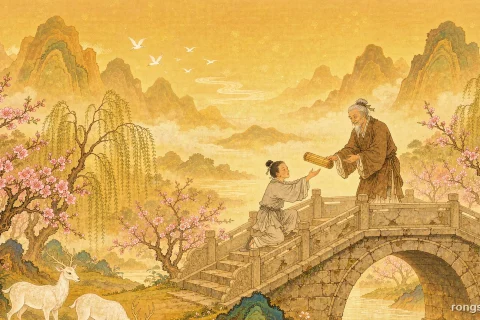
She was six. Her father was playing the lute in the next room when a string broke.
From the other room, the child said: the second string.
Cai Yong thought she had guessed by luck, so he deliberately broke another and asked her which one it was this time.
She said: the fourth.
Only then did he understand that his daughter could really hear it.
The story was later put into the Three Character Classic, a beginners text that Chinese children learned for centuries: Cai Wenji could tell the notes.
Her father taught her everything he knew. She read, she wrote, she played. She was good at all of it.
Her father did not limit her to needlework because she was a girl. He had her read the histories and memorize the old texts, the same work he gave to boys.
At sixteen she married into the Wei family in Hedong. Her husband was named Wei Zhongdao, and he was a scholar too.
They were married a little over a year when he fell ill and died.
They had no children. She went back to her father’s house.
She was about twenty.
She believed the hardest thing in her life was already behind her.
It was only the beginning.
North, Into the Grassland
In 189 the emperor died and the warlord Dong Zhuo brought his troops into Luoyang and took control of the court.
Dong Zhuo wanted Cai Yong for his reputation and called him into office, promoting him three times in three days.
In time Dong Zhuo was killed. And Cai Yong, sitting at the table of the man who had arranged his death, let out a sigh.
For that sigh he was thrown into prison.
He asked for any punishment they liked, even the loss of his feet, if only he might live to finish the history of the Han.
The men in power did not agree.
He died in prison, at sixty.
Her father’s death took away the last thing she could lean on.
In 195 the old followers of Dong Zhuo, Li Jue and Guo Si, fought each other across the region. The southern Xiongnu, seeing the disorder, came south to raid.
The fighting reached her home district of Chenliu.
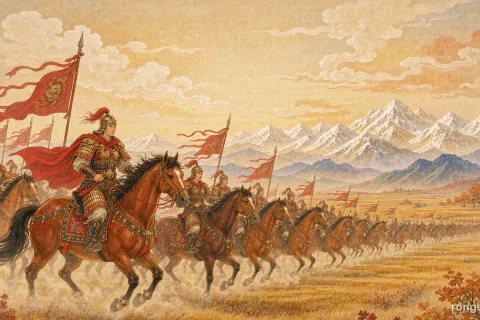
She was carried off by a troop of horsemen, along with many other women.
She later wrote about that road in the Poem of Grief and Anger.
She wrote: heads of men hung at the horses sides, and women loaded behind them.
That line is her own record, not something a later writer put into her mouth.
On the march, the captives were not allowed to gather and talk. For the smallest mistake they were cursed and beaten.
She wrote that down too.
Thousands of captives were driven west through the pass, then turned north, up onto the highlands of the north.
The road ran for nearly a thousand miles.
She left home at about twenty. She came back twelve years later.
Twelve Years on the Steppe
She was given into the household of the Wise King of the Left of the southern Xiongnu.
The Book of the Later Han covers this in a single line: she was taken into the household of the Wise King of the Left, and she was among the northern peoples for twelve years.
In those twelve years she bore two sons.
The histories do not say what she was to the king. The Book of the Later Han says only that she was taken into his household. It does not say whether she was a wife or something else.
Later plays made her the beloved consort of the Wise King, with deep feeling between them.
That is more likely what other people wished for her.
Life on the grassland had almost nothing in common with home.
The people there wore felt and fur. They ate meat with a strong smell. They spoke a language she could not understand at all.
In winter the wind came like a knife across the face.
She used to stand outside the tent and look south, toward a heartland that was thousands of miles away and closed to her.
Now and then someone from the Chinese lands would pass by, and she would go up and ask whether they had come from her own district.
They never had.
In one poem she wrote: their customs are different, and I cannot fit myself to them. Their desires are not mine, and there is no one to speak with.
She thought about dying.
The Poem of Grief and Anger is clear about that. She was not clinging to life, and she was not without shame.
She simply did not want to die in a foreign place.
She said that even if nothing were left of her but dry bones, she wanted them to go home.
That one thought carried her from one day to the next.
Twelve years is long enough to turn a young woman into a middle aged one.
The wind and frost roughened her face. She learned some of the language of the steppe, and she learned how to live inside a felt tent.
But not one day passed in which she thought of herself as belonging there.
Bought Back With Gold
In those same years the situation in the heartland changed.
Cao Cao had brought the north under his control and made himself Chancellor.
As a young man in Luoyang, Cao Cao had gone to Cai Yong for instruction, and the two had become friends across the gap in their ages.
He heard that the daughter of Cai Yong was living among the southern Xiongnu, and he sent envoys north with gold and jade to buy her back.
The reason was simple. He had been a friend of Cai Yong. Cai Yong was dead. Cai Yong had no son.
It was an act that let Cao Cao look generous. What he spent was money. What came back was the blood of an old friend.
For Cao Cao this was no great expense. He had money and he had soldiers.
For her it was an order.
She could go. The two boys could not.
She had to choose one of the two.
The histories do not say how long she thought about it.
On the grassland in those days, everything probably looked the same as on any other day. The wind blew. The sheep grazed. Only she was turning over inside.
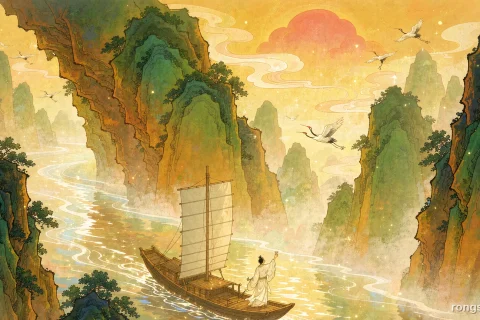
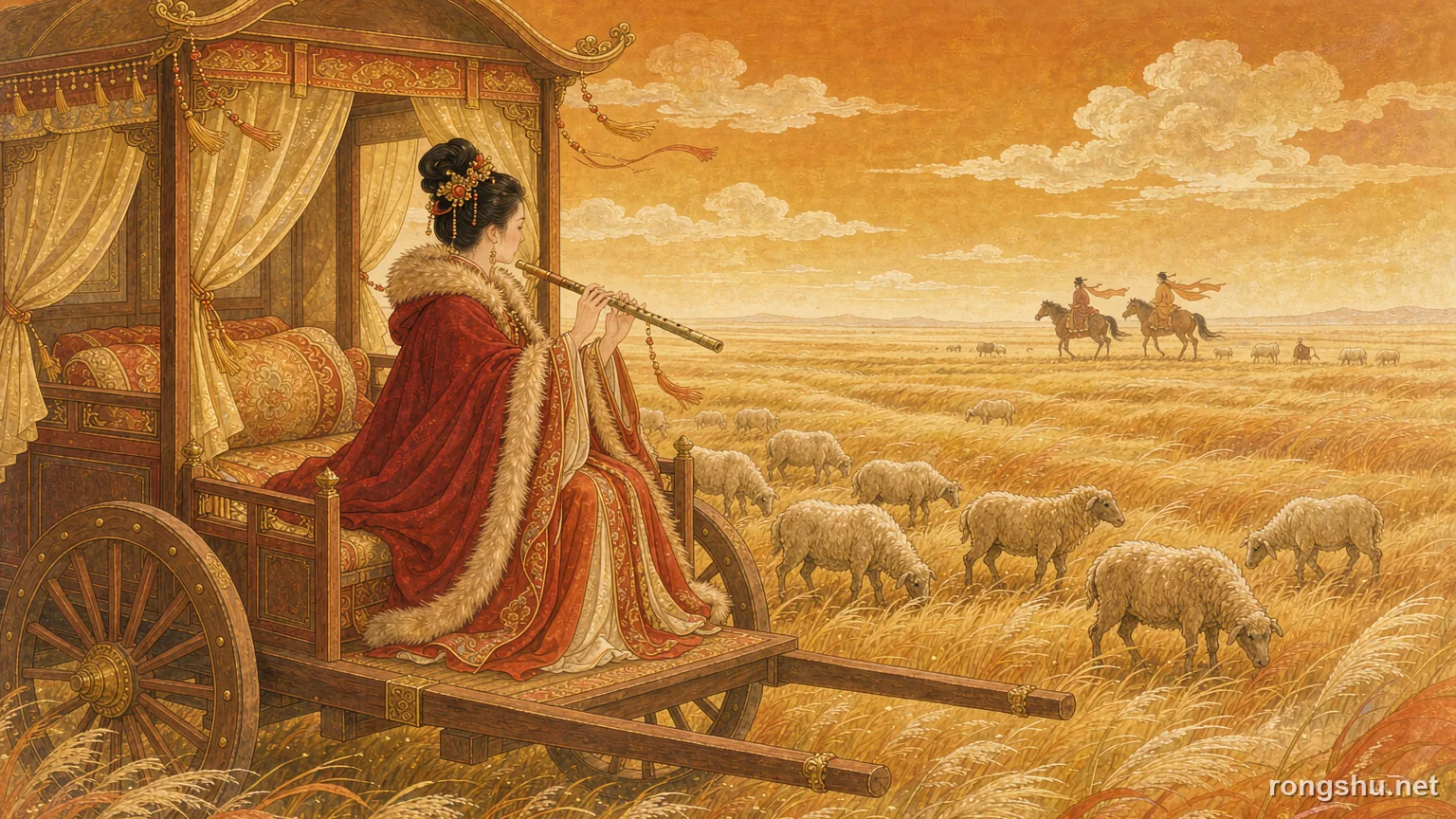
She got into the carriage in the end. The wheels began to turn, and the grassland receded behind her.
She wrote the Eighteen Songs of a Nomad Flute about that journey.
The nomad flute is an instrument of the steppe. Its sound is like a sob.
Song here means a section. Eighteen Songs means eighteen sections.
In the Northern Song, a scholar named Guo Maoqian included the poem in his collection of Music Bureau verse.
Whether Cai Wenji herself wrote it has been argued for a thousand years, and the argument is not settled today.
That has to be said plainly.
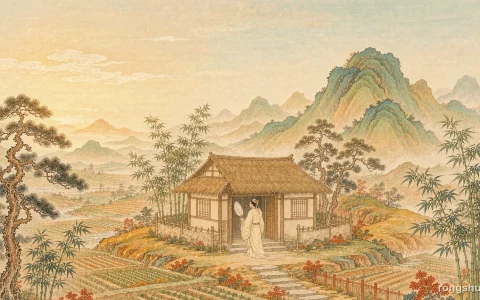
Back in the heartland, she went first to her old home in Chenliu.
The house was still standing. There was nothing in it.
Her books, and her father’s books, were all gone.
Cao Cao sent for her again, brought her to the city of Ye, and arranged a marriage for her with a colonel of the garrison farms named Dong Si.
Four Hundred Lost Books
In the second year of that marriage, Dong Si broke the law and was sentenced to death.
She went to plead for him.
That day Cao Cao was holding a banquet, and the hall was full of ministers and famous men.
She came in with her hair loose and her feet bare.
She knelt before Cao Cao and spoke slowly, and very clearly.
She said: I was carried off to the grassland for twelve years. It was out of regard for my father that you brought me home, and out of regard for me that you arranged this marriage. Now my husband is to be put to death. If I am left alone in the world, that was surely not what you meant by bringing me back.
Many of the men in the hall had known Cai Yong. When they heard this, their faces changed, and some of them wept.
Cao Cao said: what you say is right, but the order has already gone out.
She said: your stables hold ten thousand fine horses, and your guards stand as thick as a forest. Would you grudge one rider on one fast horse to save a life that is not yet spent?
Cao Cao sighed, signed a pardon, and sent a rider after the order.
It was winter. Cao Cao saw that she had no shoes, and had a scarf and shoes brought for her.
A woman who could recite four hundred books from memory had walked into the hall of the Chancellor barefoot.
She had not thought about that. She had come to save a man.
Later Cao Cao asked her about her family library.
Her father had owned more than four thousand scrolls. Through all those years of war, they were gone.
Cao Cao asked how much she still remembered.
She said she could still recite more than four hundred pieces.
Cao Cao offered to send ten clerks to her house to write them down as she spoke.
She said it would not be proper for men and women to work that way. She asked only for paper and a brush.
Then she wrote out those four hundred pieces herself.
The Book of the Later Han records the result in four words: not a single error.
Not one character wrong.
Cao Cao later had her put her father’s surviving papers in order.
A library that had been scattered to nothing, rebuilt one piece at a time out of one woman’s memory.
Only three of her poems survive.
Two of them are the Poem of Grief and Anger, one in the five character line and one in the older Sao style, and both are recorded in the Book of the Later Han.
The third is the Eighteen Songs of a Nomad Flute.
All three tell one story: the capture, the loss of her sons, the return.
People sum her up with two words. A talented woman. An unlucky one.
But that is not what she wrote about herself.
In the Eighteen Songs there is a line: if heaven has eyes, why does it not see me drifting alone? If the gods have power, why have they set me down at the far corner of the world?
That is not complaint. It is a person asking.
More than eighteen hundred years have passed, and the sound of that carriage is still there.
She wrote: the horse stood still and would not move, and the wheels would not turn.
A mother going home, and two children who could not go with her, at the front of one carriage, and none of them able to move.
She went in the end.
She left the two boys behind on the steppe.
Afterwards she and Dong Si followed the Luo River upstream and settled in the hills.
In 218 Cao Cao passed that way on campaign and stopped to visit her.
That is the last thing the histories record about her.