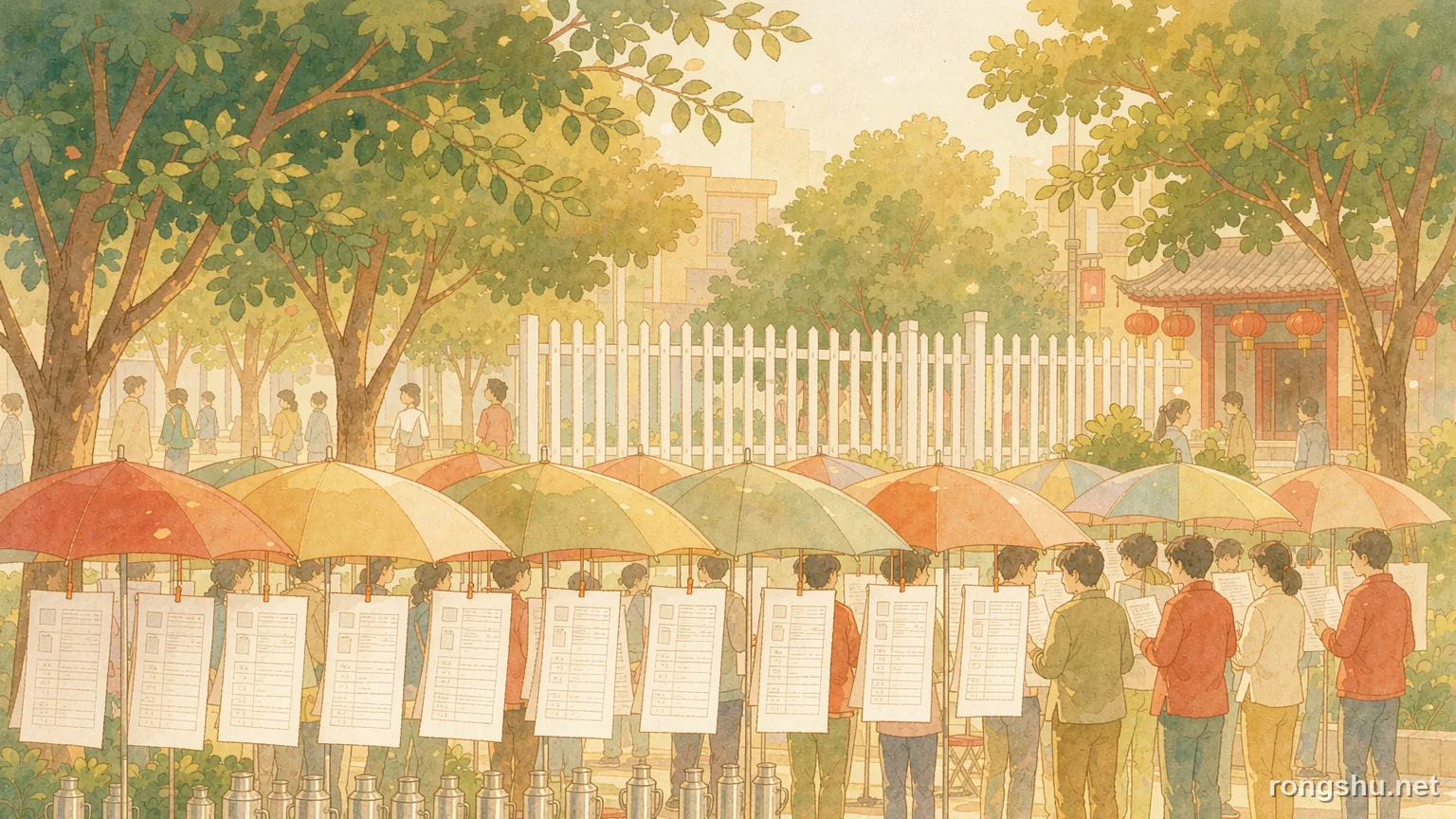
Every Saturday afternoon, a corner of People’s Park in central Shanghai fills up with paper.
Hundreds of pages, each one slipped into a clear plastic sleeve, hang from open umbrellas or lie in long rows on the paving stones. Every page carries a short list: a birth year, a height, a university degree, a job, a monthly income, a district, sometimes the size of an apartment in square meters.
At the top of each page, two words. Male. Female.
No one is selling anything. The pages are advertisements, and the people they describe are the grown children of the parents who stand beside them, holding thermos flasks and folding stools.
A Market With Nothing For Sale
The Chinese name for this place is xiangqin jiao, the matchmaking corner. Foreign visitors almost always call it the marriage market, and the name has stuck, because it is close to the truth.
Every weekend, in cities across China, parents gather in a public park to look for husbands and wives for their sons and daughters. The most famous is here, near the fifth gate of People’s Park, a short walk from the busiest metro station in Shanghai. Beijing has one in Zhongshan Park. Chengdu has one. So do Guangzhou, Hangzhou, and a dozen smaller cities, and some have been running for twenty years.
The rules are unwritten but firm. Parents arrive around midday, carrying stools and tea. They pin their child’s page to a board, or rest it on the ground, or simply stand and hold it. Then they walk slowly along the rows, reading, the way a person might browse a shelf.
When a page interests them, they stop. A conversation begins. It is rarely about love, and not usually about the young people themselves. It is about what the Chinese call tiaojian, conditions.
What Goes On the Page
A typical page reads like a resume with everything human taken out.
Female. Born 1993. 165 centimeters. Master’s degree. State-owned company. Annual income 250,000 yuan. Owns an apartment in Pudong. Only child.
Or: Male. Born 1990. 178 centimeters. Bachelor’s degree. Software engineer. Parents retired, both with pensions. Apartment paid off.
Parents will tell you that the details split along familiar lines. The parents of daughters tend to lead with education and appearance. The parents of sons tend to lead with height and property. Few pages mention a hobby, unless the hobby is a signal in disguise.
Some parts of the market carry their own labels. One row is set aside for children who studied overseas. In some cities there is a corner for families who own more than one apartment, and everyone standing nearby understands what that corner means.
Not every question is asked openly. A parent who wants to know whether a family owns a home near the city center is more likely to ask whether the parking nearby is convenient, or whether the drive home at rush hour is bad. The answer is read like a map. Property, in this market, is never far from the conversation.
When two sets of parents decide the conditions might fit, they exchange phone numbers, or more often a WeChat contact. If things go well, they arrange what they cheerfully call an old friends’ dinner. The two families meet at a restaurant. The young man and the young woman are expected to come along.
Often, they hear about it only a day or two before.
Why the Parents Come
Almost everyone standing in the rows is over fifty. Their children are mostly in their late twenties and thirties, and most of those children are somewhere else.
The parents come for reasons that are easy to understand and very hard to change.
Most of them raised a single child. During the years when the one-child policy was in force, from 1980 to 2015, city families put almost everything into one son or one daughter. Now that child is grown, and the parents have time. Many of them are retired. They keep a fixed spot in the park the way other people keep a seat in a teahouse.
There is a practical gap as well. A family in a village or a small town once knew every eligible young person within twenty kilometers. Matchmakers, aunts, and neighbors did the work. When families moved to the big cities, that network did not move with them. A mother in Shanghai may have no idea who lives two floors down, let alone who is single and looking.
So they go where the information is, and where everyone else with the same problem has already gone. The park becomes the network they lost.
Underneath all of it sits a belief that is still widely shared. In Chinese it is summed up in a phrase every child grows up hearing: cheng jia li ye, to make a family and build a life. Marriage is not only a private matter between two people. It is a stage a family is expected to pass through, and it is a stage the parents feel responsible for.
The Children Who Were Not Asked
The young people whose lives are printed on those pages have complicated feelings about all of this.
Some do not know their parents come here at all. Some know, and have given their blessing, and treat the corner as one more channel, no different from an app. And some find it embarrassing, or worse. For them, being reduced to a row of numbers, in public, on a laminated sheet, comes close to an insult.
Two generations want the same thing and disagree completely about how to get it. The parents are sorting and comparing. The children are looking for a feeling that does not fit on a page.
There is also a quiet puzzle in the rows. Count the pages and the ones for women outnumber the ones for men. China does not have a surplus of unmarried women. It has the opposite. The reason lies in who is thought to be a catch, and by whom. A man of modest means is often considered not yet ready to be advertised. A woman with a good job and a good degree is advertised by parents who quietly fear that her success is running out the clock.
There is a word for that fear, and it is worth handling with care. Some media and some parents use the term sheng nu, which translates roughly as leftover women, for unmarried women past a certain age. The phrase has been widely criticized, including by women who point out that no one applies it to men. It survives anyway, in headlines and in family arguments, and its survival is part of the story.
Something has begun to change, slowly. In recent years, a few young people have started showing up at the park on their own, with pages they wrote themselves. Their sheets list hobbies and habits, a taste for travel, a preference for someone who is careful with money, even a short form about how a person treats animals. It is a small counter-current, and the parents who notice it are not always sure what to make of it.
Where the Pressure Comes From
The parents in the park are responding to pressures that are real, and some of them are getting heavier.
China registered about 6.1 million marriages in 2024, the lowest number since 1980 and a fall of more than twenty percent in a single year. The number of people in the main marriageable years is shrinking too. There are simply fewer young adults than there were a decade ago, and every parent in the park can feel it.
For those who do marry, the cost has climbed. An apartment in a major city can take two families a generation to pay off. In many regions, the bride price, called caili in Chinese, adds a further sum on top, and the government has spent years urging families to keep it reasonable. Some parents speak of needing the wallets of six people, both sets of grandparents included, just to get a young couple started.
At the same time, women are more educated and more financially independent than at any point in Chinese history. More of them can support themselves, and more of them would rather wait than settle. That is good news for the women, and a hard fact for parents who came of age with a different set of expectations.
The parents are not wrong that the ground has shifted. They are standing in a park, holding a page, trying to hold it still.
How Young People Look Now
The parents have their own view of modern dating, and it is not a generous one.
Young people in China meet each other the way young people do almost everywhere: at work, at school, through friends, and on their phones. Several homegrown apps, among them Tantan and Momo, are built for exactly this. A long-running television show, If You Are the One, has turned the search into a weekly spectacle, with one contestant facing a row of strangers who decide, one by one, whether to keep a light on.
None of it reassures the parents in the park. To them, a screen is not a place where a serious match is found. You cannot see a family through an app. You cannot check whether the parents have pensions, whether the apartment is paid off, or whether the young man is steady. The park, for all its bluntness, feels honest. The numbers are there to be read.
The young people often see the same place very differently. To them, the park is the opposite of romance. It is a spreadsheet, and they are one row on it. Many would rather find someone on their own and take their chances than be matched by a page their mother wrote.
So the two generations work in parallel. The parents stand in the park on Saturday. The children swipe on their phones on the subway home. Both are looking for the same thing, and neither quite trusts the other way of finding it.
Not an Arranged Marriage
For anyone raised on stories about arranged marriages, it is worth being precise about what this is.
The parents here are not choosing spouses. They are opening doors. They find someone whose page seems to match, pass along a contact, and step back. The young man and the young woman take it from there, and they are free to say no. Most of the time, they do.
The difference between this and a Western blind date is mostly about who does the first filtering. In many Western countries, that job belongs to an app, and the app sorts by photo, swipe, and a few lines of text. Here, the first filter is a parent holding a sheet of paper, and the sheet of paper sorts by income, height, schooling, and real estate.
Two systems, one instinct: reduce a stranger to a set of conditions, and hope the rest can be discovered later. The Chinese version is simply more visible. It happens outdoors, on a weekend, with the numbers written down where anyone can read them.
One more idea explains a great deal of what you see. The Chinese call it mianzi, face. It is not vanity in any simple sense. It is a person’s standing in the eyes of the people around them. For a parent, a child still unmarried at thirty-five is not a failure. But the neighbors ask, and the relatives ask, and the same question, repeated often enough, becomes a weight. The park is one place to set that weight down.
Hope Under the Umbrellas
The matchmaking corners are not efficient. The parents will tell you so themselves.
Every informal count seems to agree on roughly the same figure. Fewer than one match in a hundred goes anywhere. Some parents have been coming for three years. Some have been coming for ten. They know the odds. They come anyway.
For many of them, the point is not only the match. It is the company. Week after week they stand beside the same faces and talk about the same worries, and the park becomes a waiting room where no one has to wait alone.
Late on a Saturday, the light turns gold and then grey. The parents start to pack up. Umbrellas fold. The pages go back into plastic folders, carefully, the way a person handles something that matters.
A father in a grey jacket takes down the page carrying his daughter’s details. He reads it once more before he puts it away. Tomorrow is Sunday, and on Sunday the park fills again.
This story is based on publicly documented practices at China’s informal marriage markets, including the weekend gatherings in People’s Park in Shanghai, and on reporting in the Chinese and international press. The families described are illustrative, and no individual is identified.