In 338 BCE a man of middle years reached a frontier post in Qin and asked for a bed for the night.
The keeper asked him for papers. An identity document, or a permit from a magistrate.
He had none.
The keeper said that under the law of Lord Shang, a man who let a traveller stay without checking his papers answered for it himself.
The man was Lord Shang.
The law was his own.
The Records of the Grand Historian set down the sound he made. He sighed, and he said: alas, that the defects of the law should come to this.
The story begins twenty years earlier.
A Man Wei Would Not Keep
His name was Gongsun Yang. He came from Wei, in the north, and he was a distant kinsman of the ruling house, so people also called him Wei Yang. Only later, when Qin gave him fifteen towns in the district of Shang, did he become Lord Shang.
As a young man he studied the school of law and punishment. What interested him was not how to be good. It was how to make a state work: how to write rules, how to enforce them, how to turn a country into a machine.
He went to Wei and became a retainer to the chancellor, Gongshu Cuo.
Gongshu Cuo knew what he had in the man. Before he could recommend him to the ruler, he fell ill.
The ruler of Wei came to see him. Gongshu Cuo said: this retainer of mine, Gongsun Yang, is young, but he has a rare talent. I beg Your Highness to give him the government of the whole state.
The ruler did not answer.
Gongshu Cuo had everyone else withdraw and spoke again. If Your Highness does not intend to use him, he said, then you must put him to death, and not let him leave the country.
The ruler agreed, and left.
Gongshu Cuo called Wei Yang in and told him the whole of it, and said: go, now, or you will be taken.
Wei Yang said: the ruler could not bring himself to follow your advice and employ me. Why would he follow your advice and kill me.
He stayed.
In 361 BCE the ruler of Qin, Duke Xiao, came to the throne at the age of twenty one.
He issued a proclamation: whoever, among my guests and my ministers, can offer a plan to make Qin strong, I will make him an officer and share my land with him.
Wei Yang heard, and went west into Qin.
He got his audience through Jing Jian, a favourite of the duke.
At the first meeting he spoke of the way of the ancient emperors. Duke Xiao dozed.
At the second he spoke of the way of the kings. It went no better.
At the third he spoke of the way of the hegemon, of plain dominance. The duke listened, and liked it, but took no action.
At the fourth he spoke of the way to make a state strong.
This time the duke forgot himself. The Records say that as they talked his knees crept forward over the mat until he was sitting off it. They talked for days and he was not tired of it.
Afterwards Jing Jian asked what had done it.
I began with the way of the emperors and kings, Wei Yang said. He told me it was too far off, that he could not wait. So I told him how to make a state strong.
In 359 BCE the duke wanted to change the law, and was afraid of what people would say. So he put the question to the ministers in open court.
The old noble houses opposed him.
Gan Long said: a sage does not change the customs of the people in order to teach them; a wise man does not change the law in order to govern.
Du Zhi said: unless the gain is a hundredfold, do not change the law; unless the advantage is tenfold, do not change the tools. Nothing goes wrong by following antiquity, nothing goes crooked by keeping the rites.
Wei Yang answered with eight characters that are still quoted. To govern a state there is no single way. If it benefits the state, do not follow the old.
The duke said: good.
The Pole at the South Gate
The new laws were ready but not yet published. Wei Yang was afraid the people would not believe them.
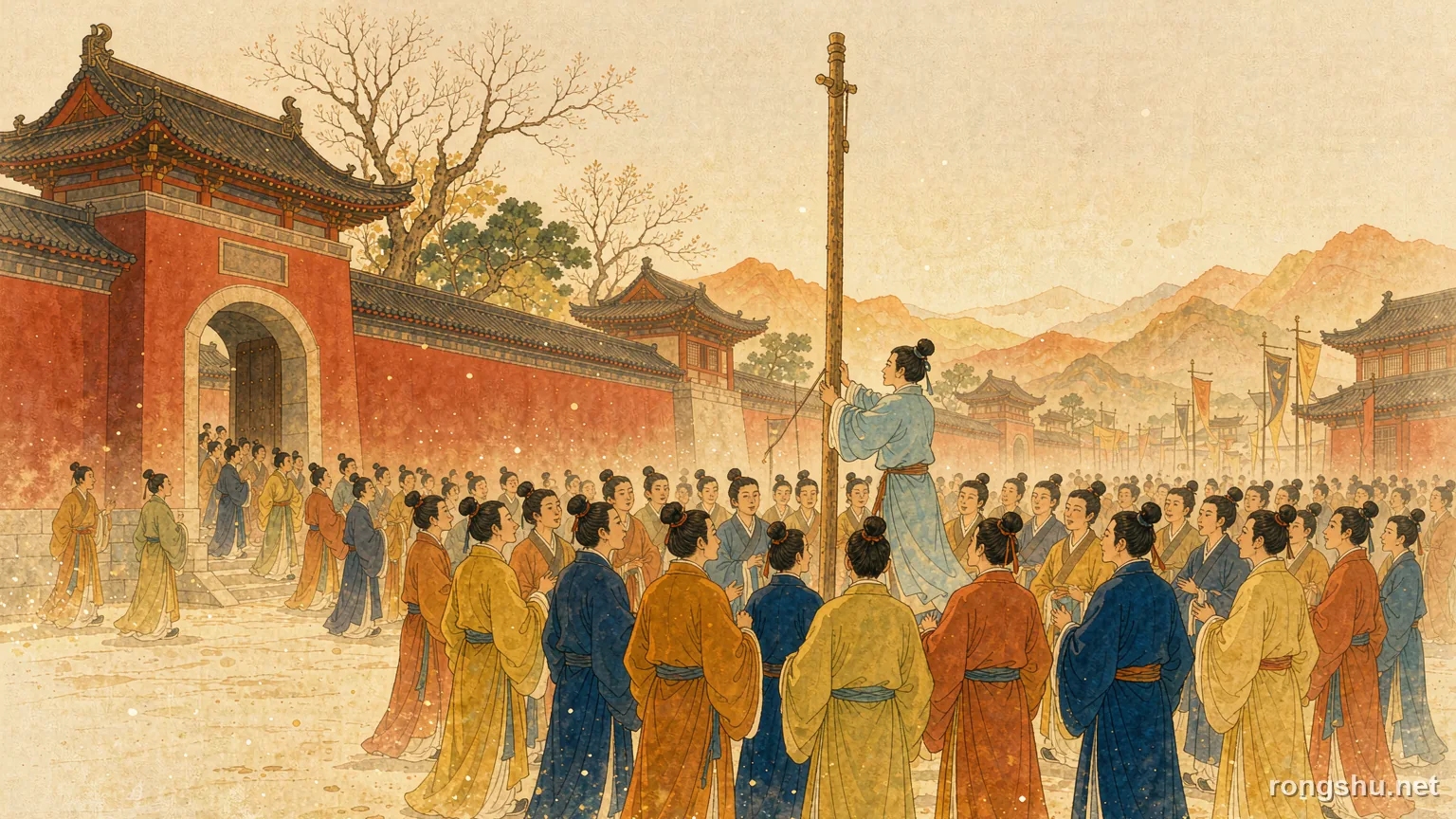
So he had a wooden pole set up outside the south gate of the market in the capital, three zhang tall.
Three zhang is about the height of a single storey.
Beside it a notice went up. Whoever carries this pole to the north gate will be given ten jin.
A crowd gathered. Nobody moved.
Carrying a pole from the south gate to the north gate is not hard. The reward was absurd. Nothing falls out of the sky, and nobody could see what the trap might be.
A second notice went up. Whoever carries it will be given fifty jin.
One man stepped out. He carried the pole from the south gate to the north gate.
Wei Yang gave him fifty jin then and there.
The next day the laws were published.
A Net of Five and Ten
The first set of laws came down to four things.
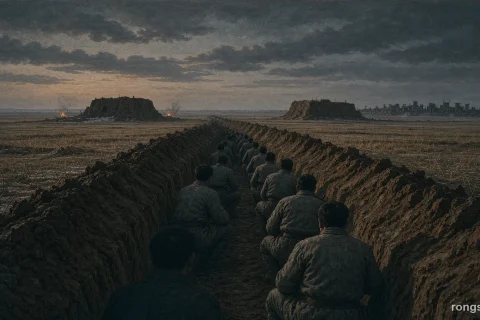
First, the people were counted and tied together. Ten households made a shi, five made a wu, and the households in each group answered for one another. If one committed an offence, all were punished with it. A man who did not report an offence was cut in two at the waist. A man who reported one was rewarded as though he had taken an enemy head in battle. A man who sheltered an offender was punished as a deserter.
Second, the households were split. Any family with more than one grown man that did not divide its property paid double tax.
Third, rank came from the battlefield. Every enemy head taken raised a man one grade. A noble family with no record of military merit lost its place on the clan register and its titles. Private brawling was punished by severity.
Fourth, the land was worked. Men who produced more grain and cloth than the standard were excused labour service. Men who were poor because they traded or were idle were made slaves of the state, with their families.
Taken together, the four say one thing. The country was to be a farm and an army at the same time.
People were fixed to the land, and fixed inside the ledger. There was one road upward, and it went through a battle.
After a year, thousands of men from the capital were going about saying that the new laws did not suit them.
Then the heir to the throne broke the law.
Wei Yang said: the law does not move because those above break it first.
He meant to try the heir.
But the heir was the duke’s successor, and could not be punished.
So the two men who taught him were punished instead. One, Gongzi Qian, took the penalty in his body. The other, Gongsun Jia, was tattooed on the face.
The next day the people of Qin fell into line.
Here English readers may feel they have heard this before, because they have. In the first year of the Roman republic, Lucius Junius Brutus had his own sons put to death for conspiring with the exiled kings, and stood and watched. In Athens, Solon wrote the law up on wooden tables where anyone could read it, and Draco before him had made even idleness a capital offence. The idea that the law stands above the family, and above the man who wrote it, is not a Chinese idea. It is one of the few things almost every settled state has invented on its own. What is unusual about Wei Yang is that he paid for it himself.
Ten years on, this is what the Records say of Qin. Nothing dropped in the road was picked up. There were no thieves in the hills. Every household had enough. The people were brave in public war and timid in private quarrels.
In 350 BCE came the second set of laws.
Qin moved its capital from Yueyang to Xianyang. Moving a capital is not a removal. The noble houses and the great clans left the ground their ancestors had held, and everything in the new city was built from nothing.
At the same time the state banned fathers, sons and brothers from living in one house. It merged the small townships and hamlets into counties with a magistrate and an assistant, thirty one of them. It broke up the old field boundaries and let land be bought and sold. It standardised the measures of grain, of weight and of length.
Moving a capital to break a nobility is an old trick, and it works the same way everywhere. When Peter of Russia built a new capital on a marsh at the edge of the Baltic, he was not only opening a window on Europe. He was putting several hundred miles between his court and the old families of Moscow. A court that has to travel is a court that has been re-sorted.
Four years later, Gongzi Qian broke the law a second time.
This time his nose was cut off.
After that he shut his door and did not come out. Eight years later his turn came.
The Oath by the River
In 341 BCE the state of Qi destroyed a Wei army at Maling.
The next year Wei Yang spoke to Duke Xiao. Qin and Wei, he said, are like a man with a disease in his belly. Either Wei swallows Qin, or Qin swallows Wei.
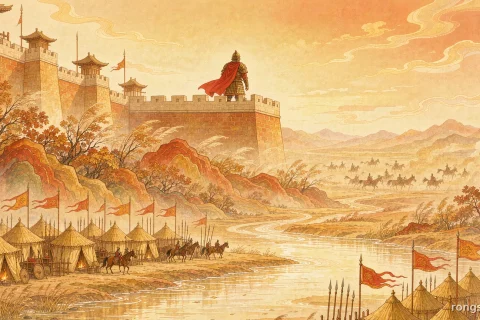
The duke sent him against Wei at the head of an army.
The Wei commander was a man named Gongzi Ang.
Wei Yang and Gongzi Ang had been friends.
He wrote to him. We were friends once, and now we command the armies of two states, and I cannot bear to fight you. Let us meet, swear an oath of peace, drink together, and take our men home, and both Qin and Wei will be at ease.
Gongzi Ang agreed.
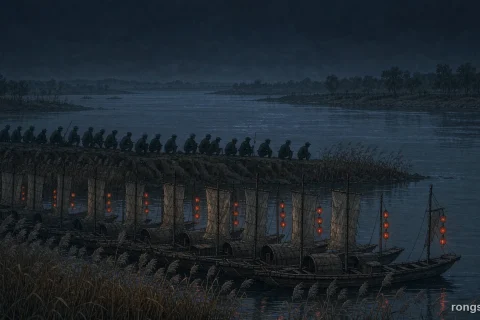
They met. They swore. They drank. The armoured men Wei Yang had hidden came out, took Gongzi Ang alive, and turned on the Wei army. It broke.
Wei had one road left. It ceded the land west of the Yellow River and sued for peace.
The ruler of Wei said: how I regret not taking Gongshu Cuo’s advice.
For this, Duke Xiao gave Wei Yang fifteen towns in Shang. From then on he was Lord Shang.
He had been chief minister of Qin for ten years, and the great families hated him.
A man named Zhao Liang came to see him and gave him a long warning. You stand on the support of one man, he said, and you have made enemies of every old house in the state. When you go out, ten carriages follow you and armoured men ride on them, and without them you do not leave the house.
Your danger, he said, is like the morning dew.
Lord Shang did not take the advice.
Five months later, Duke Xiao died.
The Inn Without Papers
The heir took the throne. The party of Gongzi Qian accused Lord Shang of plotting rebellion.
Lord Shang fled to the frontier post, and asked for a bed.
The keeper did not know him, or knew him and did not dare to say so. He wanted the papers, because the law of Lord Shang was perfectly clear. A man who let a traveller stay without checking his papers answered for it himself.
He sighed, and he went on.
He went to Wei. Wei had not forgiven him for the trick on Gongzi Ang and the ruin of its army, and would not take him in. They said: Lord Shang is a traitor to Qin. Qin is strong, and a traitor has come into Wei, and if we do not send him back we will answer for it.
So they sent him back to Qin.
Lord Shang returned to his own towns, raised the men of the district, and marched north against Zheng. The armies of Qin came out, and killed him at Mianchi.
The new ruler had his body torn apart between chariots, and made a proclamation over it. Let no man rebel as Lord Shang did.
Then he wiped out the family.
Lord Shang died. His law did not.
From Duke Xiao to the First Emperor, for more than a hundred years, Qin kept the same machine. In 221 BCE Qin swallowed the other six states and made the first empire of China.
In the Shanghai Museum there is a bronze measuring vessel known as Lord Shang’s square measure.
On one side it carries an inscription put there in the years of the reforms, giving its capacity.
On the other side is the edict of the First Emperor, standardising weights and measures across the empire.
One vessel, two orders, more than a hundred and twenty years apart. The first was cut by Lord Shang. The second was cut by the man who finished what he started. In the years between, the method never stopped running.
The writer of the Records of the Grand Historian gave him eight characters at the end. Lord Shang, he wrote, was by nature a hard and ungenerous man.
The measuring vessel is still in its case in Shanghai.