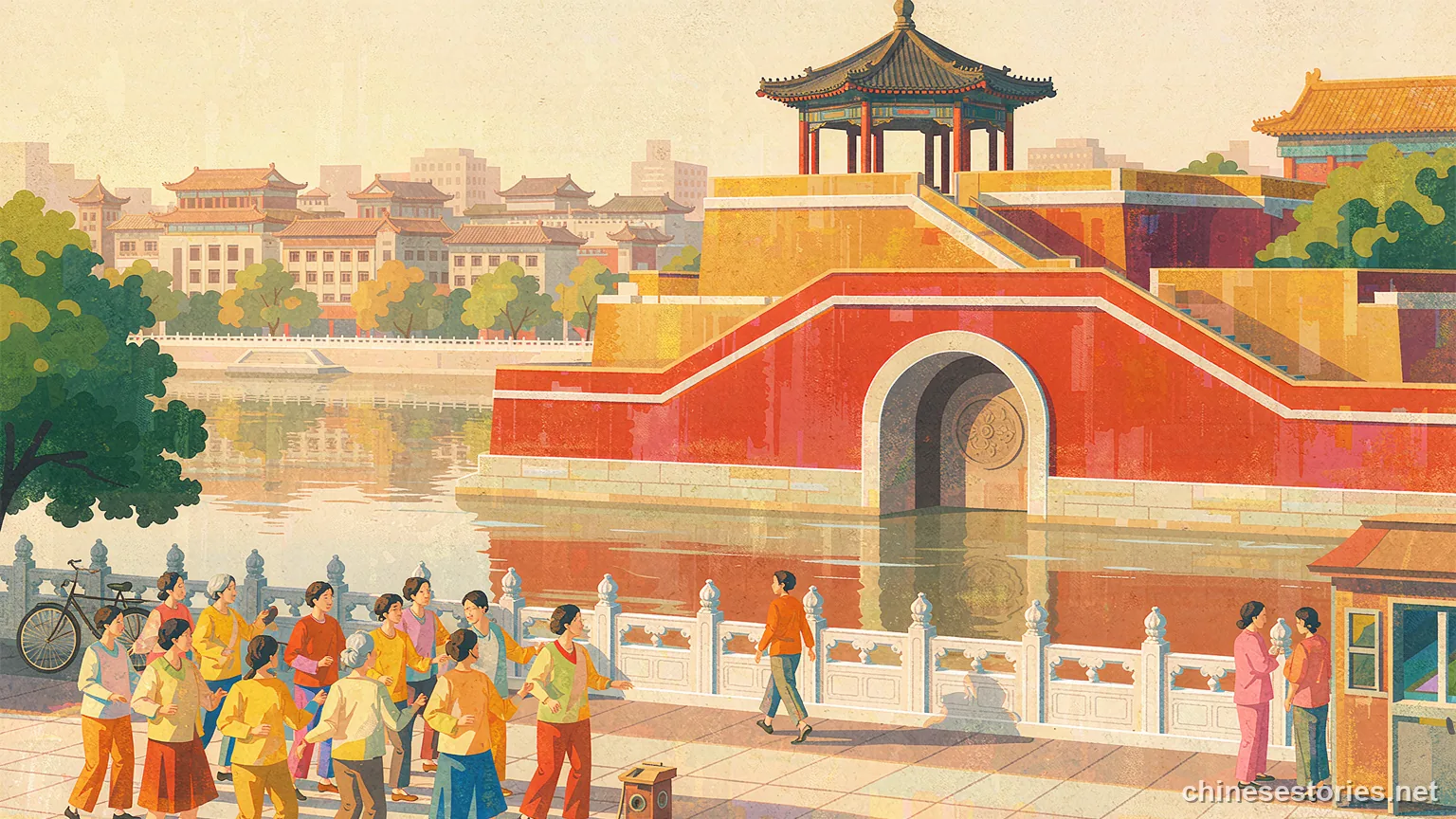
A little after seven in the evening, a woman in her sixties wheels a trolley speaker to the edge of a riverside plaza, sets it down, and presses a button.
The music starts, bright and rhythmic, loud enough to fill the open space. Within minutes a small crowd gathers. Women in loose trousers and soft shoes take their places in rough rows, facing the speaker. A few men join the back. Then the dancing begins, a repeating set of steps that everyone already knows.
By the time the light turns gold, the square is full. In another neighbourhood, ten minutes away, the same thing is happening. So is a park across the river, and a paved area beside a supermarket, and a small square in a town hundreds of kilometres from here.
On warm evenings there may be several groups in sight of one another, each with its own speaker and its own style. On cold ones, the dancers wear padded coats over their tracksuits and keep their gloves on between songs. Neither the weather nor the distance seems to interrupt the hour.
What Square Dancing Is
The activity has a name in Chinese: guangchangwu, which means square dancing or plaza dancing. In English-language media, the participants are often called dancing grannies, a label many of them dislike.
It is exactly what it sounds like. Groups of neighbours gather in a public open space, usually in the evening, and dance together to amplified music. There is no stage, no ticket, and no instructor charging a fee. Someone at the front knows the steps, and everyone follows.
The scale is larger than most outsiders expect. By common estimates, around 100 million people take part across the country. The great majority are women, mostly between fifty and seventy, though some groups now include younger dancers and a few men.
It happens in almost every city. It happens in county towns and in villages, on flat ground beside a road or under the lamps of a public square. It costs almost nothing, and that is a large part of why it spread.
The form is not new. It grew out of the fitness routines and group dances that became popular in Chinese cities in the 1990s, as people gained more free time and public squares became common. The word guangchangwu, plaza dance, took hold in the early 2000s. From there it spread across the country alongside the growth of the cities themselves.
You have likely seen a version of it without knowing the name. Travel videos of China often include a shot of a square at dusk, ringed by dancers, speakers propped on a low wall. For many Chinese viewers the scene means something simple: this is home, this is an ordinary evening, this is how the neighbourhood looks when the day ends.
A Speaker and a Square
The equipment is simple, and the simplicity is the point.
A group needs flat ground, a speaker, and a phone or memory card full of music. The speaker is usually a portable trolley unit, wheeled in on a handle, charged overnight at home. Many groups share the cost, or one member owns the speaker and brings it every night.
The music is chosen by the group’s leader, often a woman who learned the steps first and now teaches them. The songs range from folk tunes and older revolutionary melodies to pop hits and the fast, catchy tracks from short-video apps. When a new dance becomes popular online, it can reach a plaza within days.
A single group may have twenty members or a hundred. They arrange themselves in rows, and new dancers start at the back, where mistakes are less visible. Over months, some move to the front. One organiser described a woman who watched from a bench for three years before joining, then became one of the group’s most committed members.
There are no dues, no uniforms unless a team is competing, and no attendance list. People come when they can. The looseness is what keeps it alive.
The learning is social, not formal. A new member watches the row in front and copies. Nobody corrects them at first. The steps are forgiving, and the point is to take part, not to perform perfectly. Within a few evenings, most people can follow along.
There is a small economy behind the scene. Vendors sell speakers, tracksuits, and the bright, inexpensive outfits that teams wear to competitions. Short-video apps carry a steady stream of new routines, taught by popular instructors to audiences of millions. A dance can travel from a phone screen to a plaza in a week.
Why the Women Lead
Ask the dancers why they come, and the answers usually start with health and then move somewhere else.
The health part is real. The dancing is gentle aerobic exercise, easy on the joints, done in company. Some participants joke that it is their open-air hospital, and they mean it as a compliment. Studies of older adults have linked group exercise of this kind with better balance, mood, and sleep.
But the second answer is the one that matters more. Many of these women spent decades looking after a household, raising a child, and often working full-time as well. When they retired, the days emptied out. A phrase heard again and again is that one day they were speaking at a meeting, and the next day they were alone at home scrubbing the floor.
Square dancing gave the days a shape. It gave them a place to be, a group to belong to, and a reason to leave the flat at the same time every evening. For people who grew up valuing collective life, it also brought back a familiar feeling of being part of something organised.
The generations matter here. Many of today’s dancers were born around 1960. They grew up in a time when work units organised much of social life, and the habit of doing things together stayed with them. Square dancing does not only fill an evening. It restores a feeling they recognise.
There is also a practical side. Retired women in a Chinese city often live close to one another, in the same compound or on the same block, and they see one another daily. A dance group is a natural extension of those already-close ties. It gives the neighbours something to do together, rather than only something to talk about.
There is a smaller, prouder reason too. For many women, it is the first time in their lives that they have performed for anyone, worn bright colours, and been told they look good. Some of them move from the back row to the front over a couple of years. That progress is not about fitness. It is about being seen.
Men are a small minority, and the reasons they give are telling. In interviews, older men often say they feel awkward dancing in public, that it is not their place, or simply that they would rather fish, walk, or practise tai chi. Where men do join, they tend to be welcomed, and a mixed team may even gain a point at a competition. But the squares are still mostly women’s spaces, and everyone seems to accept that.
When the Music Meets the Neighbours
Square dancing is not always welcome, and the friction is part of its story.
A speaker loud enough for a hundred dancers is also loud enough for every flat within a few hundred metres. Residents with young children, night-shift workers, and students preparing for exams have all complained over the years about the noise and about squares being taken over.
The disputes have sometimes turned ugly, with arguments over volume, timing, and space. In a few cities, rival groups have competed for the same patch of ground.
Over time, the two sides have worked out rough rules. Many groups now write down their own pledges, agreeing to start no earlier than seven in the morning and stop by nine at night, to keep the volume down, and to move away from schools and homes during exam season. Some cities have designated spots and times for dancing.
Rules have also tightened at the national level. A 2015 push in Beijing standardised a set of routines, partly to make the dancing more orderly. Later, updated rules on noise pollution set limits on volume and allowed fines for people and groups who ignore them in residential areas. Enforcement varies from place to place.
What makes the argument hard to settle is that both sides have a point. The residents are right that the noise is real, and that a home should be quiet. The dancers are right that they have as much claim to a public square as anyone, and that they have few other places to go. Most solutions, in the end, are a negotiation between two reasonable claims about the same patch of ground.
The pandemic years interrupted the dancing. For a while, groups stopped or shrank, and some moved online, with members dancing alone in front of a screen. When the squares reopened, most groups came back, a little smaller at first and then larger again. The habit had proven stronger than the interruption.
The aim, in most cities, has been to keep the dancing rather than to stop it. The activity is officially encouraged as part of a public fitness drive, and in 2017 it was even included as a mass participation event at the National Games.
Compared With Western Retirement
An English-speaking reader may wonder what the closest equivalent would be at home.
Western retirement has its own group hobbies: walking clubs, choir, line dancing, bridge, a weekly game of golf. Some of these look quite similar. Line dancing in particular shares the rows, the repeated steps, and the social warmth.
The differences are in the setting and the scale. Square dancing happens outdoors, in public, in the middle of a city, and it is impossible to ignore. It takes over a shared space rather than booking a private one. For better and worse, the whole neighbourhood knows it is happening.
It is also more common and more widespread than any single Western hobby. In a country where the number of people over sixty-five has grown past 220 million, the evening plaza has become one of the most ordinary sights of urban life.
Another difference is who pays for it. In many Western cities, group activities for older adults happen inside community centres, libraries, or church halls, funded by a mix of public money and fees. Square dancing needs almost none of that. It uses ground that already exists, and the only running cost is the electricity to charge a speaker.
The scale also changes what it means. In the West, a hobby like line dancing is a personal choice, shared with a few dozen people. In a Chinese city, square dancing is closer to weather: something that happens around you at a certain hour, whether or not you join in. You do not have to like it to notice that it holds a city’s evenings together.
And it is unusually cheap. There is no membership, no equipment to buy, and no venue to rent. A person needs shoes and a little time. That low threshold is what turned a neighbourhood pastime into something closer to a national habit.
The Last Song
By nine, the music winds down. The leader unplugs the speaker and wheels it away. The dancers drift off in twos and threes, still talking, some heading home to a spouse, others to an empty flat.
Tomorrow the group will meet again, at the same hour, in the same place. A new dance is already being practised by the front row, learned from a video and passed on quietly.
Not every group lasts. Leaders move away, members fall ill, and a plaza may be dug up for repairs. When a group breaks up, the dancers often scatter into other groups nearby, carrying the steps with them. The dancing is not really owned by anyone, and that may be why it survives.
On the way home, some of the women stop at a fruit stall, still warm from dancing, and buy something for the morning. The music is off. The square is dark. The evening is over, and in a few hours the first group will arrive for the morning session, when the light is soft and the air is cool.
The plaza returns to its daytime self, a crossing for commuters, a place for children on scooters. Then, as the light softens again, someone will arrive early, set down a speaker, and press play.
This story is based on publicly documented practices and on reporting in the Chinese and international press. The families described are illustrative, and no individual is identified.