Once a year, the mountain woke up.
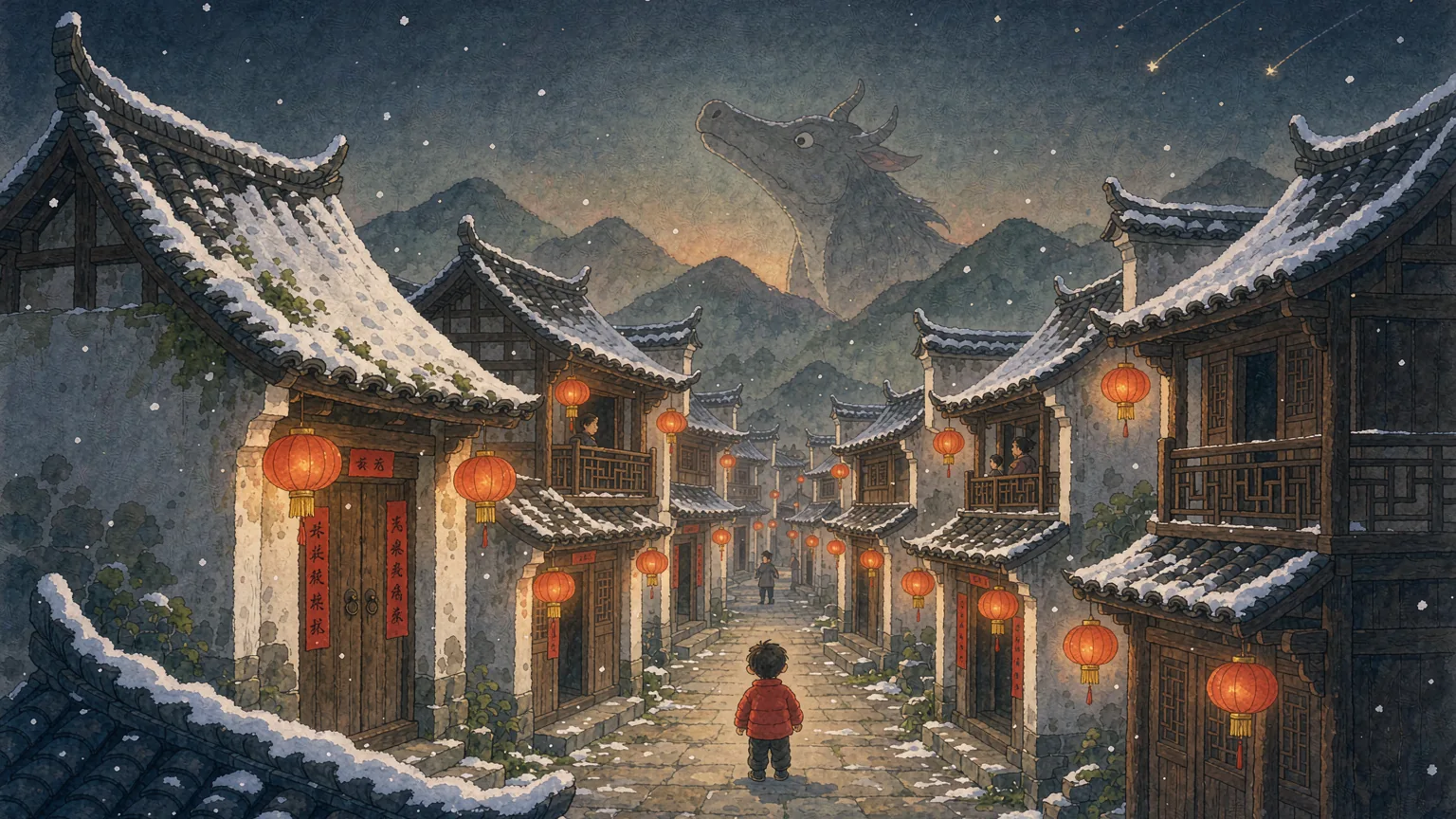
At the bottom of the mountain there was a village.
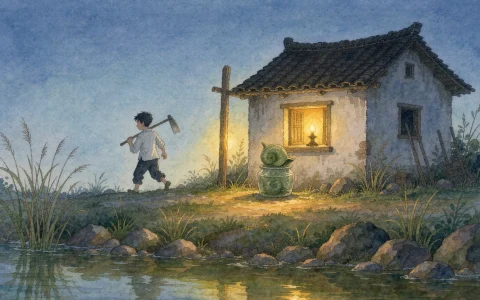
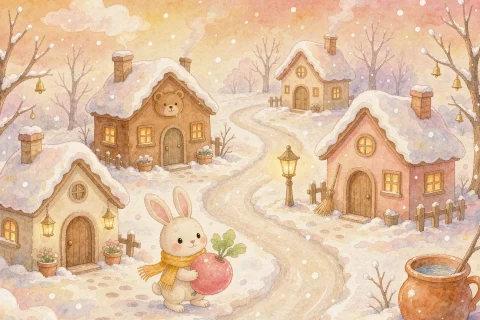
The village was small. It had one river, one field, and a row of little houses with gray roofs.
Most of the year, nothing much happened there.
People planted rice in spring. They dried it on the road in autumn.
In the evenings, they sat outside and watched the light go.
The children chased the chickens. The old men talked about the weather.
It was a quiet place.
But the last night of the year was different.
On that night, the dark came early.
The wind came down off the mountain, and it smelled of snow.
And Bao knew what was coming.
Nian was coming.
Nian was a beast.
He lived at the very top of the mountain.
He slept the whole year round, and he woke up on one night only.
The last night of the year.
He was big. His steps were loud.
When he stamped his foot, snow slid off all the roofs.
He had two horns, a long gray coat, and eyes like two slow lamps.
He never bit anyone. He was only hungry.
He had slept for a whole year, and there was nothing to eat up there.
So down he came.
He nosed at the rice jars. He leaned his weight on the doors.
Grain went everywhere. Baskets rolled over.
People were afraid of him.
Nobody in the village liked that night.
The mothers put their children to bed early.
“Sleep now,” they said. “Do not listen to the wind.”
On that night, every window was shut.
Every door was barred.
And nobody made a sound.
Bao was afraid too.
He sat behind the stove with his knees pulled up.
Thump. Thump.
The footsteps came closer.
And then the window turned red.
Bao looked up.
It was Grandmother.
She was hanging a red lantern on the door.
“Grandmother,” he said. “Are you not afraid?”
“I am,” she said. “But look at this. Red things frighten him.”
“How do you know?”
“Last year, my red cloth blew out of the door.”
“He walked up to it. Then he stopped.”
“And he took one step back. Then another.”
Bao remembered that.
He thought about the gray shape stopping in the dark.
He found the red paper. He pasted one sheet on the door, and then one more.
Then he ran to the house next door.
“Grandmother Wu! Put red paper on your door! Nian is afraid of red!”
She stared at him for a moment. Then she went to find her red paper.
And he ran to the next house.
And the next.
And the next.
He ran past the well, and down to the last house on the lane.
Some people laughed at him. Then they found their red paper too.
That night, every door in the village was red.
That night, the lanterns began to glow, one after another, all down the street.
That night, Bao threw dry bamboo into the fire.
Crack. Crack.
The sound went all the way up the mountain.
Nian came down.
He walked through the pine trees, and they leaned away from him as he passed.
He reached the edge of the village, and he stopped.
He lifted his head.
And he saw it.
One whole street, all red.
Red doors. Red lanterns. Even the sky was red.
He stood there and looked for a long time.
He thought the sun was coming up early.
So he yawned.
Then he turned around and walked back up the mountain, one slow step at a time.
He curled up at the top, and closed his eyes.
That sleep lasted a whole year.
In China, this night is called New Year’s Eve, and the days that follow are Chinese New Year.
People paste red paper on their doors. The paper is called spring couplets.
They light red lanterns.
They set off firecrackers, because that is the sound Bao made with his bamboo.
And nobody goes to bed until the sky turns light.
That night, the whole village kept its lamps burning.
Nobody slept at all.
Not until the sky really did turn light.
Then they blew out the lamps, one house after another, and went to bed.
Bao slept too.
He slept a long, long time, with the sun on his face.
Because the new year had started, and everyone was sleeping in.
Nian is one of the oldest Chinese folktales, and it is still a favorite Chinese fairy tale at bedtime.
Up on the mountain, the snow is still white.
The red paper on the doors lifts a little in the wind.
Outside, the wind is quiet now. The mountain is asleep.
Somewhere far off, a dog barks once, and then stops.
Now it is time to close your eyes.
Good night, Bao.
Good night, Nian on the mountain.
This is a very old Chinese bedtime story. It is not long, and it is very gentle. Best read slowly, with the lights low.