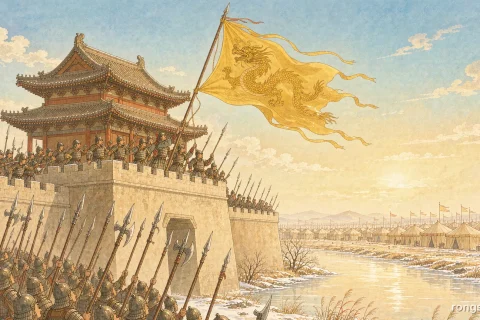
On the thirteenth day of the sixth month, 1402, the sky over Nanjing went dark with smoke.
The fire was inside the palace. It rose behind the walls, thick and black, and by the time it was noticed the soldiers of the Prince of Yan were already in the city, and nothing had stopped them worth mentioning.
Some said the emperor had burned himself in the palace. Some said he had gone out through a tunnel. Nobody produced a body.
That same day a squad of soldiers came to the house of Fang Xiaoru.
He did not run.
The official record of the reign gives the whole of it one line. Ji Tai, Huang Zicheng, Fang Xiaoru and others, ringleaders among the wicked ministers, were brought before the gate.
Arresting people is the most ordinary act of any change of dynasty.
To see what that day weighed, you have to know what the four years before it had done.
It begins with Zhu Yuanzhang, the founding emperor of the Ming.
He handed the throne to an unexpected man. Not to one of his sons. To a grandson.
His eldest son and heir had died young. Instead of choosing among the surviving princes, Zhu Yuanzhang named his dead heir’s son, Zhu Yunwen, as his successor. In 1398 the old emperor died. Zhu Yunwen, twenty-one years old, took the throne.
What he inherited was an empire seeded with uncles.
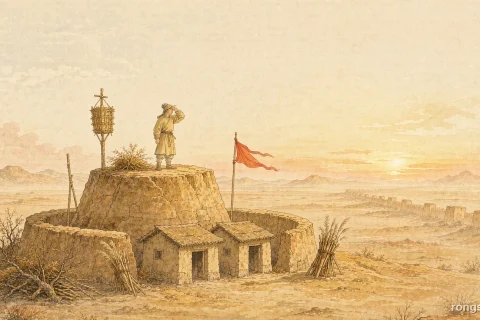
His father had placed his own sons along the frontiers as princes with their own armies, their own fortresses and their own officials. They were the empire’s border defence and its permanent risk, and every one of them was older, harder and more experienced than the boy on the throne.
The young emperor’s advisers told him to take their power away.
He did more than that in his four years. He reorganised parts of the bureaucracy, softened the criminal law, and reduced several taxes that had been falling too heavily on the south. Fang Xiaoru drafted much of it.
It was the first attempt in the Ming to govern the empire by a scholar’s methods. It lasted four years.
The reductions went through quickly, and each uncle met a different end. One was stripped of his title and sent to Yunnan. Three more lost their princedoms in turn. The Prince of Xiang, who had a harder temper than the rest, watched the government troops arrive at his gate, set fire to his own palace and burned to death inside it with his wife and children.
Then the court reached the uncle it was most afraid of.
The Uncle in the North
That was Zhu Di, Prince of Yan, based at Beiping, which is now Beijing.
Zhu Di commanded the best frontier army in the empire, and he had spent twenty years using it against the Mongols. He had not learned war inside a palace.
The man who set him on that road was a Buddhist monk.
Yao Guangxiao had taken vows at fourteen, and had also studied the arts of divination under a Taoist. At their first meeting he told the prince that he would present him with a white cap. Put the character for white above the character for prince, and the word becomes emperor. Chinese is a language in which a hat can be a coup.
The prince understood him.
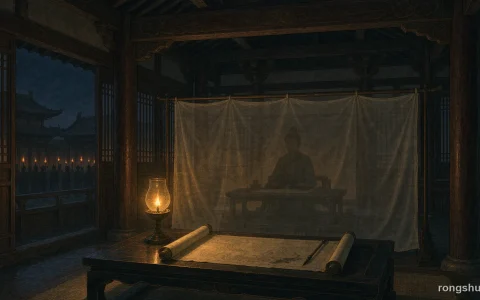
Through the four years of the war, it is said, the great decisions of the campaign were made in the rear by that monk.
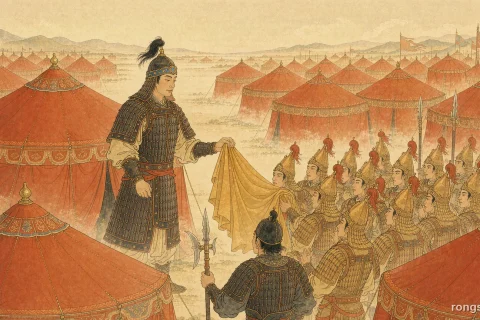
In 1399 he rose in rebellion. His stated purpose was to clear the emperor’s flank: the throne, he said, was surrounded by wicked ministers, and he was marching to remove them.
The war lasted four years.
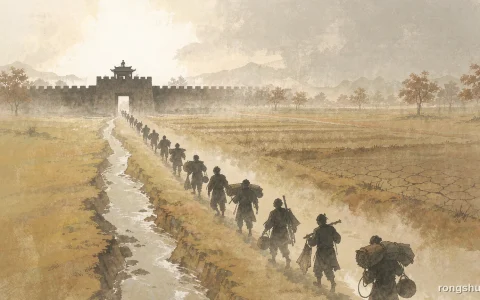
The court had far more soldiers. But Zhu Di had only one road that led anywhere. He did not stop to take cities. He went south, toward Nanjing.
The court was not without able men.
At Jinan, in Shandong, a civil official named Tie Xuan held the walls for three months and threw the northern army back more than once. Zhu Di went around the city and continued south, because he could not get through it.
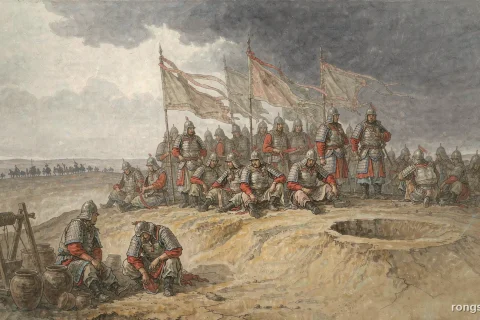
Several times the court very nearly finished him. Several times he recovered.
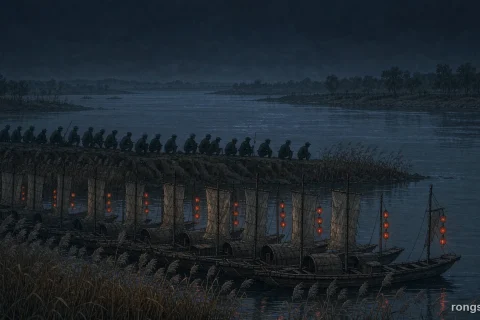
In 1402 he crossed the Yangtze.
Once across, Nanjing lay directly in front of him.
Inside Nanjing, the emperor’s ministers divided into those who advised him to hold the city and those who advised him to leave it.
In the end he did neither.
And there is a further question that has been argued without pause since 1402. Did he die at all?
The court said he burned. Nobody produced a body, then or later.
One of the explanations offered for the great sea voyages of Zheng He, which began three years later, is that part of the purpose was to look for him.
The Day the City Fell
Fang Xiaoru was forty-six.
He came from Ninghai in Zhejiang, where his father had been a local official. His teacher had been Song Lian, the most famous civil servant of the early Ming, who once described him as a phoenix among ordinary birds.
Zhu Yuanzhang had met him twice and filed him away as a man to be used later. When the young emperor took the throne, he summoned Fang Xiaoru to the capital and raised him from a ninth-rank teaching post in the provinces to the inner circle of the court.
He was consulted on state papers. He drafted the pronouncements of the throne.
And he had written the proclamations condemning Zhu Di as a rebel. All of them, or close to all of them, came from his brush.
So he was on the list.
The roll of wicked ministers published the day Zhu Di entered the city carried fifty-three names. Fang Xiaoru was fifth.
He was arrested that day. The record adds one detail that has never stopped being read closely: the order was that he was not to be allowed to die quickly.
It is worth setting the order of that week down plainly.
On the seventeenth of the month Zhu Di formally took the throne.
On the eighteenth he abolished the reign title of the Jianwen emperor and renamed the year the thirty-fifth of Hongwu. In other words, the four years of his nephew were struck out of the calendar.
On the twentieth he buried the Jianwen emperor with full ceremony and closed the court for three days of mourning. A dead emperor was given a funeral by the man who had taken his place.
Fang Xiaoru was executed in the marketplace that day, with Ji Tai and Huang Zicheng, five days after the funeral of the emperor he had served.
Wipe out an emperor, bury him, then kill his ministers. The order matters, and it was followed.
At the beginning of the rebellion, it is said, Zhu Di had been given a warning by his chief adviser, the monk Yao Guangxiao. When the city falls, Yao Guangxiao told him, Fang Xiaoru will not surrender. Spare him. Kill that man and the seed of scholarship in the empire is destroyed.
The Brush on the Floor
What happened next is the version everybody knows.
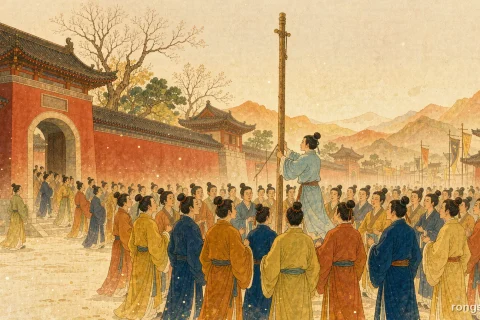
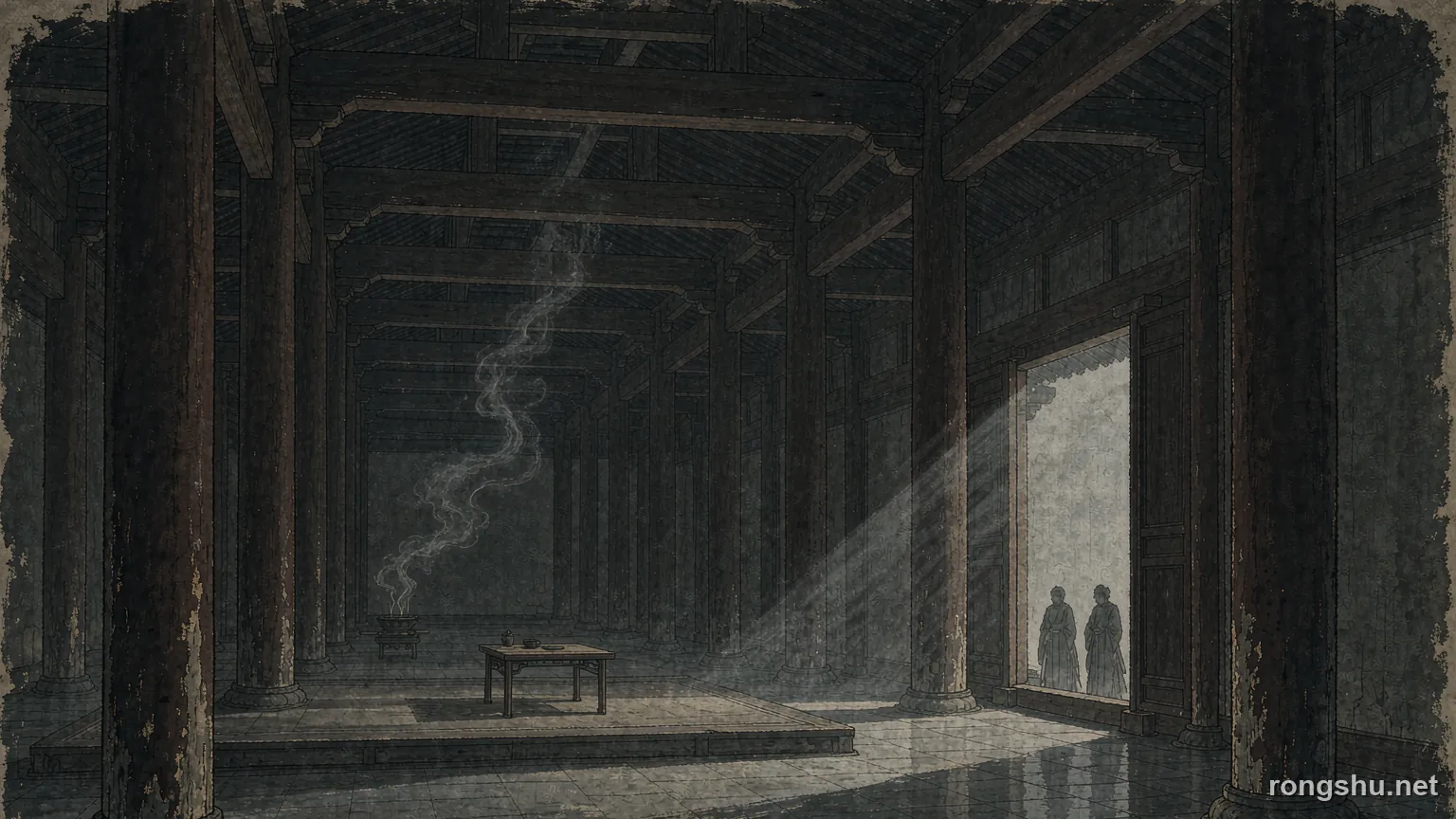
Zhu Di, it is said, wanted Fang Xiaoru to draft his accession proclamation. A new emperor needs a document announcing him to the empire, and a document written by the most respected scholar alive would mean that the most respected scholar alive had acknowledged him.
Fang Xiaoru was brought to the hall.
He came in mourning dress, weeping aloud.
Zhu Di came down to him and said that he was only imitating the Duke of Zhou, who had governed on behalf of a young king.
Where, said Fang Xiaoru, is that young king now?
He burned himself, said Zhu Di.
Then why not set up that king’s son?
Because the state needs an older ruler.
Then why not the king’s brother?
That, said Zhu Di, is my family business.
A brush was held out to him. He threw it on the floor and shouted that he would die, and the proclamation would not be written.
Zhu Di asked whether he was not afraid of the punishment that reaches nine degrees of kinship.
Fang Xiaoru gave the answer that is printed in a hundred books: ten degrees, and what of it.
So it was ten.
Father’s line, mother’s line, wife’s line, and for the tenth degree, his students and his friends.
That passage is legend, and it should be marked as legend.
The official biography in the Ming History does contain the scene. What it says is that the emperor, enraged, ordered him torn apart in the marketplace, and that Fang Xiaoru went to it calmly at the age of forty-six. It does not say ten degrees of kinship.
The court record of the reign gives one word for what happened to him: executed. He was killed in public, in the marketplace, on the twenty-fifth of the sixth month, together with Ji Tai and Huang Zicheng.
The phrase ten degrees first appears in a book called the Wild Notes, written by Zhu Yunming in the early sixteenth century. That book is a collection of stories, and it was put together about a hundred years after Fang Xiaoru died. Zhu Yunming himself was born almost sixty years after the execution.
The scene with the brush first appears a little earlier, in a collection by Li Xian in the middle of the fifteenth century.
And the line about the seed of scholarship, attributed to the monk, appears latest of all, in the 1520s. Scholars have gone through everything Yao Guangxiao left behind. The line is not in any of it.
How the Story Grew
Set the three layers side by side and the pattern is plain.
First: he was executed. Then somebody supplied a reason, and the brush went onto the floor. Then the punishment that reaches nine degrees of kinship became ten, so that his friends and students could be counted in. And then the monk was given a line, so that a more impressive witness would be on record as having tried to save him.
Each layer is more detailed than the last. Each layer is more terrible.
Nobody was lying.
What happened was that scholars of the later Ming were speaking for a man who would not bow. During the Yongle reign the subject was not open for discussion: Zhu Di ordered that anyone who kept the writings of Fang Xiaoru would be put to death. When the political air finally loosened, books about the Jianwen court came out one after another, and the age wanted a man who could stand for the integrity of the scholar class.
By then Fang Xiaoru had been dead for eighty years.
Nobody called him the seed of scholarship while he was alive. The phrase grew for him after he was gone.
As for the number of people killed with him, the accounts give two figures: eight hundred and forty-seven, or eight hundred and seventy-three. Both come from later writers.
Who Collected the Bones
Outside the legend, a few things are solidly on the record.
After the execution, members of his clan were killed as well; his wife and sons died in that season, though the accounts do not agree on the manner.
His younger brother, Fang Xiaoyou, was taken to the place of execution with him. The story is that on the way he recited four lines of verse, of which two survive. When a thousand years have passed and the stone pillar stands at the road, the travelling soul will still come home to the mountain.
By the rules of the time, the body of an executed traitor could not be claimed. Relatives who tried it risked the same end.
Two young men went anyway. Liao Yong and Liao Ming, sons of a founding general, recovered the remains and buried them in the hills south of the city.
It was discovered. Both brothers were put to death.
An order went out forbidding the writings of Fang Xiaoru to circulate. Somebody hid the manuscripts, and kept them hidden for decades.
A few generations on, the wind changed. Under the next reign the family was gradually pardoned. By the end of the sixteenth century the court had built a shrine to him in Nanjing and enrolled him among the loyal.
His grave is still there.
A hundred and thirty-three years later, England did something very close to this.
In 1535 Thomas More, the author of Utopia and a former lord chancellor, was taken to the block because he would not swear to the Act of Supremacy and acknowledge Henry VIII as head of the church. He would not sign, and he would not say why he would not sign.
The king who killed him and the emperor who killed Fang Xiaoru had both learned the same lesson. Kill one man who will not put his name to the new order, and everyone else will see it done.
The difference is that More died an old man. Fang Xiaoru was forty-six.
In Ninghai there is still a shrine. Lu Xun, writing in the 1930s, said that the men of that part of Zhejiang carry a particular kind of hardness in them. Hu Shi called Fang Xiaoru a man who died for his principles, and did it greatly.
Both of them were talking about the brush on the floor.
Whether the brush ever actually lay on the floor is another question. The Ming History says so. The Wild Notes says so. So did the men who were afraid to speak during the Yongle years, and finally spoke.