This was an army that was hard to kill.
Their skulls were bronze. Their foreheads were iron. When they were hungry they ate sand and stone.
The Yellow Emperor fought them many times, and lost every time.
The battle is recorded in several old books, and the details differ from one to the next, but the shape of it is stable.
The most important account is in the Classic of Mountains and Seas, in the chapter on the northern lands beyond the sea. It runs like this.
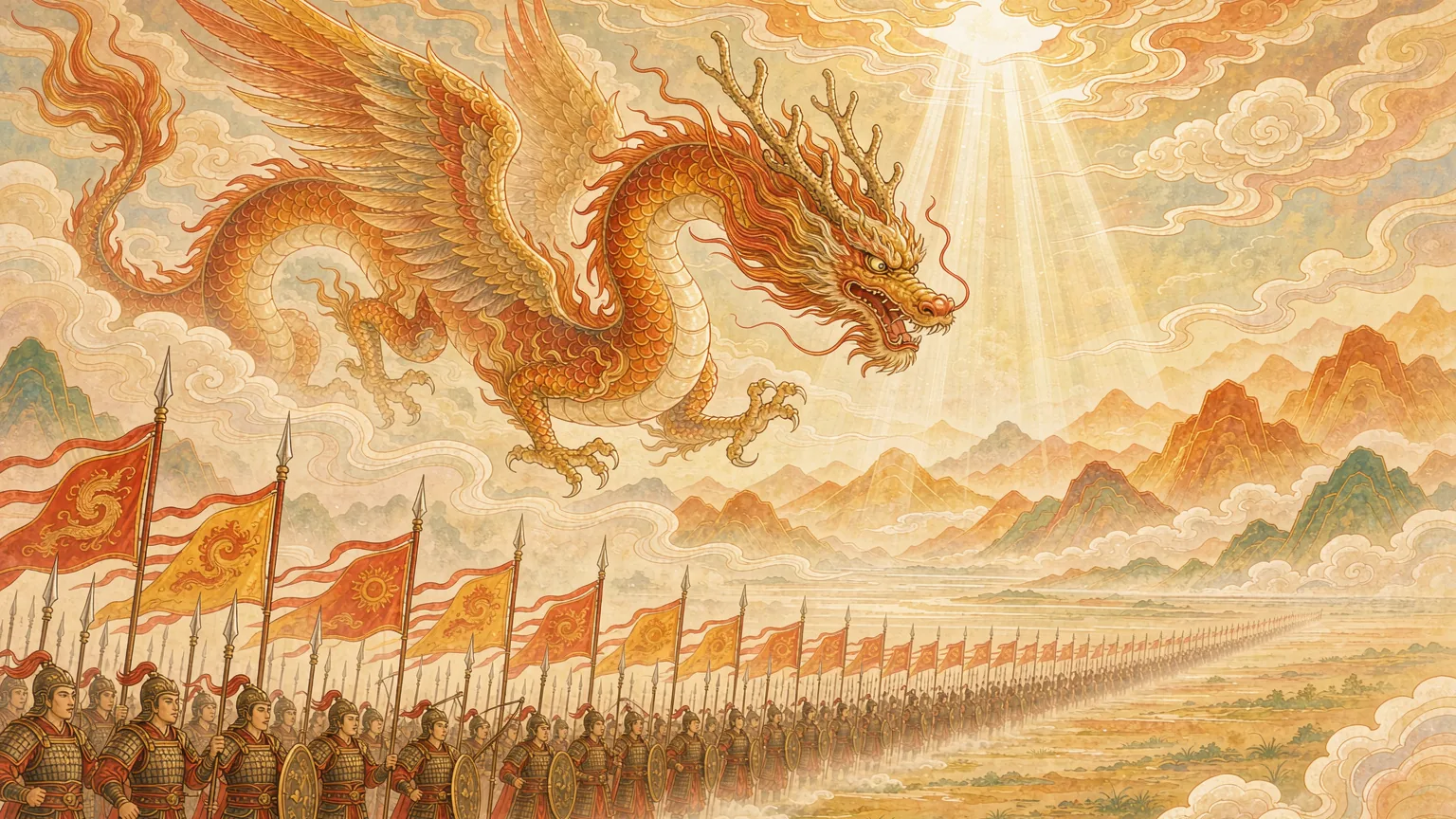
Chiyou forged weapons and attacked the Yellow Emperor. The Yellow Emperor ordered Ying Long, the winged dragon, to meet him in the open country of Jizhou. Ying Long gathered up the waters. Then Chiyou summoned the Lord of the Wind and the Master of Rain, and they loosed a great wind and a great rain. So the Yellow Emperor sent down a daughter of heaven named Ba. The rain stopped, and Chiyou was killed. And Ba could not go back up, and wherever she stayed, no rain fell.
The Records of the Grand Historian gives a shorter version. Chiyou made rebellion and would not obey the command of the emperor. So the Yellow Emperor called up the armies of the lords and fought Chiyou in the wild country of Zhuolu, and took him and killed him.
Put the two accounts side by side and the outline is clear. In the open ground at Zhuolu, two sides fought a war over who would be in charge.
Almost every culture keeps one version of this story. A god with a thunderbolt, or a spear, or a hammer goes out to meet a monster that threatens the order of the world. Marduk fights Tiamat. Zeus fights Typhon. Thor fights the giants. Indra fights Vritra. The god wins, the world is set right, and the account ends.
Chinese mythology has its own member of that family, and it has two differences worth noticing.
The first difference is that both sides command the weather. In the Greek and Norse and Babylonian versions, the storm belongs to the god and the monster has none of it. Here Chiyou can call the wind and the rain exactly as easily as the Yellow Emperor can. When the two armies meet, the sky switches sides.
The second difference is the ending, and we will come to it. It is the reason this story is worth telling at all.
Start with Chiyou himself.
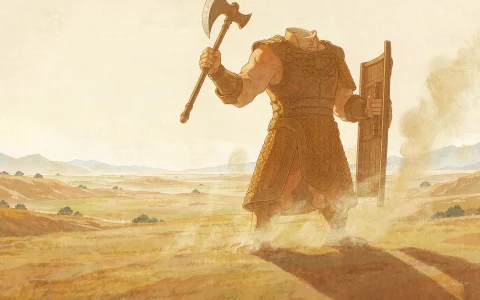
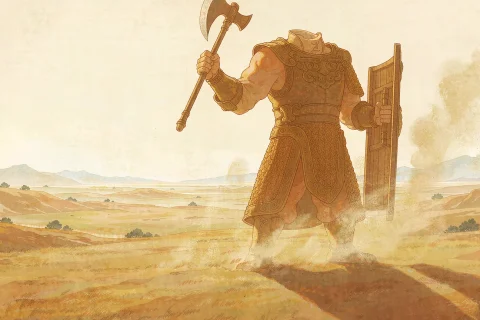
A very widely repeated later version says he had eighty-one brothers, and every one of them had the body of a beast, the speech of a man, a bronze skull, an iron brow, and a diet of sand and pebbles.
That is not a way of saying he was fierce. It is a way of saying he was not human. He belongs in the gallery of Chinese gods and monsters without quite being either one. He was a category of being that could be killed, but could not easily be starved.
There is a second thing worth knowing. In later Chinese tradition, Chiyou is the patron of weapons. The oldest account opens with the words Chiyou forged weapons. He is the one who made the armaments.
That detail matters. This was not the Yellow Emperor marching against a savage. This was the Yellow Emperor marching against someone who had better equipment.
And what did the Yellow Emperor have? The books say he had the lords.
Which means the Yellow Emperor was a warlord with allies, not a man alone. He could call other people in.
So the two sides stood in the open country at Zhuolu. On one side, a bronze-skulled army. On the other, a coalition of tribes who had come to help.
The first round went badly, and the books say so plainly.
He did not win.
Another passage, preserved as a quotation in a later encyclopedia, puts it more sharply. The Yellow Emperor fought Chiyou nine times and did not win nine times.
In old Chinese writing the number nine usually means many. It does not have to mean exactly nine. But the meaning is not in doubt. The Yellow Emperor lost again and again before he won once.
That is the part most tellings skip. Everybody remembers that the Yellow Emperor won. Almost nobody remembers the long stretch at the beginning where he did not.
Then the allies start arriving on both sides.
The Yellow Emperor moved first. He sent Ying Long.
Ying Long is a dragon with wings. His particular skill is water. He gathers it up and holds it, all in one place, and then lets it go and drowns whatever is in front of him.
So the Yellow Emperor sent him out into the flat country of Jizhou to collect the waters.
It was a practical move. An army is most dangerous when it is standing still and organised. Water breaks a formation.
Chiyou had people of his own to call on. He summoned two of them. One was the Lord of the Wind. The other was the Master of Rain.
The wind and the rain arrived. The battle turned over.
They came straight down out of the sky. Every drop of water Ying Long had been holding came back at once, and more than had been taken. The Yellow Emperor and his men stood in the mud with their eyes shut, unable to hear an order, unable to see the other side.
And then the fog.
One account deals with this alone. Chiyou made a great fog, and it did not lift for three days, and the soldiers of the Yellow Emperor were all confused, and every one of them lost the direction he was facing.
That is the turning point.
What the Yellow Emperor did next was not force.
First, he had something built.
A man named Feng Hou, the story says, built a cart modelled on the stars of the northern sky.
Whatever way you turned that cart, a small figure standing on top of it kept its arm pointing the same direction.
This is the south-pointing chariot.
With it, the Yellow Emperor and his men could no longer walk in circles inside the fog. Orders went down the line. The army could form up again.
One honest note about the cart. It does not appear in the oldest text. It shows up in later records and later commentaries, which puts it in the category of things that some versions say. But it has survived two thousand years for a reason, and the reason is not the gearbox. It is the plain truth that an army lost in fog does not need courage. It needs a direction.
Second, he called for someone from the sky.
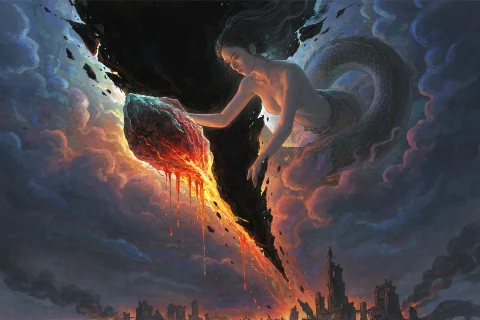
The old text says he sent down a daughter of heaven named Ba. The name is pronounced like the word for pulling something out.
Ba is a goddess of drought. Wherever she is, no rain falls.
The purpose of bringing her down is completely straightforward. Chiyou was winning with weather. So the Yellow Emperor brought in the end of weather.
The power of the Lord of the Wind and the Master of Rain ran into drought itself, and there was nothing left for it to do.
The rain stopped.
The wind stopped. The cloud broke apart. For the first time the wet ground showed dry patches.
And then the book gives four characters. And so Chiyou was killed.
At that point the battle of Zhuolu is over. Somebody has won.
In an ordinary myth, that is where the account would end. The winner is settled, the loser is dead.
This one refuses to end there.
The next sentence says that Ba could not go back up, and that wherever she stayed, no rain fell.
Think about what that means.
She was sent down. In old Chinese the word means from heaven to earth. She came down, she stopped the rain, she helped win the war.
And when it was over, she found that she could not go home.
The book never explains why. Perhaps she had picked up something of the earth along the way. Perhaps once she had done the work of stopping rain, she could not turn back into what she had been. The book only gives the outcome. She could not go back up.
So the daughter of heaven who won the world for the Yellow Emperor became a person stuck on the ground.
And her gift was drought.
Where she goes, the rain does not. The fields dry. The grain fails. People go hungry.
What happened next is the hardest part of the story to read.
People started driving her away.
There is an old Chinese ritual for this. In a bad drought, a crowd would take up sticks and pots and go out shouting, and chase her from one district into the next, and ask her to leave.
She had done more for the victory than anyone. Her reward was to be run out of every town she came to.
Ying Long walked the same road.
A different passage in the Classic of Mountains and Seas says that Ying Long lived in the far south, that he killed Chiyou and also killed Kuafu, and that he could not go back up either. And so there was drought in the world.
It killed Chiyou. It killed Kuafu, the giant who chased the sun. And then it could not go home, and went to live at the southern end of the world, and after that the land was often dry.
So the Yellow Emperor won this battle with two beings who came down from heaven.
One stopped the rain. One gathered the water.
Neither of them got home.
That is the real weight of the story.
It is not good against evil. It is this: in order to win, the Yellow Emperor brought down people from the sky, and when it was over, neither of them had anywhere to go.
And there is one more cold layer underneath.
Chiyou died, and Chiyou did not go away.
In later Chinese practice he was worshipped as the Lord of Soldiers. When the First Emperor toured the east, Chiyou was one of the eight deities he sacrificed to. Before Han dynasty armies marched out, they made offerings to him as well. The enemy the Yellow Emperor had to kill became the figure that every army in the country honoured before it went to war.
The battle he lost decided who ruled. The position he ended up with is steadier than that of most of the winners.
You could not beat him. You could only kill him. And after you killed him, you had to bow to him anyway.
At the end, come back to the open country at Zhuolu.
The war is over. The wind and the rain have gone. Ying Long has gone south to the end of the world. Ba has been chased off to somewhere else. Chiyou has been beheaded, and the old books say the Yellow Emperor had the body buried in separate pieces, in separate places, so that he could not come back.
Only the ground is left.
And the dry part of it did not see rain for a long time.