The water did not come as a single flood.
It came, and then it stayed.
The father worked at it for nine years, failed, and was killed. The son took over, and worked at it for thirteen.
Almost every old culture has a story about a great flood, and most of them run the same way.
In the Hebrew account a man named Noah is warned in advance, builds a boat, and floats. In the Babylonian version, the one baked into the epic of Gilgamesh, a man named Utnapishtim is also warned, also builds a boat, and is granted immortality afterward. The Greeks tell it about Deucalion, who survives on a chest with his wife and then rebuilds the human race by throwing stones. India has Manu and a fish.
The pattern is always the same. The flood is a punishment. One man is told in advance. He escapes the water on a boat.
Chinese legends tell it differently, and the difference is the whole point.
Here nobody is warned. Nobody builds a boat. The flood is not a punishment for anything. And the man in the story does not escape the water. He goes out into it, and he stays there for thirteen years, and he moves it.
The flood in this version is not a judgement. It is a problem of engineering.
The story is scattered across several old books, and they only make a whole line when you put them together. The main sources are the Classic of Mountains and Seas, the Mencius, the Records of the Grand Historian, and a set of later accounts about the monster he fought in the Huai river.
Two men do the work. The father is Gun. The son is Yu.
It is worth knowing who sent them. The ruler of that age was Yao, the first of the great sage kings of Chinese tradition. When the water rose, Yao asked his people who could deal with it. They named Gun. Yao was not convinced, and sent him anyway. That is where the nine years came from.
After Yao came Shun. Gun was dead, the water was still there, and Shun handed the problem to the son. So Yu did not inherit a family trade. He inherited a job his father had failed at, and a death.
Yao, Shun and Yu are remembered together as the three sage kings. But on that list, the man who started the work is the one who failed and was killed.
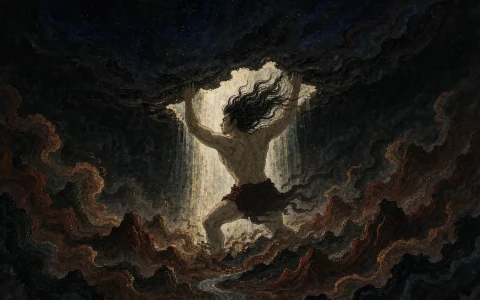
The Classic of Mountains and Seas gives the father one short passage. The flood reaches the sky. Gun steals the swelling earth of the High God in order to dam the water, without waiting for the order. And the High God sends the fire god Zhurong to kill Gun at the foot of Mount Yu.
The swelling earth is worth stopping on, because it is one of the strangest objects in Chinese mythology. It grows. You dig out a basket, and the hole fills back in. You pile it by the water, and the pile gets taller by itself.
Earth that grows, used to dam a flood. That sounds unbeatable.
He lost anyway.
Why he lost is the key to the story.
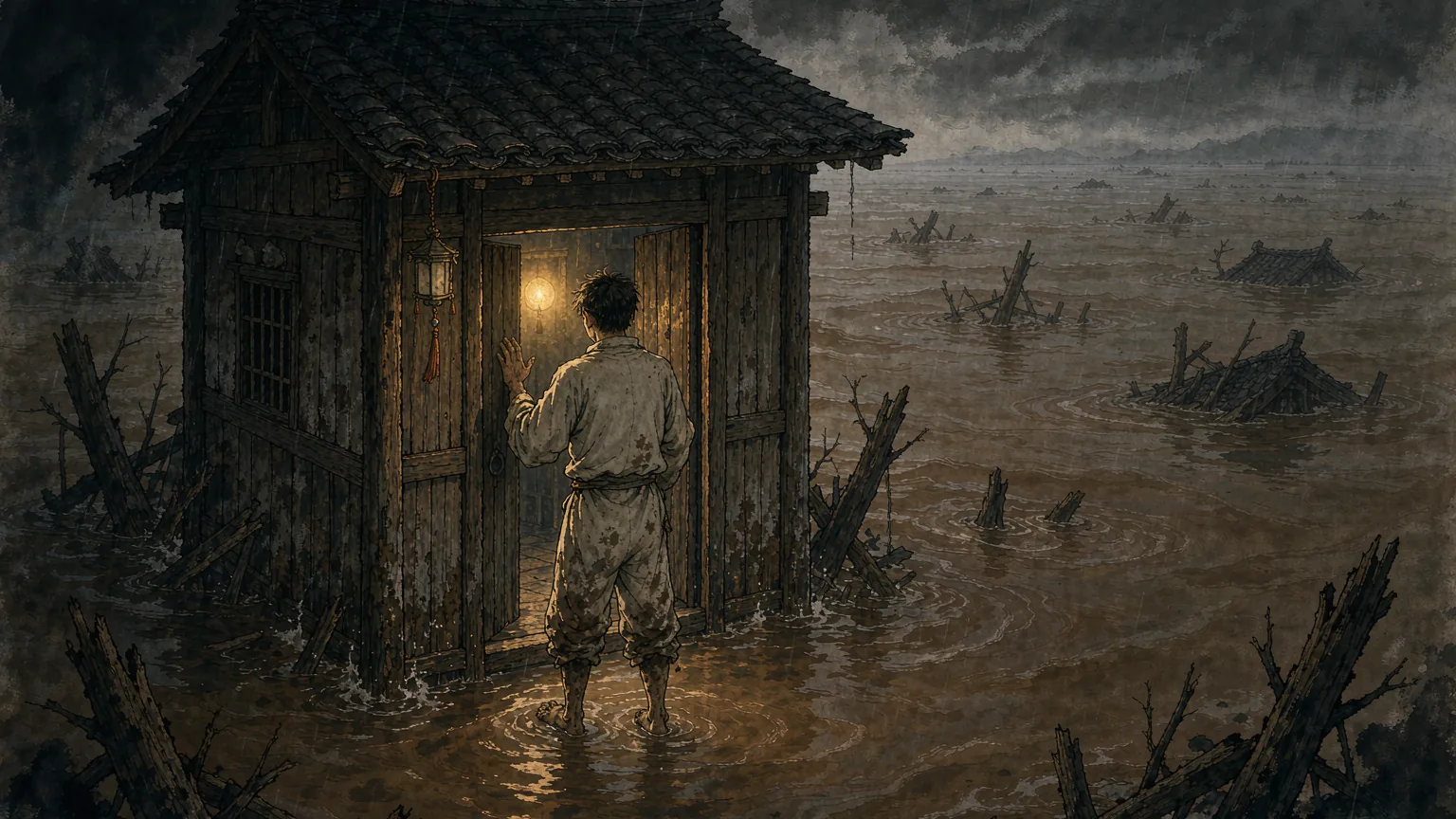
Here is what he did. He blocked.
Wherever the water spread, he built a bank. When the water broke the bank, he built a taller one. The swelling earth grew, so his banks could keep growing with it, and this was probably the cleverest answer anybody at the time could have given.
What he did not allow for is that water is alive.
Block it here, and it goes around. Block it there too, and it finds something lower. It does not climb the bank. It gathers behind it, higher and higher, until one moment when the whole bank goes at once, and takes the earth and the village and the people with it.
Nine years of this. The banks got higher. So did the water. He was in a race, and the water never had to rest.
The old books do not record how many times he tried. They record the result. Nine years, and nothing.
Then the dry line. The High God ordered the fire god to kill Gun at the foot of Mount Yu.
What happens to him afterward is stranger still. A commentary on the Classic of Mountains and Seas says his body lay there for three years without rotting. Somebody cut it open, and a child came out of it. That child was Yu.
Another version says he turned into a yellow bear and went into the water.
Those are the parts where the tellers disagree. The spine of the story holds. The father failed and died. The son came out of the father.
So Yu did not inherit a job. He inherited a debt.
Yu changed one word.
The father blocked. The son channelled.
That sounds simple. It is not. Channelling means you do not stand in front of the water and push. You find the water a road, and let it leave.
The Mencius puts it plainly. Yu dredged the nine rivers and guided them all out to the sea. He was not fighting the water. He was moving its house.
Moving a house takes more work than building a wall across the door.
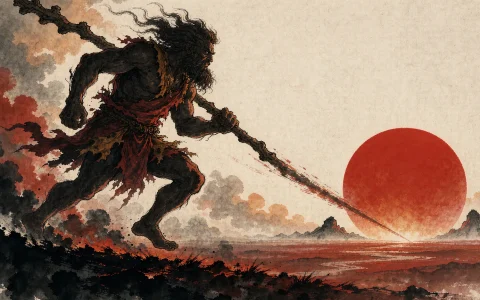
He had to cut through mountains.
The Yellow River, running down toward what is now the border between Shanxi and Shaanxi, was stopped by a mountain. The water could not get out, so it backed up and spread, and became a lake the size of a province.
Yu took men up that mountain.
It was stone. There was no explosive and no steel bar. They had three things. Fire, water, and wood.
They built fires against the rock until it was red and cracked, then threw cold water on it. The stone could not take that, and split. They followed the splits with wooden wedges and stone hammers, and opened it a piece at a time.
Year after year of that, and there was a gap through the mountain.
That gap is called the Dragon Gate.
Stand there today and look up at the two walls of rock on either side, and it is possible to work out how they were cut. Fire and water, and a hammer.
It is also possible to work out the price. Fires had to burn without a break, because a cold seam will not split. The water had to come up the mountain in relays, one line of men after another. Men were killed by falling rock. Men were taken by water that came down on them without warning. Yu raised no monument to any of them and the old books do not carry a single name.
And the man who set that work going had not been home in years.
There was one piece of the work that was easier, and a god did it.
Among the creatures under Yu was a dragon called Ying Long, the Responding Dragon. It had wings. It did not carry stone and it did not dig. Its job was to draw on the ground with its tail.
Where it crawled, the line of its tail became a river course. Men followed that line and cut it deeper, and the water went where the mark went.
So half the rivers of China were dug by people, and half were drawn by a dragon.
Ying Long turns up one other time. When the Yellow Emperor went to war against the rebel Chiyou, the same dragon was there, holding back and releasing water. It served two masters, with many generations between them.
Six characters in the Mencius are the most famous household saying in China.
Three times past his own gate, and never once inside.
Six characters. So picture the rest.
The first time he passed, a child was being born in that house. His wife was called Nüjiao, and he had married her on the road, between one flooded district and the next. There were voices inside, and then a baby crying. He stood outside the gate and listened for a while. In his hand was a water map that had just been finished.
He did not push the door open.
The second time, the child was old enough to be carried, and was being carried at the gate. The child saw him and reached out in his direction, and waved twice. He lifted his hand, and then put it down. He had to go and look at a new section of bank. Three villages sat below it.
The third time, the child could run, and could ask questions. He stood in the doorway and asked where his father was.
That time, Yu did not go in either.
The son was named Qi. The word means to open, or to begin.
One episode in all those years deserves its own section, because it is the only time in the story that Yu set out to destroy something.
He was working the section around the Tongbai mountains, and the rivers there were behaving impossibly. The Huai and the Guo ran the wrong way. They would not go where water should go, as if something were holding them down.
He sent men to find out what it was. What they found was called Wuzhiqi.
The description is stranger with every line. It had the shape of an ape. Flat nose, high forehead. Blue-green body, white head, golden eyes, snow-white teeth. Its neck stretched a hundred feet. It was stronger than nine elephants. It had lived in the Huai river, and when it came out the wind and thunder came with it, and nobody would touch it.
Yu sent several of his spirit generals. They could not hold it.
Then he sent one called Gengchen, and Gengchen brought it down.
Yu did not kill it. He put an iron chain around its neck and a golden bell through its nose, and had it pinned under Guishan, a hill in what is now Xuyi county in Jiangsu.
A reader today will find that shape familiar. An ape of enormous strength, causing havoc in the water, chained under a mountain. Chinese mythology did that more than a thousand years before the monkey under the mountain that everybody knows.
Once more he acted, and this time the victim was a man.
When the work was nearly done, Yu called the gods of the four quarters to a meeting at Mount Kuaiji. Everyone came. One god arrived late. His name was Fangfeng.
Yu had him killed.
There is an odd footnote to Fangfeng. His bones were enormous. Generations later, when the state of Wu attacked the state of Yue, a single bone was dug up that was too big to be carried on anything smaller than a special cart. Nobody knew what it was, so they sent a messenger to ask Confucius. Confucius told them it was the bone of Fangfeng.
One line, and a whole flood myth is stitched to a bone that somebody dug out of a field much later.
The day it was finished, the old books say very little.
The water went down. The land came out. Yu divided the world into the Nine Provinces, and cast Nine Cauldrons out of the bronze of those provinces. Each cauldron carried the mountains, the rivers, the plants and the creatures of its region, so that anyone who looked at them would know what the world held and where it was.
Then he became king. He gave his dynasty a name, and the name was Xia. It is the first dynasty in Chinese history.
The cauldrons became the weight of a nation. Whoever held the Nine Cauldrons held the world. Centuries later a king of Chu asked the Zhou court how heavy they were. Asking the weight of the cauldrons was the same as asking whether he could carry them off. The phrase is still in the language.
Later he died on a journey to the south, and was buried at the foot of Mount Kuaiji.
Here is the small thing that finishes him.
Thirteen years of walking the Nine Provinces left a mark on how he walked. The hair was worn off both legs from the mud and the water. His knees and the soles of his feet could no longer produce a normal step. He went along with a kind of hop.
The old writers gave that walk a name. They called it the Yu step. Centuries afterward, Daoist priests used it in their rituals.
It is not a dignified way to walk. It is what is left of a man who did not go inside his own gate.