The sun never stops.
It comes up in the east, goes down in the west, and does not pause for anything.
One man decided to catch it.
The story is in the Classic of Mountains and Seas, the oldest collection of Chinese mythology and monster lore, and it comes in two short passages. One passage sits in the chapter on the lands north of the sea. The other sits in the chapter on the great northern wilderness.
The first passage is this. Kuafu raced the sun and reached the place where it goes down. He was thirsty and wanted a drink. He drank at the Yellow River and the Wei River, and the two rivers were not enough for him. He turned north to drink at the Great Marsh. He never got there. He died of thirst on the road. The staff he was carrying fell from his hand and became a forest called Denglin.
Denglin means peach grove.
One note on who he was, because it matters. Kuafu is not a human being. The name belongs to a clan of giants, and the old text makes them descendants of Houtu, the god of the earth. That is where the legs come from. That is what makes the idea possible at all.
The same book shows that clan one other time, and it is not a good moment. When the Yellow Emperor went to war against the rebel Chiyou, this clan stood with Chiyou. They lost. Ying Long, the winged dragon, killed them.
So the man who chased the sun belonged to a people who had already been beaten.
Put those two facts next to each other and the story stops being a joke about somebody with no sense of scale.
Because the thing he decided to catch was not an animal.
It was the one object that a person can never reach.
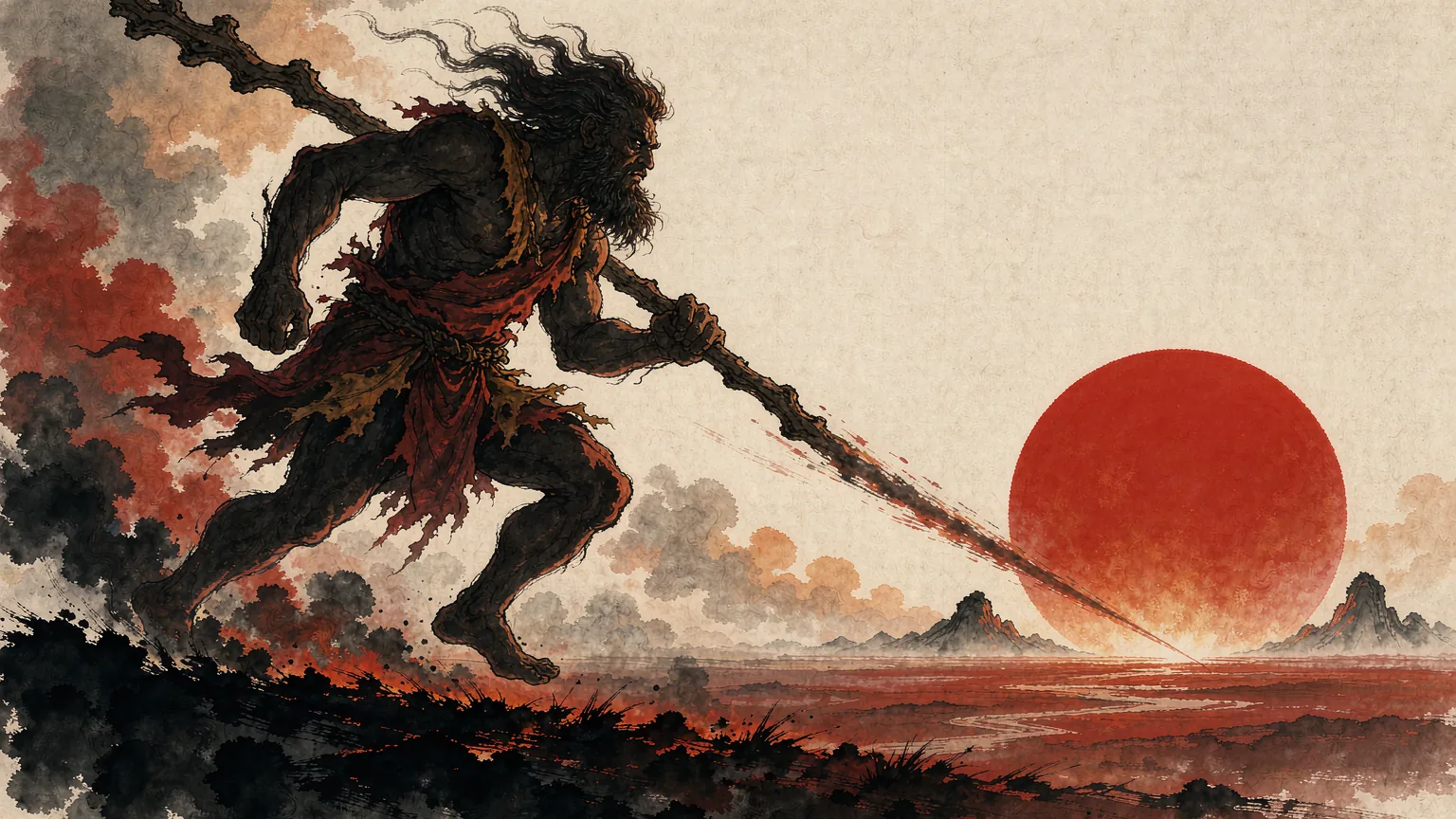
The old text never says why he did it.
It uses two words. He raced it. Then he is already gone down the road.
So fill the blank in the way that makes the most sense.
The season was turning, or the light was failing. When the sun leaves, the young crops freeze and the people go hungry. He was standing on a ridge in the west, watching the sun sink by a hand width at a time, watching the shadows of everything stretch out.
This was not stubbornness. It was refusal.
Why should the light end on schedule? He decided to put the question to the sun itself, with his legs.
He started walking. Then he started running.
A river went under him like a puddle. A mountain went under him like a stone in a path.
The sun did not hurry. It did not slow. It kept the same pace on the same course and never once looked at him.
And then something began to happen. The closer he came, the hotter it got.
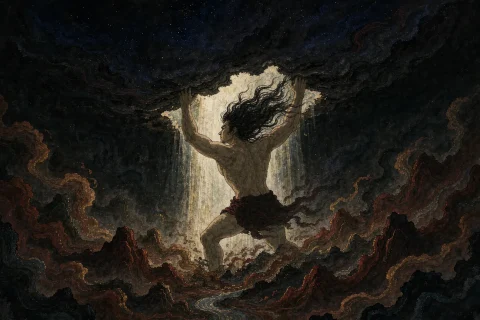
The grass under his feet wilted first, then scorched, then smoked. His throat was hot when he breathed. His face split open. Sweat came out and dried at once, and after a while there was no sweat left in him to come out.
He kept running.
No place he crossed has a name in the old books. And nobody saw him pass, because at the start of that road there was nobody going the same way.
The people down in the valleys could see something, though.
They could not see a man. They saw a line of smoke. A thin line, always moving west. It started at the foot of one hill, thinned out by the middle of the slope, and the next day there was another one further west.
The old people said it was a wildfire. The children said it was somebody doing something enormous and stupid.
Nobody went up to look. Nobody could. There was no water on that road.
The old text gives none of this. It says two words and moves on. But think about what those two words cover. A man running from the eastern end of the world to the western end passes through country where people live, and every village along the way would have seen something. And when the Classic of Mountains and Seas sets the scene, there is nobody in it but him.
That is how this story is built. In the whole account of the chase, no other person takes part.
Then the two words. He entered the sun.
Those two words can be read two ways.
One reading has him running into the place where the sun goes down, a valley called Yu, which is where the sun is said to wash the day off before it leaves. He arrived at that place. He reached the home of the sun.
The other reading has the sun simply close over him.
Either way, this line is the peak of the whole story. He caught it.
He did not fail. He caught it, and then he found out what catching it meant.
The sun is not a thing that can be held. It is a fire. He walked into the fire, and when he came out of it he was not the same shape as before.
The first thing he felt afterward was thirst.
The old text is exact here, with no decoration. He was thirsty, he wanted to drink, and he drank at the Yellow River and the Wei.
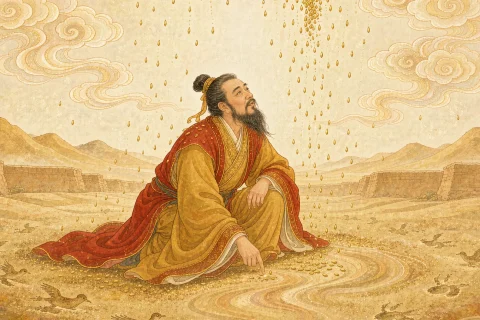
He drank the Yellow River.
He drank the Wei River.
The two largest rivers of the north, and he lay down at the bank and took them in at a breath. The water level dropped until the stones of the riverbed came out into the air.
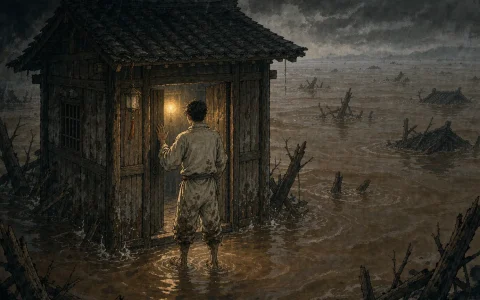
There were boats on those rivers. A river is a working road, and the banks were full of people, and all of it had been alive that morning. When the water went down the boats settled into the mud, and the hulls knocked against the riverbed with a low sound. The fish could not follow the water out fast enough. They were left turning in the gaps between the stones.
Then four characters, and they are the hardest four characters in the story. The two rivers were not enough.
Not enough.
Two great rivers were not enough for one man.
So there was only one place left to go. Far to the north there was the Great Marsh, an enormous lake. He turned and started walking.
The Great Marsh was not invented. Old texts call it the Juye Marsh, and it lay in what is now Shandong province. It was the largest lake in the north of China. Silt filled it in over the centuries, and by the Song dynasty there was nothing left but a wide patch of low wet ground.
But in his lifetime it was water, and it was his last chance.
The road went north, and the further it went the less water there was. He did not speak and he did not look back. A man who has come that far has stopped being in the habit of looking back. Behind him there is only a line he made himself.
The sky behind him went dark. The stars came out. When the first one appeared he was still walking.
He had spent the whole day running so that the light would not end. The light had ended anyway, and he was walking into the dark, and the only reason was that somewhere in that direction there was a body of water he had not yet drunk.
He never reached the marsh.
The text says he did not arrive, and died of thirst on the road.
It does not say what position he was in when he fell. It does not say whether he was facing north, or facing the sun.
So we decide. A man who has come that far falls forward. His legs are still in the shape of walking, because walking is the only thing they were ever asked to do.
He had been carrying a staff the whole way.
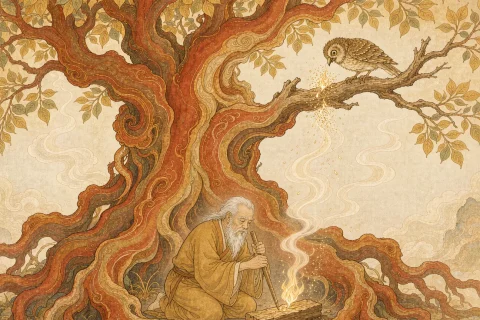
Men of that age carried one on the road. Cut wood, about the height of a man, used to lean on over long distances and to defend yourself with if it came to that. He had carried his staff through the entire chase and never dropped it.
When he fell, he let it go.
The story could stop there.
But the text adds four more characters. It became Denglin.
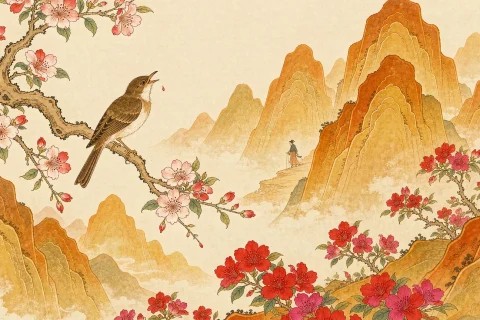
The staff he dropped turned into a peach grove.
Not a grave. Not a stone. Not a mountain named for the place where he ran. A whole stand of trees that flower and bear fruit.
And from that time on, anyone who walks that road and gets hot and thirsty in the middle of it comes upon a peach grove. The fruit is on the branch. Take one and eat it. Spit out the pit and keep going.
Most of them have no idea where the grove came from. Not one of them has ever asked.
The old writers had an idea where it was. It lay in the country between modern Lingbao in Henan and Tongguan in Shaanxi, and they called it the Taolin Pass.
That location is worth a moment, because it matters. The pass is the narrow corridor between the mountains where the road from the Guanzhong plain into the central plains has to go. Two ranges, one gap, and a road. It is one of the most fought-over pieces of ground in Chinese history.
So the grove that grew out of one staff was planted on the busiest road in the country.
There is one more line about it, in the Book of Documents. After King Wu of Zhou destroyed the Shang dynasty, he turned the war horses loose on the south side of Mount Hua, and let the oxen out into the fields of the peach grove.
The fighting had ended, and the animals went into the trees that a man left behind when he fell.
That is what stayed. Not a footprint. Not a bone. A place where the country put its plough animals down and stopped.
There is another version, and it should be told.
In a different passage of the same book, the ending is not thirst at all.
Ying Long, the winged dragon, killed Chiyou. Then Ying Long killed Kuafu.
So in that telling he was not worn out by heat. He was killed by the great dragon, and that killing was part of the aftermath of the war between the Yellow Emperor and the rebel Chiyou.
Some readers go further and say the name Kuafu does not belong to one person. It belongs to a clan. The chase may have been the work of many people, or of several generations, compressed later into one man.
Those are the parts where the tellers disagree. Chinese folktales of this age rarely survive in a single shape. The spine does not move. He chased the sun. He died. A peach grove is there now.
In the Greek stories about reaching too high, somebody is always punished for it, and the punishment is the point.
Icarus flies toward the sun on wings of wax. The wax melts, and he falls into the sea. Phaethon takes the chariot of the sun belonging to his father, cannot hold the horses, and the gods strike him down before he burns the world. Both stories are warnings. The lesson is written at the bottom: do not reach for what belongs to the gods, because the gods will see to you.
Nobody strikes Kuafu down in the main version of this story.
There is no god in it. There is no judgement. There is no warning attached to the ending. He reaches the sun, he burns, he dies of thirst, and the story does not tell anybody not to try. It simply reports what he did, and then it reports the peach grove.
That is the difference, and it is worth sitting with. Athens makes a cautionary tale out of the man who flew too high. China makes a fruit tree.
So what is left of him in the end is not a footprint, or a bone, or a place he ran to.
It is a stand of trees.
Trees do not talk, and nobody knows who planted them. They flower every spring and they fruit in summer.
Somebody picks a peach and bites into it. It is sweet.
That person has no idea they are eating what is left of the staff of the man who tried to catch the sun.