There is a kind of wound that stops a person from moving.
This was not that kind.
He lost his head, and then he stood up, and then he went on fighting.
The whole story is four sentences long. It is written down in the Classic of Mountains and Seas, in the chapter called the Classic of the Western Regions Beyond the Sea. That book is the great gallery of Chinese gods and monsters, and Xingtian has one of the shortest entries in it.
Here is what the four sentences say.
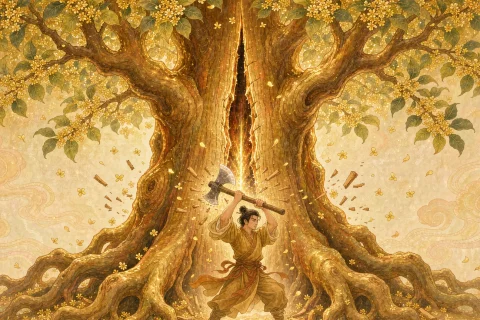
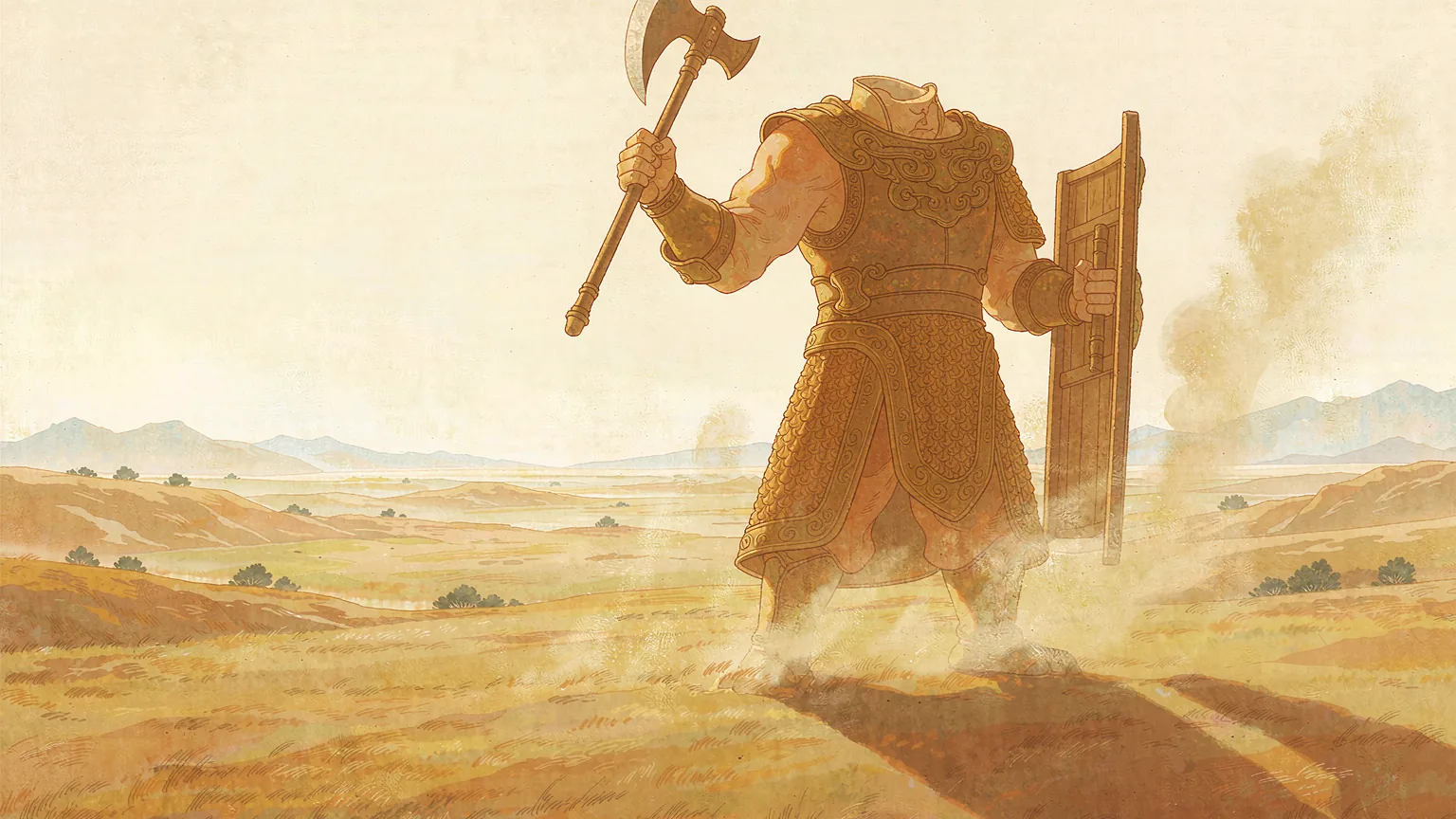
Xingtian fought with Heaven here over who would be a god. Heaven cut off his head and buried it at the foot of Mount Changyang. And then he used his nipples for eyes, and his navel for a mouth, and he raised his shield and his axe, and he danced.
That is the entire episode. A man alive, a man beheaded, a man standing back up, all inside four lines.
Start with the name, because the name is doing work. Xingtian was not the name he was born with. In the old commentaries the two characters mean the one who was punished by Heaven. Whatever he was called before that is not recorded anywhere.
A man whose name got replaced by his sentence.
Now the weapons. The shield is called gan. It is made of wood, long and flat, wide enough to cover half a body. The axe is called qi. It is bigger than an ordinary axe, and it was used for executions as well as for war. Together the two objects make up the most basic kit a fighter in ancient China could carry: one thing to block with, one thing to cut with.
So why did he fight Heaven in the first place?
The book does not say.
It only gives the two characters that mean contending for godhood. That could mean fighting over a throne. It could mean fighting over who gets to decide. It could mean fighting over the right to be worshipped.
A much later tradition offers something more specific. In that version, Xingtian was an officer of Yandi, the Flame Emperor. Yandi and the Yellow Emperor went to war over the world and met at a place called Banquan, and Yandi lost. Yandi accepted the loss and withdrew to the south.
Some of the men under him did not accept it.
Xingtian was one of those men.
That detail is not in the original text. It was added centuries later by writers trying to fill in the gap. But it turns an abstract quarrel into something a reader can hold. One god gave up. One soldier did not.
So he went to challenge the strongest being there was.
How the fight went, the book does not say either.
It gives the result in four characters. Heaven cut off his head.
You can fill in the rest yourself. That means a blade, and a neck, and a great deal of blood. It does not mean a slap.
And then there is a detail that is easy to read past. The book says Heaven buried the head at the foot of Mount Changyang.
Think about that for a moment. Heaven had already killed him. The head was already off. Why go to the trouble of finding a mountain and burying it?
One reading is fear.
Not fear of this one man. Fear of the story. Burying the head inside a mountain is how you make sure that nobody can find the place, and nobody can point at it, and nobody can say afterwards that this is where it happened.
A mountain on top of a man is the cheapest way to close a file.
The file was closed. Heaven went away, presumably.
In every ordinary version of a story like this, that is the end. Plenty of figures in ancient myth get beheaded. When the head comes off, the account stops.
This account does not stop.
The book carries on. And he used his nipples for eyes, and his navel for a mouth.
Stop there and actually picture it.
No head.
The upper body is still upright. Two nipples, which are among the softest places on a human frame, have become the eyes. The navel, which is the scar left by the cord that once joined him to his mother, has become a mouth.
He cannot see far. He cannot see clearly. Those two points on his chest are all the sight he has. He cannot shape a full sentence, because the only mouth left to him is on his stomach.
And he is still standing.
The old book does not spend a single extra word here. It never mentions pain. It never mentions hate. It simply reassigns three body parts and keeps walking.
Then come the last three characters.
He raised his shield and his axe, and he danced.
Danced.
Not fought. Not struggled. Not attacked. Not charged.
In Chinese mythology, that one word settles everything that follows.
If the book had said he fought, it would be a battle. A battle has a winner and a loser and a final tally. If the book had said he struggled, it would take two, because struggling needs an opponent.
A dance does not need an opponent.
Heaven had gone. Mount Changyang was still there, with the head underneath it. There was nobody else around. One man with no head stood in an open space, lifted a shield and an axe, and danced.
Dancing for whom?
For the place where Heaven used to be.
Now set him beside the rebel that the English-speaking world already knows.
In Greek myth there is Prometheus, who stole fire and gave it to human beings. For that, Zeus had him chained to a rock, and every day an eagle came and ate his liver, and every night the liver grew back, and the next day the eagle came again.
The two stories start the same way. A being defies the highest power in the world, and the highest power breaks him for it.
They come apart at the ending.
Prometheus is chained. He cannot move a finger. His eternity is stillness, and the stillness is the punishment.
Xingtian loses his head, and then he moves anyway. Heaven took away the part of him that sees and speaks and thinks, which is about as complete a punishment as can be designed. It did not work, because he simply reassigned the jobs.
The sentence handed down to both of them was the same sentence: you will do nothing, forever. One of them obeyed it.
It is worth noticing how strange this is, because headless figures are not normally treated this way.
In Irish story there is the Dullahan, a rider with no head, and people lock their doors at night because of him. In Indian tradition there is Chhinnamasta, a goddess who holds her own severed head in her hand, and the image is meant to shock. In medieval European legend there are saints who carry their heads after death, and the effect is meant to be uncanny.
In nearly every other tradition, a body without a head is a horror. It is a thing you are supposed to run from.
In this one it is an obstacle, and he works around it.
This is a hard scene to fill in, because the space in it is so wide. So let us fill it.
First, the sound of the axe. When it cuts the air it makes a thin whistle. When it lands on the ground it makes a dull knock. He does not strike the ground, so all we get is the whistle. Once. Then again. Then again.
Second, the feet. Without a head, the body is not steady. He has to judge direction from the two eyes on his chest, and those eyes cannot see the stones under him. So he walks unevenly. He stumbles at a bad patch, catches himself, straightens up, and goes on.
Third, the blood. The book does not mention it, but a cut like that does not stop. It runs from the neck down over the shoulders and chest and darkens everything it touches, including the two new eyes and the new mouth. Whatever he sees, he sees through red.
Fourth, the time. How long the dance lasted, the book does not say. A day? A year? Or has it never stopped?
The grammar gives a small clue. The old text does not say that he began to dance. It says that he danced, in a form that describes a continuing state.
So what we are looking at is not an action. It is a condition.
One more question, and the book does not answer this either. Did he know that his head was gone?
The first moment, certainly. The second moment is harder. A man who sees through two points on his chest sees a world that is very close, and red, and low. He cannot see that his head is missing, because the head used to sit above him, and above him is the one direction he no longer has.
He can only see the small patch in front. There is no enemy in that patch. There is no head in it either.
So he probably does not know whether he is standing or lying down. All he knows is that the two things in his hands are still there, one to block with and one to cut with, and that the only thing left to do with them is to swing.
Centuries later, a poet named Tao Yuanming read that line and wrote two of his own.
Xingtian dances with shield and axe. His fierce will is still here.
Dances. He uses the same word the old book used.
Fierce will. Not hope, and not anger. Something closer to a stubborn refusal to lie down.
Still here. Which is to say: not summoned up now, but never gone in the first place.
Those two lines do something the four sentences never did. They turn a body that will not stop moving into a mind that will not stop either.
In the last telling, we followed Jingwei, the drowned girl who came back as a bird to fill the sea. Tao Yuanming put these two figures side by side in the same poem. A bird that will not stop carrying stones. A man with no head who will not stop dancing.
One refuses to give up by going down. The other refuses by pushing forward.
Now set him against the winners.
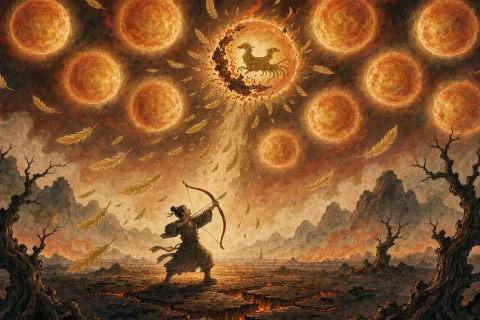
Ancient myth is full of people who won. The Yellow Emperor won. Yu the Great won. Houyi shot down nine suns. And every one of them did the same thing after winning. They built an order. They made rules. They made sure that everyone remembered who was in charge.
Xingtian won nothing. He could not even keep his head.
And the Classic of Mountains and Seas gave him a full entry anyway, written out neatly in the chapter on the western lands. The most completely defeated figure in the book is the one who refused to close.
That is why the story does not stop where he fell.
It is also a pattern. In Chinese mythology, the whole line of defiant figures loses. Kuafu dies of thirst. Jingwei drowns. Xingtian is beheaded. Gun, who tried to stop the great flood without permission, is executed and does not rot for three years. The winners are the Yellow Emperor, Yu the Great, Houyi. The two sets sit side by side in the same books for thousands of years, and neither one ever argues the other out of existence.
People in China have kept both. They honour the Yellow Emperor when they want to talk about order. They tell the story of Xingtian when they want to talk about something else.
One more thing worth knowing, because it changes how the name gets used later.
In some old texts, the name gets written in slightly different ways, and the variants drift toward a meaning like damaged in body. So a portion of the tradition stopped treating him as one particular rebel god and started treating him as a symbol: the shape that stays standing after it has been broken.
The two readings do not conflict. The further a story travels, the more it becomes a sentence rather than a person.
And one last note.
In later folk practice, Xingtian is sometimes honoured as a headless god of war. In a few places, the phrase about dancing with shield and axe is treated as the origin of a kind of military drill, a war dance. A row of people, each with a shield and an axe, stamping and shouting and lifting together.
Picture that line of them, moving as one, with a single figure out in front.
That may be the only time in the whole story when he was not alone.