The sky had been mended. The river ran. And in the whole wide world beneath it, there was still no one.
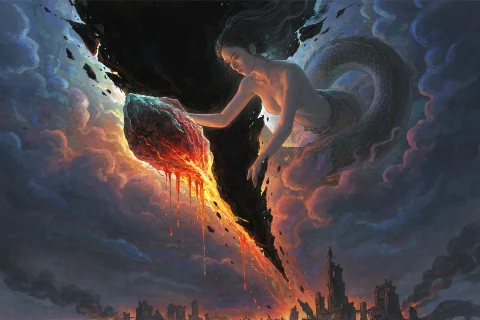
The repair work was finished. A broken pillar had been propped up again at the corners of the earth, and the hole that had opened in heaven was closed with melted stone. The waters had gone down. And the goddess who had done all of it came down from the sky and sat beside a river to rest.
She looked around her. Water, grass, wind, birds. But no people. Nothing that could look back at her and answer.
Before the story goes further, one thing should be said. There are two famous acts in the life of Nuwa, and they are usually told as two separate stories. One is mending heaven. The other is making human beings. In the old texts they sit close together, and they belong together. First she saves the world, and then she fills it.
The oldest whisper of the second act is in a book called the Chuci, the Songs of Chu. A poet named Qu Yuan asked a question nobody could answer. Nuwa has a body, he wrote. So who made her?
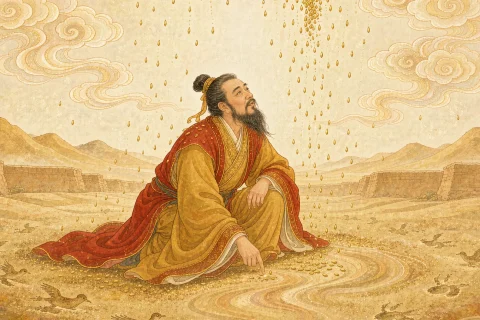
The answer to how she made everyone else comes from a much later book, the Fengsu Tongyi, written around the second century. It is short and very plain. When heaven and earth had just opened, it says, there were no people. Nuwa took yellow earth and kneaded it into figures, in her own shape. The work was heavy, and one pair of hands could not keep up. So she dipped a rope in the mud, lifted it, and swung it, and every drop that flew off and landed became a person.
The book adds one more sentence, and it is worth stopping over, because it is the old world explaining itself. The people made from the fine yellow clay, it says, became the rich and the noble. The people who flew off the rope became the poor and the ordinary.
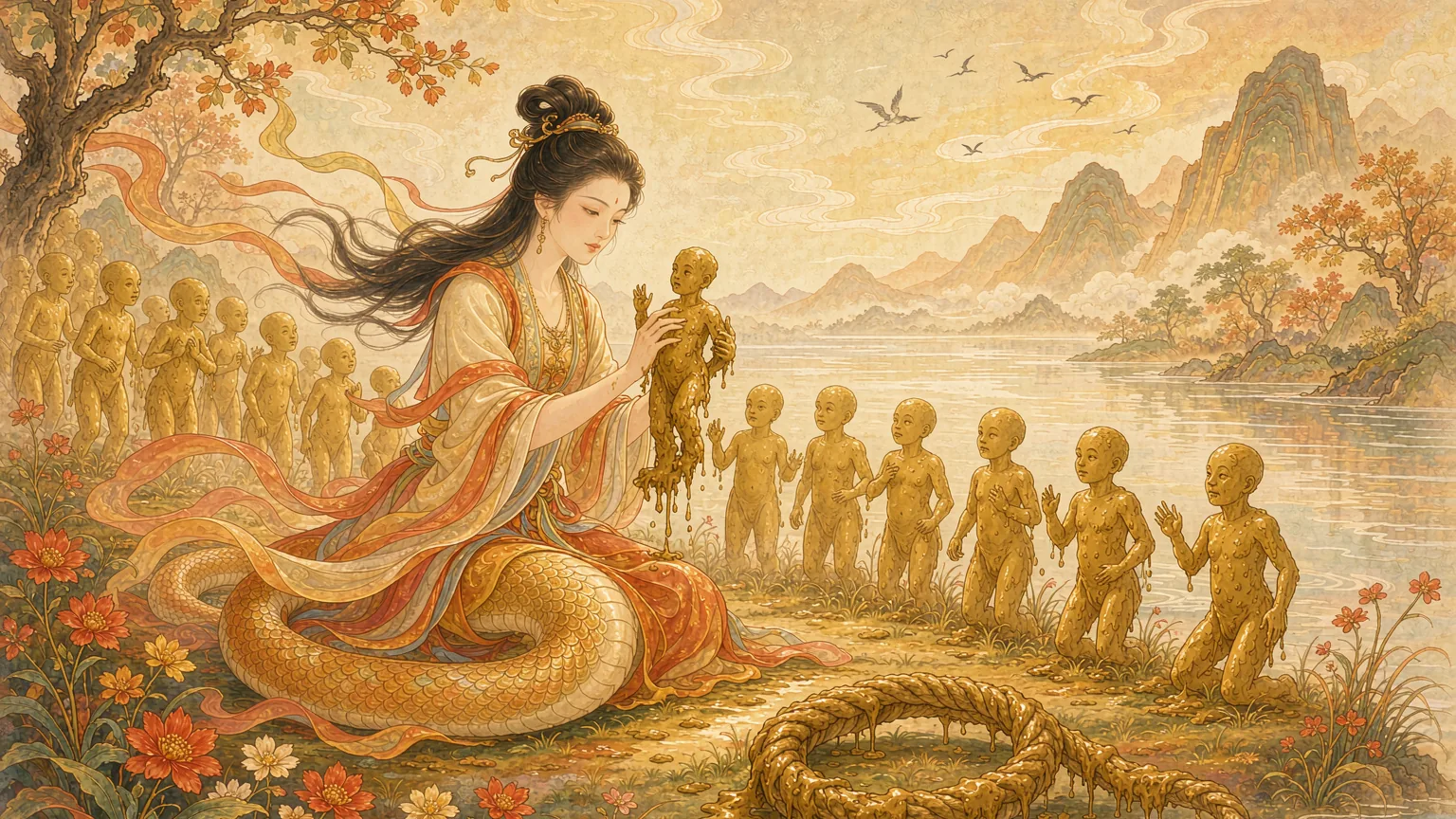
Now, other old civilizations told a version of this scene too, and the differences are small enough to be instructive.
In the book of Genesis, God shapes the first man out of the dust of the ground and breathes into his nostrils the breath of life, and the man becomes a living being. In Greek myth, Prometheus mixes earth and water and moulds human beings in the shape of the gods. In both stories the recipe is the same as Nuwa’s. Earth for the body. Breath or spirit for the life.
And there is one more parallel that is stranger and closer. After the Greek flood, when only Deucalion and Pyrrha were left, they were told to throw the bones of their mother behind them. They understood this to mean the stones of the earth, and so they walked along throwing stones over their shoulders. Every stone Deucalion threw became a man. Every stone Pyrrha threw became a woman.
An old Greek story and an old Chinese story, both of them far apart, both of them deciding that thrown earth turns into people. Nobody borrowed it from anybody. It is simply one of the ways the old world liked to think about where we came from. Something is scattered, and people come up out of the ground.
The material matters too. Nuwa uses yellow earth, and yellow is not an accidental color in China. The great river of the north is called the Yellow River, and the soil it carries is that same pale gold. People spoke of their own land as yellow earth, and of living on it as living on the yellow earth. The dust that a human being is made of, in this telling, is the dust of home.
So, first, what did Nuwa look like?
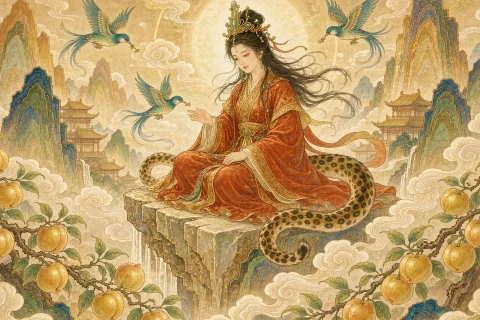
In the oldest pictures and the oldest books, she is not a seated lady in robes. She has a human head and a body that ends in a serpent tail. The Classic of Mountains and Seas says she changed seventy times in a single day, and never settled into one shape.
A snake body sounds like a monster to modern ears, so it is worth explaining. In the oldest Chinese myth, the snake was a sign of water and of the earth itself. A snake sheds its skin and seems to live again. Coiled up, it looks like a thin breath rising out of the ground. Giving Nuwa a serpent tail was a way of tying her to birth, to water, and to growing things. She is not a monster. She is the ground, and the ground is alive.
That is also why her way of making people makes sense. Earth for the body, hands for the shaping, breath for the life. Those three things are the oldest ingredients in the world, and she uses all three.
So on that afternoon she sat by the river and made the first one.
She dug up a handful of yellow earth from the bank, mixed it with water, and worked it in her hands until it held together and would stand on its own. Then she began to press it into a shape. An arm. Another arm. The legs. The round curve of a head. Whose face did she copy? Her own face, the one she could see in the water.
She set the little figure down on the ground. It did not move. The clay was cool, and in the sunlight it was only a small thing made of mud.
Nuwa bent down, put her face close to its face, and breathed on it.
The eyelids trembled. They opened.
When the first human being stood up from the riverbank, the water happened to make a sound.
She was glad. She made a second, and then a third. By the tenth, the sun had begun to lean toward the west.
Then the trouble showed itself. There were not enough.
The world was enormous. One riverbank could be filled with people, and every other place would still be empty. Each figure took her half a day, and each person would live only a few decades. However fast she worked, she could not make people as fast as they died.
Her hands were caked with mud. Her knuckles had gone stiff. Her shoulders ached. She stopped, looked at the row of half-finished figures, and understood something. At this rate she would never fill the world, not if she kept at it until the end of time.
So she got up and went to find a rope.
She dropped the rope into the wet clay and rolled it, until it came up thick with mud. Then she lifted it, and swung it against the ground.
A spray of mud flew off and landed. Wherever a drop touched down, a person stood up.
She swung once, and a whole field of people stood there.
Some of the drops were big, and those became tall people. Some were small, and those became slight people. One drop flew high and struck a stone, and lost an eye to the corner of it. That one began to cry, and Nuwa hurried over and pinched the lost piece of clay back out of the stone and put it right.
From that day on, she swung. She swung all day, and by evening the river flat was crowded. When it was dark she was still swinging. She swung so hard that her arm ached, and wherever the drops fell, someone was laughing.
Later readers took that sentence about the rope and turned it into an explanation of wealth and poverty. The people of yellow clay, they said, are the noble. The people of the rope are the low and the common. It is worth saying plainly that this is a story the old world told about itself, to make unfairness look as old as creation. It is not a law of nature. It is a sentence that one writer added to a myth, so that the world he lived in would feel inevitable, and the people who suffered in it would feel that they were born into their place.
It is hard to believe Nuwa herself would have agreed.
And when there were many people, things did not go the way she had hoped.
The ones she had shaped by hand sat in circles around fires and argued about when to put seed into the ground. The ones who came off the rope bent over the fields from sunrise to dark, until their backs ached. All of them called her mother. She could still recognize the first few. The rest of them, she could no longer tell apart.
At night the patch she had put into the sky was still bright. She sat on the riverbank and watched the crowd of them, so many that they looked like a field of grain. She heard someone crying, someone singing, and someone quarrelling. She did not go over.
One old version says there is a sequel to the story.
After a great flood, only two people were left alive, and their names were Nuwa and Fuxi. Fuxi was her brother, and like her he had a human head and the body of a serpent. To keep human beings from coming to an end, the brother and sister climbed Mount Kunlun, the great mountain in the west where the gods were said to live. At the top they rolled two millstones down the slope, and they agreed on a sign. If the two stones came to rest together at the bottom, they would marry. The stones rolled all the way down and settled side by side.
In that version, human beings were not made at all. They were left over.
It is worth knowing a little about Fuxi, because in the old images he and Nuwa almost always appear as a pair. Fuxi is her brother, and also her husband in the stories that marry them. He is credited with the eight trigrams, the set of stacked lines that later grew into the Book of Changes, and with teaching people to fish with nets and to hunt. On Han dynasty carvings the two of them are shown side by side, human above the waist and serpents below, their tails wound around each other. A mother goddess alone would have been strange to some of the old storytellers. A brother and a sister, sealing the bargain with two stones, made the beginning of the human race into something two people had to agree on.
The two versions do not look alike. Yet they start from the same place. Before there could be people, there had to be a first person, and someone had to make that first person, or keep that first person alive.
In later centuries people gave her many names. Nuwa the Lady. The Empress Wa. The Ancestor of Humans. In the temples her statue is a calm seated woman with neat robes and a five-colored stone in her hand.
But if we go back to the first afternoon, she has nothing. Only a river, a lump of yellow earth, and one thing she discovered while sitting there, which she simply had to do.
She bent down and lifted another handful of earth out of the river.
This time she worked slowly, so slowly that the dark came all the way down, and she had not yet finished a single one.