East of the Bohai Sea, many tens of thousands of miles out, the wind stops.
The water there does not flow and does not make a sound. It only does one thing. It sinks. Every river in the world, every stream from all eight directions, and even the water of the Milky Way when it falls, all of it ends up pouring into this one opening.
It has poured in for ten thousand years, and it has never once filled.
In Chinese legends there is a name for the place. They call it Guixu, the Returning Abyss.
The account of it is in the Liezi, in the chapter called Questions of Tang. East of the Bohai Sea, it says, there is a great chasm, a valley with no bottom, and its name is Guixu. All the waters of the world run into it, and it neither rises nor falls.
Water runs into a bottomless hole, so of course it neither rises nor falls. What is worth looking at is not the hole. It is the things floating above it.
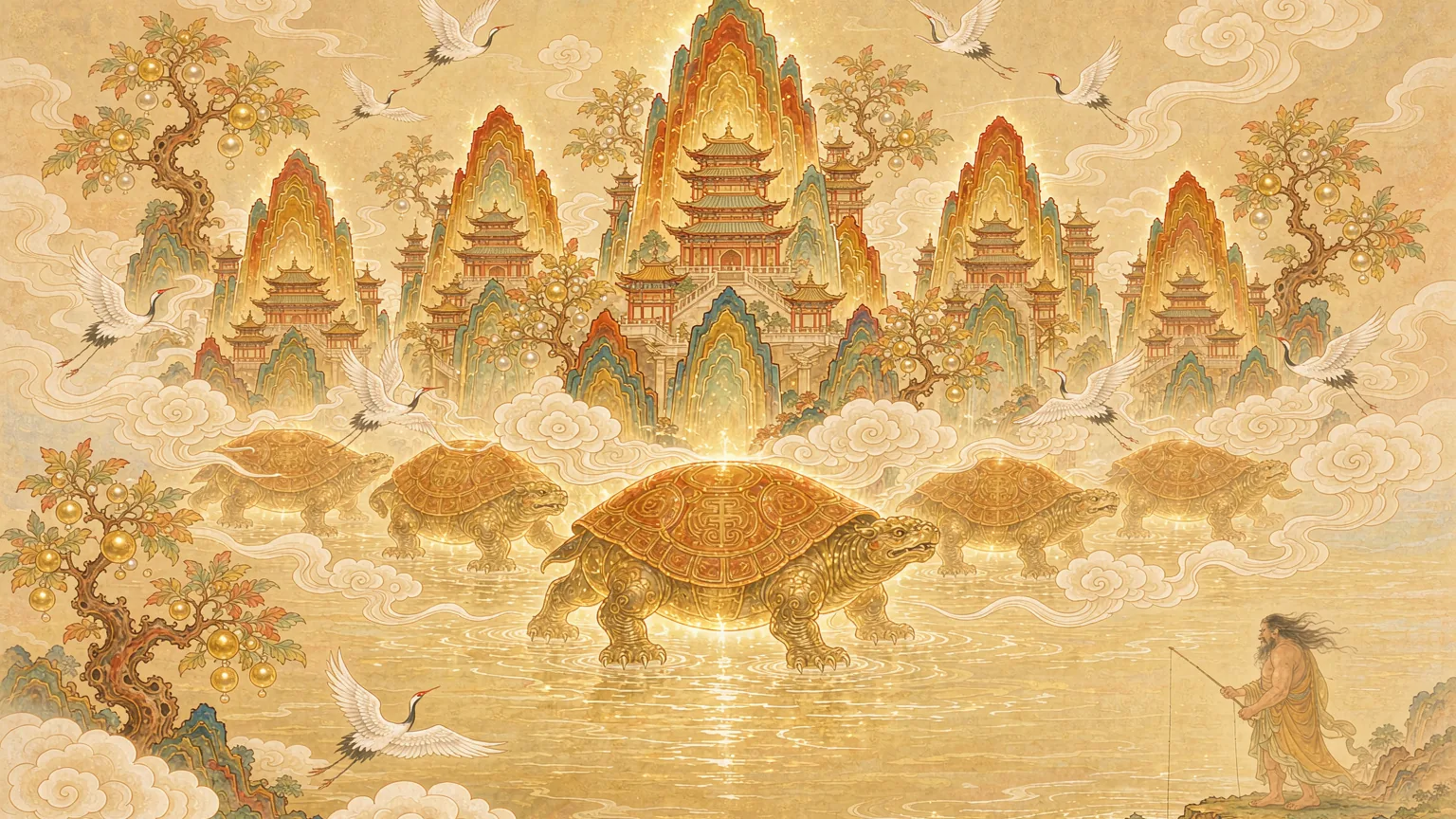
Above Guixu, the book says, there are five mountains. Their names are Daiyu, Yuanjiao, Fanghu, Yingzhou, and Penglai.
Each mountain is thirty thousand miles around. The flat top of each is nine thousand miles across. Between one mountain and the next there are seventy thousand miles, so that they count as neighbors.
Seventy thousand miles as the distance to a neighbor is the furthest thing the old writers could think of. And on those five mountains lived something else. They lived on the mountains, and they were called the immortal sages.
The Liezi is attributed to a man named Lie Yukou, who lived in the age of the warring states. But the version we have was put together much later, in the third or fourth century. That is how Chinese mythology works. One name goes on the cover, and a great many hands write the book, adding a line each, across several hundred years.
First, what did the five mountains look like?
Their towers and terraces were built of gold and jade. Every bird and every animal on them was white. There was a kind of tree called the pearl tree, and it grew in whole groves, and its flowers and its fruit both had a taste, and whoever ate the fruit did not grow old and did not die. One old account says that a single bite of the fruit kept a person warm for a day, and a lifetime of eating it kept a person free of sickness for a lifetime.
The people who lived there were all immortal sages. Countless numbers of them flew back and forth between the five mountains in the course of a day and a night.
They held their banquets on terraces of gold and jade and walked under the pearl trees. Seventy thousand miles lay between the mountains, but that was nothing to them. One step into the air and they were there.
Everything about the place sounds like the best of all possible worlds. And the five mountains had one fatal flaw.
Their roots did not reach the sea floor.
Each mountain simply floated on the water, going up and down with the tide, drifting back and forth. It was not a violent motion. But it never stopped, and never for a moment stood still.
The immortal sages could not stand it. To them, living forever counted for nothing if the ground under their feet would not hold still. So they took the matter up with the Emperor of Heaven.
They did not go to weep. They went to argue. We have cultivated ourselves for all these years, they said. We finally have somewhere to live, and it rocks on the water every day. What kind of holy mountain is that?
The Emperor of Heaven was afraid.
What frightened him was not the mountains themselves. It was something else. The sea runs east, and if the mountains drifted away on it, all the way to the farthest eastern edge, they would tip over, and the home of all those immortals would be gone.
And the Emperor of Heaven knew perfectly well that he was the one who had put the mountains there in the first place. If they were badly placed, that was his problem.
So he sent a god named Yuqiang to deal with it.
Yuqiang is the god of the sea and of the wind. He appears in other old books, and his shape is strange. He has a human face on the body of a bird, two blue snakes hanging from his ears, and two more blue snakes under his feet. This is the god who was sent to do a very practical job. He was told to move some turtles.
He found fifteen giant turtles.
Nobody says how large they were. Only that their heads could hold up a mountain thirty thousand miles around.
How were they placed? Three turtles under each mountain, five mountains, three times five, fifteen exactly. But the Emperor of Heaven had a further arrangement. The fifteen were not all on duty at once. They worked in three shifts. One shift held the mountains, and the other two shifts rested. Every sixty thousand years, they changed.
From that day, the five mountains held steady. The tide still rose and fell, but the mountains no longer drifted. The immortal sages could finally sit still for a while in their own courtyards.
The old book gives this whole passage in a dozen characters. But think about those fifteen turtles. They were living things, not stones. Sixty thousand years is one shift. Nobody knows what they thought about it.
Sixty thousand years is not a moment in a human life. For those fifteen turtles, it was all the days they had left.
The settled years lasted a long time.
Then a man came along. He does not even have a name. The old book only says where he was from. He came from the country of Longbo.
The people of Longbo were giants. How tall they were is not written. What is written is a more alarming sentence. They could take a few steps and arrive at the place where the five mountains were.
A giant took a few steps and crossed a sea with no edge to it.
When he got there, he did what anyone does by the water. He went fishing. He let his line down, and he pulled it up, and he had caught six turtles.
Six. One line. One cast. Six.
He probably did not think it was anything much. To him the things floating on the sea were not mountains. They were a few rocks with grass on them. And the turtles were not holy creatures. They were simply fish of a larger size. He reeled in his line and left.
He tied the six turtles together, slung them over his back, and went home to Longbo. When he got there, he did not treat them as treasure. He burned the shells and used the bones to tell fortunes.
Fifteen turtles in three shifts, and now six were gone.
Two mountains had been resting on three turtles each. Now the space under them was empty. Daiyu and Yuanjiao gave a slow shudder, then came off their places, and began to drift north.
They drifted all the way to the northern pole and rolled over into the sea.
The immortal sages on those two mountains lost their homes in a single night. The old book has one cold sentence for it. The sages who were displaced and scattered numbered in the many millions.
Millions of people, out over the ocean, with nowhere to set down. And the cause of it all was that a giant on the eastern shore had been hungry and wanted to catch some fish.
The mountains went over slowly, the way a person lies down. The pavilions, the trees, the birds still singing in the trees, all slid into the water one after another. The people on the mountains had no time to carry anything away. They could only fly up, and watch their home become a whirlpool on the surface of the sea.
This time the Emperor of Heaven was truly angry.
He punished the country of Longbo. He did it in two ways. He cut back their territory, so that their land shrank. And he cut back the people themselves, so that each generation stood a little lower than the one before.
By the time of Fuxi and Shennong, the ages of the first sages, the people of Longbo were still several dozen yards tall.
Only several dozen yards.
Shrinking was, for a giant, the heaviest punishment of all. Their island was pared back by a ring, their children were shorter than they were, and their grandchildren shorter again. Thousands of years later they were still there. They were simply no longer giants.
As for the remaining three mountains, Fanghu, Yingzhou, and Penglai, they are still in the eastern sea.
In later ages the seekers of immortality said that Penglai was out there on the water, and that a person who found the right heading could reach it. The First Emperor of Qin sent men to look for it. Emperor Wu of Han sent men to look for it. The boats went out, and every one that came back said it had not been found.
Later books renamed the three mountains the Three Holy Mountains. They are out on the sea, the books say, and they look close. But when a boat rows toward them they retreat into the water, and when the wind blows they scatter.
What nobody knew was that Penglai was still standing because the three turtles under it were still there.
Three turtles, changing shifts every sixty thousand years. When they change, the mountain gives a small shake, and a fine line moves across the surface of the sea. The people who lived by the shore saw that line and said to each other, the mountain is moving again.
The story this most resembles is the one from the other side of the world.
The Greeks told of an island in the Atlantic called Atlantis, a great civilization, which sank into the sea in a single night and never rose again. And in Greek myth it was Atlas who held up the sky, so that it would not come down on everybody.
China had its own version of both ideas, and put them together. The sky-bearer became a turtle, and there were fifteen of them, and what they carried was not the sky but five mountains on the sea. And when two of those mountains finally sank, it was not because a god was angry or a city had grown wicked. It was because a giant who lived by the sea had gone fishing once.
After that accident, the five mountains on the sea became three.
The old book says nothing more about those three turtles. They are probably still in their places, holding their shifts, changing every sixty thousand years.
Only, from that day, nobody has ever really seen Penglai. The surface of the sea is empty, and the wind blows, and there is nothing there.
Many years later, the people who lived by the shore were still waiting. Perhaps what they were waiting for was never a mountain at all.