Before there was fire, the night was completely dark.
Dark enough that nobody walked far from the cave. Dark enough that a single cry from a wild animal could keep a whole family awake until morning. The people of that age did not know what fire was. But they had seen it.
They had seen lightning split a tree and set it burning. They had seen a whole forest go red, and afterward found the stones still hot. They had seen the animals that died inside it.
Fire was, in those days, the most unreasonable thing in the world. It came for no reason and left for no reason. People avoided it the way they avoided a dangerous animal that could not be talked to.
First, a word about the name. The Chinese word for the man in this story is Suiren, and the first part of it, sui, means the wood used to make fire, and later the tool that makes it. So Suiren means something like the Fire-Maker. The old lists place him among the Three Sovereigns, the earliest rulers in Chinese mythology, alongside Fuxi and Shennong: one who brought fire, one who taught hunting with nets and the eight trigrams, and one who taught farming and tasted the herbs.
The earliest clear account of what he did is in the Han Feizi, a book of political philosophy written in the third century before the common era. In the earliest times, it says, there were few people and many wild animals. People ate fruit, and shellfish, and raw meat, and the rank smell of it hurt their stomachs, and many of them fell ill. Then a sage appeared. He drilled wood and brought out fire, and used the fire to cook the meat, so that the rank taste went away. The people were glad, and they made him their king, and called him Suiren.
It is worth noticing something here. Han Feizi was not writing mythology. He was arguing about politics, and he used the story of Suiren as an example, to make the point that people only follow a ruler who solves a real problem for them. The myth survived because a philosopher borrowed it and put it in a book. Sometimes that is how the oldest stories reach us.
It is also worth setting this beside another old story, because the two are close cousins and they end in opposite directions.
In Greek myth, fire belonged to the gods, and Zeus kept it for himself. Prometheus carried it down to human beings hidden inside a hollow stalk of fennel. When Zeus found out, the punishment was enormous. Prometheus was chained to a rock in the Caucasus, and every day an eagle came and ate his liver, and every night it grew back, and this went on for thousands of years.
The Chinese version has no theft in it, and no punishment. Nobody hoards fire. Fire is not the property of the gods. It is already here, hidden inside dry wood, waiting for anybody who bothers to look. And the person who finds it is not chained to a rock. He is made a king.
That difference is worth holding on to. In one tradition the greatest gift to humanity had to be stolen, and the thief paid for it forever. In the other the gift was simply hidden, and the person who found it was thanked. The same invention, and two very different ideas about what the world owes us.
Now, back to the evening when it began.
It was nearly dark, and a man was crouched by a river with a piece of raw meat in his hands. He was hungry, but he did not want to eat it. The meat was cold and bloody, and its smell climbed straight up into his nose. He shut his eyes, bit down, chewed twice, and swallowed.
In the middle of the night, his stomach hurt so badly that he could not stand up straight.
He lay in the grass and heard wolves calling somewhere far off, and a thought came to him that he could not put into words. Human beings had been given the wrong teeth. They could not tear raw meat and they could not stomach the smell of blood, and no amount of cleverness fixed that. A wolf was stronger than a man at exactly the thing a man needed most.
He looked up. The stars were cold and far away. And a sentence formed in him that he could not yet say clearly: somewhere in this world there must be one more thing that we have not found.
The old Chinese legends give two accounts of what happened next.
One says he learned from lightning.
In a summer storm, a bolt struck a tree in the woods and set it burning. Every animal ran. He walked toward it. The heat pressed against his face, and he stepped back, and then stepped forward again. He picked up a branch that was still burning and started home with it. Halfway there the fire went out, and he was left holding a stick of black charcoal, which he turned over in his hands for a long time.
He tried it again, and again, many times, and slowly he learned three things. Fire fears water. Fire wants fuel. And fire always finishes, and you have to begin again from nothing.
The other account is older and stranger, and it is the one people kept telling.
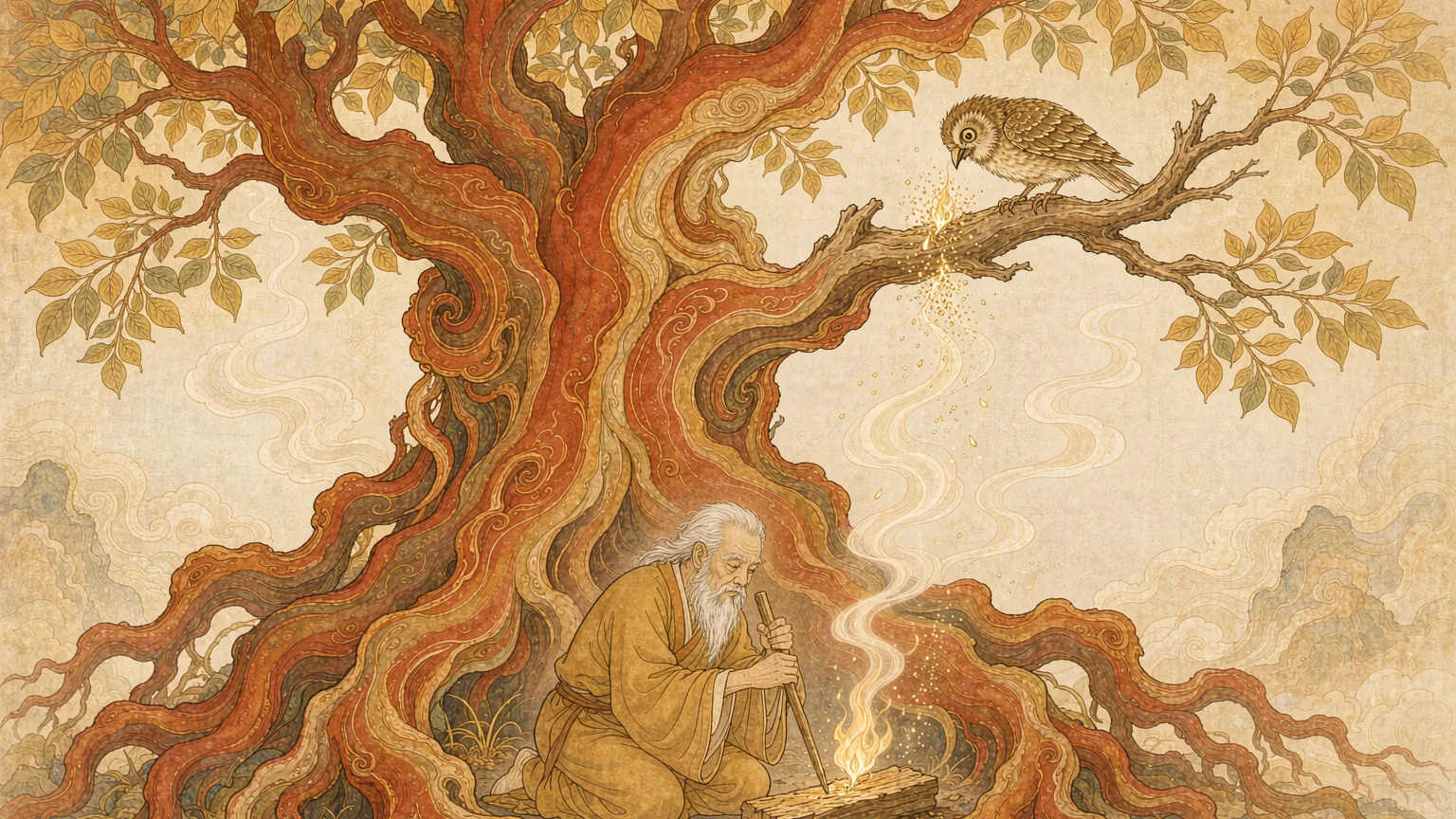
Far to the south, the book says, past the place where one day cannot carry you, there was a country called Suiming, the Land of Bright Fire. In that country grew a tree called the Burning Tree. Its branches spread for thousands of acres, and cloud and mist rose out of it. The people of Suiming knew no difference between day and night, and no difference between spring and winter.
Suiren walked for many days, and came to the foot of that tree.
It was so large that standing under it he was like a grain of sand. The wood was dark. He was looking for a place to rest when he heard a sound above his head.
It was a bird.
It looked like an owl. It had landed on a dead branch, and it was striking the wood with its beak, once, and again, and again.
Each time it struck, a small point of fire flew off its beak.
One spark. Then another. In that dark wood the sparks were almost painful to look at.
Suiren stood still and watched for a long time. And what he understood was this. It was not a magic bird working a spell. This tree had something in it that other trees did not have. The beak struck the wood, again and again, and the wood could not bear that striking. It grew hot. And the heat became fire.
The fire was not in the sky.
The fire was inside the wood.
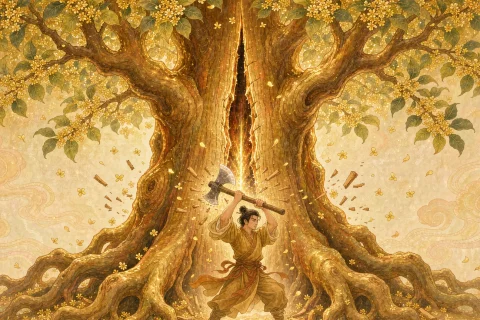
He stood up and broke off a small branch, and copied what he had seen. He pressed the sharp end against a piece of dry wood and rubbed it between his hands, back and forth, drilling.
At first nothing happened. His palms were hot and there was a little wood dust, and that was all.
He did not stop. The sun crossed over him. The bird flew away. He kept drilling. And then, from the seam in the wood, a thin thread of white smoke came up.
Smoke.
He leaned a handful of dry grass into it and blew gently.
The flame jumped once, and stood.
That night, for the first time, a fire made by a human hand lit the forest of Suiming.
He carried it home.
One thing should be said clearly here. What he carried home was not a flame shut in a jar. A jar of fire goes out, and the road was long. What he carried home was the method: which wood to choose, how to make the dry tinder, and how to bring the spark from the wood into the straw.
And he taught the method to everyone.
The first thing they did was hold meat over it. The moment the meat touched the flame, fat ran down and hissed, and the rank smell went out of the air. It was replaced by another smell, and that one made their mouths water. They sat in a circle around the fire and ate, and nobody spoke.
And when they were finished, they understood something. The night had come down. And they were not afraid.
Fire gave them more than cooked meat. It kept the wolves at a distance, so long as it was burning. It heated the stones they slept on, so that their hands and feet came back to life. It lit the walls of the cave, and for the first time they could see the shape of the place where they lived.
Fire gave people many things. It also taught them, for the first time, what it could take.
Someone copied him and built the fire too large. A gust of wind came, a spark drifted onto a straw roof, and the roof caught. That night half the village burned to ash. The people wept, and cursed the fire, and said it was an evil thing and that every fire in the world should be put out.
Suiren did not curse it.
He crouched in the ash and turned over a half-burned log, and he buried it in wet earth with one end left out. The next morning he dug it up and found, inside, a small red coal still warm. He blew on it, and the coal brightened again.
Then he told them what he had learned. Fire is not to be feared, and not to be hated. If you fear it, keep your distance. If you want to use it, you must know when it will go wrong. Fire has to be watched, and kept, and given a way back. It must not go out, and it must not be let loose.
And from that day, people made a division in the world. There was the fire in the hearth, and there was everything else.
At night they took turns watching it. Whoever had the watch fed it one stick at a time until morning, and the watcher was not allowed to sleep. That rule is older than most of the rules that came later, and it came out of the same plain fact. A fire left alone will go out, or it will eat the house.
The books end the story quickly. Because he taught people to use fire, they made him their king, and called him Suiren.
In the old lists of the Three Sovereigns, he comes first. Fuxi taught people to hunt and to fish. Shennong taught them to farm and to taste the herbs. But before Suiren, there was not one cooked meal in the world.
Over the centuries, people told the story differently. Some said his fire came from lightning. Some said the Burning Tree was a divine tree and the bird was a messenger from heaven. They would rather believe that a god sent fire down to the world.
But go back to the foot of that tree, and there is no god there. There is a bird, and a dead branch, and a man standing with his head tilted back, watching one small thing for a whole long afternoon.
What he learned was only this. Inside a piece of dry wood, there is fire.
And after that day, fire never left the hearth again.