Heaven and earth were not always apart.
They began as one thing.
It was shaped like an egg, and there was someone asleep inside it.
The story is written down in the Sanwu Liji, the Chronicle of the Three and Five, put together by a scholar named Xu Zheng in the third century AD.
That date matters. The Babylonian account of how the world began, the Greek account, the Hebrew account, all of them were written down centuries or millennia earlier. Chinese mythology took its time. The people who told this story about the very first moment had already been using writing for two thousand years before anybody thought to write the beginning down.
So this is a story that lived as speech for a very long time. It was passed along, mouth to ear, and it changed as it went. That is worth remembering, because it explains why parts of it feel added on. They were.
What the egg was like, the old book covers with two characters. Chaos.
Those two characters are the whole description.
So let us look inside.
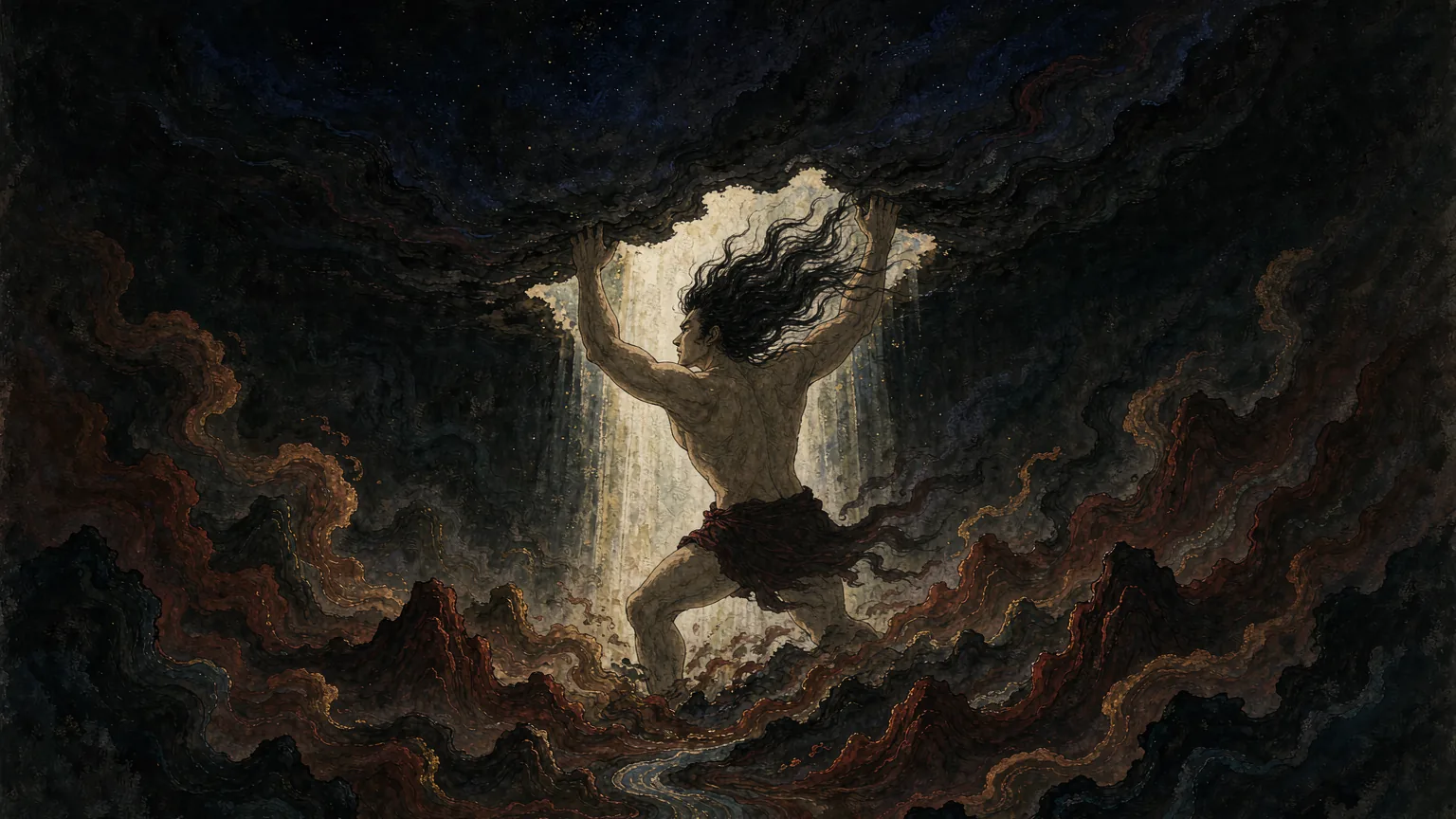
Chaos is not darkness.
Darkness is something you can see into. Close your eyes and there is still a layer of dim red light and the sound of your own heart. None of that was there.
There was no up. Without up there could be no down. There was no distance either, because a sound did not travel and did not fade. It stayed where it was made and went nowhere. You could stretch out an arm and never reach an edge.
Above all there was no time. A thousand years in there and one afternoon in there were the same length.
Pangu slept in that, for a length of time the story cannot name because there was no time yet to measure it with.
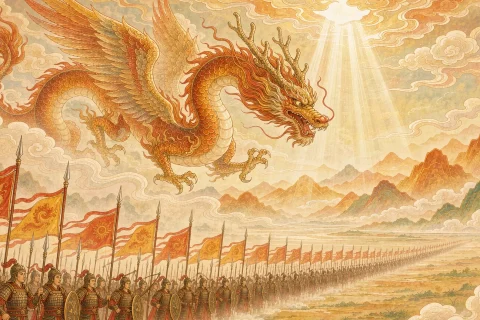
Later texts give him a body, and it is worth knowing what they settled on. In one description his head is the head of a dragon and his body is a snake. His breath becomes wind and rain. The air he blows out becomes thunder and lightning. When he opens his eyes it is day. When he closes them it is night.
That description comes much later than the egg. It is also logical. He is the only living thing inside that shell, so every sound and every change of light in there has to be coming from him.
Then he woke up.
The first thing he felt was that there was no room.
Not the ordinary cramped feeling of a body that cannot stretch its legs. This was pressure on every side at once, with nowhere to back into. When he moved, the walls moved with him. When he held still, they pressed in until they touched his face.
Before we go further, one honest note about the axe.
The earliest text does not have an axe in it.
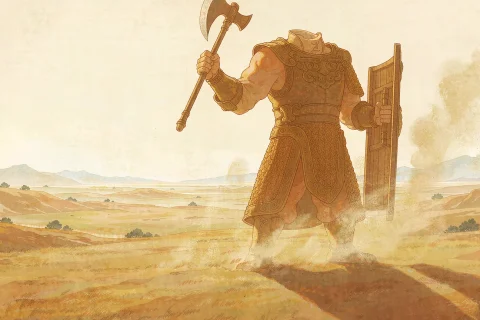
The Sanwu Liji says only that heaven and earth were opened. It never says how. The axe was added by later storytellers, for a simple reason. Everybody who heard the story asked the same question: how do you open an egg from the inside? And there was only one answer that satisfied them. He must have had something in his hand.
So the axe went in, and it has been in the story for a thousand years since, and it is in almost every picture you will ever see of him.
That day, inside the dark, he raised his arm.
There was no crack. What he opened was not wood and not stone.
What he opened was up and down.
The sound of that moment is the cleanest sound in the whole of Chinese mythology.
The light parts rose. They floated upward, spread out, and became the sky.
The heavy parts sank. They settled downward, packed tight, and became the earth.
The old line has twelve characters. The clear and rising becomes the sky. The turbid and sinking becomes the earth.
This is the oldest form of a pairing that runs through everything Chinese. Sky and earth here are not a god and a place. They are a light thing that goes up and a heavy thing that sits down. That same idea later went into Chinese medicine, into the placement of buildings, and into the way people describe a good mood as light and a bad one as heavy. It started here, with one stroke of an arm.
But the two were not far apart yet.
They had opened only a crack. The sky floated above, like a mat that has just been unrolled and has not settled. The earth below was still soft, like mud that has been poured and has not dried.
They were going to close again.
Pangu saw it. And then he did the thing that took him the longest. He put himself into the gap, stood straight, and pushed upward with both hands.
From that day he did not move.
The old book records the years the way a clerk would record them. The sky rose ten feet a day. The earth thickened ten feet a day. And Pangu grew ten feet a day.
A zhang, the measure used there, is a little over two metres. So each day the sky gained two metres of height, and he grew two metres taller to hold the new space open.
This was work with no way to cheat it. He could not sit down, because sitting would bring the sky down with him. He could not sleep, because sleep would loosen his hands and the crack would narrow. He could not even shift his weight from one hand to the other, because both hands were holding the sky up, and whichever one he moved, that side would drop a little.
So he stood, and he pushed, and he grew.
For eighteen thousand years.
Eighteen thousand years. China has about three thousand years of recorded history. The time he spent standing there is six times longer than all of it.
Whether he spoke during that time, the book does not say. Whether he asked himself when the job would be finished, the book does not say either.
One thing is certain. He could not look back. There was nothing behind him. Above his head was the sky that he himself was holding up.
And what that sky looked like, no old text describes at all. Not one line.
So we picture it from his posture. The ground under his feet grew thicker, until his weight stopped leaving marks in it. The sky above him grew further away, until the lights floating in it were no longer lights but a thin bright haze. His eyes stayed in the dark the whole time. There was no sun yet and no moon.
He held up a sky he could not see.
Then a day came when the sky was high enough and the ground was thick enough.
They would not close again.
The work of holding them apart was finished.
And Pangu fell.
When he came down, the space between sky and earth made a sound for the first time. And his falling was not the end of him.
The next passage, in another old book called the Wuyun Linian Ji, is the most generous page in Chinese mythology. Nothing in it is kept back.
His breath becomes wind and cloud.
His voice becomes thunder.
His left eye becomes the sun. His right eye becomes the moon.
His arms, his legs and his trunk become the four edges of the world and the five greatest mountains.
His blood becomes the rivers.
His veins become the roads and the lines in the land.
His muscles become the fields.
His hair and his beard become the stars.
His skin and the fine hair on it become the grasses and the trees.
His teeth and his bones become metal and stone.
His marrow becomes pearls and jade.
His sweat becomes rain.
Read that list slowly and notice how exact it is. Blood is what flows, and so are rivers. Marrow is the innermost thing in a bone, and what comes out of it is the innermost kind of treasure.
Nothing on the list is left for him.
He did not keep so much as a place to stand. He could not, because the whole place is him.
There are variations, as there always are with stories this old. Chinese legends rarely come down to us in a single shape.
Some tellers use the eyes as a clock rather than as two lights. He opens his eyes and the world has day. He closes them and the world has night. Others swap the eyes around and make the right one the sun.
One version says he did not turn into landscape quite completely. A breath of him was left over, and it stayed on Mount Kunlun in the west, and later it became something else.
These are the parts of the story where the tellers disagree. The spine of it never moves. He pushed the sky away from the earth, and then he took himself apart and spread himself out.
Pangu is one of the few figures in Chinese mythology who is never asked for anything afterward. There is no temple custom for him, no festival, no prayer. He does his work, and then he is gone, and the world is made of him.
Other cultures killed a giant to build the world. The Norse tell it that way. Odin and his brothers killed the giant Ymir and made the earth from his body, the sky from his skull, the sea from his blood, the mountains from his bones. In India the first man, Purusha, was offered up, and the parts of the world were cut from him. In Babylon, the sea dragon Tiamat was split in two, and one half of her was lifted up to be the sky.
China has the same idea, and it goes further than any of them. In the other versions, someone else does the killing. Here the giant and the killer are the same person, and the killing is not a killing at all. He simply finishes his work, lies down, and becomes the world without being asked.
That is the part that stays with people. Not the axe. The lying down.
So some of what is around you is older than you were told.
The light you walk out into in the morning is one of his eyes.
The soil under your feet is the thickest layer of him.
The rivers coming down out of the hills ran out of him.
And when rain lands on your skin, that is the last of his sweat coming down.
For eighteen thousand years he did not move once. Since he fell he has not moved either.
Every step you take lands on him.