The East Sea pushes at the shore.
It pushes, it draws back a little, and then it pushes again.
One girl was taken by that motion.
This story is written down in the Classic of Mountains and Seas, one of the oldest books in the Chinese tradition. It is part geography, part bestiary, and part record of the gods. Nobody knows exactly who put it together, or over how many centuries.
It is the single richest source of Chinese mythology that survives, and it is where most of the Chinese folktales in this series begin.
One of its chapters, the Classic of the Northern Mountains, describes a mountain called Fajiu.
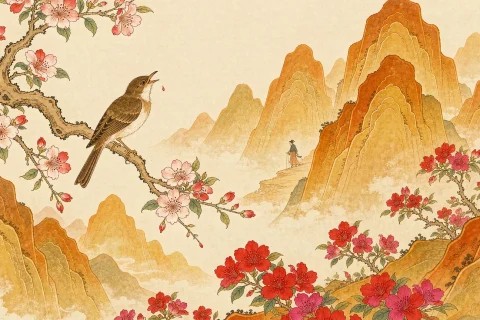
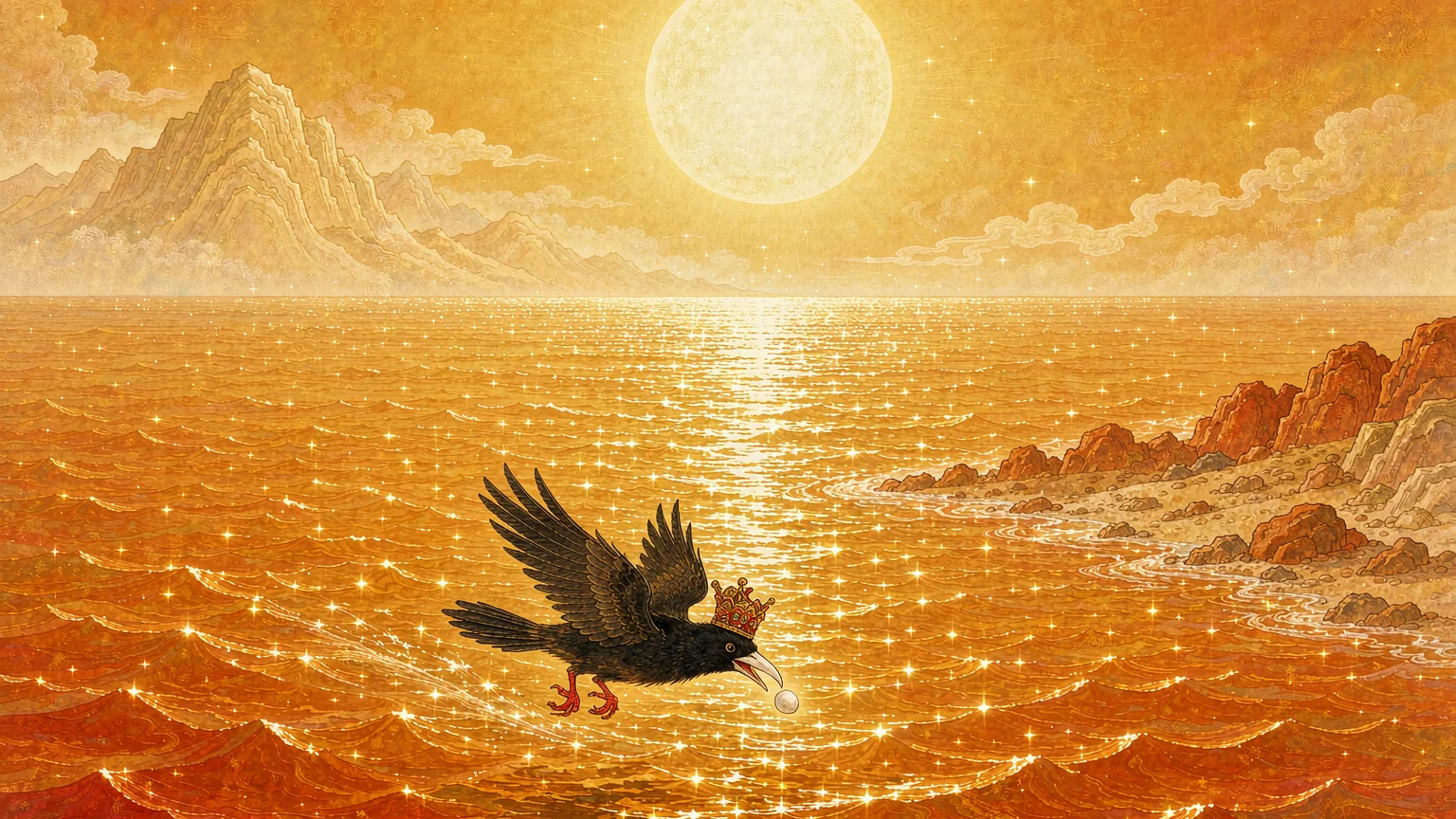
Thorn trees grow thick on the slopes of that mountain. And in those mountains there is a bird that looks like a crow, with a patterned crown on the head, a white beak, and red feet.
Its call is its own name. Jingwei. Jingwei.
Then the book adds the sentence that carries the whole story. That bird used to be the youngest daughter of Yandi, the Flame Emperor, and her name was Nuwa.
One note here, because this trips up almost everybody who meets the story in English. This Nuwa is not the goddess Nuwa who mended the sky. The two names come out the same when they are written in our alphabet. The Chinese characters are different, and so are the two women. One patched the heavens. One drowned.
Yandi was one of the oldest of the Chinese high gods, the lord of the southern sun and of the five grains. He belongs to a generation of gods that most people outside China have never heard of, the ones who ruled before the Jade Emperor and before the whole later pantheon settled into place.
Nuwa was his youngest child.
What happened to her takes six characters in the original.
She went out to play on the East Sea, and she drowned, and she did not come back.
What those hours were actually like, the book does not say.
So we fill the blank in the way that seems most likely.
It was probably a good day. The stones along that shore are white, and in the sun they get hot enough to hurt a bare foot. The water was probably calm, because the book would have mentioned a storm.
She was probably alone. The book never once mentions a companion.
A child sees the sea and the first thought is not fear. The first thought is to walk in.
Water to the ankle. Water to the knee. Water to the waist. She kept walking.
The sea has a temper. On a quiet afternoon it lies flat like a sheet of blue silk, and it looks like something a person could simply walk across. Underneath there are currents, and there are waves that do not announce themselves. Anyone raised on that coast can stand on the sand, look at the water for a moment, and know that something is wrong.
She was not raised on that coast. She was a child of the palace, and every body of water she had ever seen had been a pool with a stone rim around it.
That wave came faster than the rest.
Not a great wall of water. It was the ground going out from under her. The sand was pulled away, she slid after it, and her hands closed on nothing but water.
Somebody on the shore may have heard a shout.
It is also possible that nobody heard anything at all.
Sound does not carry far under a wave.
Some later versions say she walked into the deep on purpose. Others say she had gone looking for the place where the sun comes up out of the sea. Those versions are trying to give her a reason, because a child who wades out too far is a harder thing to think about than a pilgrim.
We would rather keep her ordinary. She simply walked out further than she meant to.
That is the worst part of the whole story. There is nothing glorious in it. She did not die for anybody. She was not proving a point. She was a child who believed, the way all children believe, that water is soft.
The water took her.
Then the book says: and so she became Jingwei.
Look at how little that sentence does. It does not explain. It does not describe a transformation, step by step, the way a later storyteller would. It does not offer the comfort of a soul going up somewhere. It states the result. The girl who drowned is this bird now.
Chinese mythology is at its most ruthless in exactly this kind of place. It does not console. It turns a person into a different thing and then keeps talking.
And the thing she became is not a beautiful bird.
A crow, with a pattern on the head, a white beak, and red feet.
Nor is it a bird that sings. The book says its cry is its own name. Jingwei. Jingwei.
She became a bird that can only call her own name.
At this point the story could stop.
A girl dies and becomes a bird. That is sad enough and short enough. Most myths would end right there, and most tellings of this one do.
But the book writes one more sentence.
That sentence is where the real story begins.
She is always carrying wood and stones from the western mountains, and dropping them into the East Sea.
Always. Not once. Not twice. Always.
Wood and stones from the western mountains. That means flying a long way west, taking a twig in the beak or a stone in the claws, and coming back.
And dropping them into the East Sea.
Filling the sea.
Stop here and work out how hard that would be.
Start with the distance. Fajiu Mountain is in what is now Shanxi Province, in the north of China. The East Sea is the water off the coast of what is now Shandong and Jiangsu. Between the two lies the whole North China Plain and the Taihang mountain range.
How much can a bird the size of a crow carry in one trip?
One thin twig. Or a stone the size of a hen egg.
And how big is the East Sea? The book does not say. But you only have to stand on the shore for one afternoon to understand the problem. One wave comes up the sand and erases the small pile you spent the morning building. Then the next one does it again.
That is the work she is doing, one trip at a time.
Not for a day. Day after day. The original uses the word for always. Not once. Not twice. Always.
Now think about the figure the English-speaking world already has for work like this.
His name is Sisyphus. He is the man in Greek myth who was punished by the gods, and the punishment was to push a boulder up a hill. Every time he reached the top, the boulder rolled back down, and he had to start again. Forever.
The two stories look almost identical from a distance. A small creature. An impossible task. No end.
But they are not the same story, and the difference is the reason this one is worth telling to a child.
Sisyphus did not choose his boulder. The gods chose it for him, and they chose it as a punishment, and the point of the punishment was to break his spirit.
Nobody gives Jingwei her sea. Nobody sentences her to it. There is no judge in this story at all. She was drowned by accident, and she came back as a bird, and she looked at the water that killed her and started carrying stones.
The Greek version is about what the gods do to a man. The Chinese version is about what a small creature decides to do with the thing that broke her.
While she was doing it, what did the other birds think?
The book does not mention other birds.
No companion. No children. Nobody to take over when she is gone. She must have passed other birds in the sky, and they must have given her room, because her beak was full of stone and she had no song worth listening to.
It is possible that one of them asked her what she was doing.
The only answer she had was her own name. Jingwei. Jingwei.
That is not an answer. That is a name.
Think about doing one task that can never be finished. Do it long enough, and when somebody finally asks you what you are doing, the only thing you can still say out loud is your own name.
Did she ever finish? The book does not say.
Let us be honest about it. No. The East Sea is still there. She has not filled it.
Her name shows up again in later books. One of them, the Record of Strange Things, lists the other titles that people gave her. The Sworn Bird. The Wronged Bird. The Bird of Will. In the villages along the coast they called her the Emperor Daughter Sparrow.
Sworn. Wronged. Will.
Three single words, three completely different verdicts passed on the same small creature. One says she is a fool. One says she is a victim. One says she is a hero. For a few thousand years people have kept re-deciding what her one action means. That argument is still going on.
The most famous verdict was written by a poet named Tao Yuanming.
Late in life he wrote a set of poems about the Classic of Mountains and Seas. Two lines of that set are about her.
Jingwei carries a tiny stick, intending to fill the vast sea.
Carries. One thin stick at a time.
Tiny. As small as small can be.
Intending to fill the vast sea.
Tao Yuanming was not mocking her when he wrote that. The next line of the same poem is about another figure, a god who went on fighting after his head was cut off, and it ends with the words: his fierce will is still here.
A person who knows the thing cannot be done, and does it anyway, every single day. That is what the poet loved. His own career had gone badly. After forty he went home to farm, and his poems hold both the grievance and this stubborn thing.
So the part of the story that refuses to let go is not that she died.
It is that she kept working after she died.
In an earlier telling we followed Kuafu, the giant who chased the sun, died of thirst on the road, and left a peach grove behind him. He is the kind of figure who runs forward and never turns around, even when he hits a wall.
Jingwei is not that. Jingwei is the one who turns back.
Every day she flies the other way. Out from the East Sea to the western mountains. Then back again with something in her beak.
Kuafu chased a thing. Jingwei does a task. The thing cannot be caught and the task cannot be finished, but the task has to be done one day at a time, and there is nobody else to do it.
The East Sea is still pushing at the shore today.
It pushes, it draws back a little, and then it pushes again.
And if the ears are sharp enough, the people who live along that coast say that sometimes a bird can be heard calling.
It does not sound like singing. It sounds like somebody very far away, saying her own name.