There was a man who tested the poisons first, on behalf of everybody else.
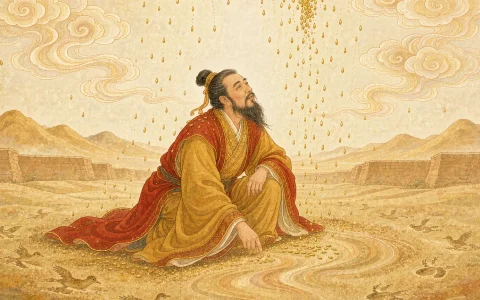
He did not test them one at a time and stop. He walked the hills and put the plants into his mouth one after another. Some were bitter. Some numbed his tongue. Some started a slow burning in his gut half an hour later.
On one day, he ran into seventy poisons.
The account of this is in the Huainanzi, a book put together more than two thousand years ago. It does not open with the hero. It opens with what ordinary life was like.
The passage says: in the earliest times people ate grass and drank water, gathered the fruit of trees, and ate the flesh of snails and mussels. And so illness, poison and injury were common among them.
Only then does the text introduce Shennong.
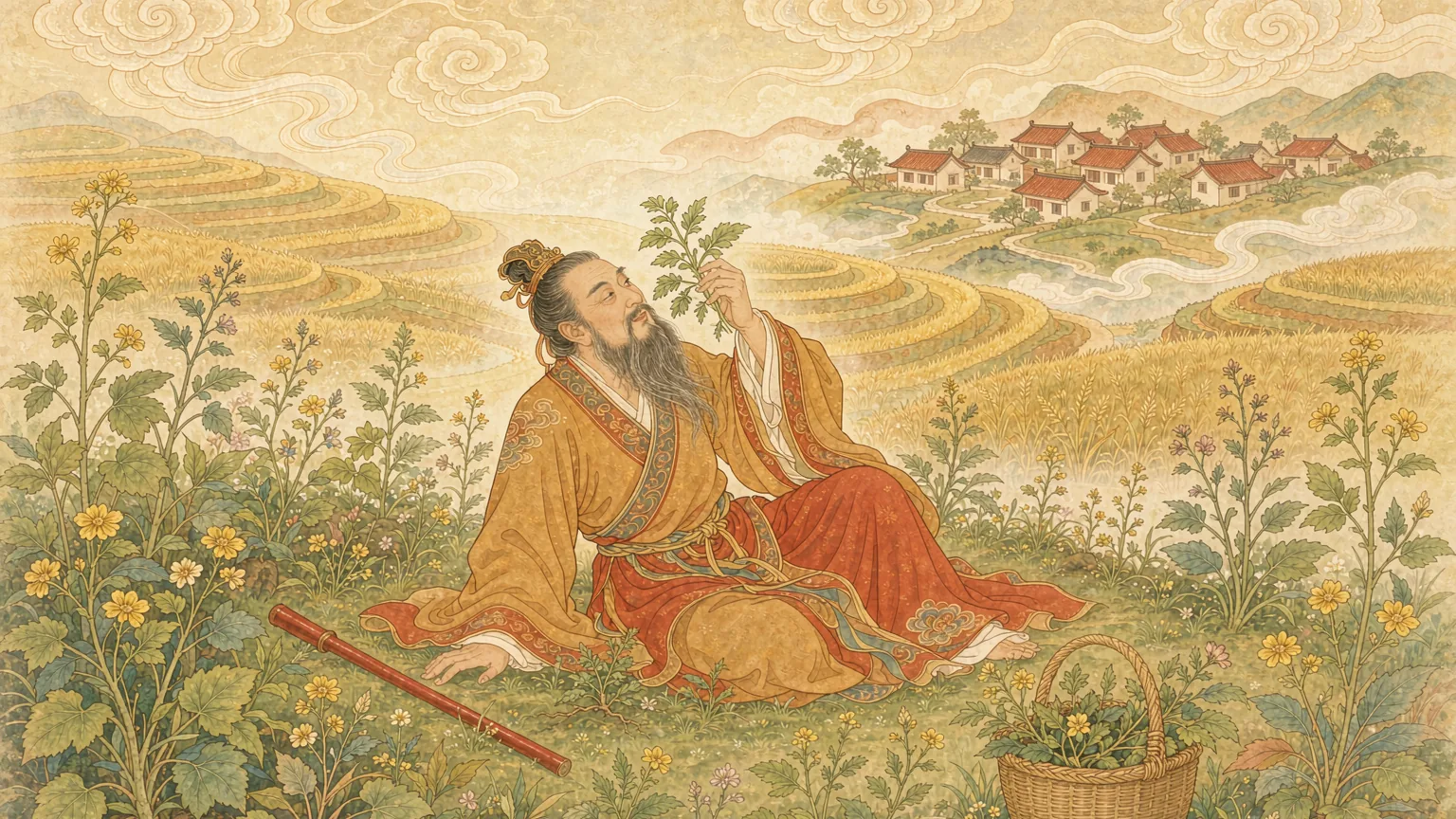
It says that he began by teaching the people to plant the five grains. He studied the land, to see which ground was dry and which was wet, which was rich and which was poor, which was high and which was low. He tasted the flavors of the hundred herbs, and the sweetness or bitterness of springs and stones, and by doing this he let the people know what to avoid and what to approach. And at that time, in a single day, he ran into seventy poisons.
There are four things in that passage, and each one is heavier than the last.
He taught the people to plant grain. He walked the fields and read the soil. He tasted the plants, the springs and the stones. And the purpose of all of it was to teach people two words: what to avoid, and what to approach.
Avoid and approach. That is the whole point of the passage. He was not hunting for medicine. He was finding out, for everybody else, what not to put in the mouth.
And the last six characters are the coldest. In one day, he ran into seventy poisons.
Notice the verb. He did not select seventy poisons to test. He walked, and they happened to him.
It is worth setting this next to a story the West already knows.
In Greece there was Asclepius, the son of Apollo, who became such a healer that he could bring the dead back to life. That was too much for the order of things, and Zeus killed him with a thunderbolt. The staff with a snake coiled around it that still appears on hospitals and ambulances today is the staff of Asclepius.
And there was Prometheus, who stole fire and gave it to human beings, and was chained to a rock for it, and had his liver eaten every day by an eagle, and grew it back every night.
The pattern is the same in all three places. Somebody gives people something enormously useful, and then pays for it personally, and the paying is physical, and it does not stop.
Chinese mythology and Chinese legends add one detail that neither Greek story has. In the Greek versions, the gift is an object. Fire, or healing. In this one, the gift is information, and the method of obtaining it is to put it into the body of one man first.
Now say who he was.
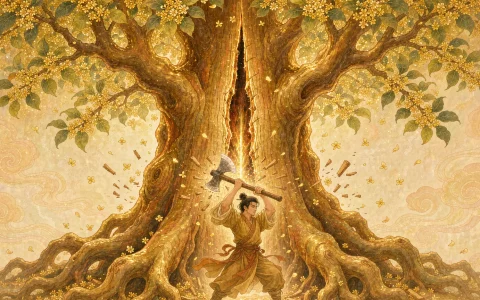
Shennong is the Flame Emperor, one of the three legendary sovereigns at the beginning of Chinese history. In the old books he is credited with a surprising range of things. He taught people to make the plough. He taught them to plant the five grains. He also, according to the Book of Changes, opened the first market.
So one man stands at the beginning of farming, of medicine and of trade.
That is not as strange as it sounds. The three belong to one line. Once people plant, they have to know the seasons. Once they live close together, they get sick, and they have to know which plants are poison. Once they grow more than they can eat, they have to trade, and a place to trade appears.
He was the first person on that line to think it through.
He had two pieces of equipment, and neither of them is in the official texts. Both are folk inventions, and both are worth knowing, because Chinese listeners clearly needed them.
The first is a whip.
A book of strange tales from the fourth century says that Shennong had a red whip. He used it to strike the hundred herbs, and by striking them he learned the whole nature of each plant, whether it was mild or poisonous, whether it was cooling or warming.
It sounds like a magic weapon. It is really a description of a method. He had some way of learning the properties of a plant quickly, so that he did not have to eat every single one and fall over every single time.
The second is his body.
The folk version says that the belly of Shennong was transparent, like crystal. Whatever he swallowed could be watched. You could see where it went, and whether the color of anything changed.
This detail is much crueler than it first appears. It turns being poisoned into something you can watch happening. He was not simply sick. He was following the poison through himself, segment by segment, seeing which part of him it reached.
One piece of equipment points outward. The other points inward. One was for speed, one was for precision.
Neither of them saved him.
Then there is the tea.
In the oldest Chinese book of medicines, which carries his name, there is one sentence about him that everyone quotes.
It says: Shennong tasted the hundred herbs, ran into seventy two poisons in a single day, and was saved by tu.
Tu is the old word for tea.
So the first cup of tea in China was not drunk for pleasure. It was taken as an antidote. He was on the hillside, chewing through plants, and his stomach turned over, and he grabbed a handful of leaves and chewed those as well, and the churning eased.
That is how tea entered human life.
Then there are the five grains.
The old books say that he taught the people to plant them.
Those five characters mean more than they look. Remember what came before. The earliest people gathered the fruit of trees. Gathered. Whatever was on the tree, they picked. Whatever the hill had, they ate. And when it was gone, they moved.
Planting is the moment that finding turns into keeping.
The first village that put seed into the ground and then stayed there to wait for it to come up had taken hold of next year. Grain could go into a storehouse. A storehouse could stay in a village. A village did not have to move.
So what Shennong gave people was not food. It was a place. He gave them a reason to stay where they were.
And the market.
The Book of Changes has a line about him. It says that when the sun reached the middle of the sky, the market opened; people came from everywhere, goods came from everywhere, they traded and then they went home, and each of them got what he had come for.
The scene is a warm one, and it sits oddly beside the image of a man chewing poison on a hill.
But they belong to the same person, and they come in an order that makes sense. First he let people eat. Then he let them have somewhere to trade. And last, and only last, he had to find out what could not be eaten, and the only way he had was his own body.
Now the last plant.
There is a vine called duanchangcao, which means the herb that breaks the intestine. Its scientific name is Gelsemium elegans. It grows on hillsides and in thickets across southern China. The flowers are small and yellow and completely unremarkable. It is extremely toxic, and what it does is cramp and twist the gut.
The danger is easy to understand. The flowers of duanchangcao look very much like the flowers of honeysuckle. Honeysuckle is a common household herb in China, brewed in summer to cool the body. Duanchangcao also opens yellow, also small, also in clusters, and from a few steps away the two are almost impossible to tell apart. Every year there are families who gather the wrong one and are poisoned at their own table.
One medicine and one poison, wearing the same face. That is why he had to taste them one by one. There was no other way to separate them.
In the folk version of the story, this is the plant he tasted last.
He had no antidote this time.
One telling says that the transparent tube of his intestine came apart, link by link, and that he could see it happening, and that this was the first time in his life that he watched himself not being saved.
Another saying has survived as well. It says that when he died, he was still holding the plant, trying to remember it.
Did he die?
Here the honest answer has to be given. The old books do not say. The official sources say that he tasted the hundred herbs, and that in one day he ran into seventy poisons, and then they stop. They never say that he died of any particular plant.
The death by duanchangcao is an ending supplied by later storytellers, because listeners needed an ending.
And that ending grew into something larger. It grew into the book that carries his name, the first pharmacopoeia in Chinese history. It was compiled in the Han dynasty, centuries after his time, and attributed to him. It lists three hundred and sixty five drugs, sorted into three grades. The upper grade nourishes life. The middle grade nourishes the constitution. The lower grade treats disease.
Three hundred and sixty five. That is the number of days in a year.
A book of medicines arranged to match the days of the year is a very Chinese idea. It takes everything that grows on the hills and lays it out as one annual account, one entry per day.
The book was written by other hands, and his name was put on it. That is not entirely wrong either, because the one rule that governs the whole book is the thing he did. Every medicine in it was first tasted by somebody, on behalf of somebody else.
Look back at the order of his life, and it is clear.
First he made sure people had food. Then he made sure they had somewhere to exchange it. And last he did the one job that nobody could do for him and nobody could do instead of him. He went up the hill and worked through everything that grew there, item by item, and found out which ones could be eaten, which ones could not, how much of each, and what would happen afterwards.
What he left behind was not a set of prescriptions. He left a subtraction.
There are several thousand kinds of plants in those hills. Only a small number of them are useful. The rest are useless, or poisonous.
The Huainanzi compresses the result into two words: what to avoid, and what to approach.
The list of things to avoid is far longer than the list of things to eat. And every entry on the first list was put there by one man, one plant at a time.
The plant is still out there.
In the hills of southern China you can still find duanchangcao. It grows with small yellow flowers, and beside it the ordinary weeds look much the same.
It has been growing there for a very long time.
Nobody tastes it now, and the reason is simple.
Somebody already did.