Run silk across the back of your hand and it feels cool.
It is thin enough to show the light through. Shake it once, and it slips over your fingers like a handful of water. Wool comes off the back of a sheep. Linen is stripped from a plant. Silk comes from neither. Silk comes out of the mouth of a worm.
The woman who first worked that out was Leizu. In Chinese mythology she is remembered as the wife of the Yellow Emperor, the founding ruler of the Chinese world.
The Records of the Grand Historian, the great history written by Sima Qian, tells the story of the five earliest emperors. When it reaches the household of the Yellow Emperor, it gives his wife half a sentence. He lived at a place called Xuanyuan Hill. He married a daughter of the Xiling clan. Her name was Leizu, and she was his principal wife. She bore him two sons, Xuanxiao and Changyi.
That is all the official history says. A woman who changed what everyone in the world would wear occupies half a line in the biography of her husband.
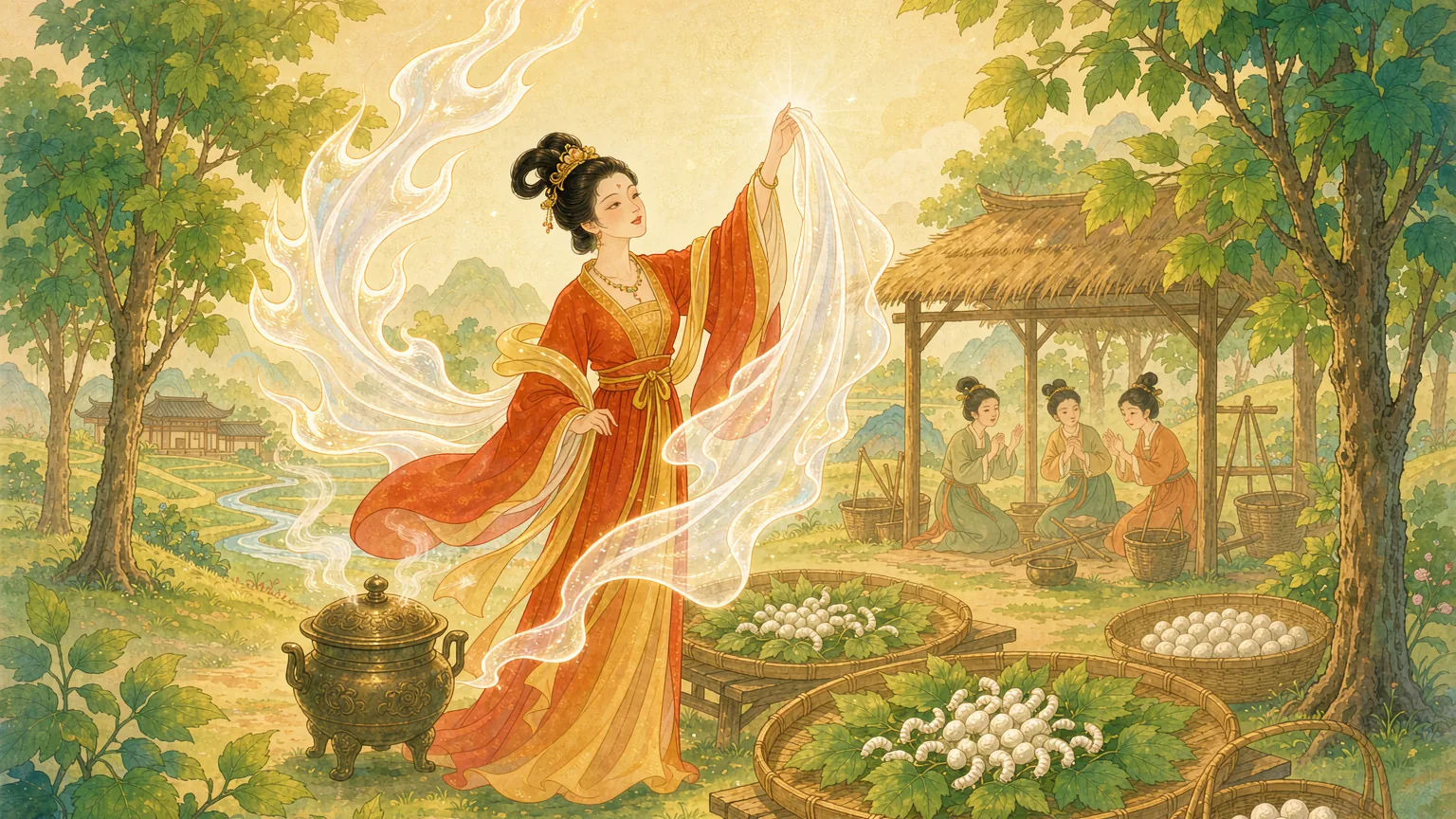
The rest of the sentence is written in other books. A later chronicle called the Lushi states it plainly. Leizu was the first to teach the people to raise silkworms and draw out the thread, and to weave cloth from it, so that there would be something to wear.
Posterity gave her a title. She is called Xiancan, the First Silkworm. Every spring, when the season for raising silkworms came around, each dynasty in turn offered her a sacrifice, with the same weight of ceremony that was given to the god of agriculture.
So the woman who gets half a line in the official record has an entire season of the countryside named after her work.
To understand what she did, it helps to think about what people wore before her.
The earliest people did not wear silk. They wrapped themselves in hides and leaves. They tore the fiber from hemp and from a vine called kudzu, twisted the fiber into thread, and wove a cloth that was coarse and stiff. In summer it scratched. In winter it did almost nothing. Wind made leather harden like a board. Rain made hemp cling to the skin and stay wet all night.
Most of human life in those centuries was spent dealing with cold. Winter was the worst of it. A family slept in one heap, with the oldest and the smallest in the middle, and got through the dark on the heat of each other. They woke with frost on their eyelashes. They put a hand into the river at dawn and felt the ache go into the bone.
A warm piece of clothing, in that world, was not a matter of taste. It was the difference between living and not living.
Leizu was a daughter of the Xiling clan. Xiling was the green hill country of what is now Sichuan, where there is a great deal of water and a great many mulberry trees. When she married the Yellow Emperor, she did not arrive empty handed.
Later books say that she was the first person to notice the white worm in the mulberry tree.
The worm is fat and pale and soft. It lies on a mulberry leaf and eats, cutting the leaf into bites until only the ribs are left. It eats for many days. Then one day it stops, draws itself together, and begins to spin a thread from its own mouth, wrapping itself round and round until the thread has closed over it completely.
She watched it finish. What was left was a small white case, warm to hold, hard on the outside and soft within.
What she thought at that moment, nobody wrote down. Something like: where did that thread come from.
The first time she drew the thread out, the old accounts say, there was water involved.
One version has her boiling the case. The water rolls, and the case turns over in the pot. She reaches in with a twig, and something catches on it. She pulls, and the silk comes.
The thread does not break.
She keeps pulling. Out of the pot comes a single unbroken line. A case the size of a fingertip gives up enough thread to wind around her whole arm, and it is still not finished.
That is the moment the trick is understood. What the worm spun day and night is not a tangle of short fiber. It is one continuous thread, thousands of feet long, folded inside a shell.
The versions differ after that. Some say she was drinking water under a tree and a case fell in. Some say she was only turning it in her hand, and her fingernail tore the shell and the end came loose by itself. Which one is true cannot be settled, and it does not matter. What can be settled is that from that day people knew a line of silk was hidden inside the case.
Ancient writers added a more mythical layer. They said the silkworm was a heavenly creature that had committed a fault and been sent down to earth, where it eats only mulberry leaves, spins only silk, and never speaks. Believe that or not. One thing is certain. The silkworm makes no sound at all. A whole room of silkworms eating mulberry leaves produces no voices, only a soft steady hiss, like rain at a distance.
Drawing out one thread is one thing. Turning that into clothing for everyone is another. Leizu did the second.
She carried the worms home from the mulberry trees and kept them indoors. She fed them leaves and watched how much they ate, how fast they grew, when they stopped. She saw that after a few days of eating they stop, and then they spin, and then there is a case. She followed the whole sequence from beginning to end, and she wrote it down.
She also failed.
The first batch of silkworms, according to the story, died in a single morning. The reasons given differ. Some say the leaves she picked carried dew and the worms sickened. Some say the fire in the room was too strong and the smoke hurt them. Some say rats got in during the night.
Whatever the cause, by daylight the whole room had stopped moving. The worms lay flat on the leaves, white and still.
She probably sat up with them all night. In the morning she did not throw the leaves away. She gathered the dead worms and the leaves together and buried them at the foot of the mulberry tree.
Then she started again.
This time she made rules. Wipe the leaves dry, and never pick them on a dewy morning. Keep the room aired, and keep smoke away from it. Guard against rats, and keep a cat. While the worms are eating, do not speak loudly and do not knock on anything. Those rules were written into the hands of silk farmers for the next several thousand years.
Raising silkworms is hard work.
The worm is delicate. It fears smoke, noise, cold, damp, rats, and mosquitoes. A household with a room of silkworms lives on the schedule of the worms. When they are small they eat only tender shredded leaves, so somebody must cut them leaf by leaf. When they are grown they eat enormously, so somebody must pick and feed all night. When they molt, they neither eat nor move, and they must not be disturbed. During the days when they spin, nobody sleeps.
In the silkworm month, whole villages closed their gates to visitors. No quarrels, no drums, no weddings. Those rules, one after another, are traced back to Leizu.
She taught people to plant mulberry. The tree grows easily, sprouts again after cutting, and yields leaves several times a year.
She taught people to reel the silk. Several cases go into hot water. The ends are found, joined, and wound onto a frame. This step is the hardest. One unsteady hand and the thread tangles.
She taught people to weave. The threads are joined side by side, put on the loom, and woven into a cloth that is soft and bright.
The day the first bolt came off the loom, the weather was probably fine. She held it up against the sun, and the light came through the threads, and the whole piece of cloth was alive.
As soon as silk existed, it stopped being something anyone could wear.
The first bolt was probably laid on an altar before it was laid on a shoulder. In the centuries that followed, silk became a matter of rank. The emperor had his colors. The lords had their patterns. The scholars had their grades of cloth. To wear the wrong one was an offense. The people in the fields went on wearing hemp, and they went on wearing it for another thousand years.
Clothing had stopped being only a defense against cold.
What happened afterward is all recorded politely.
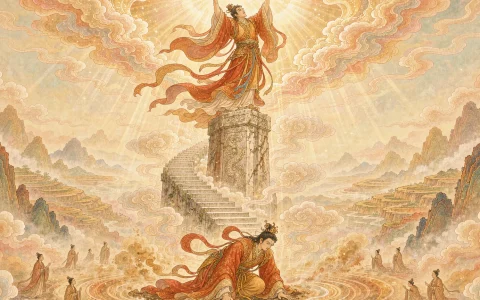
Leizu bore Xuanxiao and Changyi. Changyi in turn fathered Zhuanxu, the emperor who would later cut the road between earth and heaven. The woman who taught China to raise silkworms was the grandmother of the emperor who closed the sky.
After her death she was worshipped as the First Silkworm. The rule in later dynasties was this. Every spring the empress herself went out to pick mulberry leaves and feed the worms, and performed the rite of the first silkworm. The empress of an empire, every spring, picked mulberry leaves. It sounds like a chore rather than a ceremony. It was a ceremony.
As for silk, it traveled a long way.
The first people in the west to see it did not know what it was. They did not know it came from a worm. Some said it grew on trees. Some said it was combed from the surface of water. For the sake of that cloth, a road was later opened from the Chinese capital all the way across Asia, and the main cargo on that road was this.
The cloth is thin, light, and cool. It comes out of the mouth of a worm, passes through a great many hands, and ends up on a person who has never seen a mulberry tree.
The west has an older story about cloth. In Greek myth, a weaver named Arachne challenged the goddess Athena to a weaving contest, and for her pride she was turned into a spider, condemned to spin forever and never be thanked. The Greek tale turns the spinner into a monster. This Chinese tale turns the spinner into a goddess of the harvest, honored every spring by an empress who kneels in a mulberry grove. The same craft, two opposite verdicts.
There is no sound in the silkworm room.
A whole room of worms eating at the same time sounds like rain very far away. The people tending them do not talk and do not knock on anything. They simply sit, from morning to evening.
The first woman to sit like that was named Leizu.
While she sat, she was probably still watching the worm. It does not move much. It does not call out. It only eats, bite by bite, and spins, turn by turn.
A piece of clothing comes out of that. Nothing more.