Look up and the sky seems to be one piece.
It has been broken once.
It split open, and for a long time everything poured through the gap, and then a woman mended it. Alone.
The story is written down in the Huainanzi, a collection put together in the second century BC. It does not begin with the woman. It begins with the world after the sky came down.
The four pillars failed. The nine provinces split apart. The sky could no longer cover the earth, and the earth could no longer hold anything up.
To follow this, you need to know one thing about how the old Chinese pictured the sky.
In most of the myths you already know, heaven is a place, or a person, or a state of being. In Chinese mythology the sky is an object. It is a lid, or an upside-down bowl, laid over the world, and it is held up at the four corners by four pillars. The tallest mountains stand where those pillars meet the ground.
An object can be damaged.
This one was.
The god who did it is named Gonggong. The Huainanzi gives him one sentence.
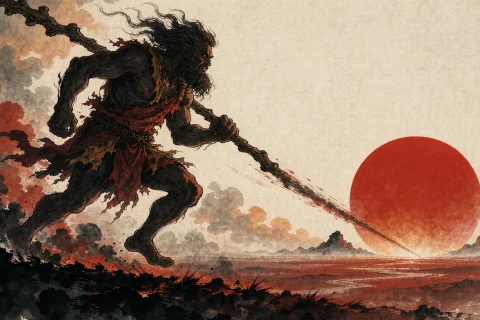
Gonggong fought Zhuanxu for the rule of the world. He lost, and in his rage he butted his head against Mount Buzhou.
A note here, because the books disagree. Different texts name a different opponent. Some say Zhuanxu. Some say Gaoxin. Some say Shennong, or Zhurong. The name changes and nothing else does. He loses the argument, and then he uses his head.
Buzhou means not whole, or missing a piece. It was not an ordinary mountain. It was the pillar in the northwest, the one holding up that corner of the sky.
Then the mountain made a sound.
Not the sound of a landslide. The sound of something snapping. Wood snaps with a crack, stone snaps with a boom, and a pillar holding up the sky makes both noises at once, from somewhere under the ground, all the way up.
And the whole sky dropped on that side.
Everyone felt it and thought the earth had moved. When they had their feet under them again and looked up, they understood. The earth had not moved. The sky had lost a pillar.
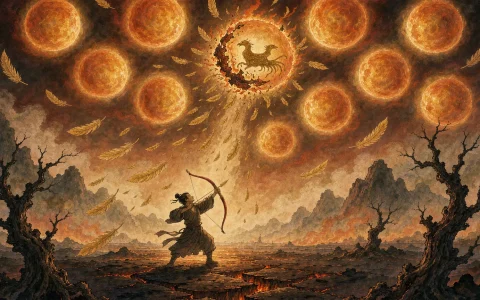
The scene that follows is one of the oldest pictures in Chinese mythology, and Chinese gods and monsters rarely get a bigger stage than this: a snapped column, a sky sliding out of true, and water coming up through the floor of the world.
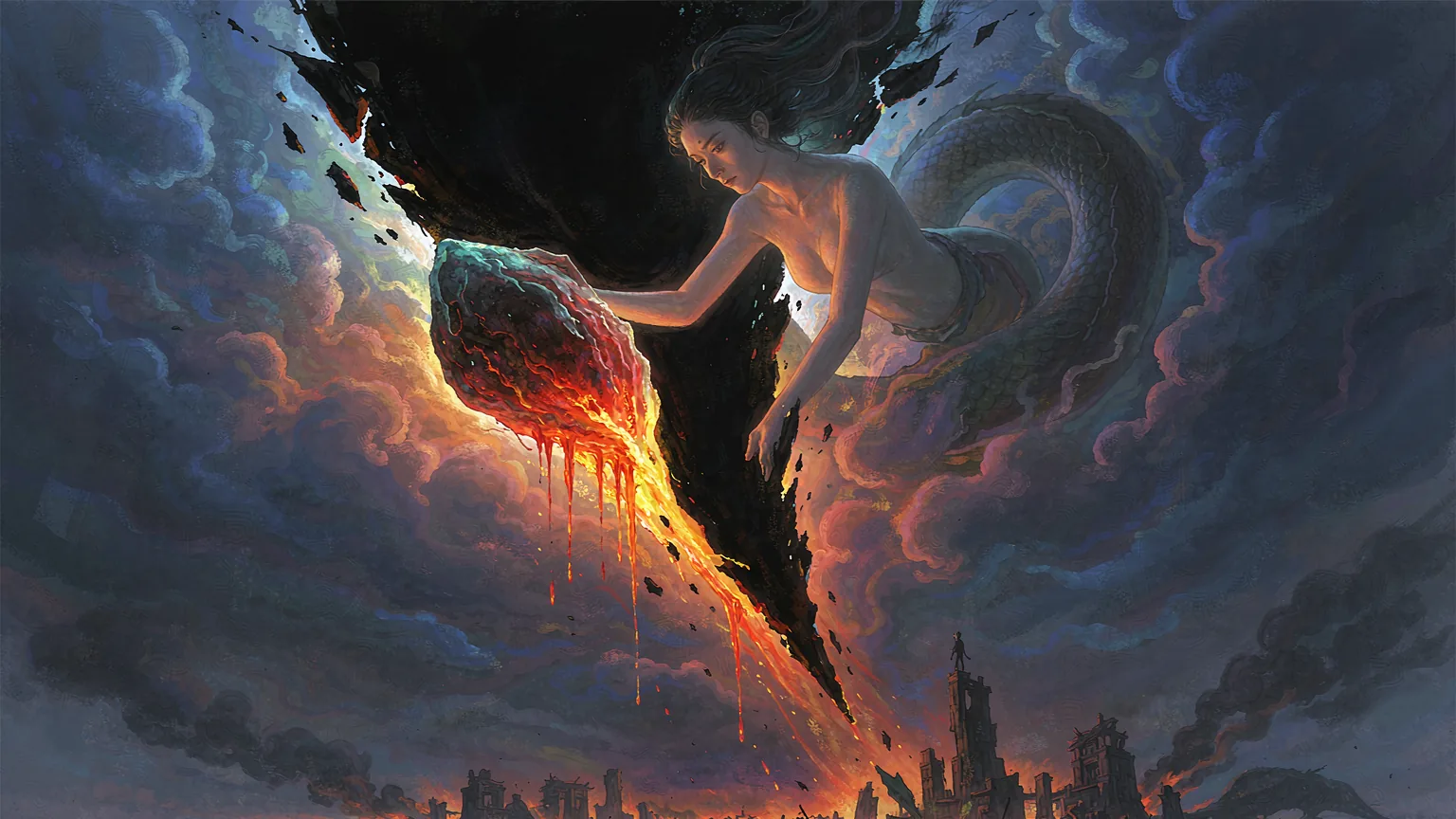
What the old book says next is very short. Every line is a different disaster.
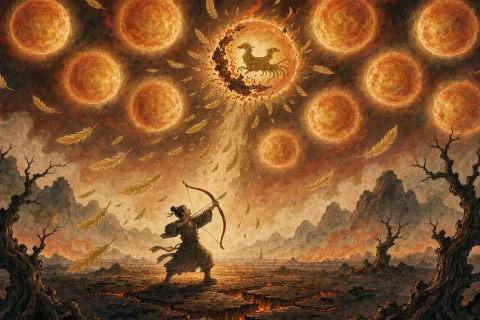
First fire. The flames spread and would not go out.
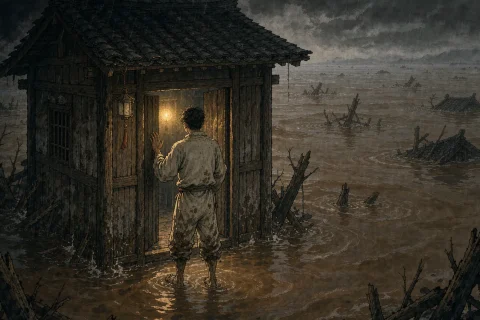
Then water. The flood rose and would not go back down.
Then living things. Wild beasts came for the good people, and the birds of prey took the old and the weak.
That is the whole account. Twenty-odd characters. Fire above, water below, and human beings in between being eaten.
What the sky actually looked like during those days, the book does not say. So picture the tear itself.
It ran from the ground line up past the middle of the sky. And nothing that came through it belonged to the world. It did not glow. It was dark. It did not warm. It was cold. Wherever it landed, the ground died.
Nobody on the earth knew which way to run. East was water. West was fire. North and south, the animals arrived faster than the flood.
Everyone looked up at the same tear.
Nobody could reach it.
This is where Nuwa enters the story.
She is much older than the disaster. She belongs to the first generation of Chinese gods, and in the oldest lists she comes first.
The dictionary written by Xu Shen describes her in a single line. Nuwa: the ancient holy woman, the one who gave form to all things.
She had already done something more famous than mending the sky.
She made people.
In the Record of Customs and Traditions, the world has just been formed and there is nobody in it. Nuwa takes yellow earth and shapes a person with her hands, one at a time. She keeps at it and her hands ache. One later version adds the detail that Chinese folktales always enjoy: when she is tired, she dips a rope in the mud and swings it, and the drops that fly off land as more people.
So when the sky fell, it did not fall on somebody else’s things.
It fell on the things she had made with her hands.
She stood and looked at them for a long time.
She had made every one of them by hand. She had given them two arms and two legs, a mouth that could cry, eyes that could see. She had meant for them to live here. Now some of them were running, some had stopped moving, and some were crouched at the edge of a split in the ground holding a child, not knowing which way to step.
She walked over, picked up a child who was still crying, and set it down on higher ground.
Then she looked up at the tear.
She wanted to help. She was one person.
She looked up at the tear all night. Then she went to work.
The first thing she did was burn stone.
The Huainanzi gives it in six characters. She smelted stones of five colours to patch the sky.
Why five? In Chinese cosmology the colours are not decoration. Blue-green, red, yellow, white and black are tied to the five directions, east, south, centre, west and north, and to the five elements that the world is built from. She is not gathering pebbles. She is taking one of each thing the world is made of.
She built the fire up until the stones went soft, and then until they ran, until they turned into something thick and bright, like sugar cooked down to syrup.
Then she carried it up.
The old book says nothing at all about that part. How she climbed. Where she stood. How the molten stone went onto the sky. All of it is blank.
The blank is where a storyteller is allowed to work.
She went up the highest mountain she could find and kept going. The higher she climbed, the harder the wind blew, and the wind came down out of the tear. She stood under it and began pressing the molten stone into the opening.
The sky is not a board. The sky behaves like cloth, and cloth moves. She pressed on a layer and it cooled and set, and the tear was still open, so she had to climb a little higher and press on another.
Layer after layer. Night into morning, morning into night.
She could not stop. The stone hardened the moment it left the fire.
She failed once in the middle of it.
Halfway up, the stone in her hands went cold. Cold stone will not press into anything and will not hold. She had to come down, build the fire again, smelt another batch, and climb back.
On the second trip she found a hairline crack running along the edge of the layer she had already laid.
She put her hand over it. It was still a crack.
So she did that piece again.
Nobody on the ground saw any of this. Up, down, up. The tear in the sky closed an inch at a time.
The patch held. But the sky kept sagging.
Because the pillars were gone.
She needed new ones. So she went to the Eastern Sea.
In that sea lived a turtle of enormous size. Its name is Ao. Chinese legends never say how big it is. They say that one of its feet, set down, makes an island.
Nuwa cut off all four of its legs.
Then she carried them, one at a time, to the four corners of the world, and stood them up, and the sky was held again.
That is all the old book gives us. It never says what happened to the turtle. Whether it died, or was left drifting somewhere out there with no legs and a shell, the text does not spend a single character on it.
Of all the silences in Chinese mythology, this is one of the loudest.
That dealt with the sky. Two problems were left on the ground.
The first was water that would not go away. The plain of Jizhou, in the middle of the country, stayed flooded. The old book says a black dragon lay under it and kept the water moving.
Nuwa killed the dragon. Four characters in the original.
The second problem was also water.
The line is easy to misread. She piled up reed ash to stop the flooding water.
The word used there does not mean what it looks like in English. It means too much. Excessive. Water that has gone past its limit.
She did not go and dam the great rivers. She burned reeds, heaped the ash into banks, and used it to hold back water that was still rising.
Reed ash soaks water up. It is a practical answer, and it is what people in China were already doing with ash three thousand years ago.
And that should be the end of it.
Patch in the sky. New pillars. Dragon dead. Water held back.
But the sky she repaired is not the sky that was there before.
The old one had sat level. The new northwest pillar was fresh and too tall, and it lifted that corner higher than the rest. The southeast corner had caved in, and she never managed to pull it flat again.
So the sky ended up tilted.
The Huainanzi records the tilt in two lines. The sky leans to the northwest, and that is why the sun, the moon and the stars all travel that way. The earth is low in the southeast, and that is why the rivers, the mud and the dust all run in that direction.
Look at a map of China. The west is high, the east is low, and every major river runs east. The Yellow River. The Yangtze. The Pearl. Not one of them runs west.
Geography will tell you why that is, and geography is correct.
But before there was geography, this was the answer the Chinese gave. Somebody broke the northwest pillar, and Nuwa patched the sky, and she did not get it level.
There is one more thing, and it is quieter than the rest.
When Nuwa finished, the story stops.
The Huainanzi lists the four things she did, and then the book simply moves on. Where she went. How long she lived. Whether anybody ever thanked her. Nothing.
Most of the gods in Chinese mythology end the same way. The work gets done, and the god disappears.
She made people first. Then she mended the sky for them. Then she said nothing more.
So the sky over your head is not the original one.
It is a patch. A little higher in the northwest, a little lower in the southeast, and it has been leaning that way for a few thousand years.
And the water at your feet is still running toward the low side.