Two men walked down out of the mountains, stood at the edge of their own village, and could not find their own homes.
The road was the same road. The river was the same river. The old tree at the mouth of the village was still standing, only thicker now. But the houses had changed, and the people had changed, and even the way they spoke had shifted. A young man went past them, and his face was so familiar that it hurt to look at, because it was the face of a relative they knew, and that relative should have been old by now. This one was young.
They asked the way. The young man did not recognize the name of the place they were asking about.
The story is kept in a book called the Hidden and the Visible, written in the fifth century.
It begins in a plain way. In the fifth year of the reign of Emperor Ming of the Han, two men of the district of Shan, named Liu Chen and Ruan Zhao, went up into the Tiantai Mountains to gather kudzu fiber.
Kudzu fiber is not food. It is stripped from the bark of a vine and used for rope and rough cloth. So these two were not hermits and they were not seekers after immortality. They were working men, going up a mountain to gather material. Tiantai is a real mountain in what is now Zhejiang, high and heavily wooded, and a trip into it was not a small thing.
They went in, and they lost the path.
On the thirteenth day after they lost it, their food ran out. The old book uses four characters for this. Starving, and close to death.
Going into the mountains in that period was done in pairs. A man who went in alone often did not come out. Two men with full packs could last perhaps ten days, and after that they lived on whatever the mountain gave them. By the thirteenth day they were past the edge of it.
Some tellings change the errand. In one version they went up to gather herbs rather than fiber. In another the mountain is a different mountain. But every version begins in the same way. Two men went in, lost the path, and ran out of food.
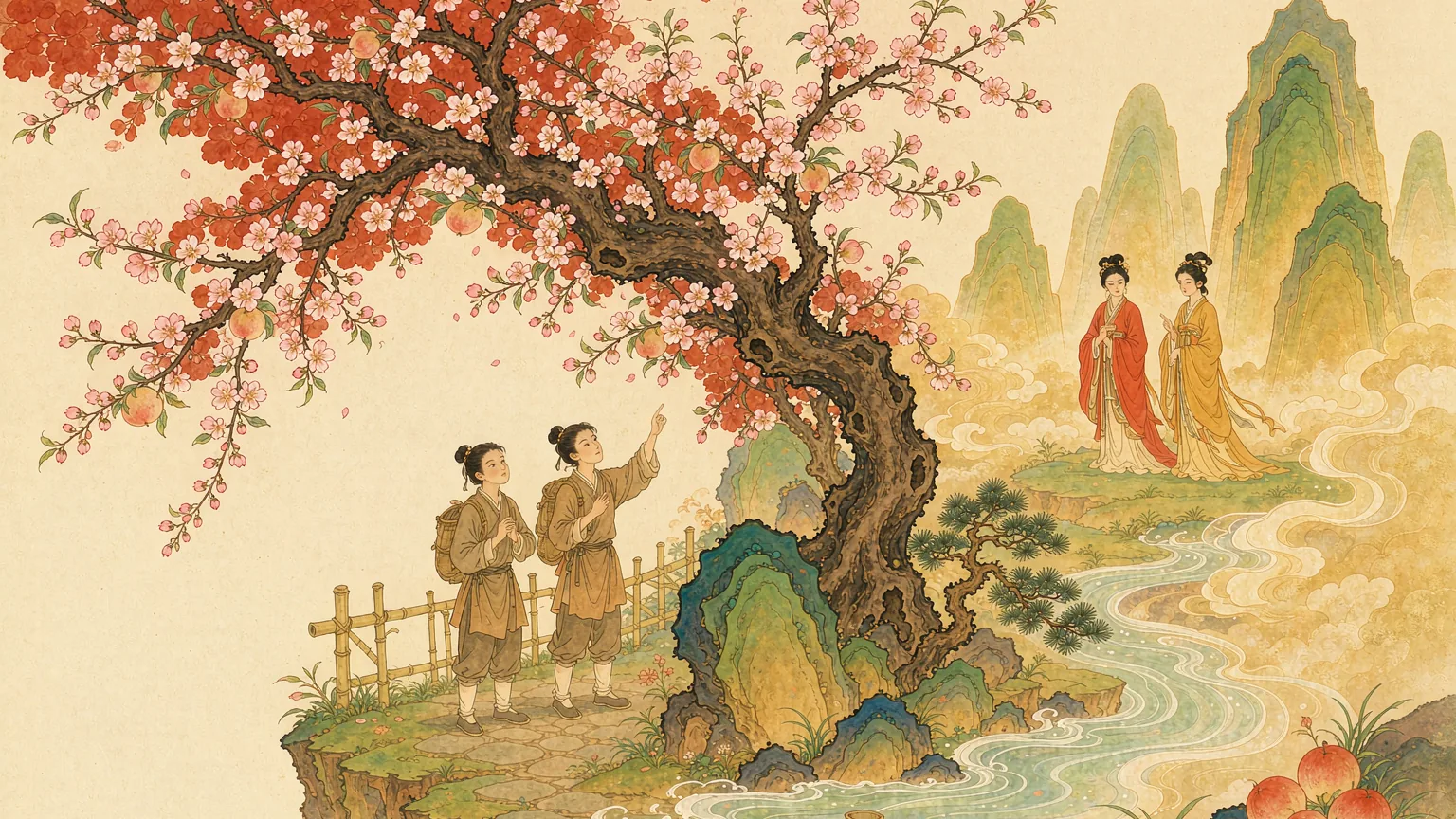
What saved them was a peach tree.
Far off on the slope they saw a tree loaded with fruit. It stood on the lip of a cliff and could not be reached from below. They threw away everything they were carrying and still could not reach it. In the end they found a creeper hanging near the root and climbed up it, and got the peaches.
They picked a few and ate them. Afterward they had strength in their bodies, and their stomachs stopped complaining.
They went on, down to a mountain stream to drink. Something floated past on the water. A leaf of mustard greens, fresh and young. A little further on, another thing came drifting down. A cup, and the cup was full of sesame rice.
The two men looked at each other. Leaves and rice meant that somebody lived upstream.
So they followed the water up.
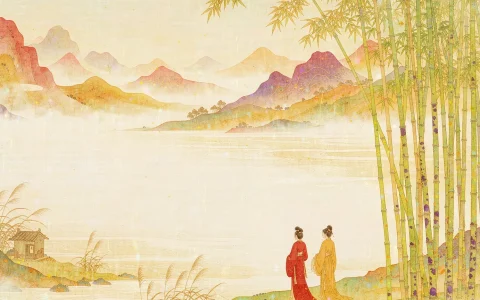
They crossed a ridge, and the land opened. A wide stream, and beside the stream stood two women. The book says of these two that their bearing and their beauty were beyond comparison. What made the hearts of Liu Chen and Ruan Zhao jump was something else. The two women saw them and spoke first, and the first thing they said was the names of the two men.
Liu and Ruan. What took you so long.
Neither man had ever seen these women. Yet they knew the men already, and they spoke as if they had been waiting a long time.
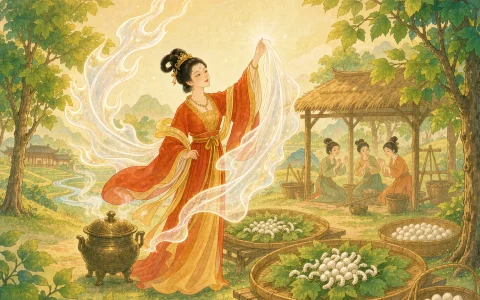
The women took them home. The house had tiles of bronze and was very large. Against the south wall and against the east wall stood two great beds, hung with crimson gauze curtains, with little bells tied at the corners.
Food came out one dish after another. Sesame rice. Dried mountain goat. Beef. The two men had not eaten for thirteen days, and they ate slowly and ate their fill.
That night the bells at the corners of the curtains rang until morning.
A few days later a dozen or more women came visiting, each carrying three or five peaches, and said to the two hostesses, with a laugh, congratulations, your husbands have come.
Only then did Liu Chen and Ruan Zhao understand that the place they had walked into was not the world of men.
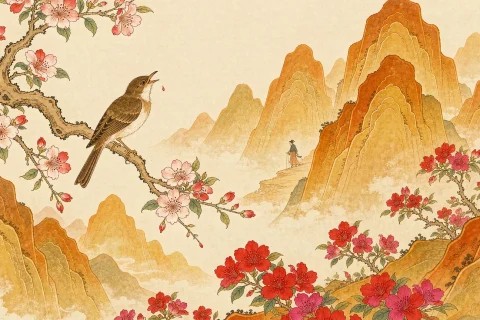
The days that followed went quickly. The weather in the mountains was mild all year, the old book says, as if it were always the second or third month of spring. The flowers never wilted and the grass never dried. Birds called overhead with a sound like music. The two men lived in a way they had never lived before. No work in the fields. No rent. No watching the sky for the shape of the coming season.
That life lasted half a year.
They asked the women where they were. The women did not answer directly. They said only that this was not a question to be asked in this place. Then they asked the two men what family they had left behind. Liu Chen said he had an old mother. Ruan Zhao said he had an elder brother and a sister in law. The women listened and said nothing more, and passed them fresh peaches.
Some tellers add a line here. Those two women had known from the first day that these men would not stay, and so they never once asked them to.
After half a year, they began to miss home.
It grew worse as the days passed. They missed the tree at the village gate. They missed their own fields. They missed the old people in their households. Men in a place like that, oddly, only think harder about the small hard life they came from.
So they told the women they wanted to go back for a while.
The women did not stop them. They said one thing only. The old book gives it in six characters. Sin holds you, it says, and what can be done.
There is no blame in that line. There is only acceptance. They had known this day would arrive, and they knew what it meant.
On the day they left, the women walked them out, pointed the way down the mountain, and told them to follow the road they had come by. They said nothing else, and they did not ask them to stay.
The road down was much shorter than the road up.
They followed the stream, and came out on the old path. The path was right. The direction was right.
Here was the village gate.
First they saw the tree. Still there, thicker, with older branches. Then they saw the houses, and the houses were not the houses they remembered. They were new, and built in a different style.
They found their own family name, and their own door, and knocked. The man who opened it was young, and did not know them.
Liu Chen and Ruan Zhao explained. We belong to this house. We went up the mountain in such and such a year. Today we have come back.
The young man stood still for a long time. Then he turned and went inside, and brought out the family record.
The record had the name. Under the name were two characters. Did not return.
Counted down the generations, the man whose name that was had been the seventh ancestor of the young man standing at the door.
So half a year on the mountain had been seven generations in the village.
Nobody in the village knew them any longer.
Their own generation was in the ground. Their children and grandchildren were old, or gone. What remained were descendants so far removed that the two of them were a name in a book rather than living men. The people spoke the same language, but some of the words had moved. They honored the same ancestor, but that ancestor was a line of text to them, not a person who had once eaten at the table.
Liu Chen and Ruan Zhao stayed in the village for a while.
The book goes on to say that after some time they wanted the mountain again. They remembered the road, and they remembered the two women. They went up to look.
They could not find it.
The peach tree, the wide stream, the house with the bronze tiles, none of it was there. The mountain was still the mountain. The road was no longer the road.
Some versions of the story end there, with the two men never seen again. Other versions say they lived on for a long time afterward, longer than anyone else in the village.
Other parts of the world tell a version of this story.
In Japan, Urashima Taro rescues a turtle and is carried to a palace under the sea, where he stays a few days, and when he goes home he opens a box on the shore and turns to an old man on the spot. In Ireland, Oisin follows a woman of the fairy folk to the land of youth, and when he comes back and his foot touches Irish soil, three hundred years fall on him at once. In America, Rip Van Winkle sleeps in the mountains and wakes to a wife who is dead and a village that has changed flags.
All of these are about the same cold idea. Time does not run at the same speed in two places. Stay a little while in the good place, and a whole human life goes by outside the door.
The Chinese telling ends a little differently.
Most of the others close on a punishment. The traveler ages, or dies on the spot. Liu Chen and Ruan Zhao do not wither when they come down. They still look like two young men. They are even given the chance to climb the mountain a second time and search.
What they cannot get back to is not their bodies. It is the village.
The peach blossoms on Tiantai open every year, the book says, on the same days as always.
They went up in spring. That is the detail worth holding on to. Two young men, in the season when the peach trees were flowering, carrying rope, going into the hills to strip bark. An ordinary job. Nobody writes poems about it.
If they had not lost the path that day, they would have carried their fiber home that afternoon. They would have eaten supper at their own stove and gone back to work in the morning. They would have lived out a plain life, and nobody would have remembered their names.
But they did lose the path, and they did look up under that peach tree on the cliff.
The mountain is still there. People still go up it and come down it. The peach trees still open every year.
Only the wide stream has never been seen again.