There is a river in the sky.
On one bank stands a man. On the other bank stands a woman. The river is not wide and the water in it is not deep, and they are permitted to meet once a year.
You can see that river on any clear night.
The earliest trace of this story is in the Book of Songs, the oldest collection of Chinese poetry, put together around three thousand years ago. And at that point it is not a story at all. It is two star names.
One poem describes the Weaver Girl. It says that she is a star that shifts her position seven times in a day, and that after a whole day of shifting she still has not managed to weave a single piece of cloth.
The next lines are harder on the Cowherd. They say that he is bright, and that he cannot pull a cart.
So the oldest surviving mention of these two stars is already a complaint about them. One cannot finish her work. One cannot do his. They sit on either side of the sky and neither of them has anything to do with the other.
The poem that made people feel something about them came later, in a collection called the Nineteen Old Poems.
It says: far off, the Cowherd star. Bright and white, the woman of the River of Han. Her slender hands reach out. Click, click goes the shuttle. All day long she does not finish her pattern, and her tears fall like rain. The River of Han is clear and shallow. How far apart can they be? One shallow stretch of water, and the two of them can only look at each other, and cannot speak a single word.
That last line is the one to keep. The river is shallow. The distance is nothing. And that is exactly enough to separate them forever.
One thing has to be understood before the story can work. In the old Chinese view, the Milky Way is not a galaxy. It is a river. It is called the River of Han, and it is also called the River of Heaven. Han means water. It runs across the whole sky and cuts the sky in two.
A river is a thing that separates. That is what rivers are for.
And in Chinese mythology the sky is not a wall. It is a country you can travel into, if you have the right thing to ride.
It is worth knowing that China did not invent this kind of story alone.
Almost every country on earth tells a version of the woman from another world who marries a mortal man. In Europe there are the swan maidens, who come to a lake, take off their feathered skins and become women, and are caught when a man hides the skin and keeps it. In the islands of the north there are the seal women, and the story runs the same way. In Japan the same two stars are called Orihime and Hikoboshi, and they are separated by the same river for the same reason.
And every country that has a story about love and an uncrossable border has also told some part of the story of Orpheus, who walked into the land of the dead to bring his wife home and lost her in the last few steps.
So the raw material here is human and old. Chinese legends and Chinese folktales carry both halves of it, the woman who comes down from the sky and the water that cannot be crossed, and they join the two halves in a way that no other tradition quite does.
What Chinese storytellers did with it is what makes this one worth reading: they moved the border into the sky, and they made it out of a single line drawn by a hand.
Now begin with the man on the near bank.
He is the Cowherd. That is not a name. It is a job. His real name changes from book to book, and in some tellings the books do not bother to give him one.
His parents died when he was small. He grew up in the house of his older brother and his older brother wife, and the arrangement was not kind. The heavy work was his. The leftovers were his. Nothing good was ever his.
Then the brothers divided the household. The house, the fields and the storehouses went to the older brother. What came to the younger one was a single ox. Some versions add a broken cart.
A young man, one ox, and that was the whole inheritance.
When he led the ox away, he had no way of knowing that the animal was worth more than the house he had just lost.
Because it was not an ordinary ox.
Then the woman on the far bank.
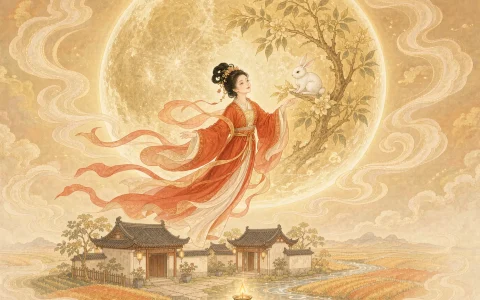
The Weaver Girl is high born. She is the granddaughter of the Emperor of Heaven, and some versions make her his daughter.
Her work is weaving, and the cloth she weaves is not cloth for people. She weaves the clouds. The red of morning and the brocade of evening, layer after layer of the color of the sky, are drawn off her loom inch by inch.
Remember what the old poem said about her. All day she shifts and cannot finish a pattern. Chinese readers have always agreed on what that means. She is thinking about somebody.
A star moves seven times in a day and cannot finish her cloth. The work of heaven has stopped, and the reason is a person.
How the two of them met comes down to us in two versions, and the distance between them is large.
In the gentler one, the ox speaks.
The Cowherd is living with the ox, working the fields, and one day the animal opens its mouth and talks. It tells him that on a certain day a group of women will come down from the sky and bathe in the river. Among them will be one in a particular color of robe. That is the one he must keep.
What happens next is written briefly in every text. He goes. He takes her robe. She cannot return to the sky, and so she stays on earth with him.
They become husband and wife.
In the rougher version, the robe never enters the story. The Weaver Girl simply comes down, meets him, sees a man with no parents, thrown out of his own house, with nothing left but one ox, and stays with him by her own wish.
Both versions survived because they are doing different work. One says that the beginning was not honorable. The other says that it was her own choice.
The married years are good.
He farms. She weaves, and her cloth is not like anybody else cloth, and the whole village learns within a season that this woman is not from here. What comes off her loom is fought over at the market.
They have two children, a boy and a girl.
An ox, a field, two children. Chinese storytellers almost never let a household like this continue, because it is too happy to last.
And it does not last.
Up in heaven, the loom has stopped.
The clouds have to be woven every day. A single day without weaving means one less band of color in the sky. Somebody in charge checked on the weaver, and the weaver was not there.
A squad of soldiers from heaven came down and took her.
Every version of the story writes this part the same way. There is no discussion. Nobody asks whether she wants to go back. Nobody offers her three days to settle her affairs. They come, and they take her.
The Cowherd came home and the house had one fewer person in it.
The children asked him where their mother had gone.
He did not have an answer.
At this point the ox begins to die.
It calls the Cowherd over and gives him one last instruction. When I am dead, take off my hide and put it on, and you will be able to go up into the sky.
He does it.
An animal that worked beside him for half his life leaves him two things: a hide that can fly, and the word hurry.
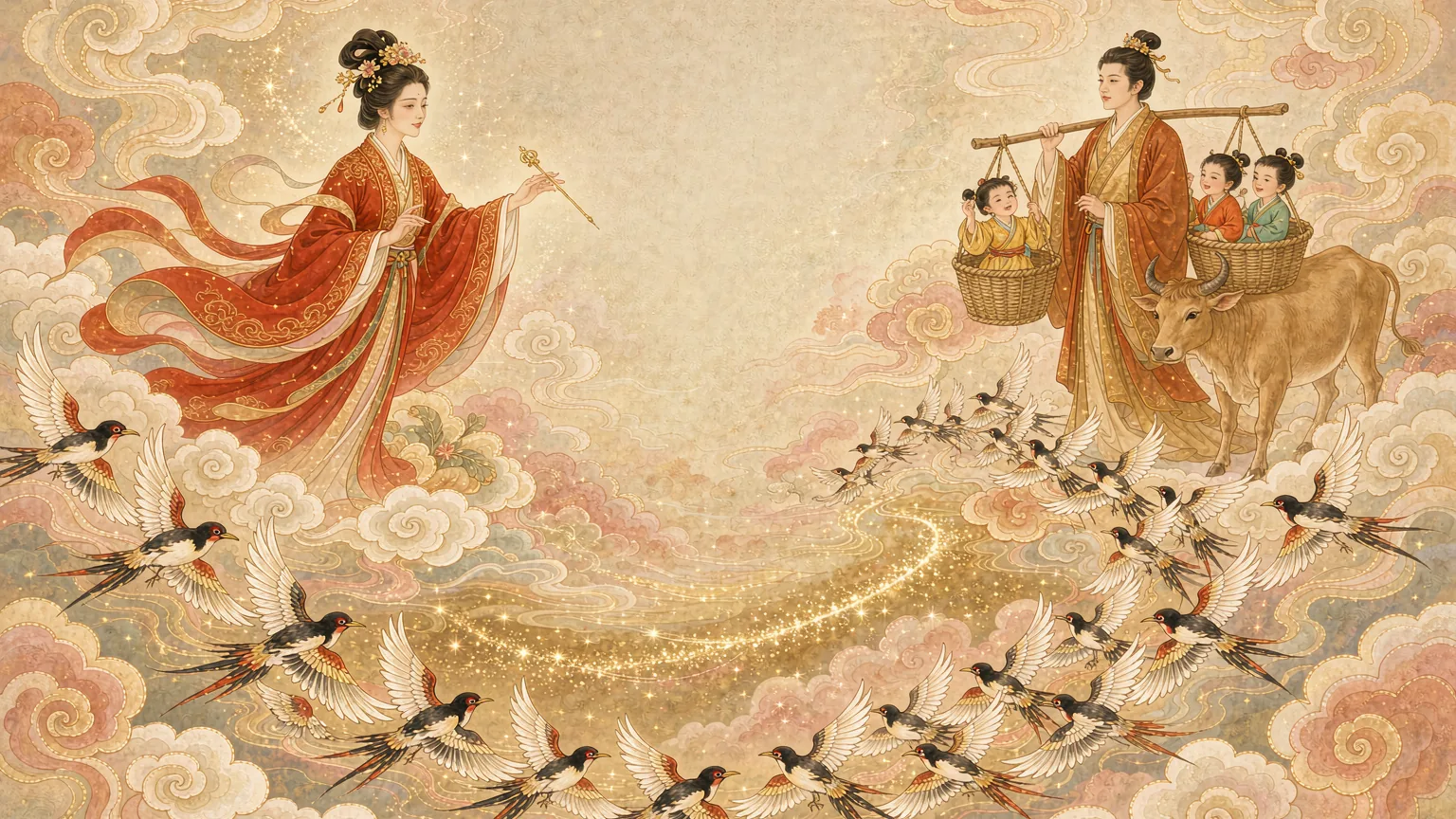
So the Cowherd picks up the carrying pole.
One child in each basket, the way farmers carry a load. He puts on the hide, his feet leave the ground, and he goes up after her.
That chase became one of the most familiar images in Chinese storytelling. A man with a pole across his shoulders, a child at each end, climbing into the sky. Ahead of him, two figures. Below him, a village getting smaller.
He gained on them fast. The hide was not magic. The hide was the whole life of an animal that had decided to spend it on this.
He almost reached her.
Then the Queen Mother of the West took a gold hairpin out of her hair.
And she drew a line behind her.
That one stroke opened a river in the middle of the sky.
It was not an ordinary river. It was so wide that the far bank could not be seen from the near bank. The water in it was made of stars. You cannot see it in the daytime. At night it is bright enough to hurt.
The Chinese call it the River of Heaven. Western astronomers call the same band of light the Milky Way. Both names mean a river. Only one of them is honest about how it is used.
The old poem had it right. One shallow stretch of water, and the two of them became two stars.
They stand and look across.
The children call for their mother from the far side. The Weaver Girl reaches out. Across a river that wide, a hand does not reach.
What happens next is the only soft thing in this story.
The magpies of the world could not stand it.
They came in flocks. They joined beak to tail to beak, and they built a bridge over the river with their bodies.
Once a year, on the seventh night of the seventh month, the bridge is open.
The Cowherd walks out onto it with his pole and his two children. The Weaver Girl walks out from her side. They meet in the middle.
For one night.
The seventh day of the seventh month is the festival of Qixi, and it is recorded in a book of customs from the sixth century. In that book, the seventh of the seventh month is set down as the night when the Cowherd and the Weaver Girl come together.
On that night, the young women of old China had work of their own.
They set out melons and fruit in the courtyard and threaded needles in the dark, and they competed over who was the most skillful with her hands. The custom is called begging for skill. The idea was to ask the Weaver Girl for a little of hers, since she is the best weaver there has ever been.
There is a second custom, and it is a charming one. People say that after Qixi, magpies have bald heads.
The bridge is made of their bodies, and on that night, two people walked across the top of them.
So when you look up tonight and find the faint band of light across the sky, it is still that river.
On the two banks, it is still the same two people.
For the other three hundred and sixty four days of the year, they stand there. They do not argue. They do not weep. They do not leave.
You think you are looking at two stars.
You are looking at two people, each standing on a shore, with one stretch of water between them that neither of them can cross.