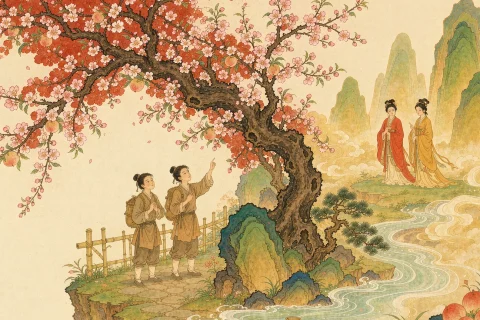
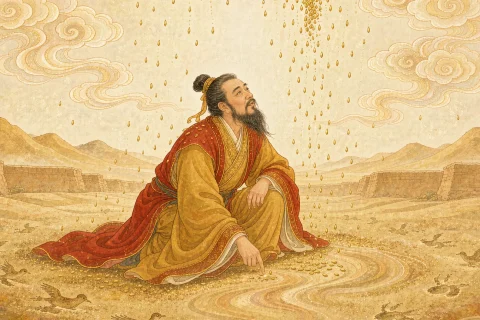
There was a road between people and heaven.
The oldest Chinese storytellers describe it the way you would describe a village lane. The gods lived above. People lived below. The stretch in between could be walked. Whoever went up carried a question from a household to the gods. Whoever came down carried a word back. If your family had a trouble, you could send a word up. If the sky had an instruction, a word came down to tell you.
Then the road was closed.
The man who closed it was Zhuanxu, an emperor of the earliest age of Chinese mythology. The story is kept in a book called the Discourses of the States, in a passage where an official from the state of Chu explains the matter to his king.
The official starts with the old days. In the beginning, he says, gods and men did not mix. The gods kept to their place. Men kept to theirs. Nobody crossed the line. The only people who dealt with the gods were a trained group, called wu and zhu, the mediums and the priests of ancient China. They handled the sacrifices. They handled divination. They decided what had to be done in what season of the year. Everyone else planted grain, hunted, and raised children. Each side stuck to its own work, and the world ran smoothly.
Then something went wrong. The old books sum it up in four words. The Nine Li broke the old virtue.
The Nine Li were a great cluster of tribes in the south. Their customs had never been the same as the customs of the central plains. Every household set up its own altar. Every person claimed to be in touch with the gods. If a family had a problem, it did not wait for a priest or a medium. It burned its own incense and asked directly. If somebody wanted a favor, he did not wait for the gods to speak. He spoke for them himself. The names of gods multiplied. The kinds of sacrifice multiplied. Every house was certain that heaven had said exactly what that house wanted to hear.
The Book of Documents describes that age in eight characters. Gods and men were tangled together, and no one could tell them apart.
Put plainly, it became impossible to say which words came from a person and which words came from the sky.
That passage is not an insult aimed at the Nine Li. It is a description of a real problem. When everyone is allowed to speak for heaven, heaven disappears. What remains is only the wishes of each household, wearing the name of a god.
As for the road itself, the old books picture it in different ways. Some say it was a tree named Jianmu, the Tree of the Center, which grew in a field called Duguang and reached up into the sky with no branches for a hundred feet. Some say it was Mount Kunlun in the far west, so tall that the clouds broke against it, and that the gate of heaven stood on its summit. Others refuse to draw it at all and simply write two characters, tian ti, the stairway of heaven. Later Chinese legends never stopped arguing about which one was the real road. Nobody drew a map. Everybody agreed it was really there.
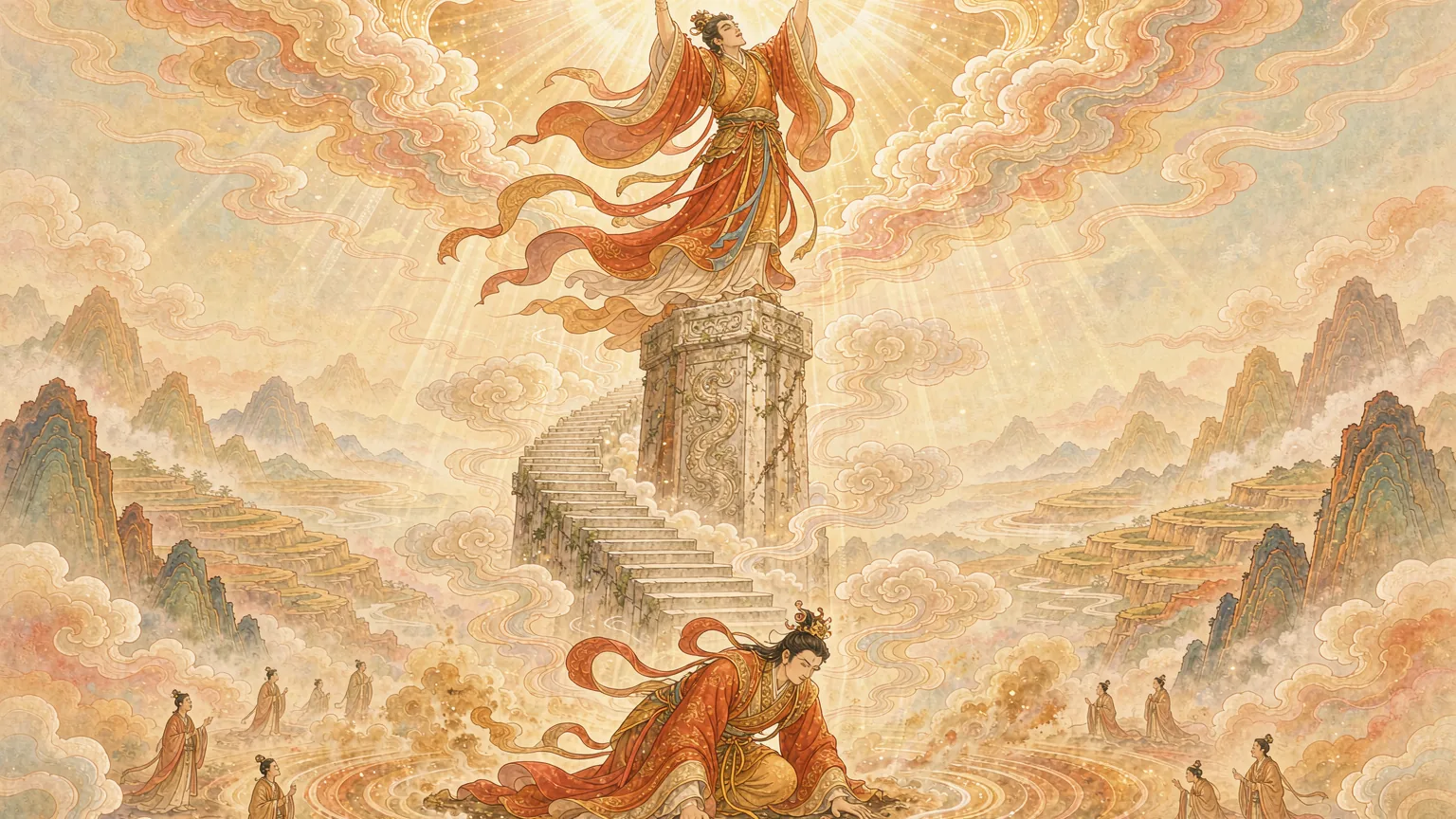
The man who cleaned up that mess was Zhuanxu.
He was a grandson of the Yellow Emperor. His father was Changyi, one of the quieter sons. As a boy, Zhuanxu was sent east and grew up among a tribe called the Shaohao. He came back at twenty and took the throne.
The first great work of his reign was that tangle of gods and men.
He did not ban incense. He did not tear down the altar of anybody. He did something colder and more complete. He took the two duties, the sky and the earth, and gave them to two different gods.
He appointed a god named Zhong to the post of the Southern Director, in charge of everything above. The register of the gods. The forms of sacrifice. Who was permitted to perform them, and on what day. From then on, above, only Zhong had the final word.
He appointed a god named Li to the post of the Fire Director, in charge of everything below. The land. The farming seasons. The ordinary days of human beings. From then on, below, only Li had the final word.
Zhong ruled the gods. Li ruled the people. One faced upward and one faced down. And the doorway between them now had a guard standing in front of it.
The old books name this act in six characters. For more than two thousand years those six characters have been repeated.
Jue di tian tong. The earth and the sky were severed.
The moment of the cutting was far larger than six characters.
Later storytellers describe it as Zhong lifting the sky while Li pressed the earth down.
Zhong stood on the pillar that held up the sky, took the sky in both hands, and pushed it up. Every inch he pushed, the sky rose an inch. Li braced his feet on the ground and pressed. Every inch he pressed, the earth grew thicker.
The sky climbed higher. The earth settled deeper. And the stretch between them, the part that used to be a road, was pulled longer and longer. It was drawn out until nobody could walk it. The sky was above, so far away that it was only a color. The earth was below, so deep that no one could dig to the bottom of it.
The lifting could not be undone. Once the sky was high, it could not be brought back down. Once the earth was thick, it could not be peeled up again. The arms of Zhong stayed raised. The feet of Li stayed planted. Neither of them dared to let go for even a moment.
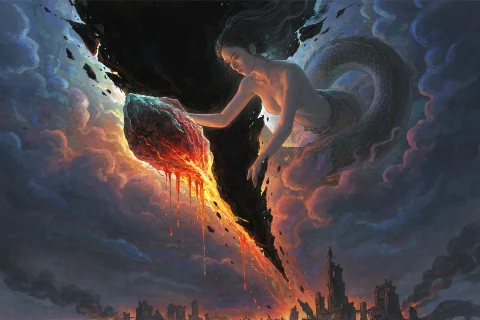
There is another telling in which the sky fell by itself. A monster named Gonggong fought Zhuanxu for the throne and lost. In his rage, he butted his head against Mount Buzhou, the mountain that held up the sky, and snapped the pillar. The sky tore open and slid down from the west. Rivers changed their courses. That version is bloodier and became the more famous one. Both versions arrive at the same end. The road was gone. People and gods were separated for good.
When the road closed, the first ones to understand were not the gods. They were the people.
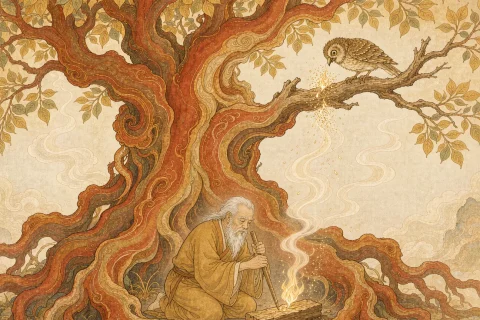
One man refused to accept it. He loaded firewood on his back and climbed the old route, looking for the place where the road had been cut. He walked for seven days. He came at last to the flat stone where a messenger used to stand and carry his words upward. The stone was still there. The wind was still there. He lifted his face and shouted his words into the air.
His words came back down to him. No echo, and nobody to answer.
He refused to believe it and shouted for three more days. On the fourth morning he untied the firewood, stacked it on the stone, and set it alight. The fire burned the way any fire burns. The smoke went straight up, thinned in the middle of the sky, and took nothing with it.
He went down the mountain. In the village the children were still burning incense the way they always had. The smoke still went up. Only nobody answered anymore.
The hardest loss was not felt by ordinary people. It was felt by the ones whose whole trade had been that road. In the old days, a man or a woman who could speak with gods belonged to a profession. They had titles, teachers, and formulas handed down from a master. They carried the affairs of people up and brought the words of gods down. Now the road was closed and the skill was worth nothing. They still built brushwood piles on the mountain. They still recited the old formulas. They still burned incense at the old hours. Then they looked up, and there was only emptiness.
Once the road was closed, a new rule took shape.
Sacrifice to heaven stopped being something anyone could do. It became something only one person could do.
That person was the king. For the next several thousand years, only the Son of Heaven could sacrifice to heaven. Only the Son of Heaven could perform the great rites on the sacred mountains, the ceremony the Chinese called feng shan. Only he could stand at the highest point and speak to the sky on behalf of everyone alive. A local lord was not permitted. A scholar-official was not permitted. A farmer least of all. That single rule grew out of the day Zhuanxu divided the two realms.
An old book of marvels, the Classic of Mountains and Seas, leaves one strange line about Zhuanxu. It says that when he died, he revived. The line has puzzled readers for centuries. Some say he went north afterward and became the god-king of the north, ruling winter and the dark. Others say he did nothing at all, and simply lived so long that people forgot whether he had been a man or a god.
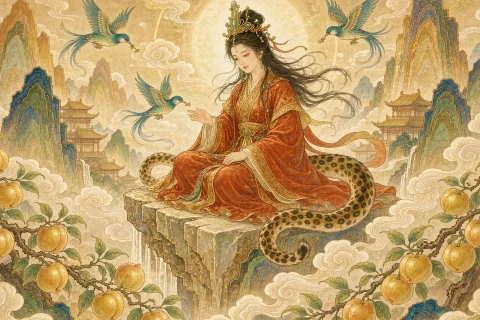
And then there is the part that seems to argue against the whole story. The famous journeys upward all happen after the road was closed. Chang E swallowed the elixir and flew to the moon. The Yellow Emperor rode a dragon into the sky. King Mu of Zhou drove a team of eight horses west to visit the Queen Mother of the West.
In other words, not one of them walked up. They flew. They were carried. Or a god simply chose to take them.
By their own two legs, people could not go up anymore.
In the centuries that followed, the rites on the mountain grew grander every year.
The bronze vessels grew heavier. The jade was chosen more carefully. The calendar of correct days was written down and copied, generation after generation. It became an enormous, orderly, beautiful ceremony. It also became something performed mainly for the eyes of other people, because from above there was never any reply.
Still, the ones who burned incense kept looking up.
The sky was there. The clouds were there. The light was there. All of it present, and none of it speaking.
Some say Zhuanxu cut too deep. Others say that if he had not cut, people would have drowned long ago in the gods they invented for themselves, since when everyone speaks for heaven, heaven is gone.
Both arguments hold. But on one point everyone agrees. Since that day, the stretch of road between people and heaven has never been rebuilt.
Look at the Tower of Babel and you will see the same fear told from the other side. In that story, people try to build a stair up to heaven, and heaven stops them and scatters their languages. In the Chinese story, heaven does not scatter anybody. A single ruler quietly shuts the door, and the confusion ends. One tale is about ambition punished. The other is about order restored at the price of a loss. The Chinese version does not decide whether the trade was worth it.
And even now, people still look up.
What they see is cloud.