The stone on the top of the mountain was not something that grew there.
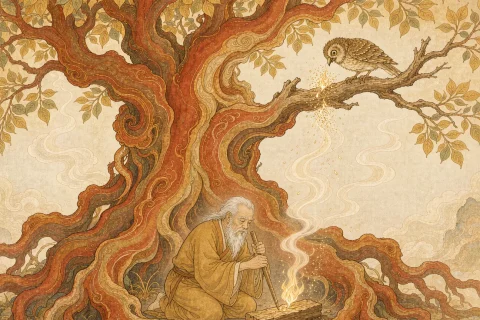
It had stood on that peak since the day the sky and the earth were pulled apart. It was thirty six feet and five inches tall, and the height matched the three hundred and sixty five degrees of the heavens. It was twenty four feet around, and the measure matched the twenty four divisions of the farming year. Nine openings and eight holes were cut into it, arranged like the eight trigrams of the old divination. No tree grew nearby to shade it. Orchids and angelica grew at its feet.
A stone, standing there, for a number of years that nobody counted.
The great novel called Journey to the West opens with this stone.
The book says that the stone received the finest essences of heaven and earth, and the light of the sun and the moon, for so long that a spirit took shape inside it. One day the stone split. Out of it rolled a stone egg, the size of a ball. The egg met the wind, and the wind turned it into a monkey, with a full set of features and four complete limbs.
The monkey could crawl and walk as soon as it was born. It bowed to the four directions. When it opened its eyes, two beams of golden light shot out of them, up into the sky, bright enough to light up the palace of the Jade Emperor.
Where it landed, the grass was pressed into a hollow. The tribe of monkeys had always lived under that stone, and nobody could say in what year it had first been set there. Then a crack opened in it, a round ball rolled out, and where the ball came to rest a monkey stood up.
The watching monkeys took half a step back. Then they took half a step forward. They looked at him for a long time, and none of them left.
The Jade Emperor sent two officials to look. One could see a thousand miles. One could hear a thousand miles. They came back and reported that this was a creature born of the pure essence of heaven and earth, and that there was nothing to be alarmed about.
The Jade Emperor said one thing. Let him alone.
That single sentence let loose a thousand years of trouble.
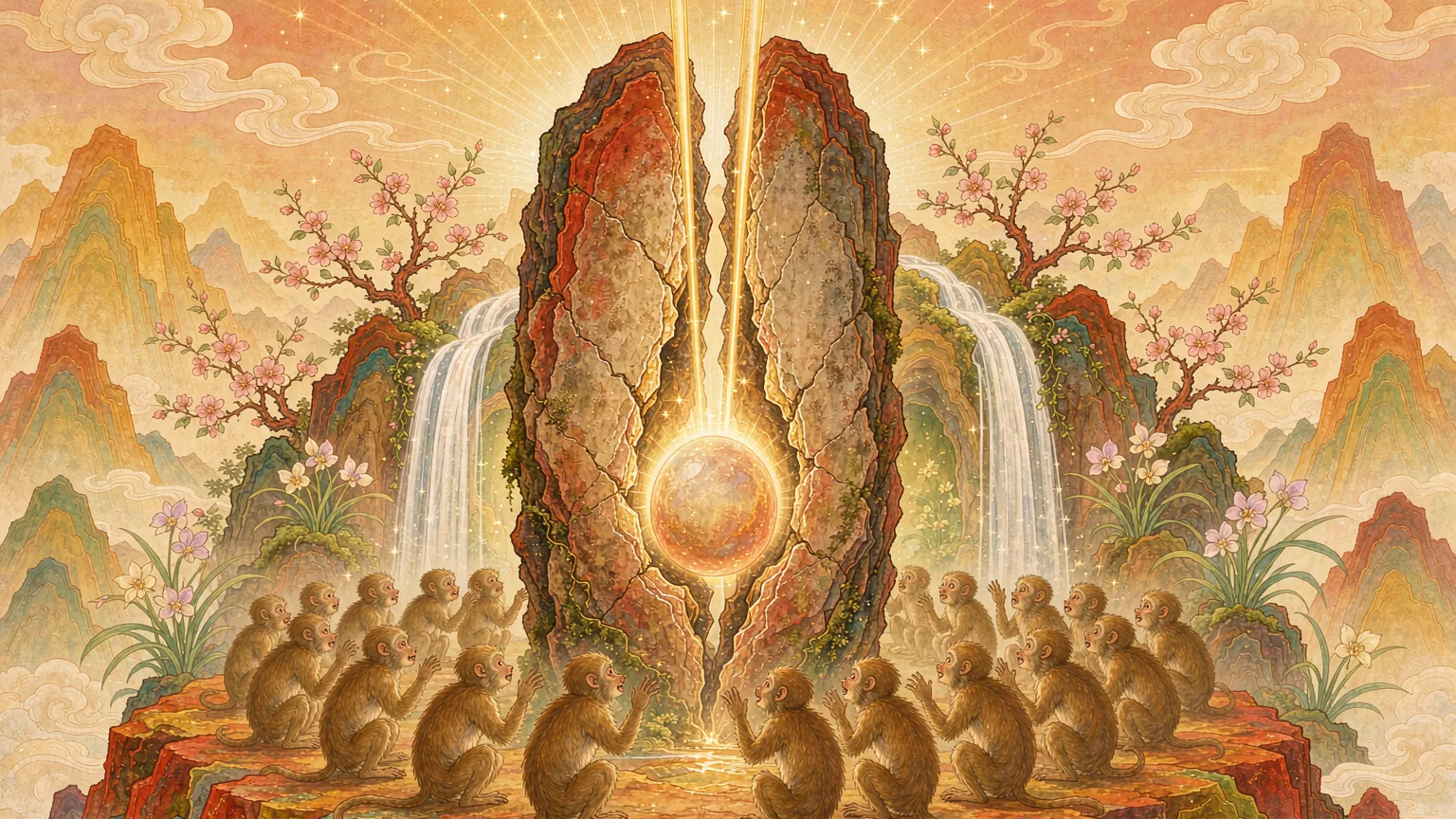
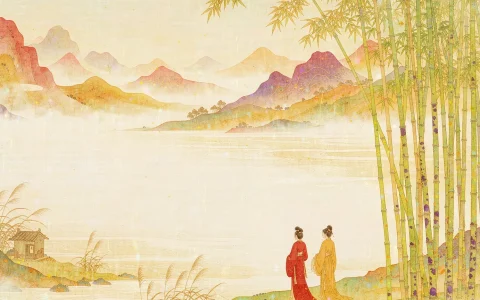
The monkey lived on the Mountain of Flowers and Fruit, in the company of a whole tribe of monkeys.
One day the tribe was bathing in a stream, and they followed the water up to its source and found a waterfall. The waterfall hung like a white sheet of cloth from the cliff. The monkeys said to each other: whoever can go in through that water and come out again without hurting himself, we will make him our king.
The stone monkey stepped forward and said, I will go in.
He dived straight into the falling water.
There was no water inside. Behind the fall stood a stone bridge, and beyond the bridge was a cave, and inside the cave were stone pots and stone stoves and stone bowls and stone basins and stone beds and stone stools, all arranged neatly, as though somebody had lived there once and gone away. In the middle stood a stone tablet, and on it were carved these words. Here is the blessed ground of the Mountain of Flowers and Fruit, and the cave of the Water Curtain.
He jumped back out through the water and brought the whole tribe in with him, one by one. The monkeys seized pots and bowls and fought over the stoves and the beds. When the noise died down, they knelt in front of him and called him the Great King of a Thousand Years.
The stone monkey dropped the word stone from his own title, and took the name the Handsome Monkey King.
He ran the cave well. The old monkeys lived on the east side and the young ones on the west. Some gathered fruit and some kept the gate and some tended the fire, and every one of them had a job. The mountain gave peaches and pears and dates and loquats all year round, and the stream was full of fish and shrimp. He was king there for several hundred years. The rules settled into place, and the days grew easier and easier.
The Handsome Monkey King lived like that for three or four hundred years.
Then one day, in the middle of a drinking party, he began to weep.
The monkeys panicked and asked him why. He told them the truth. We are happy now, he said, but eventually we will grow old, and then we will die, and once we are dead we belong to the king of the underworld.
An old monkey in the tribe, one whose arms were long enough to reach across trees, stepped forward and said: Great King, in this whole world only three kinds of being escape death. The Buddhas, the immortals, and the gods. If you want to live forever, you have to go and learn.
The next day the Handsome Monkey King set out. He built a raft, tied fruit to it, and pushed off across the ocean.
He came first to the eastern continent, where the humans live. He mixed with the crowds and learned their speech and their manners, and picked up some of their faults as well. He searched for eight or nine years and found that everyone there was busy fighting and grabbing, and not one of them could even say the words life without end.
So he crossed another ocean and came to the western continent.
On a mountain called the Mountain of the Mind, in a cave called the Cave of the Slanting Moon and the Three Stars, he found a master.
Readers have noticed a second layer in those two names. The Mountain of the Mind is the mind itself. The Slanting Moon and the Three Stars, drawn together, make the Chinese character for heart. The master lives inside the mind, and the thing the monkey has come to learn is not somewhere else.
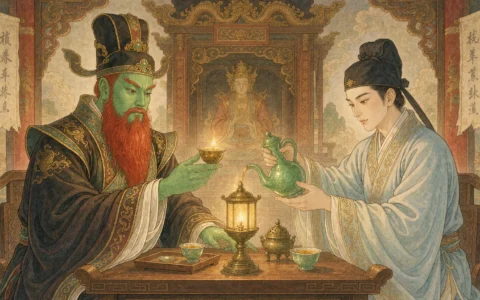
The master was named Subhuti, an old man with no visible age. He asked the monkey for his surname.
The monkey answered: I have no temper. If people curse me I do not get angry. If people strike me I do not resent it. So I have no nature.
The master said: I did not ask about your nature. I asked what surname your parents gave you.
The monkey said: I have no parents. I was born out of a stone.
The master was quietly pleased. He had taught many students, but a creature formed by heaven and earth was new. He said: You look like a macaque. The old word for macaque loses its animal radical and becomes another character, and that character is Sun. I will give you the surname Sun.
And a personal name. The master said: My school has twelve generation names. Yours is the generation of Wu, which means awakening to emptiness. So your whole name will be Sun Wukong. In English, the Monkey Who Has Awakened to Emptiness.
That is how the Monkey King got his name.
The name came first. The powers came later.
The master did not teach him anything at once. First he set the monkey to chores. Sweeping the courtyard. Weeding the garden. Pruning the flowers and tending the trees. Gathering firewood. Carrying water.
That went on for seven years.
Then one day the master mounted his platform and asked the monkey what he wanted to learn. I have a school of divination, he said, and a school of chanting and images, and a school of sitting in stillness, and a school of mixing cinnabar for long life.
The monkey asked one question. Can these make me live forever.
The master said: No.
The monkey said: Then I will not learn them.
The master lost his temper. He jumped down from the platform, struck the monkey three times on the head with his ruler, folded his hands behind his back, walked into the inner room, and shut the middle door.
The other students grumbled at the monkey for ruining the lecture. The monkey only laughed.
He had understood. Three strikes meant the third watch of the night. Folding his hands behind his back and shutting the middle door meant coming in by the rear entrance.
At the third watch he crept to the master and knelt at the foot of the bed. The master was pleased to see him, and taught him the secret of living without end. Later he taught him the seventy two transformations. He taught him to ride the clouds, so that one somersault carried him a hundred thousand miles.
Once he had the powers, the trouble came with them.
One day his fellow students asked him to show off. He changed himself into a pine tree, and the whole crowd clapped and cheered. The noise was loud enough to bring the master out.
The master called him in and said: Why must you perform. If others see that you can do this, they will beg you for it. If you teach them, they will use it against you. If you refuse, they will turn on you. Your life will be ruined by this in the end.
He sent the monkey away and forbade him to mention his teacher to anyone. Then he said one cold thing more. When you leave here, you will certainly do harm. Whatever trouble you make, do not say that you were my student.
The monkey bowed, turned a somersault, and went home to the Mountain of Flowers and Fruit.
At that point he still did not know what heaven was, and he had never heard of the mountain with five fingers.
That is where the business of the stone ends.
A stone that stood for a million years. A monkey. A name. A set of powers. Put those four things together and you have the Monkey King, the one who would later fight all of heaven and then sit under a mountain for five hundred years.
The Greeks had a god called Mithras, who was said to be born out of a rock. They also had a Titan called Prometheus, who stole fire and gave it to human beings, and was chained to a cliff while an eagle came every day to eat his liver. Those two stories stay apart.
This Chinese monkey joins them into one. He is born out of stone, and he is buried under a mountain for refusing to obey.
The stone gave him his life, and it gave him his hard head as well.
The monkeys are still on the Mountain of Flowers and Fruit.
The cave behind the waterfall is still there, with the stone pots and the stone bowls. The rest of the story is long. He went down to the dragon palace and took the iron staff. He went down to the underworld and struck his own name out of the register of the dead. He took a post in heaven, rebelled against heaven, and was finally pinned under a mountain, fed on molten copper and iron pellets, where he waited five hundred years for a monk to come from the east.
But all of it begins with one stone on a hilltop.
The stone simply stood there. It did nothing at all. It waited to crack open.