Take a copper coin with a square hole in the middle. Cover the mouth of a bottle with it. Now pour a thin stream of oil through that hole without touching the coin. If you can do this, you have a skill. Nobody watching will care how long you practiced to get it.
The Chinese idiom is 熟能生巧, in pinyin *shu neng sheng qiao*. Familiarity gives birth to skill. Not talent, not luck. Repetition, until the hands know more than the head does.
This Chinese fable comes from a short book called Records of Returning to the Fields, written by the scholar official Ouyang Xiu in the eleventh century. He wrote it in retirement, from notes on things he had seen and heard. This is one small thing he heard.
In the reign of Emperor Zhenzong of the Song dynasty, there lived a man named Chen Yaozi.
The man who wrote this down was Ouyang Xiu. Late in life he retired to Yingzhou and set down, in a small book, the things he had seen and heard at court and outside it. He called it Records of Returning to the Fields, meaning notes made after going back to the farm. Most of it is about famous ministers and strange local customs. Then there is a small thing like this one.
Chen Yaozi had come first in the imperial examination, and he held high office, and after his death the court gave him the honored name Kangsu. He and his elder brother Chen Yaosou both came first in the examination, one after the other. Two top graduates from a single household was a remarkable thing in that age. And yet when people of his day spoke of Chen Yaozi, the first thing they mentioned was not his writing. It was his archery.
There is one more thing to know about the setting. The Song dynasty prized letters above arms. A scholar official was supposed to be known for his prose, his principles, his conduct. Bows and arrows were not what a civil official was expected to boast about. Chen Yaozi happened to love archery, and happened to be very good at it.
He often brought it up himself.
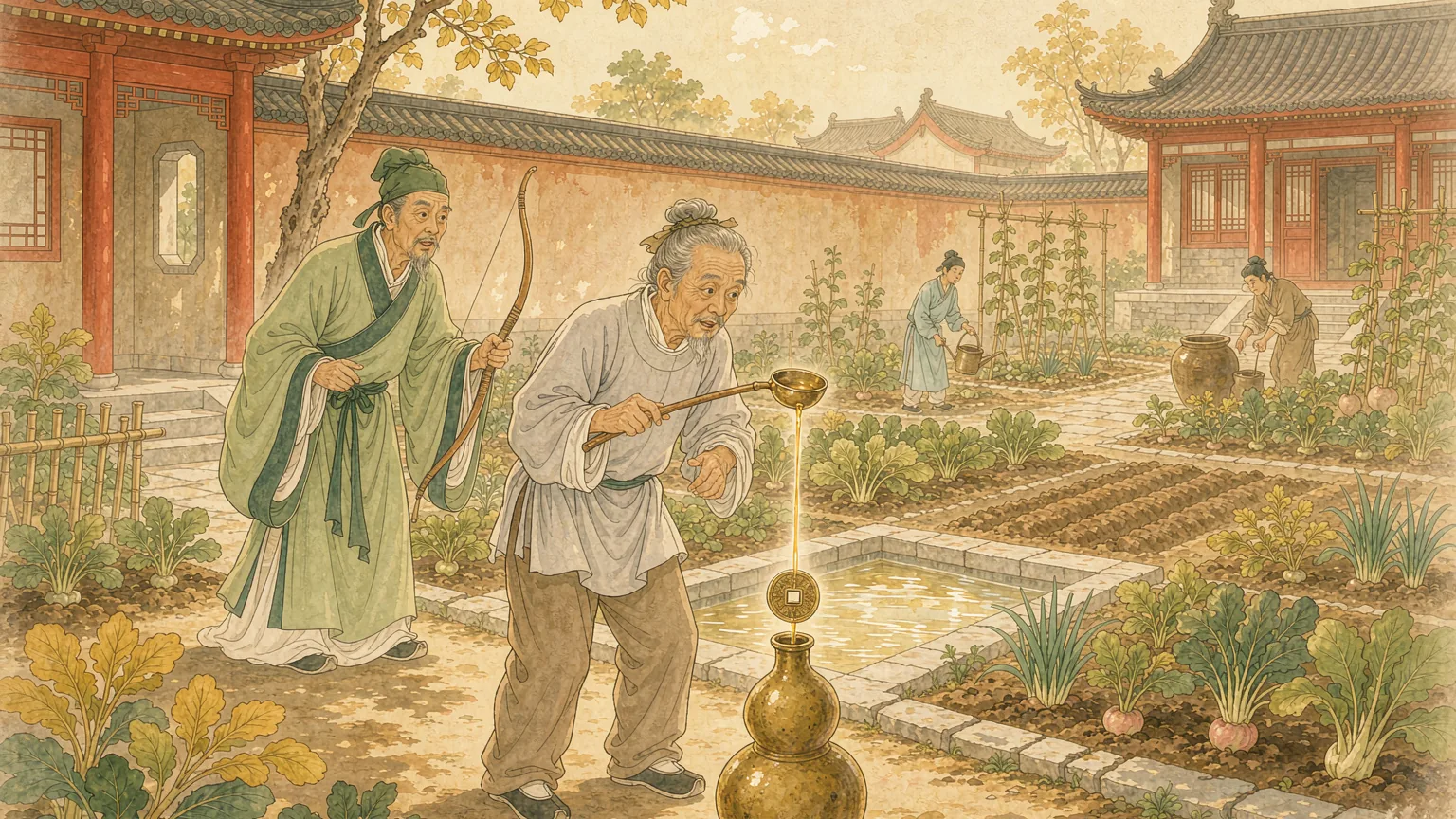
One day he was practicing in the vegetable garden of his house.
The garden was a patch of open ground behind the house, with a straw target set up at one end. He stood at the other end, nocked an arrow, drew the bow, and shot. Hit. Drew again, shot again. Hit again. Out of ten arrows, eight or nine found the target.
The bow was a good one, and the string was strung tight. The string sang as it released, and the arrow stood in the target. Draw, aim, release, and never a step out of order. By any standard of the day, this was one in ten thousand. He knew it, and he was pleased.
Outside the garden wall stood an old man selling oil.
The old man carried his oil on a shoulder pole, and he had set the pole down to watch. He did not come closer and he did not speak. He stood there with his eyes half lowered, watching one arrow after another. He stayed a long time and did not leave.
With every hit, Chen Yaozi was waiting for a word of praise.
The old man watched him hit eight or nine out of ten, and gave a very small nod.
Just one.
The archery of Chen Yaozi was said to have no equal in the age. But this old man with the oil pole watched it the way a man might watch someone sweep a courtyard. The nod meant something close to: that is done well enough.
Chen Yaozi could not hold it in.
He stopped and walked over and asked the old man: do you understand archery? Am I not a fine shot?
The old man answered evenly. There is nothing special in it. Your hand is familiar, that is all.
That sentence set Chen Yaozi alight.
His voice changed. How dare you look down on my archery?
A top graduate, a shooter with no equal in his generation, told to his face by an oil seller that there was nothing special in it. That was not a thing to swallow.
In those years, the worst charge a scholar official could suffer was the charge of pride. Chen Yaozi knew perfectly well that he talked about his archery too much, and that it had already drawn comment. But when a man with a carrying pole said it to his face, he still could not keep quiet.
The old man was not rattled.
He said: I know it from pouring oil.
Then he bent down and took one thing off his pole, a gourd bottle, and set it on the ground. From his coat he took a copper coin and laid it over the mouth of the gourd. Old coins of that kind had a neat square hole in the middle, smaller than a fingernail.
He lifted a ladle of oil and held it above the coin.
The few people standing around went silent.
The old man tilted his wrist, and the oil came off the ladle in a thin line. It did not waver. It did not shake. It went straight down through the square hole in the coin, and dripped into the gourd.
When the oil was gone, there was no speck of it on the coin. The rim of copper around the hole was clean and dry.
A whole ladle of oil had gone into the gourd that way.
The onlookers stared. Archery was a peerless skill, but archery had a bow and a target. A thin stream of oil had to pass through a hole the size of a thumbnail, and the smallest shake of the hand would spill it across the coin and outside the bottle. That steadiness was hard work, plain and simple.
The old man set the ladle down and wiped his hands.
Then he said to Chen Yaozi: I have no other skill either. My hand is familiar, that is all.
The same sentence. A moment before, it had been a needle. Now it was proof.
Chen Yaozi stood there, and then he laughed.
He did not get angry again. He waved a hand and sent the old man on his way.
The record closes with four characters. He laughed, and let him go. Whether that laugh was embarrassment or honest admiration, the old text does not say. But anyone reading it knows which man walked away having proved his point.
The old oil seller is not even given a name in the book.
Ouyang Xiu calls him the oil seller and nothing else. He arrives with his pole, pours one ladle of oil, says two sentences, and leaves. He holds no office. He has no name. He has probably never once stood inside a court. And with one sentence he quieted a top graduate and the best archer of his generation.
Out of this small scene, later generations coined the four characters 熟能生巧.
The words sound plain, and people often use them backwards. Some use them to calm an impatient student. Take your time. Do it enough times and it comes. That is true. Others use them as an excuse. I will get familiar with it eventually, so why put in the work now.
The old man makes it clear that this is not how it works.
His skill was not something he waited for. It came from carrying the oil pole every day, and pouring one ladle at a time. The pole pressed on his shoulder. The ladle sat in his hand. How many ladles a day, how many streets a month, no ledger kept. The steadiness was saved up one ladle at a time. He did not call himself clever, and he did not claim a gift. He said one true thing. Nothing else. The hand is familiar, that is all.
That small piece of skill was hidden behind a great many days of early rising. People only saw the moment the oil passed through the hole. They did not see how many times it missed. The same was true of the archery of Chen Yaozi. Eight or nine out of ten came after tens of thousands of arrows.
This Chinese fable is not a tale for children. Stripped down, it is a Chinese proverb with a bottle and a coin in it.
Skill is the fruit, and practice is the root. No mastery is ever waited into being. It can only grow inside repetition. The square hole in the coin is not easy to hit. Hit it enough times, and the oil itself learns the way. What the hands remember stays longer than what the mind remembers.