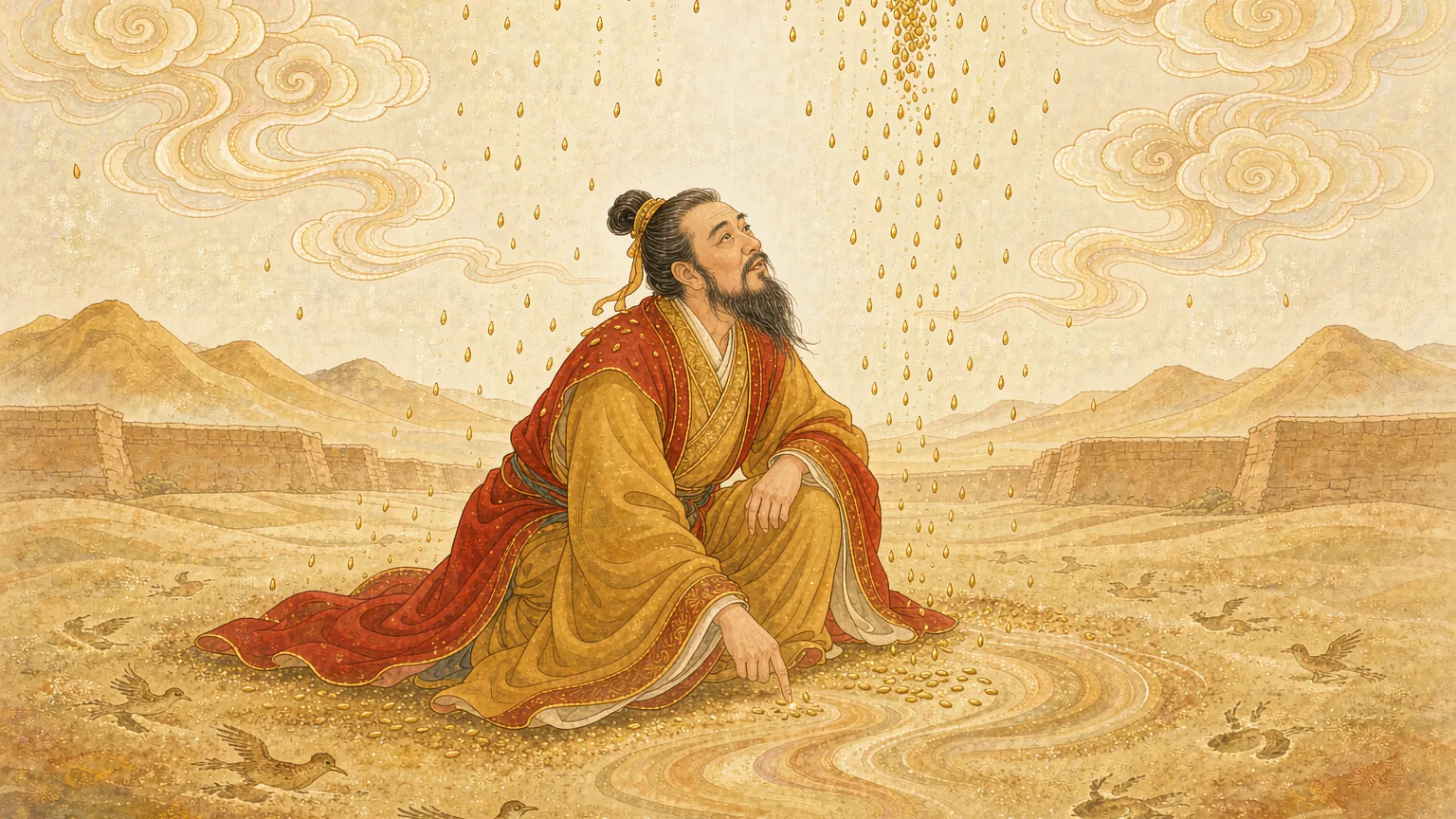
On a certain night, grain fell out of the sky.
Not rain. Millet. Small yellow grains coming down out of the dark, one after another, until the ground was covered.
And on the same night, the ghosts began to cry.
The account of this is in the Huainanzi, and it is eleven characters long.
It says: long ago, when Cangjie made writing, heaven rained millet, and the ghosts wept at night.
Eleven characters. In them is the heaviest invention in Chinese myth, and also three questions that do not answer themselves.
Who was the man? Why would heaven pour grain down on the world? And why would ghosts cry?
Before going further, it is worth knowing that another old civilization told a story about the first writing, and told it with the same doubt in it.
In Egypt, writing belonged to Thoth, the god of scribes, who was also the god of wisdom and of magic, and who is usually drawn with the head of an ibis. The Greeks later gave him the name Hermes.
Plato recorded a story about him. Theuth, as the Greeks called him, came to the king of Egypt and offered him the art of writing, and described it as a recipe for memory and for wisdom. The king did not accept it. He said that writing would do the reverse. It would produce forgetfulness, because people would stop exercising their own memory and would rely on marks outside themselves. And it would give them the appearance of wisdom without the reality, because they would be able to repeat a great deal and understand very little.
So Egypt gave writing to a god, and then put an argument against it into a king mouth.
The Chinese version does the same thing with more drama. Chinese mythology and Chinese legends do not ask a king to object. They make the sky and the dead object instead, and they make the objection physical. Grain comes down, and something starts crying.
Both cultures, in other words, greeted the same invention with the same halfway look. It is the most useful thing anybody ever made, and everybody was right to be nervous.
Start with the man.
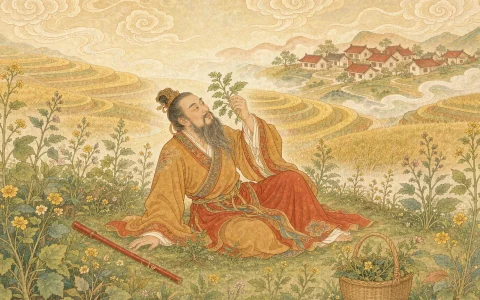
Cangjie was the scribe of the Yellow Emperor. The word for his office means the one who keeps the record. He stood beside the emperor and wrote down the dates of campaigns, the names of allies, and the fields that had been handed out.
Before writing, people kept their records with knots.
A big event got a big knot. A small event got a small knot. How much the harvest had been this year, so many knots. How many goats had been lent to a neighbor, so many knots. The old books call that period the age of government by knotted rope.
A rope has one weakness. It can remember how much, and it cannot remember what.
A string of knots will tell you that three goats went out. It will not tell you whose they were, or when they went, or whether they came back. That was kept in a person head. And when the person died, the string became a row of meaningless lumps.
Writing, as the story tells it, began with footprints.
The Han dynasty dictionary of Chinese characters says it plainly. It says that Cangjie, the scribe of the Yellow Emperor, saw the tracks of birds and animals on the ground, and understood from them that separate marks could be told apart from one another, and so he first made written signs.
That sentence is the root of the whole story.
He did not copy his characters down from heaven. He read them off the ground. A bird crosses wet earth and leaves a print. A deer crosses and leaves a different print. The print is not the bird. But the print can tell you that a bird went by.
That idea is the idea of writing.
The old books also gave him an appearance. They said he had four eyes.
Later paintings of Cangjie often show him with two ordinary eyes and two more beneath them, glowing. This is not a claim about anatomy. It is a clumsy and rather good way of saying one thing. He saw more than other people saw. Another person saw a bird. He saw the print that the bird left behind. Another person saw a bundle of knots. He saw that the knots could be replaced by something better.
And the descriptions of him are always doing the same thing with his eyes. He looks up at the curve of the stars. He looks down at the patterns on a turtle shell and the scratches under a bird claw.
Sky, ground and living creature, all three lined up in front of him, and then he drew the first character.
The characters were drawn out one at a time.
He began with the sun. The sun is round, but too many things are round, and a circle alone tells you nothing. So he put a dot inside the circle. That is the character for sun.
He drew the moon as a curved hook, because the moon is usually a hook.
He drew a mountain as three peaks. He drew water as a few strokes of a wave. He drew a person as the shape of a standing figure seen from the side, arms hanging. He drew a bird and an ox by looking at a bird and an ox.
Then he crouched on the ground and drew with his finger in the dirt.
People came and stood around him. On the ground in front of them were the things they looked at every day. A sun. A mountain. An ox.
It was the first time anybody had realized that the thing in front of your eyes could be put down on the ground.
And immediately a new problem appeared. On what grounds should anyone accept it?
He pointed at one mark and said, this is a sheep.
Somebody asked him: is this mark the same thing as that sheep standing over there?
He said no. The sheep walks, eats grass, and gets old. This does not.
The man asked: then what is it?
The old books do not record his answer. Later readers supplied one.
It is the shadow of the sheep.
A shadow follows a sheep around. When the sheep walks away, the shadow stays on the ground. And once you have the shadow, you can talk about sheep while no sheep is present.
That is writing. It does not carry the thing away. It keeps the shadow of the thing.
Now the night itself.
The Huainanzi puts the falling grain and the weeping ghosts in the same sentence, happening together. A commentator of the second century, Gao You, joined the two explanations into one passage, and it is the most famous piece of commentary on this myth.
It runs like this. When Cangjie first looked at the marks of birds and made written signs, then falsehood began to sprout. And once falsehood began to sprout, people left the root and ran to the branches. They abandoned the work of farming and gave themselves to the profit of the awl and the knife.
The profit of the awl and the knife. That is a way of describing the small money that comes from the point of a pen and the point of a blade. Writing a petition. Drawing up a contract. Buying and selling. Small money, but faster than a field.
Heaven knew that people were going to go hungry, and so it rained millet. And the ghosts were afraid of being impeached by documents, and so they wept at night.
Read that passage carefully and the two reactions turn out to be the same judgment.
The moment writing exists, people change.
Heaven worried about the stomach. Once a person can write a contract, he stops being willing to stay in his field. The ghosts worried about reputation. Once a person can write, guilt and merit have proof, and everything a ghost has ever done can be written down and held against it.
So heaven threw food down out of the sky, and the ghosts got their crying in early.
One act of pity and one act of fear, on the same night.
There is a second reading of the falling grain, and it is almost the opposite of the first.
Some say the grain was a gift. Writing was so valuable that even heaven brought a present.
Others say it was not grain at all, but rain, and that on a dark night rain can look like grain coming down, and that later storytellers turned a rainstorm into a miracle.
Which reading is right, the old books do not say.
What is worth noticing is that in every version, one detail never changes. Whatever the grain means, the ghosts are crying.
Because whether writing is a blessing or a curse, one thing about it is certain. It remembers.
There is one more layer, and almost nobody talks about it.
The philosopher Han Feizi wrote a line about Cangjie that is very strange and very precise. He said that when Cangjie made writing, a line that curls back around itself he called private, and a line with its back turned away from itself he called public.
The Chinese character for private is a shape that wraps around its own center. Take that shape and turn its back on itself, and you get the character for public. The oldest character forms actually show this. The public character is built from a part meaning to divide or turn away, placed over the private shape.
Open the private shape and you have the public one.
That is the earliest surviving Chinese statement about the shape of a character. And it is not only about a character. It says that from the first day they were made, written signs already contained a judgment about how to live. Turning around your own center, and turning your back on your own center to face other people, were different things from the very first character, and they were different characters.
The shape has come all the way down to the modern script.
Finally, the consequences of that night.
Once there were characters, people started writing things down.
How much the harvest had been. Which three goats had gone out and to whom. What the emperor had said. How much a man had borrowed, how much he had repaid, where he had gone wrong, and what his sentence was.
It was used in the court, in the market, and in the prison. For the first time, guilt and merit had a proof that could be laid on a table and looked at.
And then, later, people began to write down other things. A song. A letter. A line left behind for somebody far away, saying, I was here.
That is the real weight of the night. It was not the invention of a tool. It was the opening of a hole in the wall of forgetting. From then on a person could hand his things to somebody else, to the next generation, and to a thousand years.
Heaven knew people would go hungry because of it. The ghosts knew they would be written down. Neither of them stopped it.
So when you write your own name, it does not feel like an event.
A name on paper. A few seconds.
But the first time it happened, grain fell out of the sky, and the ghosts cried in the dark.
Those two things have been following every character ever since.