In the far west there was a mountain called Jade Mountain, and on it there lived a goddess who was not gentle.
She had the body of a woman, the tail of a leopard, and the teeth of a tiger. Her hair was loose and never combed. On her head she wore an ornament called a sheng. She did not speak so much as scream, and when she screamed, the sound carried out of the mountain and every bird and animal in it went still.
Her name was Xiwangmu, the Queen Mother of the West.
Today, when people hear that name, they picture a plump old lady in jade and gold, seated on a cloud, holding out a dish of peaches. Almost nobody remembers that the first version of her had a mouth full of fangs.
The earliest description is in the Classic of Mountains and Seas, one of the oldest books of Chinese mythology, and it is short.
It says: Jade Mountain is where the Queen Mother of the West lives. Her shape is like a human being, but she has a leopard tail and tiger teeth, and she is good at screaming. Her hair is unkempt, and she wears the sheng. She governs the plagues of heaven and the five mutilations.
Take that apart. A sheng is an ornament that women wore on the head, a bar with two upright ends, like a small balance beam of jade. That word matters. It tells us that even in the oldest text, she was already understood to be a woman, and a female highest god, though nobody had yet bothered to make her beautiful.
Then there is the loose hair. Loose hair, uncombed and untied, was the old mark of the wild. She does not sit down to listen to reason, and she does not keep to the rules of the human world.
As for what she governs, the plagues of heaven are epidemics, the kind that kill a whole village for no visible reason. The five mutilations are the punishments that take pieces off a body. The two things people feared most were disease and the sword. Both of them were handed to the goddess in the western mountains.
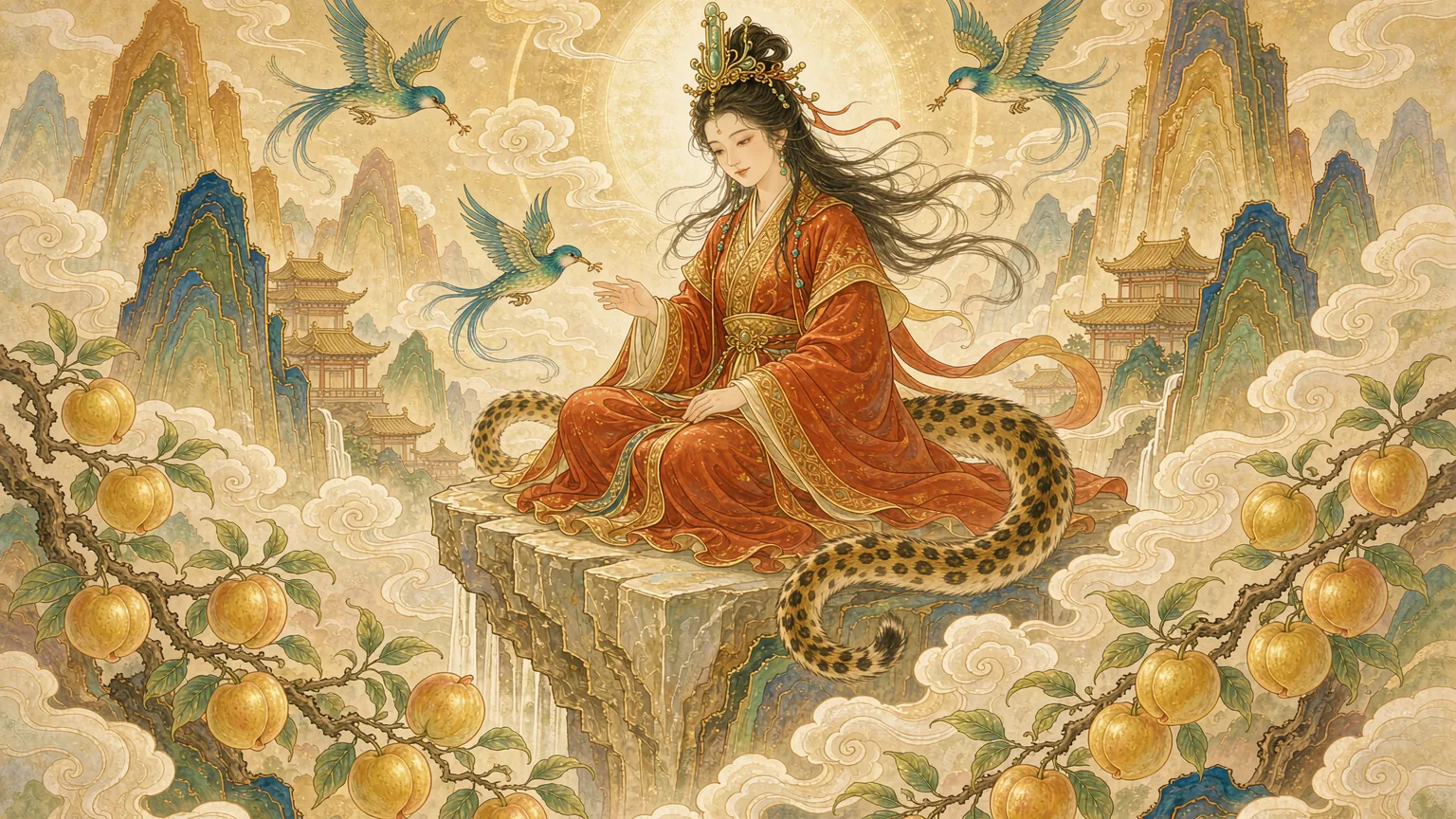
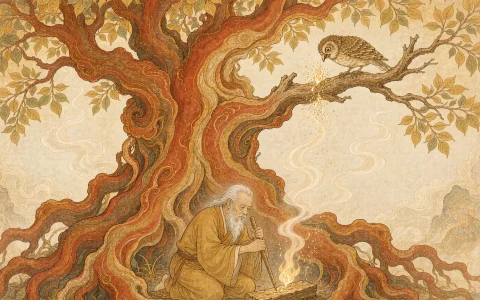
One more detail. To her south, the text says, there are three blue birds. They do nothing else. All day they do one thing, which is fetch food for her.
A goddess who rules plagues and executions, and three birds bring her dinner. That picture stuck in people, and it stayed in people for a thousand years.
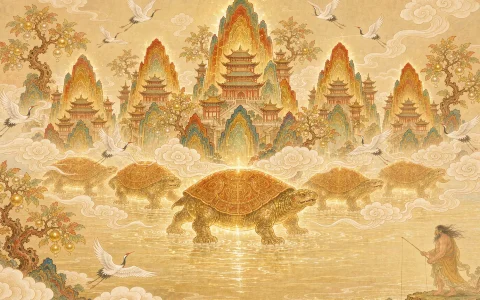
There is also a line placing her on Mount Kunlun, the great mountain of the west, said to rise in nine tiers. Around its foot runs the Weak Water, so light that even a feather cannot float on it. People cannot climb it. Birds can reach it. She lives on the highest tier, alone.
The most important thing she owns is the medicine of immortality.
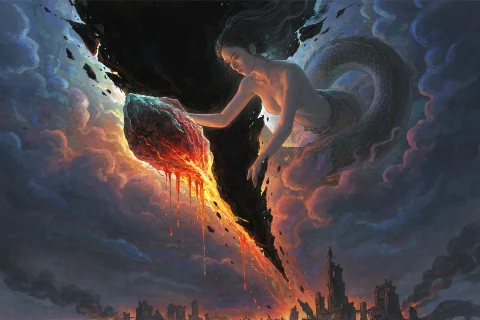
The Huainanzi gives it in one sentence. Houyi asked the Queen Mother of the West for the elixir of deathlessness, and his wife Heng’e stole it and ran away to the moon.
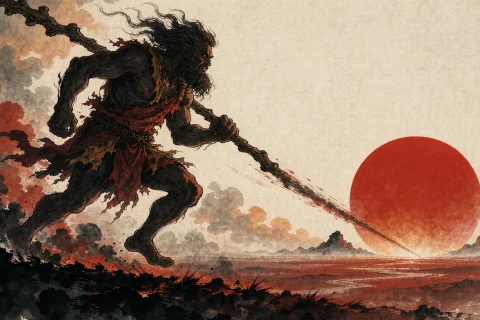
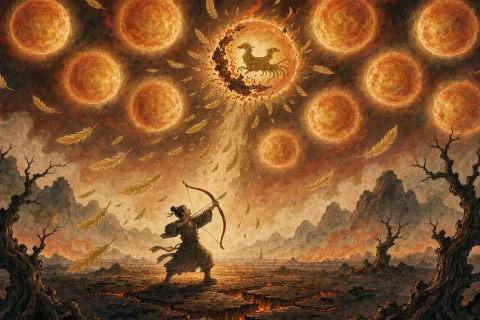
That Houyi is the archer who shot down the extra suns. And where did he go for the elixir? To her. In the eyes of the people of that age, there was exactly one place in the world where you could get a drug against dying, and it was her mountain.
The old books do not say how he got it. But the scene is easy to imagine.
He went west until he came to the edge of the Weak Water. The water was too light to hold a boat, and he stood on the bank a long time. Then the three blue birds came flying over the surface, carrying a small medicine pouch, and put it into his hands. He lifted his head to thank her, and from the mountain came one long scream.
Then he understood. He had not met a kindly spirit. He had met someone who looks at you first, and only then decides whether to give.
So she holds two things at once. One is punishment, plague and killing. The other is reward, long life. And that is the only way it makes sense. The one who can take a life is the one with the standing to hand out more of it.
Now set this beside the Greek story, and the resemblance is hard to miss.
In Greek myth the west was also where immortality grew. The golden apples of the Hesperides stood in a garden at the far western edge of the world, guarded by a dragon, and the gods themselves ate ambrosia to keep from dying. A mortal who got hold of the wrong kind of immortality could end badly. Tithonus was given eternal life but not eternal youth, and he withered until all that was left of him was a voice.
In Chinese legends of a later age, the west was still her country, and the orchard of immortality stood there under the care of a goddess. But the peach she feeds people is not stolen from her under guard. It is given, or it is refused. And the drug against death that she hands down the mountain does not come with a curse attached. It simply works too well, which is its own kind of trouble, as the woman who flew to the moon with it found out.
The change from screaming goddess to kindly lady happened slowly, and one of the steps along the way came from a king.
The Tale of King Mu records it. King Mu of Zhou rode out with his eight famous horses and traveled a long way west, until he reached the country of the Queen Mother of the West. He brought silk and jade from the central plains. She set out wine for him on the Jade Pool.
The Jade Pool, they say, lies on the summit of Kunlun, and the water is blue in a way this world does not quite produce. The feast was set at the water. The wind came off the surface. A king and a goddess sat across from each other drinking, and neither of them bowed first.
When they were merry, they sang to each other.
She sang first. White clouds are in the sky, and the hills rise by themselves. The road you came by is long, and mountains and rivers lie between us. So long as you do not die, you can come again.
He answered her. I go back to the eastern lands, to keep my people in order. When the ten thousand households are at peace, I will look for you again. In three years, I will be back on this plain.
The three-year promise was not kept.
Some accounts say that after King Mu returned, he never went west again, and in the end he died on the road. The water of the Jade Pool is still there, and the table they drank at is still there. The singers have gone. That exchange of songs became one of the most human partings in all Chinese myth. The two who speak are a goddess and a king, and what worries them is exactly what worries anyone. The road is long, the mountains are high, and the question is whether there will be another meeting.
Later, her courtyard became an orchard.
A book called the Inner Traditions of Emperor Wu of Han tells it in fine detail. On the seventh night of the seventh month, the Queen Mother of the West came down into the palace of Emperor Wu. She brought seven immortal peaches. She gave four of them to the emperor.
When he had eaten them, and found them better than any peach on earth, he saved the pits, meaning to plant them.
She laughed at him. This peach bears fruit once in three thousand years, she said, and it is not a thing that can be planted in the world below.
The peach that ripens once in three thousand years got its name from this, the Peach of Immortality. In one version of the story, a courtier named Dongfang Shuo was hiding outside the window watching, and she recognized him at a glance. She said that he had stolen peaches out of her garden three times already.
Emperor Wu looked at the half peach in his hand and said nothing.
And after that, in the scriptures of Daoism, she became the first among the female immortals, ruler over every woman who had ever achieved immortality, and the heavenly orchard became the place where she held her gatherings. That is where the famous Peach Banquet came from, growing out of the story one layer at a time.
The reason for the change is not mysterious. After the Han dynasty, people wanted very badly to live longer, and whoever held long life was lifted higher. The Queen Mother of the West held the elixir and the peach. And so people preferred to imagine her as a dignified, reasonable old lady. Nobody wants to burn incense every day to a goddess who decides who gets sick and who gets cut.
The Chinese also came to treat peach wood as a charm against evil. They hung peach branches on doors and cut swords out of peach wood. Nobody can say exactly when that began. But who owns the peach tree is a question the old books answer.
From the Classic of Mountains and Seas to the Inner Traditions is about a thousand years.
In that thousand years she changed shape twice. First the Queen Mother of the West, leopard-tailed and tiger-toothed, unkempt, in charge of plague and punishment. Then the Lady Mother, granting peaches and elixirs, seated at the Jade Pool, grave and magnificent.
Some say this is the wild being tamed, a myth filed down by a thousand years of manners. Others say it is not a different woman at all. She was always two-faced, one hand holding out the medicine and the other holding the knife, and the people who came later simply chose to remember the hand with the peach.
Two things never changed.
The three blue birds. She went from screaming goddess to gracious lady, and the birds still fetch her food. Only the place changed, from the stone chamber on Jade Mountain to the banquet by the Jade Pool.
And her address. She is always in the far west. The sun goes down there, and the roads of the human world end there. Long life and death were stacked in the same direction.
Later generations gave her many titles. The Golden Mother. The Lady Mother. The Golden Mother of the Jade Pool. In the temples her statue is a full-faced old woman with flowers in her hair and a dish in her hands.
In the dish there are always peaches.
But go back to the earliest Jade Mountain, and she had neither dish nor flowers. She stood behind the rocks with her hair loose and her tiger teeth showing, and she screamed.
And the birds and the animals of the whole mountain went quiet at once.