Every year in the second month, a bird begins to call in the mountains of Sichuan.
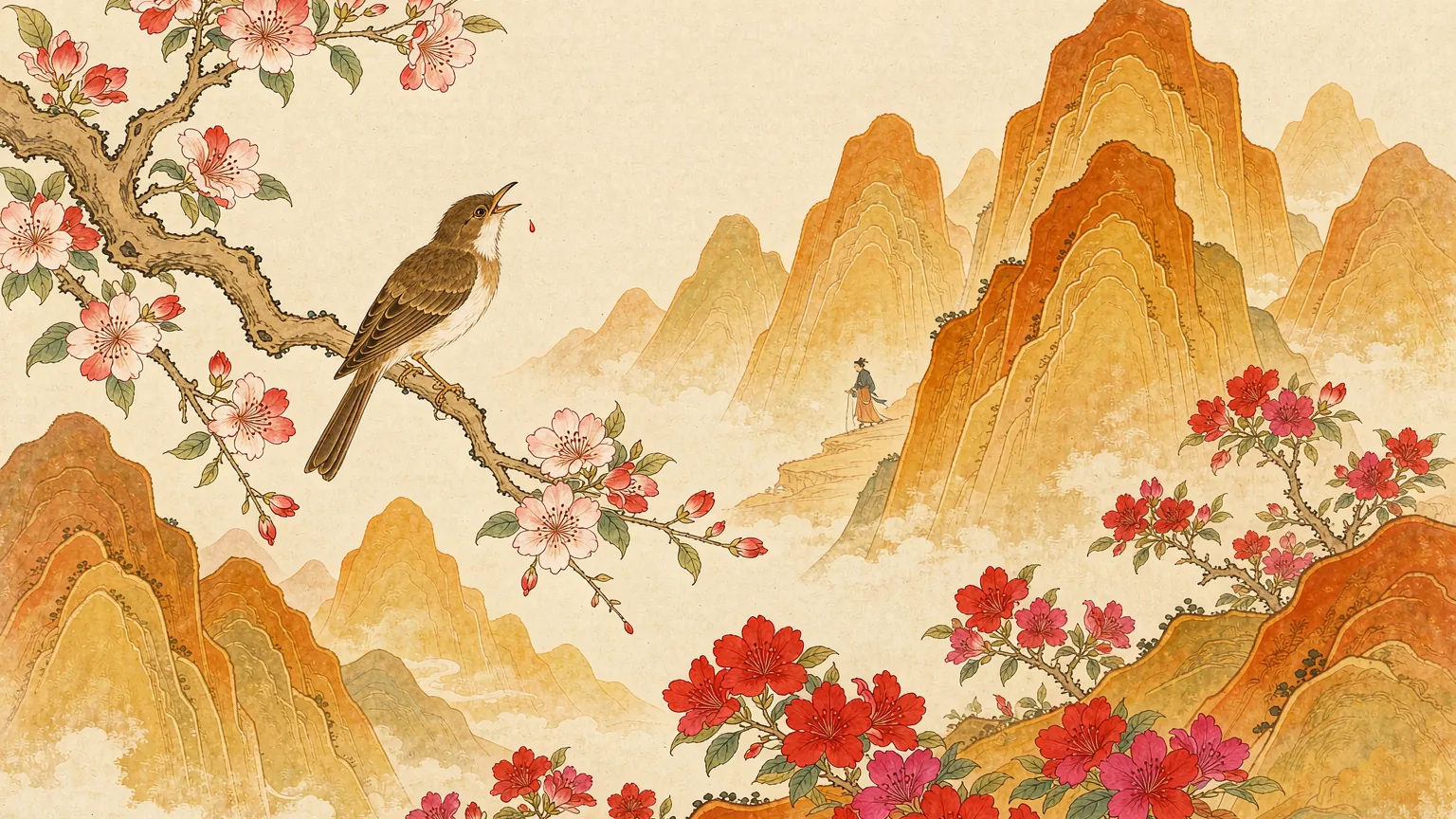
It has only two notes, and it turns them over and over, the same pair again and again, from early spring into the first heat of summer. It does not rest. By the end its voice sounds as though it has been scraped raw. The old people in the hills say it is not the voice that is raw. The bird has called until the corners of its mouth bleed.
The blood falls on the slopes, and the flowers on those slopes turn red.
Those flowers are called the cuckoo flower. That bird is called the cuckoo. And the oldest name for it is Zigui, the one who tells you to go home.
The story survives in two old books of Chinese legends from the southwest, the Records of the Kings of Shu and the Chronicles of Huayang.
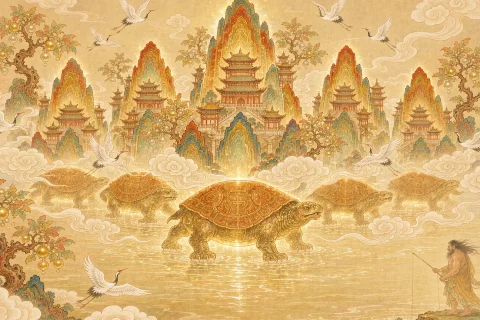
The Records say this. In later times a man appeared, whose name was Duyu, and he fell down out of the sky and came to rest in a place called Zhuti. A woman appeared whose name was Li, and she came up out of a well at Jiangyuan, and she became his wife. Duyu made himself king of Shu, and took the title Wangdi, the Emperor Who Looks Away.
The Chronicles add one important line. Wangdi was the one who taught the people to farm. That is why the people of Shu also called him Lord Du.
These two books were written by different men, one in the Han dynasty and one much later, and both of them are telling the local history of Shu, which does not match up neatly with the histories of the central plains. It does not need to. Shu had its own account of how things began.
So the first king of Shu fell out of the sky. The wife he married came up out of a well. Between the two of them, they started a country.
The falling is not much described. He landed at Zhuti, and he was not broken by it, and when he stood up he was a grown man. He did not know why he was there. He knew only that there was a river nearby, and people along the river, and that the people lived on this one piece of flat ground walled in by mountains.
The woman called Li was pulled up out of the well by the hands of strangers. How a person came to be down a well is never explained. Some said she was a water spirit. Some said the ground itself had produced her. She became his wife, and that is how it began: two people whose origins were never explained, standing at the head of a country.
Wangdi taught the people to farm. How he taught them, the books do not say in detail. It would have been the basics. When to put the seed in, when to let the water in, which soil suits which crop. All of that is written in books now, but at the time each piece of it had to be walked out to a field and explained to somebody bent over the ground.
Now, what kind of place was Shu?
Mountains on every side, and a flat plain in the middle. The mountains kept the water inside the bowl, and the water had nowhere to go.
In ordinary years this was a good fortune. The soil was rich and the water was plentiful. But in a flood year it became a trap. The water could not leave, so it came back. It filled the fields, then the houses, then drove the people up the slopes.
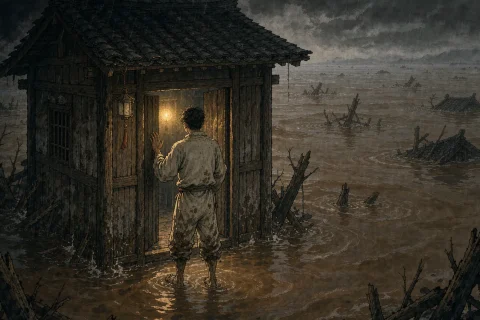
The water rose slowly. One day it was over the ankle in the fields. The next it was at the knee. The day after, it was in the houses. People carried their grain and their children uphill, and turned at the halfway point to look, and saw nothing of their homes but one roof above the surface.
Wangdi had tried to fix the water. He could not.
Then the man came, traveling on the water.
The old book says that one day a body came floating upstream in the river. The people pulled it out, and the moment they laid it on the bank, it opened its eyes and sat up.
The crowd took a step back. Water still ran off the body, and the hair was flat against the neck. He looked around at the people, and the first thing he said was to ask where he was.
His name was Bieling.
In some versions he is called Bieling the magistrate. He arrived out of the water, out of a floating corpse that became a living man, and that in itself was the mark the people of Shu gave him: this one was sent by the river.
Wangdi met him, and made him his minister.
Bieling did nothing else first but go and look at the water. He walked along the river, and walked every pass in the mountains of Shu, and at last he stopped at one place. Jade Rampart Mountain.
The mountain was holding the river back. When the water reached it, the water had nowhere to go, so it turned around and spread. Bieling took men and cut the mountain open. He opened a channel.
Once the channel was cut, the water found its road. The river poured through the new gap and ran east, and the water in Shu went down.
Cutting that mountain was brutal work. The rock was hard, and the tools were wood and stone, and a day of work might open an inch. Bieling stayed at that pass a long time with his men. By day they cut. At night they rested. The chips they knocked off piled up into new slopes.
The flood went down. The fields came back out. The foundations of the houses came back out. The people came down off the mountain and returned to where they had lived.
After the water went down, Wangdi made a decision.
He gave the throne to Bieling.
The Chronicles put it gracefully. Wangdi followed the example of Yao and Shun, the ancient sage kings, and handed the country to the man who had earned it, and went up into the western mountains and hid himself there. Bieling took the throne, and was called Kaiming.
But another version tells it differently.
In that version, while Bieling was away taming the flood, Wangdi and the wife of Bieling were together. When Bieling came back, Wangdi could not face him, and so he gave away the country and left.
One account says abdication. The other says shame. They end in the same place. Wangdi went west, into the mountains, and never came back.
Both versions survived. In the end what remains is a single plain sentence. He could not stay in that seat.
The day he left was in the second month.
He was in the western mountains, and he heard a bird calling.
The old book has one short line for this. When Wangdi went away, the zigui was calling, and so whenever the people of Shu hear the zigui, they remember Wangdi.
But there is a further layer.
Some books say that when Wangdi died, his soul did not scatter. It became a bird, the very bird that calls in the second month. He could not let go of Shu. Every spring he comes back, circles the mountains of Shu, and calls as he flies.
What the call means, nobody can understand. The old people wrote the sound down as four words. Bu ru gui qu. Better to go home. Better to go home.
He gave away the country he had built with his own hands. The flood was tamed by another man. And when he left, the country was still there, and the fields were still there, and the people were still planting. He simply could not go back to it.
The thing he was looking for was still in its place. It was only he who was no longer the man who could return to it.
That bird is the cuckoo.
The name cuckoo originally belonged to a flower. But because the bird calls until its mouth bleeds, and the blood falls on the flowers, the flowers turned red, and the flowers took the name of the bird. Today people call them cuckoo flowers, and also mountain-red, for the way they cover the whole slope.
On the mountains of Sichuan they come out red across the hillsides every spring.
The bird and the flower, one on the branch and one in the sky, share the same name. Nobody can say whether the bird came first or the flower. All anybody knows is that every year, at the same time, the two of them appear together.
In old Chinese poetry, the call of the zigui almost always means parting, or homesickness. Li Bai wrote of willow catkins falling while the zigui cries, in a poem about seeing off a friend. He wrote another line about hearing the zigui cry under the night moon, on the road into Shu, and being too sad to go on. A person from Sichuan hears the zigui and needs no explanation. They already know what it means.
It is the soul of their first king.
One thing should be cleared up about the cuckoo.
There is a bird in Europe that is also called the cuckoo in English. That cuckoo does not raise its own young. It lays its eggs in the nests of other birds and lets them do the work. So in English, the word cuckoo carries a hint of the deceiver, the one who does not own its own children.
The Chinese bird is not that bird.
The Chinese cuckoo is remembered not for its habits but for its voice. It steals nothing and changes nothing. It only calls, and calls, until the corners of its mouth bleed. The same bird, under the same name in translation, carries opposite meanings in the two languages. To an English ear, the cuckoo is the trickster. To a Chinese ear, it is an unquiet ghost that cannot come home.
The Chinese never wrote about the nest, and never cared where the eggs were laid. They remembered two things only. It comes back every second month, and it calls until it bleeds. Whether it was a decent bird was of no interest to anyone.
There is also a Greek layer to this.
In Greek myth, Philomela was wronged, and the gods turned her into a bird, and from then on she sang her grief to anyone who would listen. A bird that sings out its sorrow is a figure known to both Chinese mythology and Greek myth. The difference is what the bird is singing about. The Chinese bird is not grieving over what was done to it. It is grieving over a country it gave away, and a place it can no longer go back to.
In later ages people built Wangdi a temple. In the temple he is a robed king holding a farming tool, looking like an official in charge of agriculture.
The two characters for cuckoo were originally just the sound of the bird written down. The call sounds a little like du, and a little like juan. When people name a bird, they use the sound they hear.
Every year, when the people of Shu hear that call, they say to each other: Wangdi has come back. They do not go up the mountain to find the temple. They listen for the bird.
As for the bird, nobody built it a temple. It does not need one.
Every year in the second month it flies back on its own. Just after dawn, while the mist is still in the valley, it stands in the highest tree and calls. Look up and try to find it, and you mostly cannot. It hides behind the leaves, and calls, and calls.
The cuckoo flowers on the slopes open at exactly that time.