Ning Caichen was a young scholar from Zhejiang province. He had passed the lowest level of the imperial examinations, which made him a xiucai, and he had not yet gone any further. He was known among his friends for one boast. He said that in his whole life he had never been moved by a beautiful face. His friends laughed at him for it.
This story comes from Liaozhai Zhiyi, usually translated as Strange Tales from a Chinese Studio. It was written by a man named Pu Songling, who spent most of his life failing the higher examinations. It is one of the best known Chinese ghost stories in the language. Pu Songling worked as a private tutor and as a clerk for local officials. The rest of his time he spent listening. When somebody told him a strange story, he wrote it down.
Pu Songling lived about two hundred years before the Brothers Grimm, and he was doing the same work they did. The Grimms walked through German forests and villages and collected whatever ordinary people told them. Pu Songling collected at markets, at crossroads, and at roadside tea stalls. Both were recorders. The German material became Children and Household Tales. The Chinese material became Liaozhai. The method was the same. Only one of them ended up filed in the children section of the library.
There is one thing a Western reader should know before this story begins. Chinese supernatural tales are built on a different idea.
A Western ghost is usually a problem to be solved. It wants something small and specific. It wants its bones found and buried, or one sentence spoken aloud, or a promise finally kept. Solve the problem and the ghost stops, and the house can be sold.
A Chinese ghost is often something else. She is a person who died with something unfinished. She is not trying to frighten anybody. She is still working, still caught, still tied to one place by a rope she cannot see. Her danger is not that she is dead.
Her danger is that you cannot tell. She looks like a young woman in white who cannot sleep and wants someone to talk to.
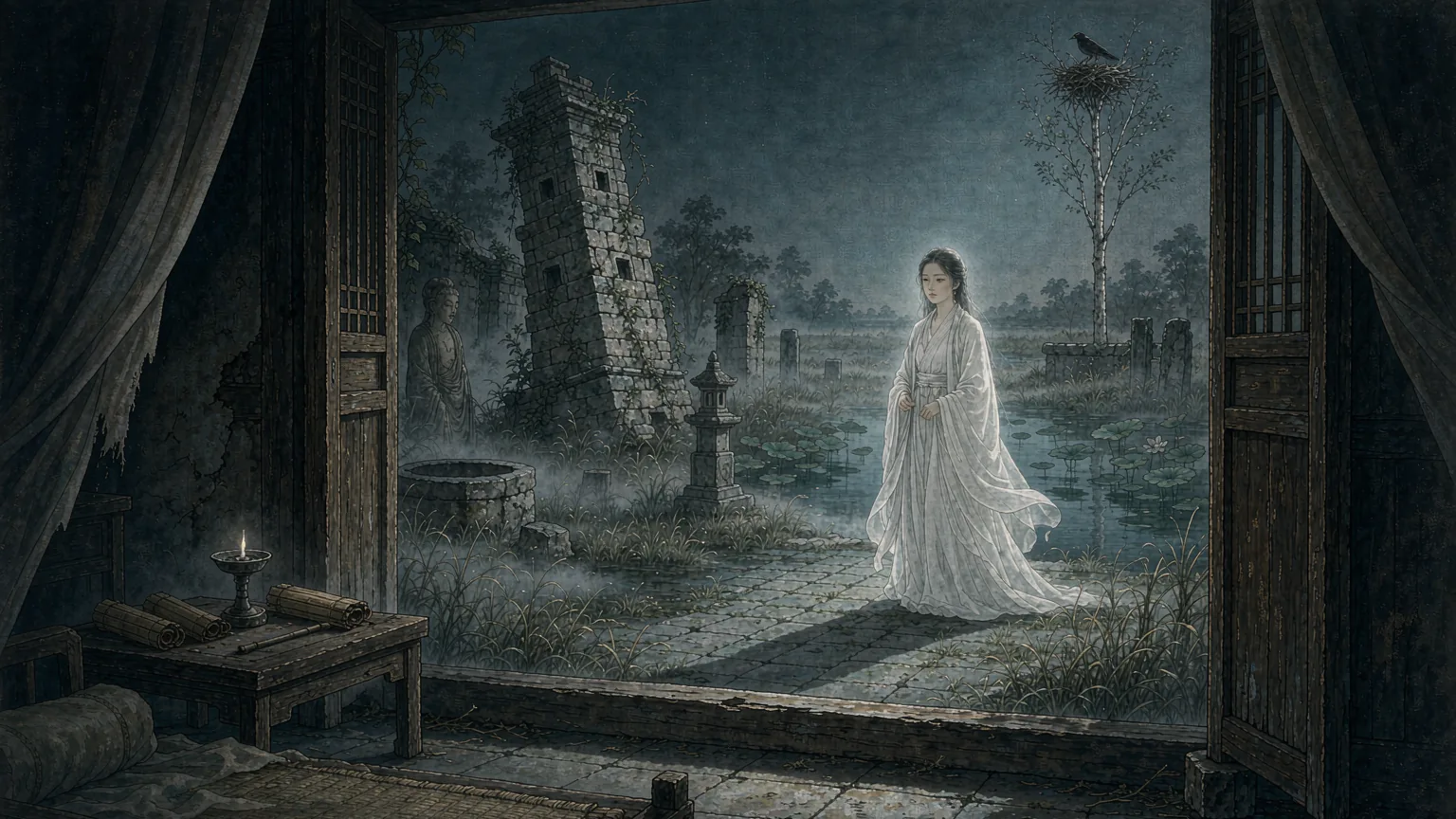
Ning Caichen reached the city of Jinhua late in the day. Every inn inside the walls was full. Somebody told him about a ruined Buddhist temple outside the north gate, empty for years, with the side rooms still standing. He went there and made himself at home in a small room on the south side.
The temple had a grand hall and a tall pagoda, and grass up to a man’s waist. Wild lotus was flowering on the pond by the steps. The smell indoors was dust and damp and long absence, and Ning Caichen liked the quiet.
He had just settled onto his bed of straw when he heard a sound outside the window. He sat up. The door was barred. The room was lit, but he had not lit a lamp.
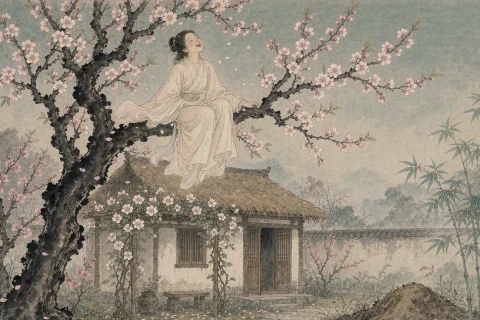
A young woman stood beside the table.
She wore white. The cloth was not merely pale. It caught what little light there was and gave it back, and her hair had the look of hair that has been washed and dried with care. She was perhaps eighteen.
She said that she could not sleep, and that she wanted someone to talk to.
Ning Caichen understood exactly what she meant. He told her, politely, that he could not.
She took one step closer.
He set his face and told her to leave. He said that if she did not, he would call the scholar in the room to the south.
She stopped. She went back to the doorway, then turned and set something on the bed. It was an ingot of gold, bright and heavy, pressing down the bedding.
He picked it up, glanced at it once, and threw it out into the courtyard. He said that unclean money would dirty his luggage.
The woman stared at him for a moment. Then she went out, bent down, and picked the gold out of the dirt. She said, to nobody, that this man must be made of iron and stone. Then she left.
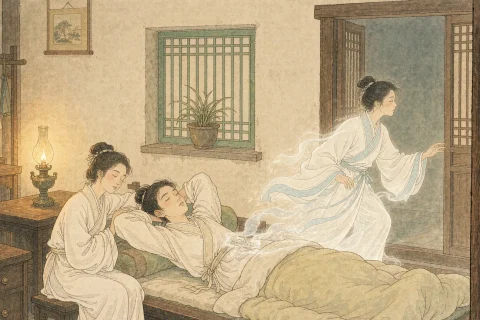
The next morning a scholar arrived from Lanxi with one servant, both of them come to sit an examination. They took the east wing. That night the scholar died in his sleep. There was a small hole in the sole of his foot, like the mark of an awl, and a thin thread of blood had run out of it. Nobody could explain it.
One night later the servant died in the same way, with the same small hole.
In the evening Yan Chixia came back. Ning Caichen asked him about it, and Yan said it was a demon. Ning Caichen had never believed in that sort of thing, so he paid it no attention.
At midnight the woman returned, and this time she did not pretend.
She said that she had met many men and that none of them had a heart as hard as his. She said that he was a true gentleman, and that she would not deceive him.
Her surname, she said, was Nie, and her given name was Xiaoqian. She had died at eighteen and was buried beside this temple. A demon held her. It forced her to do a servant’s work, to flatter strange men in the dark, and she had never wanted any of it.
Then she said that there was nobody left in the temple worth killing. The demon would probably send a yaksha for him instead.
Ning Caichen was frightened. He asked her what to do.
She told him to share a room with the swordsman, Master Yan. That would save him.
He asked why she did not simply charm Yan instead.
She said that Yan was a strange man, and that she did not dare go near him.
He asked how she worked on other men.
She answered slowly. With the ones who came close to her, she said, she pushed an awl into the sole of the foot. When they sank into a daze and knew nothing, she drew their blood to feed the demon. There was a second method, she said, and it used gold.
But the gold was not gold.
She said it was the bone of a rakshasa, a kind of demon. Anyone who kept it would have his heart and his liver cut out of him.
Both methods, she said, worked on nothing but ordinary appetite.
Ning Caichen thanked her for telling him the truth. He asked which night he should be ready.
She said, tomorrow night.
When she left she was crying. She said that she had fallen into a black sea and could not find the shore. She said that he had the loyalty of a true man and could pull her out of it. If he was willing to gather up her poor bones and carry them home and bury them somewhere safe, she said, it would be the same as giving her life back to her a second time.
Ning Caichen agreed at once.
He asked where she was buried.
She said, remember only this. The white poplar with a crow’s nest at the top.
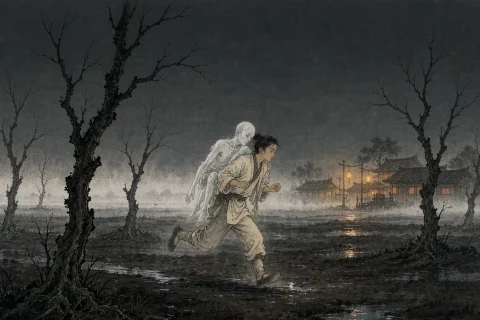
Then she walked out of the door and came apart like smoke.
The next day Ning Caichen was afraid that Yan Chixia would go out, so he invited him to breakfast early and then to lunch, and watched him closely.
He asked to share the room for the night. Yan refused, saying that he liked to be alone. Ning Caichen would not take no for an answer. He carried his bedding in and set it down.
Yan gave way. He moved his own bed a little and gave one instruction. He said that he knew Ning Caichen was a man of honor, and that he himself had private business which he could not explain in a hurry. Ning Caichen was not to open the case that sat in the corner. If he opened it, they would both regret it.
Ning Caichen promised.
They lay down, and within minutes Yan Chixia was snoring like thunder. Ning Caichen could not sleep.
Close to the first watch, a shadow showed itself outside the window. It came up to the paper, and behind it two eyes glittered.
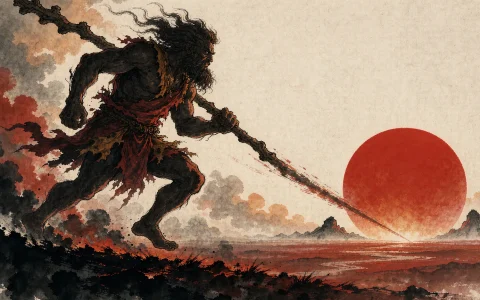
Ning Caichen was about to shout for Yan when something burst out of the case.
It was like a strip of white cloth, and it was too bright to look at. It broke the stone lattice of the window as it went, flashed out into the yard, and snapped back again, as fast as lightning going out.
Yan Chixia woke. Ning Caichen pretended to be asleep and watched through slitted eyes. Yan lifted the case and took out something small and brought it to the moonlight, turning it and smelling it. It was white, translucent, about two inches long, and no wider than a blade of chives. He studied it for a long time, wrapped it in several layers of cloth, put it back in the broken case, and said to himself that some old monster had been very bold to damage his box.
In the morning Ning Caichen looked outside. There was blood on the ground under the window.
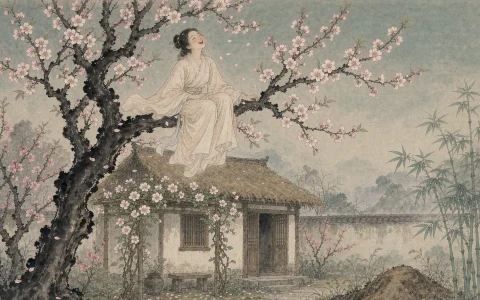
He walked north of the temple and found a field of old graves, and one white poplar among them with a crow’s nest at the top. He dug up the grave, gathered the bones, wrapped them in his own clothes, hired a boat, and went home.
Before he left, Yan Chixia gave him a farewell dinner and pressed an old leather bag into his hands. He said that this was a sword sheath, that Ning Caichen should keep it safe, and that it would keep demons away from him.
Ning Caichen buried the bones in the open ground just outside his study.
He spoke to the grave. He told her that he was sorry she had been left alone, and that he had buried her beside his own house, close enough that he would hear her if she laughed or wept, and that no stronger ghost would bully her now. He offered her a cup of thin wine and asked her not to mind that it was cloudy.
Then he turned to walk back.
Someone called after him and asked him to wait, so they could go together.
He turned around. It was Xiaoqian.
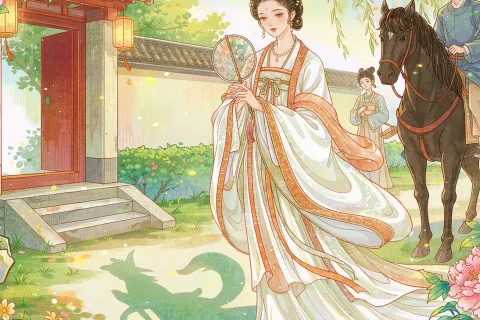
She came home with him. She swept, wiped the tables, washed the clothes, and cooked, and she did every task with more care than he did. His mother was frightened at first and would not sleep. In time she noticed that the girl did nothing strange, and that she looked like any young woman, and then she began to talk to her.
There was one thing Ning Caichen could not understand. Xiaoqian would walk up to the door of his study and stop. She paced outside it and would not come in.
He asked her what she was afraid of.
She said that his room was full of the pressure of a sword, and that it pushed her back. She said that this was also the reason she had never dared to show herself to him on the road.
Then he remembered the leather bag. He took it down and hung it in another room.
After that she sat with him in the evenings, under the lamp in the study, reading the Surangama Sutra. She said that she had memorized parts of it as a child, that she had forgotten most of it since, and that she wanted him to correct her.
She stayed in that house for years. Ning Caichen’s wife had been ill for a long time, and when she died he married Xiaoqian. The relatives who met her never suspected a ghost. Several of them said she must be an immortal instead.
Then one day she told him to hang the leather bag back up at the door. The thing from Jinhua, she said, had found her at last.
That night something came down out of the sky like a large bird.
The bag took it in.
The courtyard went quiet again. Xiaoqian stood in the doorway and looked at the place for a long time, and said nothing.
The last thing Liaozhai says about her is what other people saw. After she had lived among them for a long time, it says, she could no longer be told apart from anyone else.
Where the bones were finally buried, the book does not say.
And nobody ever asked where a girl of eighteen had come from, or who had left her under that tree and walked away.