There is a person on the moon.
She is the figure you see when you look up on a clear night. She sees you back. This has been going on for a very long time.
She did not want to go up there.
The oldest record of her is eight characters long. It sits in a book called the Huainanzi, put together more than two thousand years ago, and it says this: the archer Yi asked the Queen Mother of the West for the elixir of immortality, and Heng E stole it and fled to the moon.
Heng E is the name she carried first. In the Han dynasty a scribe changed the opening character, because it sounded the same as the personal name of an emperor, and the name that reached us is Chang E.
Three things have to be explained before the story can stand on its feet.
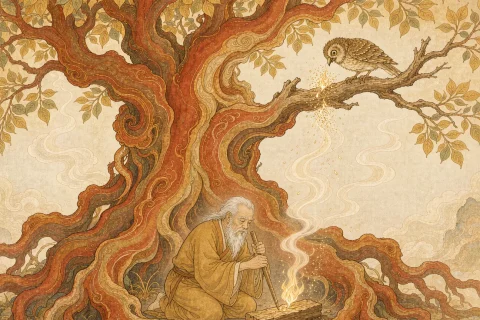
The first is the elixir. Its name is its purpose. Whoever takes it does not die. Not long life. Not good health. Just this: death, the one thing every person is certain of, no longer applies to you. In a culture that talks constantly about fate, about the portion assigned to each person at birth, this is the single item that cancels the bottom line.
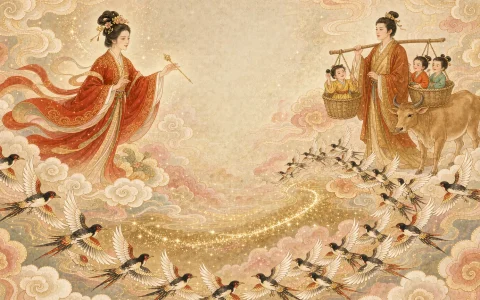
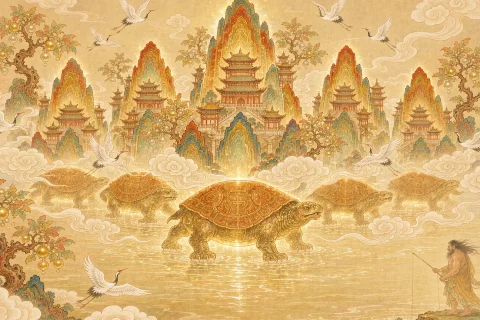
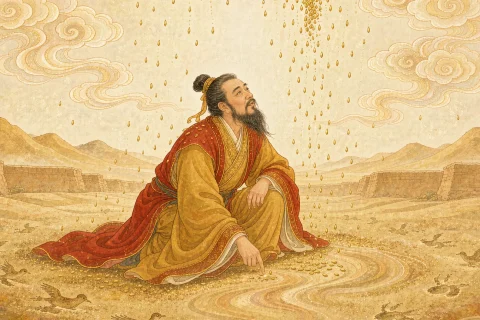
The second is the Queen Mother of the West. She is a goddess who lives on Kunlun, the great mountain in the far west, which the old books treat as the closest point between earth and sky. She governs punishments, and she governs immortality. The elixir is hers to give away.
The third is the quantity. There was one dose.
One dose. One person.
That is the fuse of the whole story.
It is worth saying first that China is not the only place that told this kind of story.
Almost every old culture keeps a tale about the one thing that cannot be taken back. In Greece there is Pandora, who opens the jar and lets out everything that will ever trouble the world. In the oldest epics of Mesopotamia, a hero crosses the sea to find the plant that restores youth, and loses it to a snake while he sleeps. In the north of Europe, the gods keep apples that hold off age, and they guard them jealously.
And nearly every culture has looked at the moon and put somebody in it. In Greece the moon was a goddess named Selene, and she loved a shepherd named Endymion, and she arranged for him to sleep forever so that he would never grow old in front of her. In Europe, country people looked at the dark markings on the moon and saw a man carrying a bundle of thorns up a hill.
So the moon, and the price of living forever, are both very old human ideas. Chinese mythology and Chinese folktales pick up both of them, and then do something the other versions do not do.
Think of it this way. Pandora is punished. Endymion is blessed. In this story one woman is handed both at the same time, and there is no way to tell which one she received.
Now go back to the man who obtained the elixir.
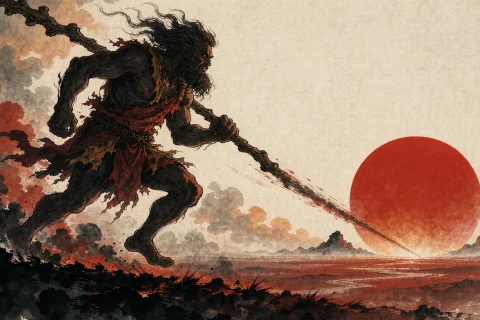
Yi was the archer who shot down the nine extra suns. That is a well known story of its own. After the shooting, the drought on earth ended, but his private troubles were only beginning.
He got the elixir.
How he got it is reported differently in different books. One account has him walking west until he reached Kunlun. Another has the goddess sending it to him. It does not matter much. What matters is that he brought it home.
And he did not drink it.
One telling says that he wanted to share it with his wife, and could not decide whether half a dose would still count as a dose. Another is simpler and sadder. He could not bring himself to do it.
So the elixir stayed at home, in its container, unused.
What happens next comes down to us in two versions. The difference between them is not a small detail. It is the question of whose fault this was.
In the version almost everyone knows, the fault is not hers.
Yi had taken a student named Feng Meng. Feng Meng learned archery so quickly that he arrived at a conclusion. For as long as his teacher lived, he would always be the second best archer in the world.
One day, when Yi was out of the house, Feng Meng came in.
He had not come for the people in the house. He had come for the elixir.
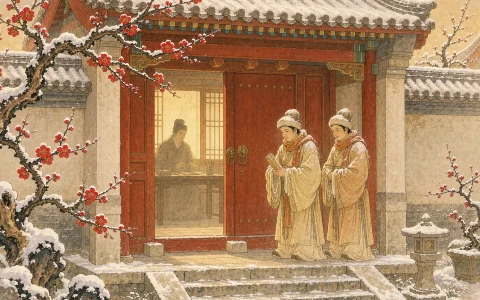
Chang E was alone.
She backed away. He stepped forward. She called out, and nobody came. The elixir was in one place, and he was faster than she was and stronger than she was.
There was no third door. She seized it and swallowed it.
The other version is older, and colder.
The Huainanzi uses a single word for what she did, and the word is steal.
The fullest old telling is by the astronomer Zhang Heng, writing in the second century. In his account she took the elixir herself and prepared to leave for the moon. And before she went, she asked a diviner to read her fortune.
The diviner gave her five lines.
The first line said she would go drifting upward, light as a bride leaving her family home. The second said she would travel west, alone. The third said that along the way the sky would darken and the light would fail. The fourth said, do not be afraid. The fifth said that in the end she would prosper.
Four of the five lines are comfort.
And in all five there is one true word, and the true word is alone.
Notice what the older version is doing. It blames her. She is a wife who steals from her husband and runs. Later storytellers could not leave it there, and so they invented Feng Meng, the student who comes through the door with his hands out, and they gave her no choice at all. The blame was taken off her by giving her something worse, which is a moment she had no way to survive except by doing the very thing that ruined her.
Both versions end in the same place. That is why both of them lasted.
Then the elixir went down her throat.
The first thing that changed was her weight. Not the lightness of hunger. The weight itself was being lifted off her, a little at a time, the way a hand takes coins out of a purse.
She stood on the floor with her feet on the ground, and the ground had stopped insisting on holding her. She reached for the door frame, and the door frame leaned with her. She looked down at her own hands, and the backs of them were shining with a light that did not come through the window.
Then her feet left the ground.
An inch, and then more, the way a sheet of paper comes off a table when a draft takes it. She struck the beam and then the tiles of the roof. The tiles made a sound, and she passed straight through the sound.
Below her the village shrank. The paths between the fields became thin lines. The river became a ribbon. The wind no longer blew against her. It went through her.
She kept going up.
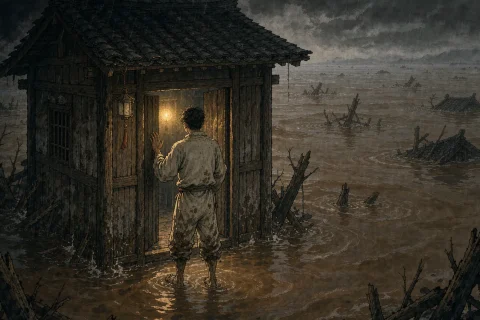
When she turned her head to look back, one small point of light was still burning down there. It was the lamp in her own house, the one that nobody had thought to put out.
That was the last of the human world she saw.
And here Zhang Heng ends the scene. He ends it with a single sentence. In his words, she settled into the moon, and she became a toad.
A toad.
That is the part that later centuries quietly removed.
It is not as strange as it sounds. If you look at Han dynasty tomb art, you find the moon painted as a disc, and inside the disc there is a toad. The image was not ugly to the people who made it. It was simply the moon, the way the moon was drawn. So when the earliest listeners heard that she became a toad, they did not flinch. They nodded. She had gone to live in the moon, and the moon is where a toad lives.
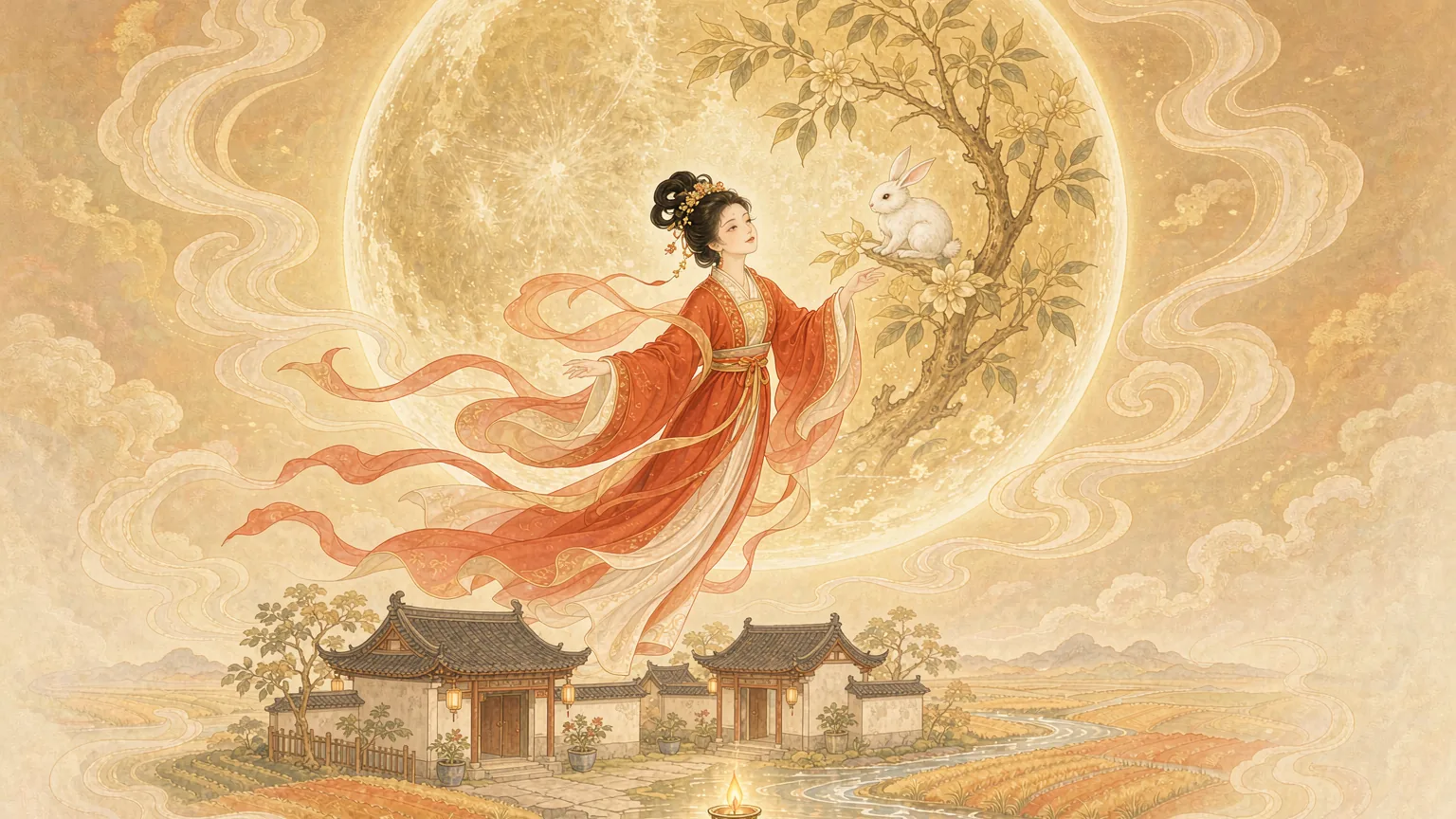
When you see her in a painting today, she is a beautiful woman in long sleeves, holding a rabbit, standing beneath a cassia tree. The oldest account does not say that. It says that after she arrived, this is what she was.
She had been given immortality. The price of it was immortality itself.
Later storytellers furnished the moon for her, the way you furnish a house that somebody has to keep living in.
They put a cassia tree up there, a tree that cannot be cut down. That is a different story, and it belongs to a different man. They put a rabbit beneath it, pounding out medicine. It is the same elixir, over and over, for nobody. They put a palace around her and gave the palace a name, the Palace of Great Cold.
Great. Cold. Two words for a building, and two words for a life.
A poet of the Tang dynasty, Li Shangyin, wrote four lines about her that Chinese readers have repeated for more than a thousand years. In them he says that she must regret having stolen the medicine, and that she sits there night after night with all the blue ocean and all the pale sky in front of her and nothing at all to do.
Now come back down to the ground, because the ground kept moving.
Yi died. He did not die of age.
His own student, Feng Meng, killed him with a heavy club of peach wood. Peach wood, in Chinese practice, is the wood that drives away evil spirits, which is a bitter joke to leave in a story about a man who could not be killed by anything else. The old books record the death in four characters: Yi died by the peach club.
So the man who walked into the house for the elixir was also the man who took her husband.
Did she know? The books do not say.
The moon is far away, but it is always up there, and any person can see it by lifting the head. She lifted her head.
There is one more thing this story does not have. It does not have a rescue.
No dragon flies up to carry her back. No god argues her case. No ritual calls her down. There is no moment, in any version of the tale, where somebody comes for her.
A great many figures in Chinese mythology behave like this. When their work is finished, they simply stop appearing in the text. She is worse off than they are, because she has no work that can be finished. She has one completed action, and it cannot be revised.
Every autumn, on the night of the full moon in the eighth month, Chinese families carry moon cakes and fruit and boiled beans out into the courtyard and bow to her. This is the Mid-Autumn Festival, one of the oldest holidays in the country.
Every household is doing the same thing, in a thousand different courtyards. They carry the best food they have into the open air and hold it up so that the moon can look at it first.
A child asks, is there really somebody living up there?
The grown ups say yes. A woman, and a rabbit, and a tree.
The child asks, then why does she never come down?
And the grown ups say, eat your moon cake.
So when you look at the moon tonight, you are looking at the same person that people have been looking at for three thousand years.
Her house is wide enough to hold the whole sky. It is cold enough that she is the only one inside it.
She was given immortality. Immortality means that even on the night she wants to die, she cannot.
And she has never once made it to the family dinner.