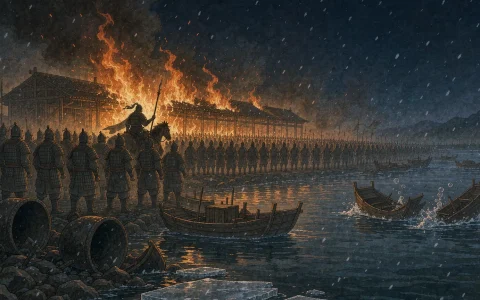
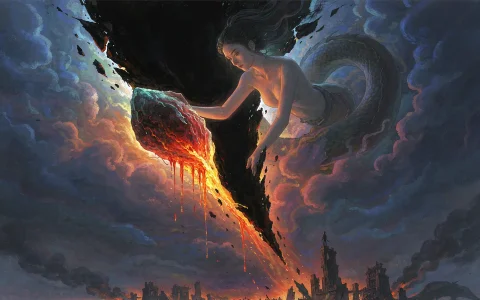
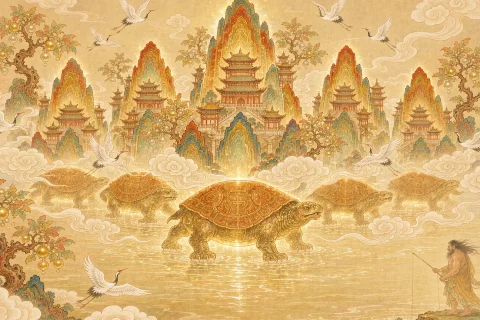
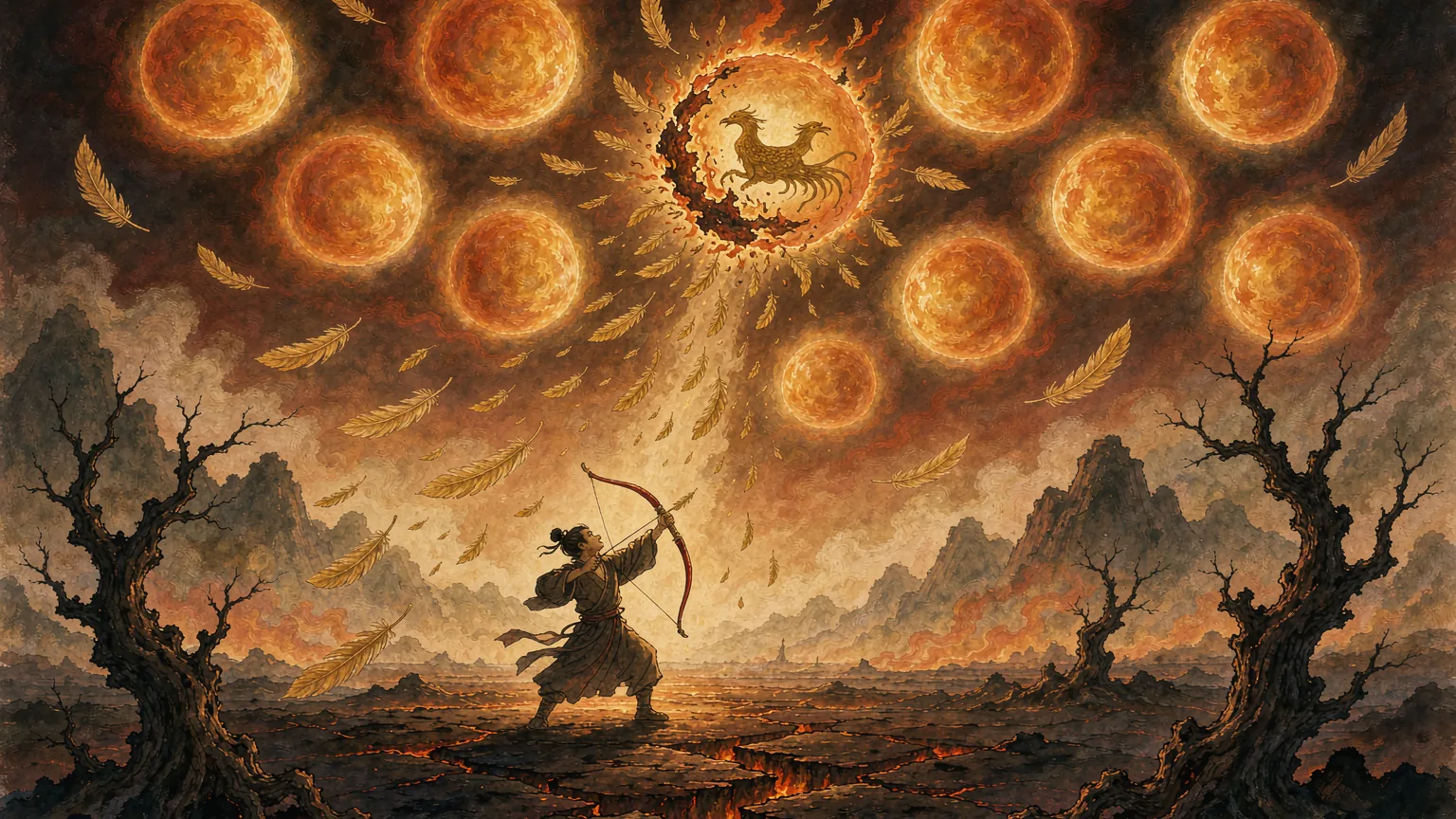
Picture the sky with ten suns in it.
Not one sun turned into ten by a storyteller. Ten separate suns, all burning at the same time, all of them close. The ground under them becomes the floor of a furnace. The wind blows hot. Even the air you breathe is hot.
This is the worst drought in Chinese mythology, and the man who ended it was an archer.
The story is written down in a book called the Huainanzi, put together in the second century BC. What it gives us is barely a paragraph. What it describes is a world on fire.
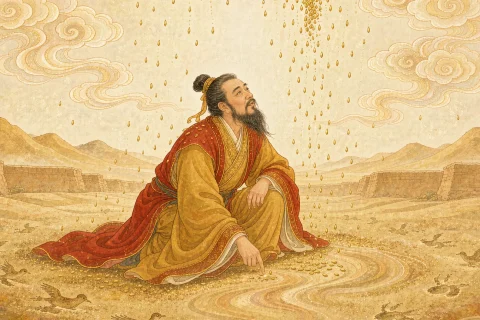
Ten suns rose together. The crops burned. The grass died. The people had nothing left to eat.
To understand why the Chinese told it this way, you have to know one thing about how they pictured the sun.
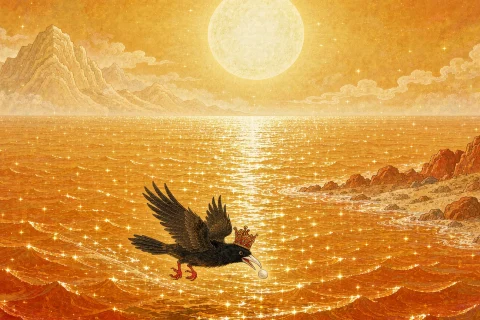
The sun was not a ball of fire. The sun was a bird.
A golden crow with three legs. Its name is jinwu.
In Chinese legends, the ten suns lived in a great tree called the Fusang, which grows on an island in the Eastern Sea, at the place where the sun comes up. The ten crows took turns. One flew out while another came home. One sun a day, and no pushing.
Then one morning, all ten of them went out together.
The nearest thing in Greek myth is Phaethon, who borrowed the chariot of the sun, lost control of the horses, and scorched the earth before Zeus knocked him out of the sky. China told the same terror a different way. In the Greek version the sun is a chariot that gets driven badly. In the Chinese version the suns are birds that simply refuse to take turns.
The drought was not the only problem.
The Huainanzi lists six more things that came up out of the ground and the water while the sky was burning: Yayu, Zaochi, Jiuying, Dafeng, Fengxi, and Xiushe. A whole gallery of Chinese gods and monsters, and every one of them with a taste for people.
Yayu looks like an ox, but the face is a human face and the feet are horse feet, and the sound it makes is the sound of a baby crying. It hunts people.
Zaochi has teeth like chisels, long enough to split a man down the middle.
Jiuying has nine heads. Some of them spit water. Some of them spit fire.
Dafeng is a bird so large that one beat of its wings takes the roof off a house.
Fengxi is a wild boar. When it roots through a field, it turns the field into a ditch.
Xiushe is a snake long enough to swallow an elephant.
Ten suns above. Six monsters below. Nobody was going to live through that.
People did try to end it the ordinary way. They prayed.
They piled altars with oxen and sheep and jade, and the priests danced in the open sun until they fell down and had to be carried off. The ten suns did not move.
Sometimes a cloud would gather at the edge of the sky, and everyone on the ground would tilt their heads back and watch it thicken, slowly, into something that might hold rain.
Then one sun would push out from behind it, and the cloud would come apart.
And there was only sun again.
Somewhere up in heaven, someone finally paid attention.
His name is Di Jun, one of the oldest high gods in Chinese mythology. Later storytellers handed most of his job to the Jade Emperor, but in this story he is still in charge. And the ten suns, as it happens, are his sons.
Di Jun called for an archer named Houyi and gave him two things. A bow painted red. A quiver of white arrows.
The order was one sentence long. Go down. Help the people.
Houyi took the bow and went.
He did not start with the sky.
He started with the ground.
The old book leaves us only a handful of place names. Put them in order and you get a man hunting his way across the whole known world.
At Chouhua, a marsh in the south, he found Zaochi. It came at him with its mouth wide open, and that was the mistake. Houyi stepped back, let the string go, and the arrow went in through the teeth.
At the Xiong River in the north he found Jiuying. It was drawing breath to breathe fire when Houyi put three arrows through it, and not one of the nine heads was left.
At Qingqiu, a lake in the east, he found Dafeng. The bird flew high, and the wind off its wings pushed a man off his feet. Houyi waited, squinting, until it skimmed over a ridge, then put an arrow into the joint of the wing. The great bird came down turning over and over.
In the mulberry groves of the central plains he found Fengxi. A boar with a hide too thick for a frontal shot, so Houyi walked around it and shot it through the eye.
At Dongting, the great lake in the south, he found Xiushe. It went into the hills. He chased it and cut it, and did not stop cutting until it lay in pieces at the water.
The sixth, Yayu, is the one the old book never puts on a map. It only tells us what Yayu looked like, and what Yayu ate.
Houyi killed that one too.
Then he looked up.
Ten suns were still in the sky.
He did not hurry.
He unstrung the bow and wiped it down. Then he picked out a rise of ground, climbed it, and began drawing arrows out of the quiver one at a time and pushing them into the dirt by his feet.
Ten arrows, standing in a row. Ten suns overhead.
Someone watching from below said he counted them.
Then he pulled the red bow all the way back.
The first arrow left the string.
Something exploded up there. A ball of fire burst open, and out of it fell a mass of golden feathers. It was a crow. It hit the ground still twitching.
So the suns could die after all.
Second arrow.
Third.
Fourth.
One after another they burst. The fireballs came down trailing long tails of flame, and where they landed they dug craters in the cracked fields. Feathers drifted down like snow.
Nobody on the ground made a sound. Some people knelt. Some covered their eyes and then looked again between their fingers.
Nine arrows. The sky was empty.
Silence.
The kind of silence you get when the wind stops.
Then someone noticed that one sun was still hanging there, far off in the east. It was much smaller now, and much dimmer, and it was trembling.
Houyi raised the bow again.
Behind him, somebody shouted.
It was Yao, the man who ruled the human world in those days. He ran forward and caught Houyi by the arm.
“Keep one! The sky cannot be left with no sun at all!”
Houyi stopped.
Then he lowered the bow.
One arrow was left standing in the dirt.
The last sun trembled its way west.
The sky went quiet, and then it went cool. Clouds came back. Wind came back. Water started moving again in the dry riverbeds. Under the blackened grass, something green pushed up.
That is where the story should end. The hero has done the job. The world is saved. He should be going home now to collect his reward.
That is exactly where the trouble starts.
Houyi was from heaven.
He was an officer of Di Jun. The bow in his hand was a gift from Di Jun. The order he obeyed was given to him by Di Jun himself.
And the sun still hanging in the sky, the one he left alive, is a son of Di Jun.
Nine sons. One archer.
So Houyi does not go home.
Nobody announces it. The door simply does not open for him again.
He tried the high ground first. He climbed the highest mountain he could find, because the top of a mountain is the closest a man can get to heaven. The wind up there was strong enough to knock him over. He stood in it and waited a long time.
Sky stayed sky. The door stayed shut.
So he stayed on earth, a man who finished a job for the whole world and cannot get back into his own house.
A quick note, because this confuses people. There are two archers called Houyi in Chinese tradition. One is this one, the archer of myth. The other is a lord of the Xia dynasty who seized a throne and was later killed by his own men. After the Han dynasty, storytellers merged the two names into one. When people say Houyi shot the suns, they mean the first one.
Houyi now had a life on earth to live, which meant he had a life that would end.
He would get old. He would die.
So he went west, to Xiwangmu, the Queen Mother of the West, and asked her for the elixir of immortality. She lives in the mountains of Kunlun, at the far western edge of the world. Nobody agrees on how the elixir is made. Only one thing is ever said about it. Drink all of it and you rise into the sky. Split it between two people and both of them live forever.
Houyi brought it home and gave it to his wife, Chang’e.
He meant to wait for a good day, and then the two of them would divide it.
He never got the good day.
One morning he went out. Chang’e was alone in the house.
What she did next depends on which version you read. In some, greed takes her and she drinks all of it. In others, she is forced into it. In a third, she only means to taste it, and the tasting decides the matter.
Either way, the elixir went down, and her body became light.
She rose. Out of the door, over the roof, higher and higher.
She came to rest on the moon.
That evening Houyi came home and looked up.
There was a figure standing in the moon.
Chinese families still look at that moon.
On the fifteenth night of the eighth month of the lunar calendar, when the moon is at its roundest, they go outside, eat cakes filled with sweet paste, and tell the children who lives up there. The night is called the Mid-Autumn Festival, and it is one of the biggest nights of the year in China. The woman in the moon is Chang’e, and this is how she got there.
There is one more thing, and it is colder than the rest.
Houyi had taken a student named Feng Meng.
Feng Meng worked hard at archery and had real talent. Somewhere along the way, he worked out that he had become the second-best archer alive.
And the best archer alive was his teacher.
So one day, when Houyi was not watching, he came at him from behind.
The philosopher Mencius records what happened in a single line. Feng Meng learned archery from Houyi, mastered everything Houyi knew, decided that the only man in the world better than himself was his own teacher, and killed him.
An older text gives us the weapon in four characters. Houyi died by a peach club.
Peach wood. In Chinese folklore it is the wood that spirits are afraid of, which is why peach branches were hung over doorways at the New Year to keep bad things outside. Houyi was killed with the one object in the house that was supposed to protect him.
Look closely, and this is not really a story about archery.
A man shoots nine suns out of the sky and saves the world, and then cannot go home.
He wants to live forever, and his wife carries the elixir up to the moon instead.
He teaches a student everything he knows, and the student kills him with something that was never part of the lesson.
China has been telling this story for three thousand years.
What people remember is never only the nine arrows.
It is what came after. One man, standing in the middle of an empty field, looking up at the moon.