English has a motto for this: if at first you do not succeed, try, try again. Chinese makes it more specific, and adds snow.
The Chinese idiom is 三顾茅庐, in pinyin *sān gù máo lú*. It means, word for word, three visits to the thatched hut. *Mao lu* is a cottage roofed with straw, the humblest kind of house — what a poor scholar lived in while he farmed. The four characters together describe going to a stranger’s door again and again, in person, until he agrees to come out and help you.
It has become the phrase Chinese speakers use for courting real talent with real humility. It comes from the *Records of the Three Kingdoms*, and from a letter the man himself wrote later, to explain why he had given his life to a man who came to his door three times.
At that time, Liu Bei camped at Xinye, a tiny county town.
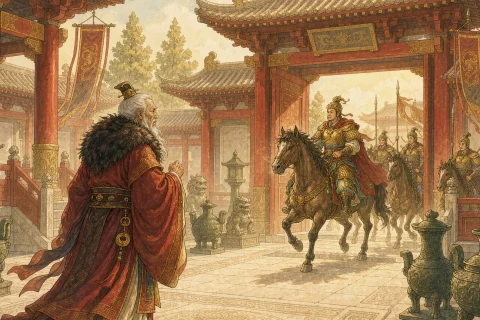
He had been fighting for most of his life. At his side were Guan Yu and Zhang Fei, two warriors who could hold a battlefield on their own. But he had no territory he could truly call his own. And he had no strategist to help him see the whole board. He was well into middle age, living under someone else’s roof, and he did not know where to go next.
One day a scholar named Xu Shu came to him.
Liu Bei talked with him several times, and each time he was more impressed. He valued the man highly.
But Xu Shu waved a hand and said he was nothing much. He had someone better to recommend.
His name is Zhuge Liang, he said. His courtesy name is Kongming. People call him the Crouching Dragon. Would you like to meet him?
Liu Bei said at once that he would, and asked Xu Shu to bring him along.
Xu Shu shook his head.
This man can only be invited by you, he said. He will not come to your door on his own. You will have to lower yourself and go to him.
Liu Bei kept those words in his mind.
He did not have many advisors to begin with. He had even fewer who would plan for him in the long run. This was a sentence worth taking seriously.
The first time he went to Longzhong, Zhuge Liang was not at home. A boy opened the door and said his master had gone out, and could not say when he would return.
Liu Bei stood at the gate for a while, left a message, and went back to Xinye.
On the road, Guan Yu said, brother, the man does not want to see you.
Liu Bei said, then we will go again.
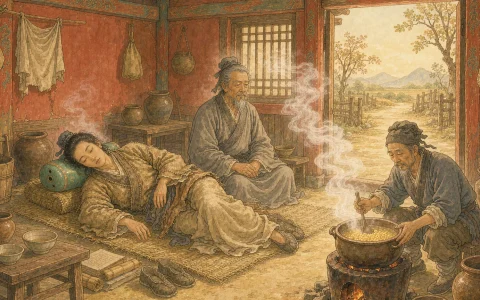
Longzhong lay twenty *li* west of Xiangyang, in a fold of the hills, a few straw cottages and a few thin fields. Zhuge Liang farmed and read there, and had lived in that place for ten years. Outside, the world had turned upside down more than once, and he was in no hurry at all. He had given himself a name: the Crouching Dragon — a dragon lying down. He had not left his hill, and yet people kept coming to him to talk about the fate of the realm. Some said he was arrogant. Some said he truly had something.
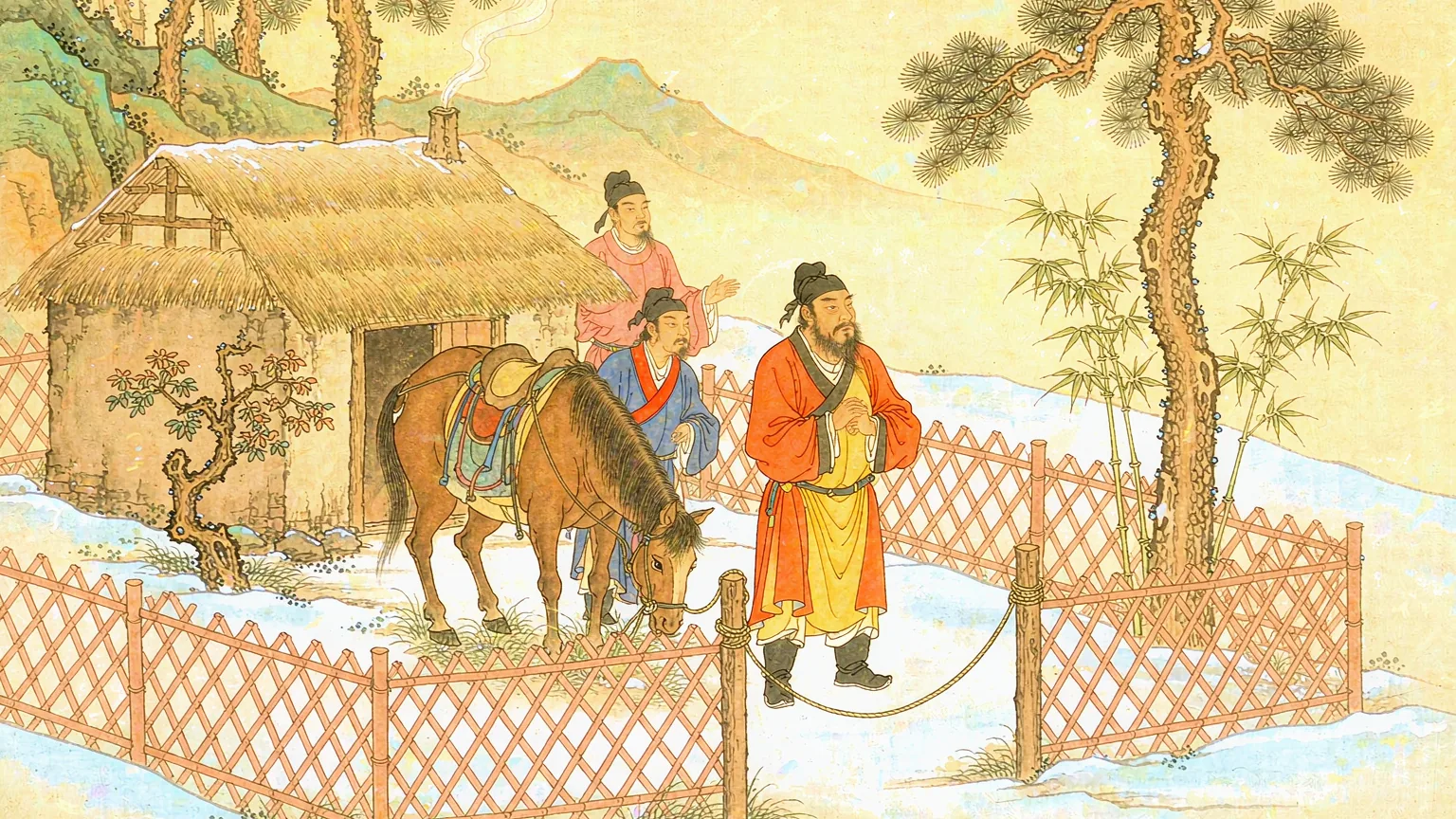
The second visit, Liu Bei ran into snow.
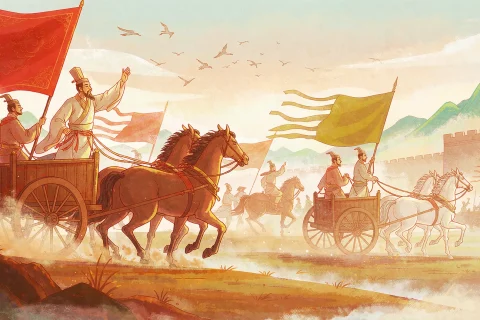
The mountain road was slippery and the wind was hard, and the horses sank into the drifts. The whole party was shaking with cold. Zhang Fei grumbled the entire way. Brother, he said, it is freezing and we are climbing a mountain road to see a farmer. Is it worth it? Just send someone to fetch him.
Liu Bei said nothing and kept walking.
At the gate of the thatched hut, Zhuge Liang was away again.
Zhang Fei lost his temper and wanted to turn back. Liu Bei stood in the snow and looked at the little cottage, bowed down under the white. He brushed the snow off his own shoulders and said, when you ask a man for help, you do not complain about the cold.
Then he said nothing more, and turned back.
The third time, Liu Bei went again.
This time, Zhuge Liang was at home.
But he was taking a nap.
Liu Bei stood outside the door and would not let anyone wake him. The boy tried to go in and announce him twice, and both times Liu Bei waved him back. He said the master would come out when he woke on his own. And so he simply stood there, for a long time, until Zhuge Liang woke up by himself, straightened his cap and robes, and came out to meet him.
That year, Zhuge Liang was twenty-seven. Liu Bei was past forty, with grey already at his temples.
The two men sat down, and sent everyone else out of the room.
Liu Bei opened his heart and poured out half a lifetime of frustration. The Han house is falling, he said. Treacherous men hold the court. I have always wanted to raise up what is right on behalf of the realm. But my wisdom is short and my plans are shallow. I have failed again and again, and to this day I have accomplished nothing. What can you tell me?
Zhuge Liang did not answer at once. He got up and unrolled a map.
What followed is known as the Longzhong Plan.
He pointed at the map and moved from north to south, from Cao Cao to Sun Quan, laying everything out for Liu Bei piece by piece.
In the north, Cao Cao holds the emperor and uses him to command the lords. He has many soldiers and able generals. You cannot meet him head on. In the south, Sun Quan holds the lands east of the river, three generations deep, and the people are with him. You can join him, but you cannot take him. Jingzhou is a fine prize — it reaches out in every direction, and it is made for action. Yizhou is ringed by mountains and rich beyond compare, a storehouse of heaven.
If you take Jing and Yi together, you can begin. Befriend the peoples of the west, and calm the tribes of the south. Ally with Sun Quan in the east, and hold off Cao Cao in the north. Then, when the realm shifts, send one army out from Jingzhou toward the north. Send the other from Yizhou straight at the passes. Let both advance together. Then the great thing can be done.
Liu Bei listened, and the more he listened, the less he could sit still.
He had heard advisors talk about the realm before. But their words were either a sigh that heaven meant to ruin him, or a small scheme to scrape by a while longer. Never once had anyone laid out every province and every step for him, plain and clear. He stood up and said one word: good.
That single word settled it. Zhuge Liang wrote about it later, in the letter known as the *Memorial on Sending Out the Troops*. From that day, he said, he was moved to gratitude, and pledged himself to Liu Bei’s service. From that day, he gave the man his life.
From then on, Liu Bei and Zhuge Liang grew closer and closer, and were hardly ever apart.
Guan Yu and Zhang Fei could not stand it. Their faces said plainly what they thought.
They had followed their brother through life and death for years. What had this young man done, to be valued like this within days of arriving?
Liu Bei saw what was in their minds, and said it to their faces.
With Kongming, I am like a fish that has found water. Say no more about it.
Only then did the two of them stop.
What Liu Bei understood, quietly, was that he was not hiring an official. He was asking for a man who would spread the whole board of the realm out in front of him, and then stay to move the pieces with him, one by one, to the end.
A young man of twenty-seven, in a single conversation, had picked up the thread of a general’s life and tied it back together. To be exact, a man of forty-something who had lost battle after battle finally had a map.
And Liu Bei followed that map. He allied with Sun Quan, took Jingzhou, entered Yizhou, and became one of the three powers that divided the realm.
Years later, before a northern campaign, Zhuge Liang wrote the *Memorial on Sending Out the Troops*. At the start, looking back to the beginning, he still told it the same way. I was a common man, he wrote, and I plowed my own fields in the south. The former emperor did not think me lowly. He humbled himself and came to my thatched hut three times, to ask me about the affairs of the age. That is why I was grateful, and agreed to serve him.
That is where the idiom 三顾茅庐 comes from. It is about finding talent. But it is even more about the posture of the one doing the finding — a man willing to lower his head, and walk, and make the trip again when one trip was not enough.
Chinese speakers still use it today. In a company, when a manager keeps going back to persuade the one person he wants on his team, someone will say he is making three visits to the thatched hut.
Back then, Zhuge Liang was out in his fields. Liu Bei was a general. And the general stood at the gate of a straw cottage, waiting for a farmer to wake up.
That wait produced a third of an empire.