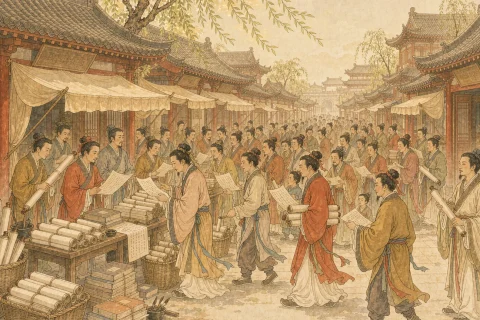
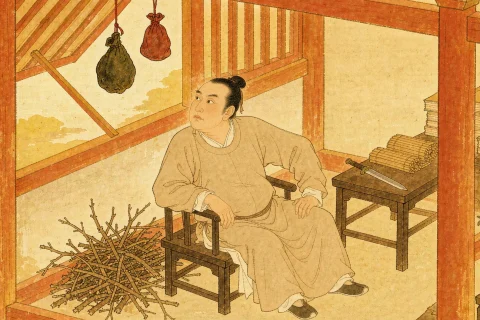
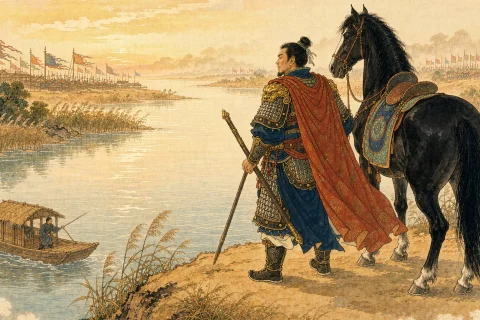
There is a Chinese idiom that sounds like a kitchen accident and a shipwreck at the same time.
破釜沉舟 — in pinyin, *pò fǔ chén zhōu* — means, word for word, “smash the cauldrons, sink the boats.”
English has something like it: burn your boats. Once your ships are on fire behind you, there is no going home, so you had better win. Chinese fables and proverbs are full of this idea. But this one is unusually concrete. It comes with real cauldrons, a real river, and a real winter night.
In a Chinese kitchen of two thousand years ago, a *cauldron* was the huge iron pot an army cooked in, and a *steamer* was the pot it steamed grain in. Sink the boats and there is no crossing back. Break the cauldrons and there is no dinner. It is one of the most famous Chinese idioms, and it is very hard to misunderstand.
Today, if a Chinese speaker says someone has “broken the cauldrons and sunk the boats,” they mean that person has destroyed every road back. No backup plan. No retreat. Whatever happens next happens going forward.
The story behind the phrase was written down in the *Records of the Grand Historian*, the great history of China completed around 90 BC by the court scholar Sima Qian. The battle it describes took place in 207 BC. It is called the Battle of Julu, and it is one of the most violent and most retold battles in Chinese history. The man at the centre of it was still in his twenties.
His name was Xiang Yu.
Winter, 207 BC. The north of China.
The Qin dynasty — the first empire ever to unite China — was coming apart at the seams. Rebellion had spread from province to province, and the empire’s last good armies were being thrown at the rebels, one at a time.
One of those armies now sat outside a small walled city called Julu.
The city was ringed by canvas tents that went on to the horizon. Inside that ring were two hundred thousand Qin soldiers under a general named Wang Li. Behind them, guarding the food road, stood another two hundred thousand under Zhang Han — the same Zhang Han who had just killed Xiang Yu’s uncle in battle.
Zhang Han had built something clever for the siege: a supply corridor with walls on both sides, a road running for miles like a long roofless tunnel. Grain carts rolled down it day and night. It fed the men outside the walls and starved the men inside them.
In Julu, the king of Zhao and his chancellor, Zhang Er, were counting sacks of grain that were no longer there. They sent riders out to every neighbouring state, begging for help.
Help came. State after state sent soldiers — ten, twelve, thirteen separate armies. They arrived. They built their own camps, with high wooden walls and heavy gates, a few miles from the fighting.
And then they did nothing at all.
They sat behind their walls and watched. Let the Qin and the Zhao bleed each other, they reasoned. Whoever crawls out of that wreck, we will deal with afterwards.
So the messages from Julu grew more desperate, and the camps outside grew quieter.
Then, from the south, the state of Chu sent an army of its own.
The man leading it was named Song Yi. He held the grand title of General-in-Chief. Xiang Yu rode beside him as second-in-command. Before they marched, the king of Chu had handed Song Yi the whole army for one purpose only: save Zhao.
The army went north. Then, at a town called Anyang, it stopped.
Song Yi ordered a rest.
One day. Two. Ten. Twenty.
Forty-six days. Not one step further.
Xiang Yu went to him. “The Qin are strangling Zhao,” he said. “Cross the river now. Hit them from behind while the Zhao hit them from the walls, and we break them in a single battle.”
Song Yi shook his head slowly. “You do not understand war. When two oxen fight, the oxen are the ones who die, and the fly gets the meat. Let Qin fight Zhao. If Qin wins, Qin is exhausted. If Qin loses, even better — we ride west and take their capital. So you see: for putting on armour and charging, I am not your equal. For sitting down and doing the arithmetic, you are not mine.”
Then he had a new order read out to the whole camp:
“Anyone fierce as a tiger, stubborn as a goat, greedy as a wolf, or too strong to take orders — will be executed.”
Everyone in the army understood who that order had been written for.
And then came the part that turned the soldiers’ stomachs.
Song Yi sent his own son to the state of Qi to take up a government post. He escorted the boy personally, all the way to the border town of Wuyan, and threw a banquet: wine, music, guests, the works.
Outside, it was raining. It was freezing. The men were eating rock-hard rations and going hungry.
Inside the general’s tent, the wine was warm and the music never stopped.
Xiang Yu stood in the rain and watched that lit-up tent. His eyes went red.
On the morning of the forty-seventh day, before dawn, Xiang Yu walked alone into the commander’s tent.
He walked up to Song Yi. Song Yi looked up. The blade came down.
Xiang Yu came back out holding the head. He stood in front of the whole camp, and his voice landed like a stone on a floor.
“Song Yi conspired with Qi to betray Chu. The king of Chu gave me a secret order: kill this man.”
Nobody said a word.
Nobody dared ask a question. The officers stood frozen. Then somebody shouted: “It was the Xiang family who first raised up the king of Chu! The general has done right!”
The camp erupted. On the spot, the officers made Xiang Yu acting General-in-Chief.
The first thing he did was send fast riders after Song Yi’s son, and have him killed inside Qi. The second was to send a full report to the king of Chu. The king had no choice left. He confirmed Xiang Yu in command.
Xiang Yu was not yet thirty years old.
His first fight went well.
He sent two generals, Ying Bu and Pu, across the Zhang River with twenty thousand men to test the Qin line. A small win — but enough to feel the enemy out.
Then he did something nobody expected.
He called the whole army down to the river bank. The wind was up. The water was cold and carried sheets of broken ice.
Xiang Yu climbed onto a platform and said four words:
“Break the cauldrons.”
The soldiers thought they had misheard.
“Break every pot. Sink every boat. Burn the camp.”
Someone shouted: “General — then what do we eat?”
“Three days of dry rations each. Inside three days we finish this fight. Then we eat in the city.”
He paused, and then said the last part very quietly.
“There is no road back across this river. We win, or we die.”
The orders went down the line.
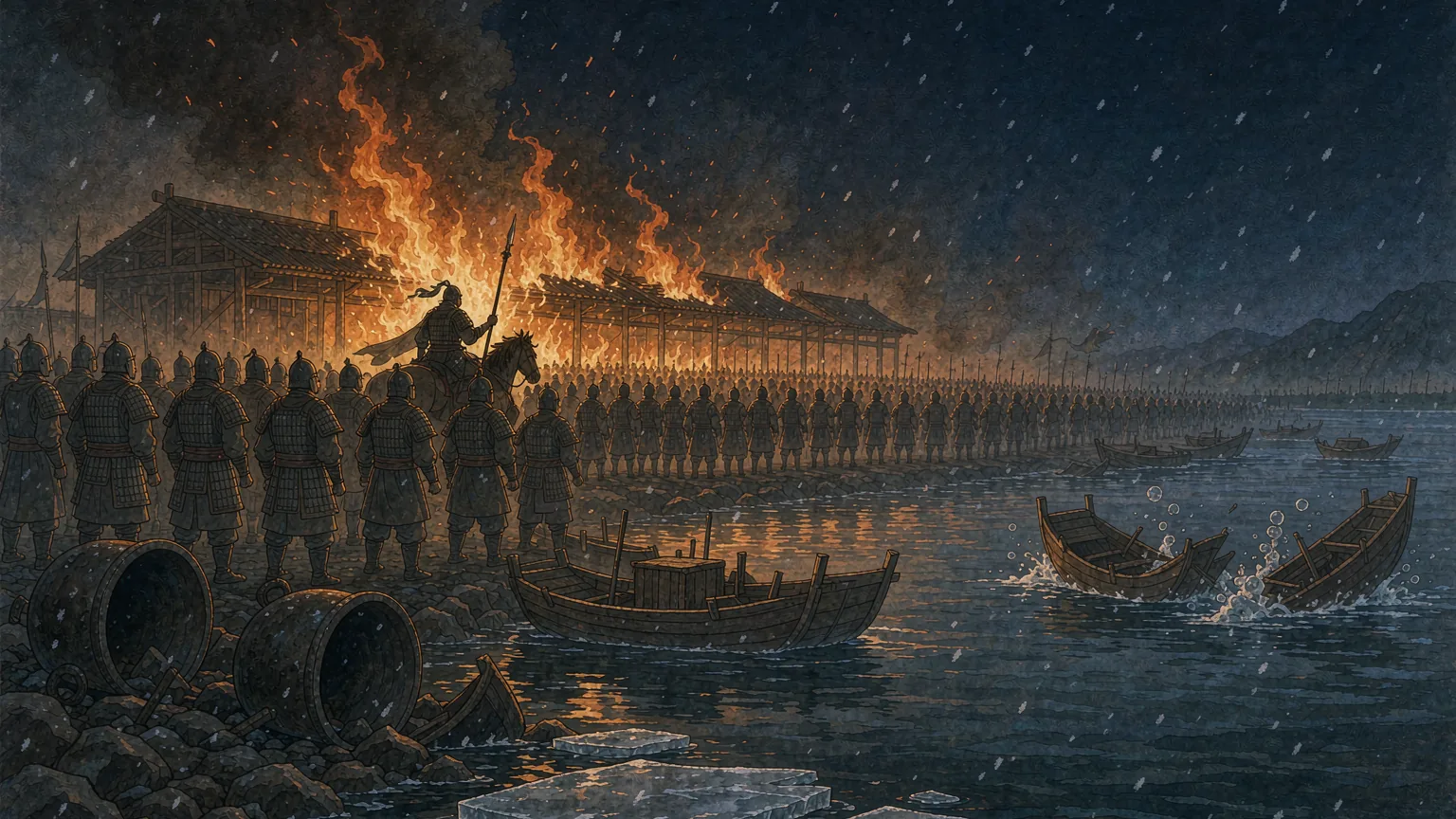
Iron cauldrons were lifted over men’s heads and smashed down onto the rocks — a flat, ringing crack. One. Two. A hundred. The steamers they cooked grain in were broken too.
Boats were holed and pushed off the bank, one after another, sinking in a trail of bubbles.
The wooden barracks behind them went up in fire, until half the sky was red.
The soldiers stood and watched. At first they just stared. Then the last small piece of doubt left their faces.
No pots, no cooking. No boats, no crossing back. No camp, no shelter.
Xiang Yu mounted his horse and pointed his halberd across the water.
Several tens of thousands of men walked into the broken ice of the Zhang River.
The Qin had never seen anything like it.
The moment the Chu soldiers reached the far bank, they came at Wang Li’s camp like men who had not eaten in three days. No careful formations. No probing. No falling back. One man taking on three, with nothing left to lose.
The first Qin line broke.
The second went the next day.
The walls of the supply corridor were torn down. The grain carts were set alight, and the flames crawled along the road towards the river.
Nine battles. Nine wins.
And a few miles away, up on the wooden walls of those dozen camps, more than a hundred thousand soldiers of the other states were watching.
They watched Chu soldiers run into the middle of Qin formations, one against three, swinging until a blade folded, then using their fists.
They watched Chu banners go down in the dust and come up again.
They heard the shouting — wave after wave of it, like thunder, from morning until dark, until the wooden walls under their hands were shaking.
One by one, the faces of the watching generals went white.
Someone said, very quietly: “Can men really fight like that?”
Nobody answered. Every man on that wall was gripping his own weapon, and every palm was wet.
By the third day, the Qin army came apart.
Su Jiao was killed. Wang Li was taken alive. She Jian, with his camp collapsing around him, refused to surrender and set himself on fire. Out on the supply road, Zhang Han watched two hundred thousand men scatter, and could do nothing but pull the survivors south.
The gates of Julu finally opened.
Zhang Er walked out and stood looking at the battlefield for a long time. Broken spears. Burned banners. Overturned grain carts, going on forever. He opened his mouth, and no words came out.
That evening, Xiang Yu summoned the generals of every other army.
One. Two. A dozen. The same men who, the day before, had stood on their own high walls and watched.
They reached the gate of the Chu camp. And there, all together, they stopped.
Then they went down on their knees, shuffled forward on them, and crawled inside. Not one of them lifted his head.
In the tent, Xiang Yu sat in the seat of honour and said nothing.
A dozen generals knelt in front of him, faces to the floor, breathing carefully.
From that night on, everyone in China understood one thing: above the lords of the states, there was now Xiang Yu.
That is where the Chinese idiom 破釜沉舟 comes from — from a night of broken iron and burning boats on the bank of the Zhang River.
It does not mean being reckless. It means something colder and harder than that. It means that a person only begins to fight with everything he has on the day he destroys his own way home.
Xiang Yu died young, years later, by his own sword, on the bank of another river. That is a different Chinese idiom story, and a sadder one.
But on that winter night, the pots broke, the boats sank, and the fire went up.
A young man stood in the middle of the broken iron and the light, and said one sentence to an army.
Somebody wrote it down. People have been repeating it for two thousand years.