English has a saying about two dogs fighting over a bone while a third runs off with it. China tells the same story with a bird and a shellfish, and adds one detail that makes it sting. Neither of the two ever stops to look at the bank.
The Chinese idiom is 鹬蚌相争, in pinyin *yu bang xiang zheng*. A yu is a snipe, the long billed wading bird. A bang is a freshwater clam. Snipes and clams at war. The full saying runs on a few words further, to the fisherman who benefits.
This Chinese fable comes from the Intrigues of the Warring States, a collection of the speeches and schemes of that era. The man telling the story is Su Dai, a traveling persuader. He told it to stop a war against his own homeland.
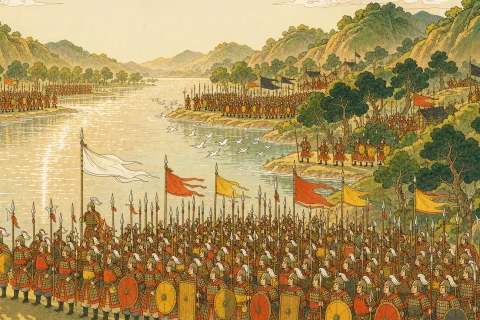
That year, the state of Zhao was going to attack the state of Yan.
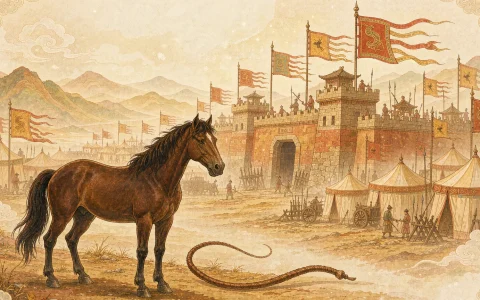
Zhao was strong. Its capital was Handan, and after a sweeping military reform, its cavalry was among the best of the age. To the north lay Yan, smaller, weaker, and close by.
The news reached Yan, and Yan had no answer. Fight, and lose. Run, and there is nowhere. Only one road stayed open. Send a man to talk.
The man they sent was Su Dai.
Su Dai was the younger brother of Su Qin, the famous persuader who had once held the seals of six states at the same time. Su Dai worked the same trade, living by his tongue. This trip, he was working for Yan.
In those decades, the map looked like this. In the west, Qin was growing larger every year. In the east, the six states could not agree on anything, and fought each other in every direction. Men like Su Dai made their living in the gaps, speaking for one state today and another tomorrow. This time, the small state of Yan had sent him to speak to the strong state of Zhao.
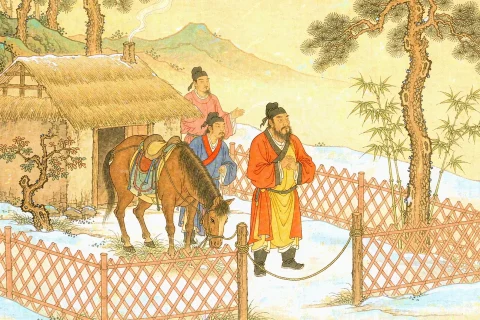
His carriage rolled south out of Yan and crossed into Zhao territory.
Su Dai did not walk in and ask for terms. To beg a favor first is to put your own neck on the table. He wanted to give the king of Zhao something to think about first.
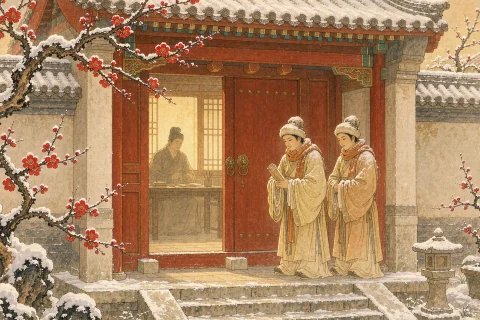
Standing before the king, Su Dai told him about something he had seen on the road.
He did not open with Yan, and he did not open with the formal manners of an envoy. He opened with a small scene. This is the oldest trick of the persuader. When the hard argument will not go through, tell a story, and let the listener do the arithmetic himself.
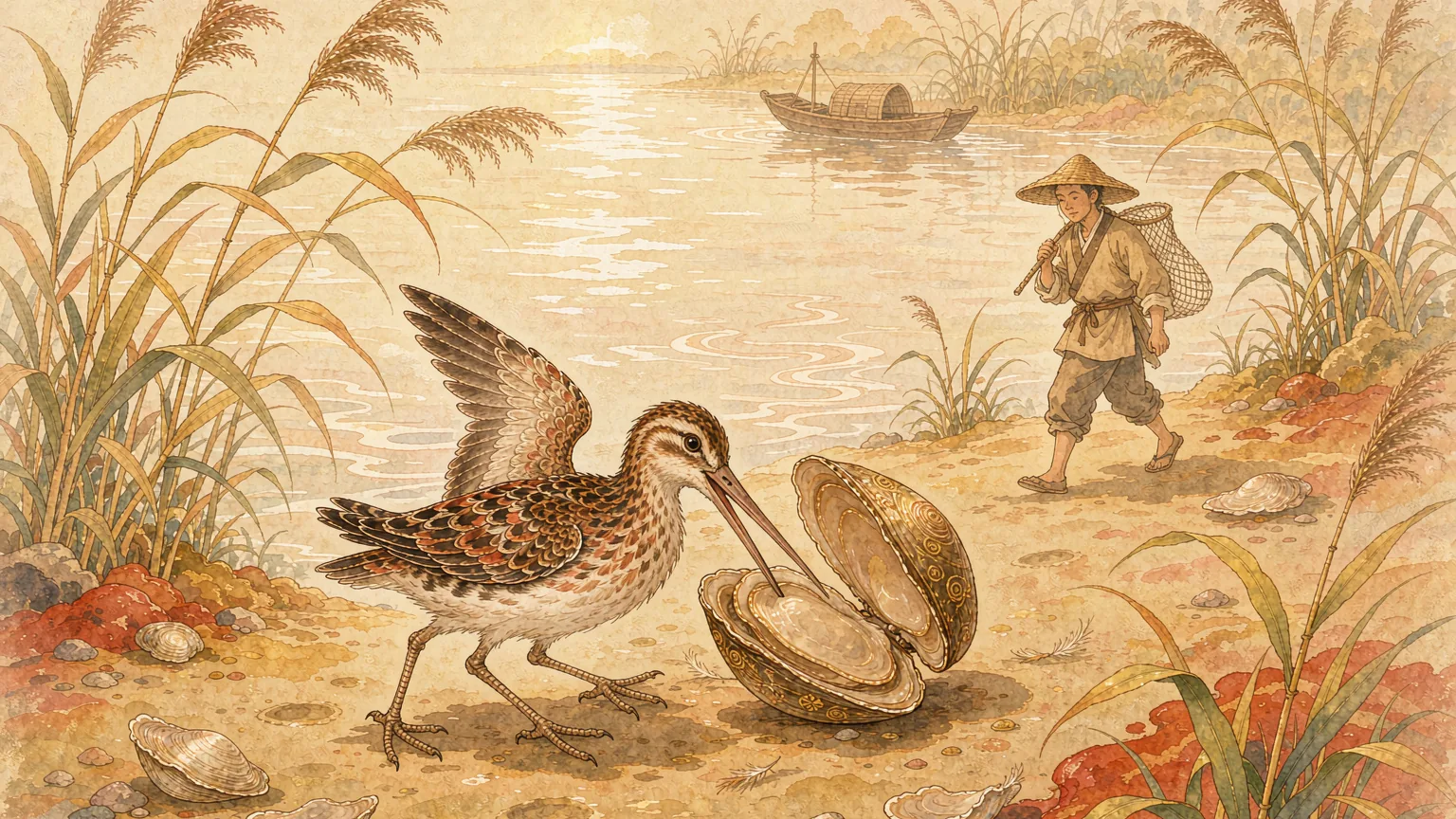
He said: on my way here, I passed a river. On the bank sat a freshwater clam. Its shells were open. It was sunning itself.
Then a snipe came down. A snipe is a wading bird, long legged, with a long pointed bill for poking in shallow water. It saw the soft flesh of the clam, and drove its bill straight in.
The clam was faster than it looked. The shells snapped shut, and clamped down on the snipe’s bill.
And there they were.
Two creatures, locked.
The snipe’s bill was pinched, but its pride was not. It said: I will not let go today, and I will not let go tomorrow. Let the sun come out and dry you, and you will be a dead clam.
The clam was just as stubborn. It said: I will not let go today, and I will not let go tomorrow. With your bill trapped in here, you will be a dead snipe.
Each one promised the other a death. Neither one let go.
Neither of them had expected this. The snipe tried to pull its bill out, and could not. The shells were clamped too tight. The clam tried to close up and slide back into the water, and could not either, with a bird’s bill across its mouth. So they stayed locked at the edge of the shallow water. The sun climbed. The last damp of the riverbank dried away. Both were certain they were winning, because both of them had counted correctly.
And then a fisherman came along the bank, carrying a net.
He did not have to work for it at all. He bent down, took one in each hand, and dropped them both into his basket.
The fisherman never said a word. He did not need to know what they were fighting about. He only saw two things on the bank that could not move.
Su Dai finished the story, and turned it on the king.
He said: right now, Zhao is about to attack Yan. If Yan and Zhao grind against each other long enough, both armies will be worn down and exhausted. And then I fear the strong state of Qin, out to the west, will play the fisherman.
So, my king, I ask you to work out this account slowly.
West of Zhao lay Qin.
Qin was growing bigger and stronger by the year, watching the plains. If Yan and Zhao went to war, the longer it lasted and the harder it burned, the better Qin would sleep. Qin would not have to send a single soldier. It only had to stand to one side and wait for the two of them to bite each other toothless, and then reach down and pick up whatever was left.
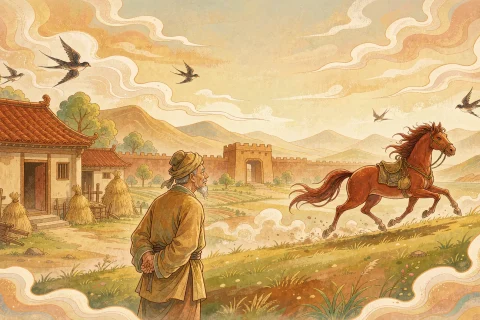
The king of Zhao fell quiet.
It was not that he failed to understand. He had soldiers, and he had the map in his head. He had already worked out which cities in the north he could take. What Su Dai put in front of him was the edge of that map, the great dark mass to the west.
Win against Yan, and gain a few cities. Fight too long, and be swallowed by Qin, and lose the whole state. That account weighed far more than one or two towns.
In Zhao court, there were men who wanted the war. Their case was solid enough. Yan was weak. Take a few cities while they are cheap. Su Dai was showing them the other column of the ledger. A bargain taken today has to be paid for later. Attack Yan, and Yan will call for help. Even if you win, your army sits in the north for a year or more. And in that year, where is the Qin army? In the west, moving one day at a time toward the east.
The king of Zhao said one word. Good.
The attack was called off.
What happened afterward is written plainly in the histories. The armies of Qin came out of the west and rolled east. Han, Zhao, Wei, Chu, Yan, and Qi went down, one after another. Neither Yan nor Zhao ever escaped the man with the net. The riverbank in Su Dai’s story became, a few decades later, the whole map.
People use 鹬蚌相争, the snipe and the clam, as a Chinese proverb for two sides locked in a fight until both are ruined, while a third party walks off with the prize.
What makes these four characters so hard to argue with is that nobody in the story is wrong. If you are the snipe, you are right. The clam really will dry out in the sun. If you are the clam, you are right too. That bill really will not come out. Both cases hold up. And both of them missed the man walking toward the river with a net.
Su Dai did not tell the king of Zhao to avoid war. He simply took the king by the shoulders, and moved him two steps back from the map, and let him see the whole river. On that bank stood not only Zhao and Yan. It also stood one fisherman.
Su Dai travelled a few hundred miles, said a few sentences, and told a story about a bird and a shellfish. He stopped a war without an arrow. That was the finest trick of his trade in those years. Not armies. Brains.
The two who fight keep their eyes fixed on each other. What defeats them is usually not the opponent. It is the quiet man on the bank, watching, saying nothing. The sun on that riverbank was shining on the clam. It was shining on the net as well.