English has a phrase for it: a blessing in disguise. Every cloud has a silver lining. Chinese has a four-character one, and a better story attached.
The idiom is 塞翁失马, in pinyin *sài wēng shī mǎ*. Word for word: “the old man at the frontier lost his horse.”
Today, a Chinese speaker uses it to mean that you cannot tell, from where you are standing, whether what just happened is good luck or bad luck. Wait and see.
Unlike most Chinese proverbs, this one has no king in it, no general, no palace. It has an old man with no name, a border village, and a horse. It comes from the *Huainanzi*, a book of philosophy written in the Western Han dynasty, more than two thousand years ago.
That is all there is to it. One horse. Three things happen. And a whole way of looking at life comes out of it.
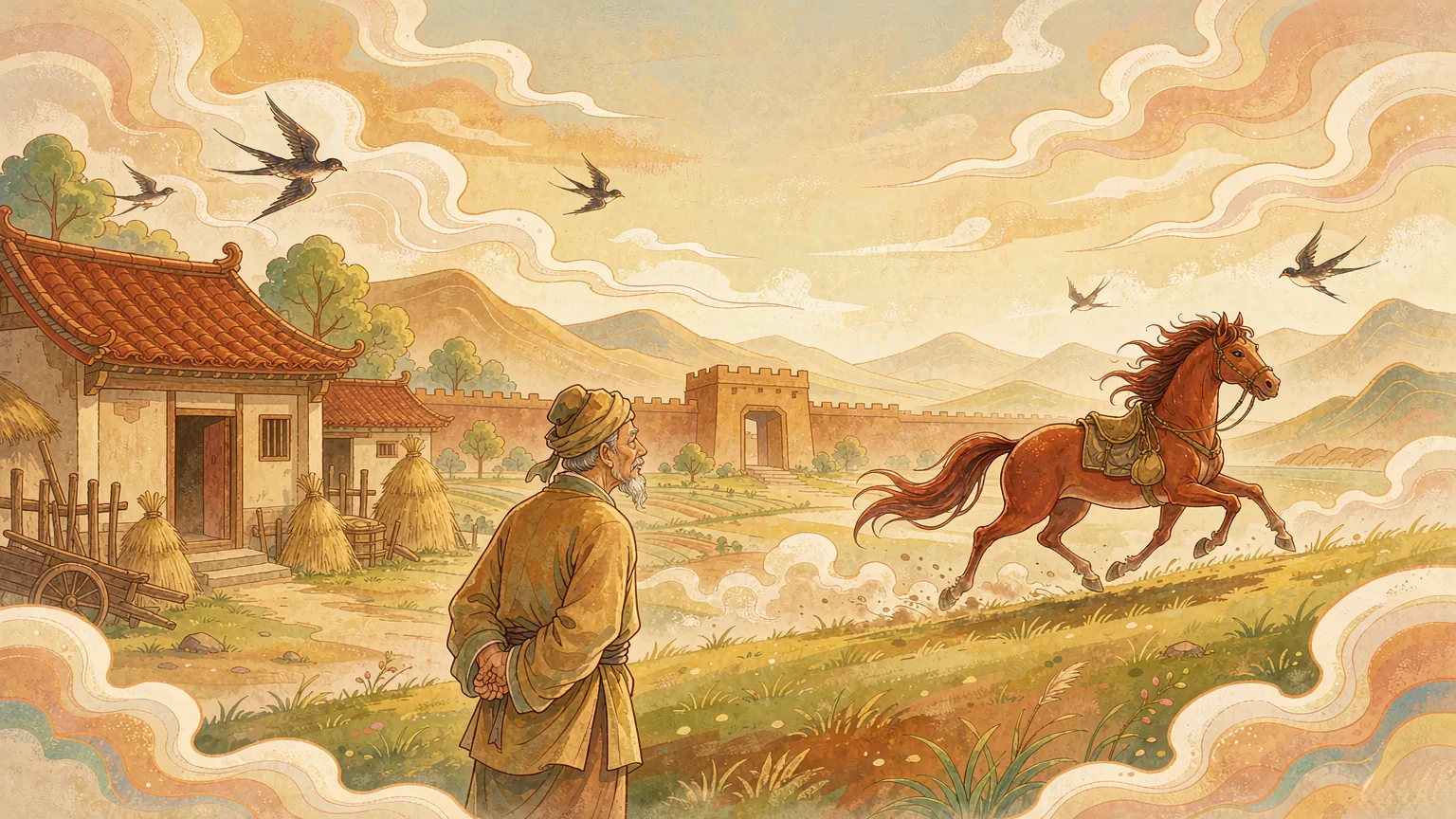
A long time ago, near the northern edge of China, there was a village.
It sat between two worlds. Behind it lay the farms and towns of the Chinese heartland. In front of it stretched the grassland, where the horse-riding peoples of the north lived. The wind came off that grassland carrying dust and the smell of grass.
Life there was not easy, and it was not rich. But it was steady, and people got by.
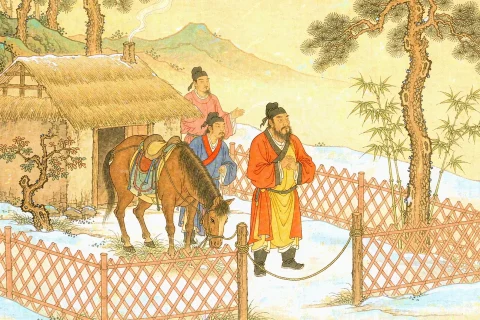
In the village lived an old man. People called him the Old Man of the Frontier. Nobody remembers his real name, if he ever had one worth remembering.
He owned one horse.
In that time and place, one horse was a family’s whole fortune. A good horse could plough, pull a cart, carry loads, and be traded for grain. It was a tool, a vehicle, and a savings account, all in one animal.
This horse had been with the old man for years. It had a dark chestnut mane and a gentle temper. When the old man reached out, it lowered its head for him. On cold nights he got up to give it extra fodder. When it rained, he led it into the shed and stood in the doorway watching it.
Half a family, that horse.
Then, one day, the old man led it out, and it slipped its rope.
It turned north and ran. It ran and ran, across the border, into the land of the northern riders.
The horse was gone.
The neighbours came to comfort him. Some of them sighed. Such a fine horse. How could it just vanish? Others worried on his behalf. How will that family manage now?
The old man sat at his door, twisting a length of straw rope in his hands. He listened for a while. Then he said, slowly:
Losing a horse — how do you know it is not a good thing?
The neighbours looked at each other. Nobody answered.
They decided the old man was too upset to think straight, and was putting on a brave face.
The days went on. The old man worked his fields. He ate his meals. He acted as if he had never lost a horse at all.
The neighbours gradually forgot about it. He kept looking north.
Months passed.
Then, one evening, a small black dot appeared on the northern horizon.
The dot grew larger. And larger. And behind it came a whole dark mass of shapes.
People ran out of their houses to look.
It was the old man’s horse. It had come home.
And it had not come alone. Behind it streamed a herd of wild horses from the grasslands. Somehow, out there on the open grass, the old man’s horse had joined a wild herd, fought its way to the front of it, and led the whole herd back with him. Hooves rolled in from the distance, raising a wall of dust, and every dog in the village started barking at once.
Just like that, the old man had a stable full of horses.
The neighbours came again — this time to congratulate him. The yard filled up. Everyone said what a lucky man he was. One horse had become a whole herd. Some of them started counting what a herd like that could buy.
The old man sat at his door, twisting his straw rope. Slowly, he said:
Getting all these horses — how do you know it is not a disaster?
The neighbours stopped talking.
This time nobody laughed at him. But nobody believed him either.
The old man had many horses now. He also had a son — a young man with a hot temper who loved to ride.
With so many good horses in the yard, the son rode every day. He rode faster and farther, always choosing the wildest horse, the one nobody else would touch. He felt like the freest man alive.
Until the day it happened.
He was on the wildest horse of all, galloping across open ground. Wind roaring past his ears. He bent low over the horse’s neck and looked at nothing but the horizon. The horse’s hoof went into a hole. Its body twisted. The boy flew off and hit the ground.
They carried him home.
His leg was broken.
It was a time with no real bone-setters. The leg healed badly, and left him lame. He never rode again. When he walked, he limped.
The neighbours came to comfort him once more. This time they were blunt. Such a fine young man, they said. What a waste. He will not even be able to work the fields properly now.
The old man sat at his door with the same straw rope in his hands, and said the same thing.
My son broke his leg — how do you know it is not a good thing?
Even the neighbours who trusted him most shook their heads.
A broken leg. What good could possibly come of a broken leg?
A year later, they found out.
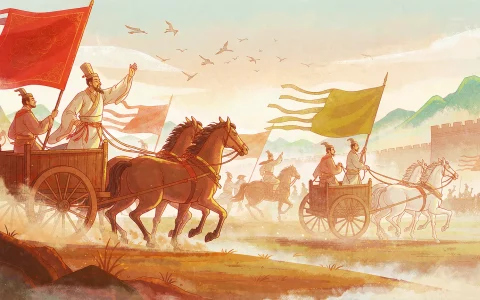
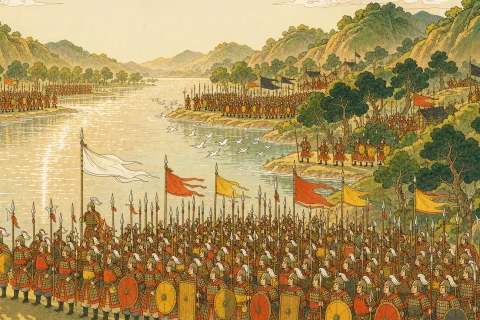
The northern riders came south. Not a raiding party this time — a full invasion.
Beacon fires lit up on hilltop after hilltop, one after another, until the whole sky to the north was red. Hooves rolled down from the border. The government ordered every able-bodied young man in the frontier villages to take up arms.
It was a slaughter.
Officials rode from door to door, writing down names. The next day they came back to collect the men. Families wept at the gate and nobody dared stop them. The young men of the village were marched away in columns, carrying spears and knives.
When the fighting was over, nine out of ten of the frontier’s young men never came home. Crops stood unharvested in the fields. The crying at village gates went on for weeks.
In the old man’s house, both father and son were still alive.
Because the son was lame, he could not ride, and so he was never taken. The recruiting officers came past the door again and again, looked at him, shook their heads, and moved on. The family kept their few rooms and their few fields, and lived.
That was when the neighbours finally remembered the things the old man had said.
Losing the horse was a misfortune — and the horse brought back a whole herd.
Getting the herd was a blessing — and the son broke his leg.
Breaking the leg was the worst luck of all — and that lame leg pulled him out of a field of dead men.
One thing after another, like an abacus being worked by someone in the dark.
And that is how the story became the four characters 塞翁失马.
It is not a lesson about giving up. It is not fatalism.
It is this: standing where you are standing, you cannot tell whether you are going uphill or downhill. When bad news comes, do not start crying too soon. When good news comes, do not start celebrating too soon. Look a little further out. Keep your mind a little steadier.
Look three steps ahead, if you can.
The old man of the frontier lived to a great age.
One winter, a beacon fire lit up on a hill again. He stood in his doorway and looked at the glow on the horizon. Then he looked at his son in the yard, limping, carrying a bucket of water to the horses.
He said nothing at all. He smiled a little, and went back inside.
In the yard, the horses stood head to head, eating grass.