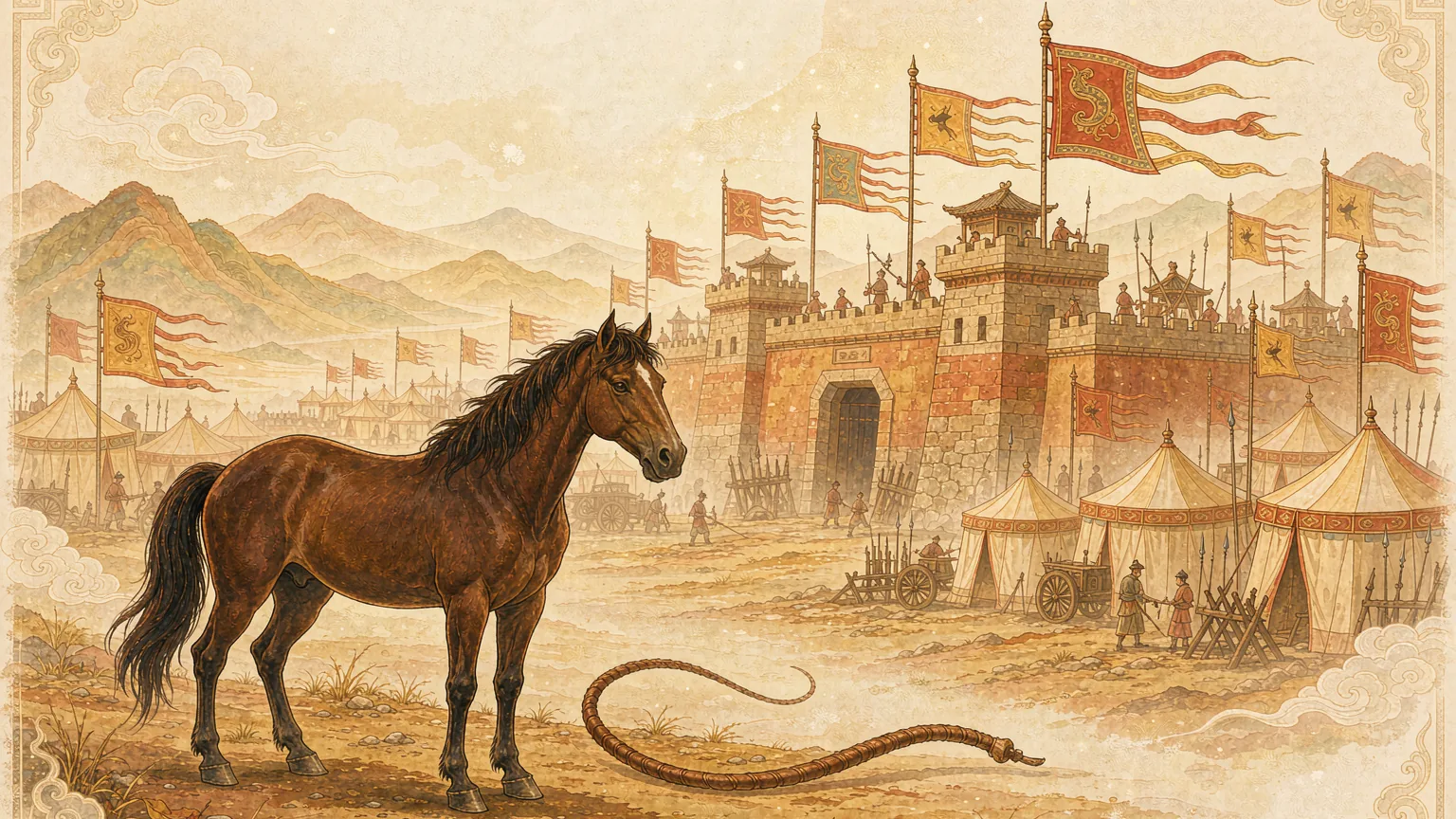
Even a long whip cannot reach the belly of the horse. The whip may be sound. The arm may be strong. The spot you are aiming at simply sits too far beneath you.
That is the meaning of the Chinese idiom 鞭长莫及, in pinyin *bian chang mo ji*. It describes a task you have the will to do and not the reach to finish. It does not mean you are weak. It means the distance is real.
This Chinese proverb comes from the Zuo Commentary, a court chronicle of the Spring and Autumn period. The man who said it was an official of the state of Jin. He said it to stop his own ruler from sending an army. To understand why a Jin minister had to argue his own king out of a war, we have to begin with a mission to the state of Qi.
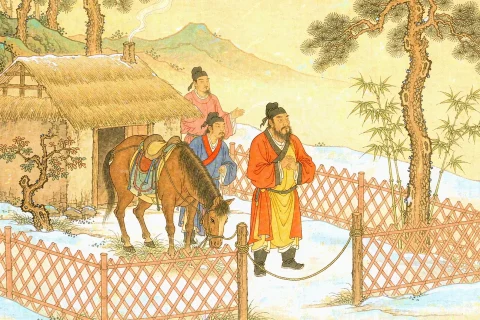
That spring, the king of Chu wanted to send an envoy to Qi.
The man he chose was Shen Zhou.
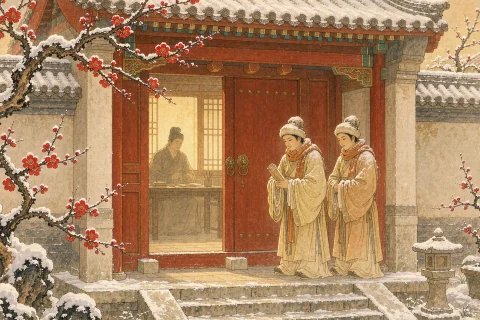
Before Shen Zhou left, the king gave him one small instruction. On the way to Qi, you will pass through Song. Do not ask Song for permission to cross. Just go through.
Shen Zhou knew at once that this was trouble.
He said to the king: Zheng understands us. Song is deaf. When envoys of Jin cross Song, Song pretends not to see them. If I cross Song without a word, I will die.
The king answered him: if Song kills you, I will attack them.
That was a promise. Shen Zhou set out.
He entered Song territory with his carriage and his escort, and sent no notice ahead, and presented no papers. In that age, an envoy passing through another state was expected to ask for the road. That request was called borrowing the road. It was courtesy. It was also recognition. Skip it, and you treated the other state as if it were not there.
In Song, an official named Hua Yuan heard about it.
His reasoning was short. A man crosses our land and will not even greet us. That is contempt. Contempt is the same as conquest. If conquest is coming either way, then let us have our satisfaction first.
Song killed Shen Zhou.
Word came back to Chu. The king was in his palace when he heard it. He leapt up from his mat and walked out, and did not wait for his shoes. Attendants ran after him with the shoes and only got them on him outside the bedroom door. His driver brought the carriage and caught up with him in the market street before the king would climb in.
That September, the army of Chu surrounded the capital of Song.
The siege lasted most of a year.
No relief army came. Inside the walls, the grain ran lower every day.
Chu could afford to sit there, and everyone knew why. Three years earlier, Jin and Chu had fought a great battle at a place called Bi, and Jin had been badly beaten. After that, one small state after another in the central plains turned toward Chu. The king of Chu was at the peak of his life. A Chu at its peak could surround a Song city, and hold, and wait.
By the following spring, Song sent word to Jin asking for help.
The ruler of Jin could not sit still. Song was his ally. If he let it be strangled and did nothing, no one would ever follow Jin again. He wanted to send troops.
An official named Bo Zong stopped him.
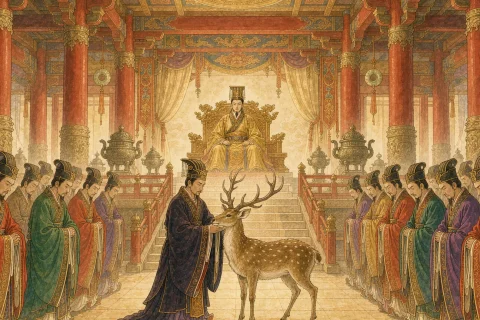
Bo Zong was a Jin minister, and he spoke carefully. He did not begin with costs and benefits. He began with an old saying.
Even a long whip cannot reach the horse’s belly. That is where the horse’s belly is, under the body, a place no whip was ever made to touch.
Then he laid it out for the ruler. Heaven is granting its season to Chu. This is not the moment to fight them. Jin is strong. But can strength outrun the design of heaven?
He went on, and said harder things as well.
Rivers and marshes take in dirty water. Deep mountains and thick grass hide snakes and vermin. Even the finest jade carries a flaw. A ruler, sometimes, has to swallow a little filth of his own. That is the way of things. Wait. Hold this one back.
The ruler of Jin listened, and held back.
But he could not simply let Song die. So Jin found another way. It sent a man named Xie Yang to slip into Song and steady them. Tell them the whole army of Jin is on the road and will arrive soon. Hold on. Do not surrender.
On the way, Xie Yang was caught by Zheng, and handed over to the Chu camp.
The king of Chu did not kill him. He offered him rich gifts, on one condition. When you go on to Song, say the opposite. Tell them Jin has abandoned them, and they should give up early.
Xie Yang agreed. Three times, he agreed.
The men of Chu raised him on a high war tower, so he could shout toward the walls of Song.
Xie Yang shouted.
What he shouted was the true message he had been sent to carry. The army of Jin is fully raised and will be here soon.
The men on the wall heard it.
The king of Chu heard it from below, and was furious. He sent men to condemn him. You gave me your word, and turned it around the moment you opened your mouth. Where is your honor?
Xie Yang answered calmly. For a ruler to issue an order is righteousness. For a servant to carry that order through is trust. I will not trade my ruler’s command for my own life.
The king of Chu heard him out, and let him go.
The men inside Song did not get a relieving army.
What they got was the last of the grain running out. The old chronicle records the depth of it in one short line. The people exchanged children to eat, and split bones for firewood. Eight characters in an ancient text, holding the last days of a city.
Hua Yuan decided to go himself.
That night he was lowered from the wall on a rope, and slipped into the Chu camp, and found his way to the tent of the Chu commander, Zi Fan, and climbed onto the man’s bed and shook him awake.
Hua Yuan told him the truth. My ruler sent me to tell you how it stands. Inside the city, we are eating our own. We are burning bones.
Zi Fan felt the chill go down his back.
Then Hua Yuan added the rest. And even so, if you ask us to kneel at the foot of the wall and sign a treaty of surrender, we will choose to die as a whole nation instead.
Zi Fan lay there a long moment. Then he nodded. He would make peace with Song.
He went back and asked the king of Chu to withdraw. The king refused at first. He had been sitting outside this city since autumn, and the walls were almost his.
Zi Fan said one sentence. I have already given him my word.
So the army of Chu pulled back thirty li, and made a treaty with Song. The pledge came down to eight characters, which later became famous: I will not deceive you, and you will not guard against me.
A siege of nine months ended on one bed, in a few quiet words.
People use 鞭长莫及 for the far thing you cannot reach, the matter you would like to fix and cannot. It is a Chinese idiom about limits, and a Chinese fable about knowing where they are.
The four words were first spoken by Bo Zong to talk his own ruler down. There was no fear in them, and no surrender either. He had simply seen one thing clearly. The further away the target, the less you can afford to reach for it on temper alone. A hand stretched too far gets pulled in after it.
Jin did not march that year. It was one of the few times that ruler held back. By holding back, Jin kept its strength for other ground. Had it not held back, Jin would have had to fight Chu at the foot of a Song wall and settle it there.
Xie Yang went home, and Jin honored him for keeping his word. Hua Yuan, who climbed onto an enemy general’s bed in the dark, was a pillar of Song for decades after.
Bo Zong, who said the words, was killed not many years later in his own court at home. Three noble families of Jin came to resent him, spoke against him to the ruler, and he was gone.
Knowing where the whip cannot reach is not the same as giving up. It is knowing which stroke lands, and which stroke only cracks against stone. Bo Zong spoke about a whip. What he really saved was the whole body of his own state.