English has the phrase to go the extra mile. It means doing more than anyone asked, without being watched. Chinese has a picture of the same idea, and the picture is a snowstorm.
The Chinese idiom is 程门立雪, in pinyin *cheng men li xue*. Word for word, it means standing in the snow at the Cheng gate. It is used for the respect a student owes a teacher, and for the patience that real study seems to demand.
Chinese fables usually happen to farmers, hunters, or officials. This one happens to a man who already had a degree, a career waiting, and nothing to prove. It comes from the *History of Song*, the official record of the dynasty, and it takes place at the door of one of the two most famous teachers in Chinese history.
Yang Shi, whose courtesy name was Zhongli, came from Jiangle in what is now Fujian, in the far southeast.
He was a bright child. He read deeply, wrote well, and thought hard about the places in the classics where the reasoning mattered. Unlike many boys of his time, he was not only chasing rank. He passed the imperial examination young.
Passing the examination meant an official post was waiting. Many men spend their whole lives hoping for those four words. Yang Shi turned the post down.
He had something he wanted more. He wanted to study under a teacher who truly knew something.
When the appointment papers came, he declined them one after another, packed his books, and traveled north. A man from his district asked him why. You finally passed the examination, he said. You will not take the post, and instead you go to be a student again? What are you after? Yang Shi answered that a post could be taken at any time. A teacher’s knowledge, once missed, would not come back.
At that time, two brothers named Cheng Hao and Cheng Yi were the finest teachers in the empire. People called them the two Cheng. Every student in the country wanted a place in their school. But the Cheng brothers chose their students by one measure. Not reputation. Willingness to do the slow, unglamorous work.
Yang Shi went to Yingchang in Henan and entered Cheng Hao’s school.
He studied solidly. He would question his teacher and keep pushing a problem to its bottom. Cheng Hao’s teaching centered on one word, respect, the sense that a person should carry something inside that he does not dare treat casually. Yang Shi kept that word for the rest of his life, and passed it on to his own students first of all.
When his studies were done, he prepared to go home. Cheng Hao walked him out and watched him go, and said one sentence. My way is going south now.
It was a high compliment. Cheng Hao was placing the future of his teaching on this one student.
Four years later, Cheng Hao died.
When Yang Shi heard the news, he set up a tablet for his teacher at home, wept before it, and wrote to every fellow student to tell them.
The teacher was gone. The learning was not. Yang Shi did not stop.
Later, he took Cheng Hao’s younger brother, Cheng Yi, as his teacher.
For this teacher, he went to Luoyang. From Fujian to Luoyang is a journey of several thousand li, and he made it more than once. By then Yang Shi was forty years old. There was grey at his temples, and he still put himself under a teacher and began again as a student.
Among Cheng Yi’s students were men younger than him, and men with higher office.
He did not care about any of that. What he recognized was the learning. In his eyes, the relation of teacher and student had nothing to do with age or rank. Inside the gate, he was a student. Outside it, he could be an official.
One day, Yang Shi and a fellow student, You Zuo, went together to visit Cheng Yi.
You Zuo, whose courtesy name was Dingfu, was also a student of the Cheng school, and would later be known in the history of philosophy himself. He and Yang Shi were about the same age and had the same temper. Both were the kind of men who, once they accepted a teacher, would bow their heads and study plainly.
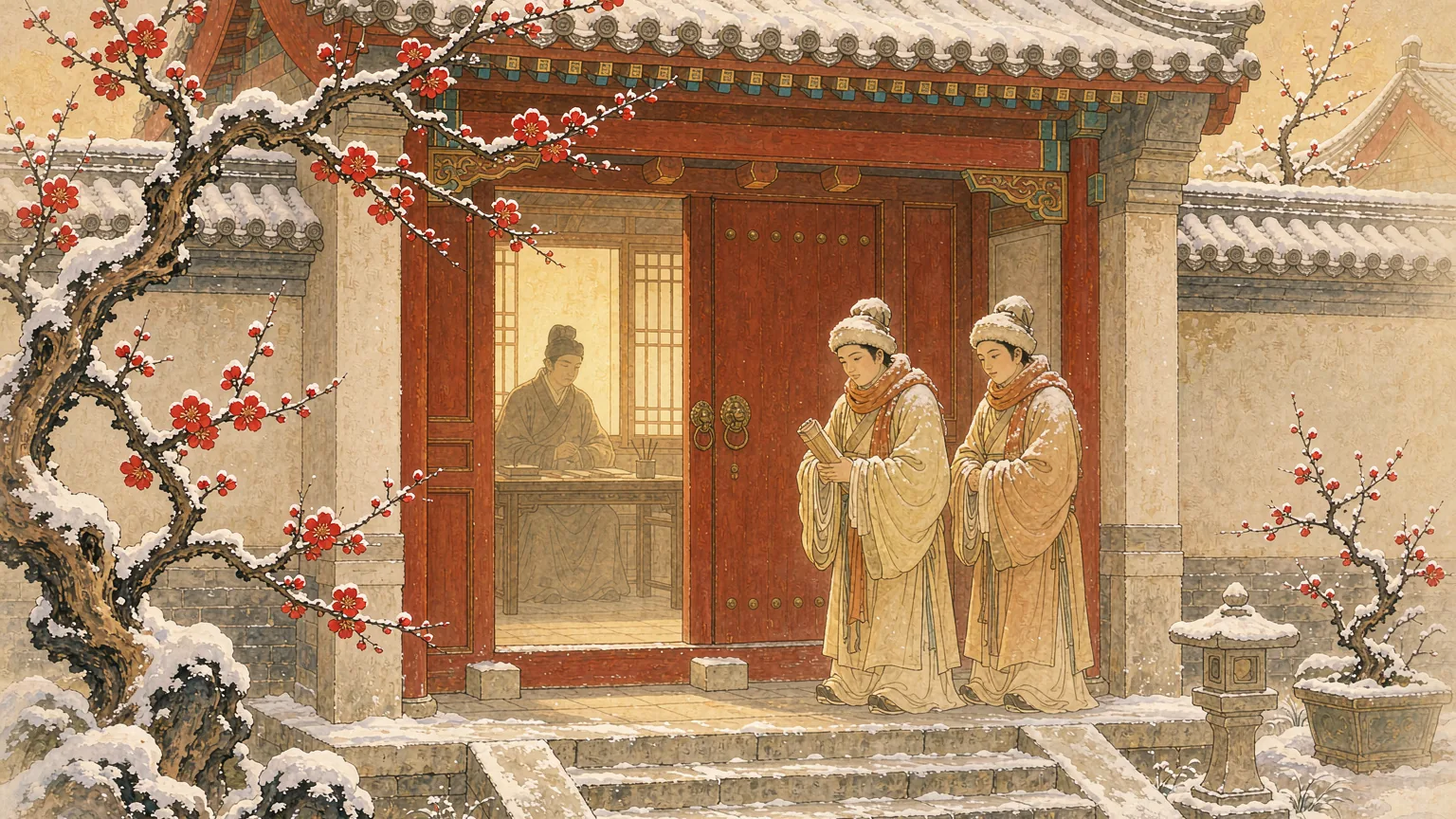
The two of them reached the gate and looked in. Their teacher was sitting with his eyes closed, meditating.
The teacher had not made a sound.
So they would not make one either.
The ordinary thing to do was to wait at the gate, or to ask a servant to announce them. Yang Shi did neither. He would not disturb the man. He simply stood outside the door and waited.
Then it began to snow.
Snow settled on their shoulders and on their caps, and melted into their collars. The ground at their feet went slowly white. Inside their shoes, the cold reached their toes.
You Zuo stood for a while. His feet were cold. He glanced at Yang Shi, meaning to say something, and swallowed it.
Yang Shi did not move.
It was not that he did not feel the cold. He stood there because of one idea. His teacher was meditating, and to call him now would break his practice. The teacher’s work was the largest thing in the world. What was standing at a door, compared to that.
The snow came down harder.
The courtyard was so quiet that you could hear the flakes land. Ice began to hang from the eaves. Somewhere far off a dog barked once, then stopped. Frost formed on Yang Shi’s eyelashes. He still did not move.
The two of them stood outside the gate for a long time. There was no shelter under the eaves. The wind came in at their cuffs. Neither of them reached out to knock.
Inside, Cheng Yi opened his eyes.
He seemed to remember, just then, that two students were still standing outside. He rose and opened the door.
The snow outside had piled up a foot deep.
Two lines of footprints ran from the courtyard up to the threshold.
Cheng Yi looked at the two men in the snow. He said little. He brought them inside.
They came in, brushed the snow off, sat down, and went on with the questions they had come to ask. As if the half day at the door had never happened.
After that, the *History of Song* says very little. But one sentence, the snow a foot deep outside the gate, was enough to be remembered for a thousand years.
From then on, the four characters 程门立雪 stayed with Yang Shi.
When his studies were finished, Yang Shi went back south. He taught in the southeast, and students came from every direction. Scholars came to call him the true heir of the Cheng school. The teaching of the two Cheng brothers passed down through him, to Luo Congyan, then to Li Tong, and at last to Zhu Xi, the man who would shape Confucian thought for the next eight hundred years. If you trace the southern line of Song neo-Confucianism back to its source, it runs through Yang Shi.
He held office and he taught, all his life. He rose to the rank of academician, and he spoke up at court for the common people. In the last years of the Northern Song, when the Jin armies pressed south and some officials argued for ceding territory to buy peace, he stood up and opposed it, laying out the consequences, and would not give way. He lived past eighty.
He left a body of teaching with a school of its own. Yet when people remember him, the first thing that comes to mind is still that doorway in the snow.
He stood in the snow that year without knowing he would become a bridge. He simply would not knock on the door while his teacher sat in stillness.
The snow melted. The footprints were covered by the next fall. Yet that one foot of snow has been remembered for a thousand years. What people remember is not the cold. It is how steady one forty-year-old man stood at a stranger’s gate.
Learning can be taught slowly, over years. That steadiness cannot be taught at all. You have to stand there yourself. The Chinese proverb for it has not changed in a thousand years.