English has a phrase for this mistake: the perfect is the enemy of the good. Chinese tells it as a race with a jug of wine, and the loser is the man who was winning.
The Chinese idiom is 画蛇添足, in pinyin *hua she tian zu*. Word for word, it means drawing a snake and adding feet. A snake has no feet. If you draw one and then keep going, you have not improved the picture. You have ruined it. The phrase is used for anyone who does one thing too many, and loses what was already in his hand.
It is one of the most loved Chinese fables, and it is short enough to tell a child in a minute. But in the book it comes from, the story was not told to a child. It was told to a general, to stop a war.
That book is the *Intrigues of the Warring States*. The man telling the story was a traveling persuader named Chen Zhen. The man listening was a Chu general named Zhaoyang, who had just won a great victory and was about to start another fight.
Zhaoyang belonged to the ruling clan of Chu. He was one of the most powerful men in the state, and he had commanded armies for years. When he moved troops, nobody at court could stop him.
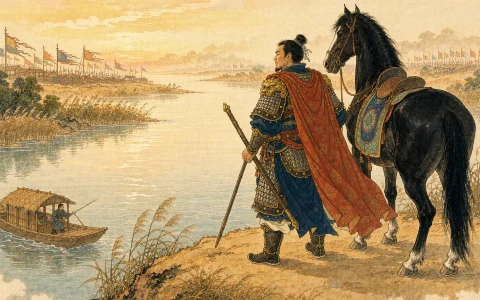
He had spent his life taking whatever he attacked. That year, he led a campaign against the state of Wei, took eight walled cities, and killed the Wei commander in the field. His army was at its peak.
He had rank. He had territory. He had rewards. Most men would have stopped there and enjoyed it.
Zhaoyang did not stop. He turned his army east, and prepared to attack the state of Qi.
Qi was alarmed.
The army of Chu stood on the border, and Qi could not raise a force that could meet it in time. The whole court was looking for a way out.
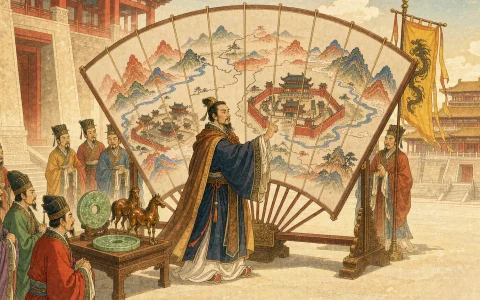
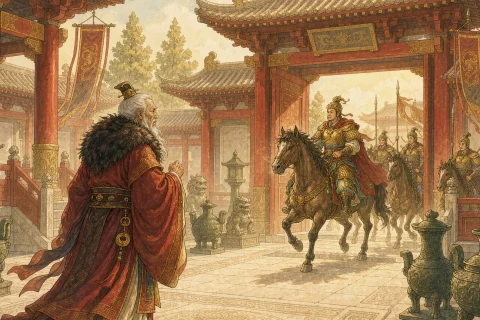
At that moment, a man named Chen Zhen happened to be passing through on a mission for the state of Qin. Chen Zhen was a professional talker. He could argue for one state today and the next state tomorrow, and he was good at it. He heard about Zhaoyang, and he went to see him.
He said he wanted to tell the general a story first.
Zhaoyang told him to go ahead.
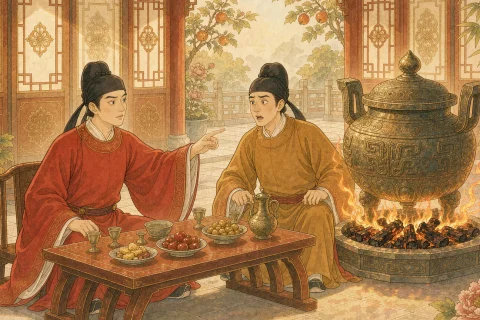
Chen Zhen did not mention Qi. He did not mention Wei. He lifted his cup, and he began with a small thing that had once happened in a Chu village.
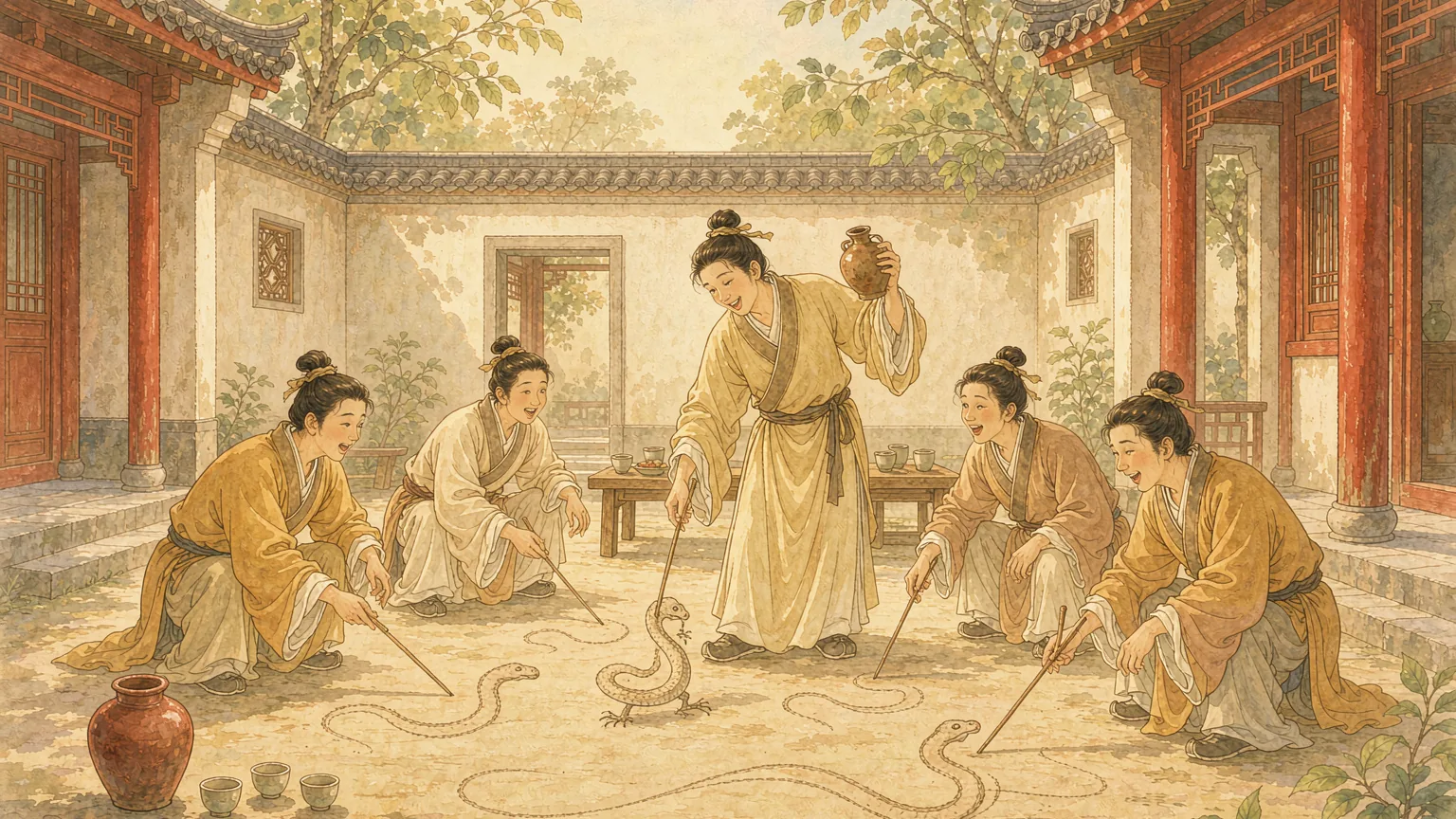
A household in Chu had finished its sacrifices to the ancestors. When the work was done, the master of the house gave the servers and retainers a single jug of wine.
Wealthy families in that age kept a crowd of such men around them. Some gave advice, some ran errands, some were good with words, and some were only there for the meals. The master fed them, and they worked for him. This jug of wine was the master’s thank-you after the ceremony.
There was one jug.
There were several men.
They sat down together to work out how to divide it. If everyone took a sip, nobody would get enough to taste. If one man drank it all, he would drink his fill.
Somebody had an idea. Let us draw snakes on the ground, he said. Whoever finishes his snake first gets the wine.
Everyone agreed.
Not one of them stopped to ask a simple question. They were busy comparing who could draw fastest. Nobody asked what a snake actually looked like, or whether a snake had feet.
So each man found a stick, crouched down, and began to draw.
Drawing a snake on the ground is harder than it sounds. You press a stick into the dirt and pull the head first, then drag one line down to the tail, keeping the body even and straight. Some hands were quick and some were slow. The men crouched in a circle, nobody speaking, and the only sound was the scratch of sticks in the dust.
One man finished first.
Three strokes, and his snake had a head, a body, and a tail. He threw down his stick and reached for the jug.
By any fair reading, the contest was over. He had won.
But he was too pleased with himself, and his hand was still itching to draw.
He picked up the jug with his left hand. He looked at the men still bent over their own work, and he said, you are all so slow. I still have time to add feet to my snake.
Then he crouched back down and started drawing feet.
The man beside him kept his head down and said nothing.
A snake has no feet. As he drew, he began to feel that something was wrong. But he had already said the words out loud, so he kept going. He hooked one foot onto the body, then another. Some of the onlookers laughed out loud, and still he did not stop. The more he drew, the more awkward it looked, but his hand would not quit. He could not take back the sentence he had just spoken.
He was adding the last foot when somebody else finished a snake.
That man stood up and snatched the jug out of his hand.
The first man protested. I finished first, he said.
The other man answered with one line. A snake has no feet, he said. If you give it feet, it is not a snake. The first man to finish a snake was me.
There was nothing to say to that.
The jug changed hands, the cork came out, and the wine went down. The whole jug was gone.
The man who had added the feet stayed crouched on the ground. His feet were not finished, and his wine was already inside somebody else.
The jug had never belonged to anyone yet. But every man in that yard learned the same lesson that afternoon. The man who drew first lost to the two strokes he did not need.
Then Chen Zhen looked up at Zhaoyang.
He did not circle around it. He put the point directly on the general.
You have already beaten Wei, he said. You broke their army and killed their general, and you took eight cities. There is no second man in Chu with a record like that. Your rank is at the top. There is nowhere left to promote you.
And now you want to move on Qi, he said. Qi hates you. Wei has not recovered. That fight may not go well. If you lose, your earlier victories are discounted. And even if you win, the reward cannot be raised, because your rank cannot be raised. How much higher can it go? Merit has a ceiling too. Past a certain point, more of it is only more of the same.
That, he said, is what it means to add feet to a finished snake. If you win, there is nothing left to give you. If you lose, you lose what you already hold.
Zhaoyang was quiet for a while.
He called off the attack.
A war that was never fought was stopped by a story about drawing, and the state of Qi got away without a scratch.
Nobody in that Chu courtyard was clumsy. The man who lost the wine was the fastest hand in the group. He won the race outright.
What beat him was the one extra thing he could not resist doing.
The habit is everywhere. A deal is agreed, and someone reopens one clause and breaks it. A price is settled, and someone pushes once more and drives the buyer away. A job is finished, and someone shows off and leaves a handle for others to grab. The extra bit is usually not skill. It is pride. The Chinese proverb for it is four characters long, and it has been in use for more than two thousand years.
The snake was drawn perfectly well. The feet came later. So did the loss of the wine.