Modern athletes have a phrase for it. They call it being in the zone — the state where the body seems to know exactly what to do, and the mind just watches.
Chinese has a story for it, and the story is about a cook with a knife.
The idiom is 庖丁解牛, in pinyin *páo dīng jiě niú*. It means, literally, “Cook Ding carves an ox.” Today a Chinese speaker uses it to describe someone who has mastered a craft so completely that the work seems effortless — who moves through a hard task the way a blade moves through a gap.
It comes from the *Zhuangzi*, one of the founding books of Daoist philosophy, written more than two thousand years ago. The book is full of strange little tales, and this is one of its best.
There is no battle in it. Nobody dies. There is a ruler, a cook, and an ox — and a knife that is nineteen years old.
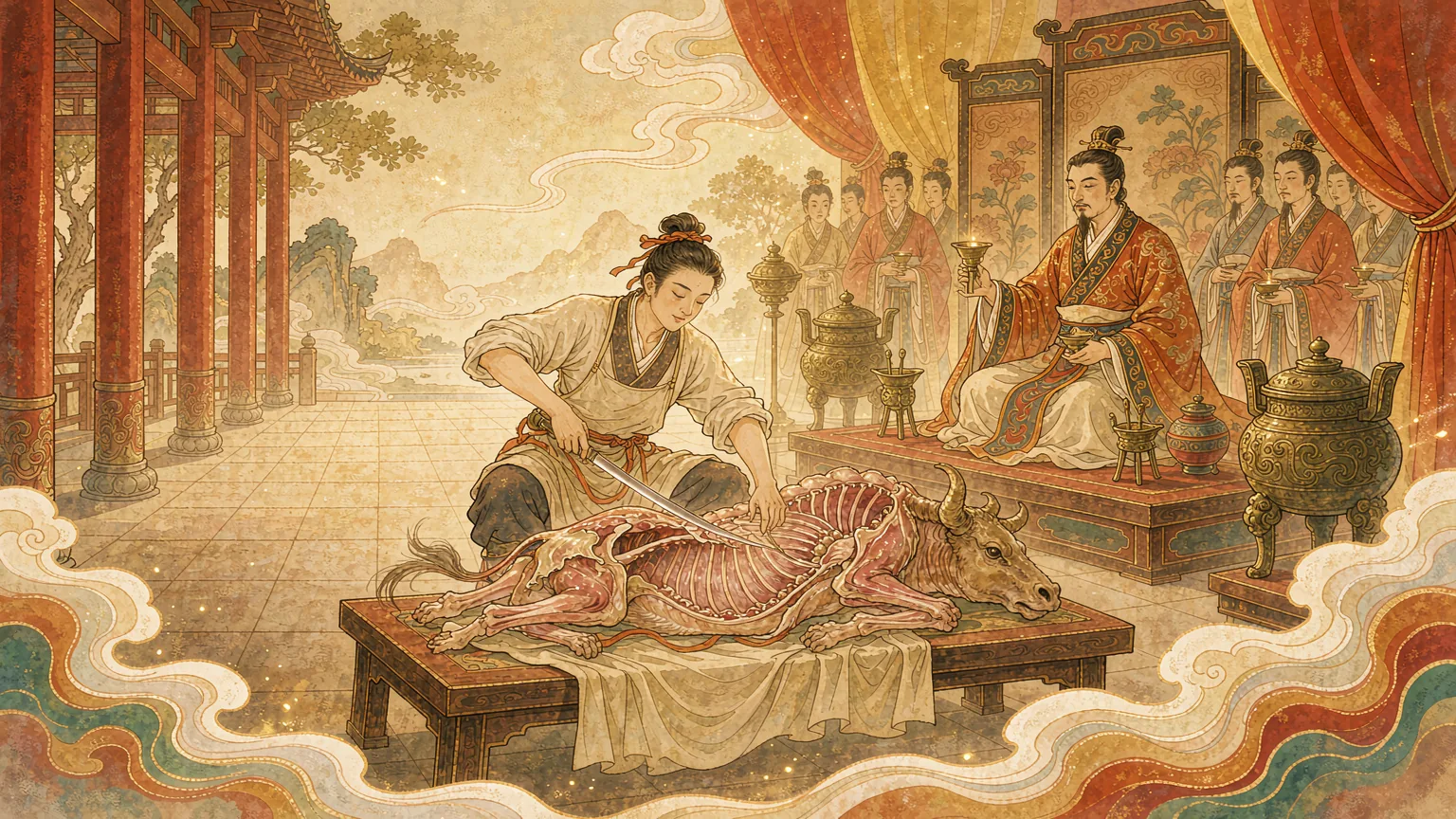
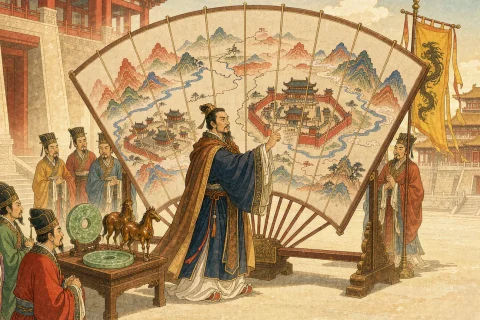
The story opens in the hall of Duke Hui of Wei, a ruler of one of the great states of ancient China.
A guest of importance had arrived. By the custom of the time, a great house marked a guest of honour by slaughtering an ox and serving it fresh — part banquet, part display of wealth. When the ox was led in, the whole hall went quiet.
The animal was enormous, its shoulder higher than a man’s waist. It walked in slowly, head down, tail swinging.
Out stepped the cook. His name was Ding. He was not tall and not broad. In his hand was a single knife — not long, nothing special to look at.
Cook Ding walked once around the ox. He pressed his hand along its neck, down its spine, back to its hind legs. Then he stopped, and took one deep breath.
What happened next made the whole hall stare.
Wherever his hand touched, the ox opened. Wherever his shoulder leaned, the flesh parted. His foot pressed, his knee pushed, and every movement landed exactly where it needed to. The blade going into the meat made a soft rush of sound, like water over stones. The blade passing between joints made a light *shh*.
And the sounds came out in rhythm. Rising and falling, light and heavy — not the sounds of butchery at all. It sounded like someone playing a set of bronze bells. It sounded like an old piece of music.
Cook Ding did not hurry. The knife went where the hand sent it. The hide opened where it was meant to open, the sinew parted where it was meant to part, as though it had all been written on the ox already, and he was simply reading it aloud. The watching courtiers forgot to blink. Nobody breathed.
The hall was perfectly silent.
And the ox did not struggle or bellow. It came apart line by line, tendon by tendon, laid out neatly on the ground.
Duke Hui stared. It took him a moment to find his voice. Then he slapped his knee and said:
Wonderful. How can your skill possibly reach this level?
Cook Ding set down the knife and bowed.
What I care about, he said, is the Way — the *Dao*. That is a step beyond skill.
Skill is a matter of the hands, he went on. The Way is a matter of the mind. What the hands can learn has a ceiling. What the mind can learn has none.
Then he told them how he got there.
When I first began carving oxen, I saw an ox. A whole ox. Standing in front of it, I saw horns, legs, belly, tail — and no idea where to start. One animal, like a mountain in front of me.
After three years, I no longer saw a whole ox. Before the knife went down, I already knew where the meat was, where the bone was, and where the gaps between the bones were.
Today, I do not use my eyes at all. I feel it with my hand, with the sense of it, with the small clear knowing inside me. My eyes and ears stop, and the mind keeps moving.
Someone in the hall muttered that this sounded far-fetched. Cook Ding heard it and did not turn around.
When I cut, he said, I follow the shape the ox already has. Where there is a gap between bones, I follow the gap. Where there is a hollow between joints, I follow the hollow. The places where sinew and bone are twisted together, knotted tight — I never force those. And never, never the big bones.
The duke asked: how long have you had that knife?
Cook Ding lifted it so the hall could see.
Nineteen years, he said. Several thousand oxen. And it looks as if it came off the whetstone this morning.
A stir went through the hall. Someone leaned forward to see whether the edge really was unmarked.
Cook Ding went on, and explained it.
A good cook changes his knife once a year — because he cuts. An ordinary cook changes his knife once a month — because he hacks. I do neither. My blade has almost no thickness at all. And the joints of an ox have gaps. Where the blade is thin and the gap is wide, the blade passes through and still has room to spare.
That is why, after nineteen years, the edge is still new.
The hall nodded.
Then Cook Ding added one more thing.
Though not every time is easy.
Whenever I come to a place where sinew and bone are tangled and knotted, I know it will be hard. I go careful. My eyes stop moving. My hand slows down. The blade moves a very little — and then, before I know it, that knot has fallen apart, like a clump of earth coming loose and dropping to the ground.
When he finished, Cook Ding straightened up with the knife still in his hand.
He looked around the hall. His face was completely at ease, and quietly, deeply satisfied. Then he wiped the blade clean, slid it back into its sheath, and put it away.
And on the ground lay the ox, opened perfectly, bone white and meat red.
For a long time, Duke Hui said nothing.
Plenty of men in that hall had watched an ox butchered before. Nobody had ever seen anything like this. It did not look like a man forcing an ox apart with strength. It looked as though the ox had been waiting for this moment all along, and Cook Ding had simply let it happen.
Afterward, the duke had the knife brought to him. The blade was thin, almost translucent in the light. He turned it over twice and found no wear on it anywhere.
Later, the duke said something to the people around him.
Good. From what Cook Ding said, I have understood how to live.
That is where the idiom 庖丁解牛 comes from.
It is not about talent. It is not about some magical gift.
It is about what happens when a person does a thing long enough, and goes deep enough, that the thing itself changes shape in their eyes. At the start, it is one ox, and every part of it is a difficulty. Later, it is not an ox at all. It is its own grain, its own seams, its own joints.
A true master does not sharpen the knife harder. A true master takes the knife away from everything it should not touch, and sends it only through the gaps.
The knife lasts nineteen years because it never once hits anything hard.
People with real skill in their hands usually do not show much on their faces. They are not fighting the ox.
They are talking with it.