English has a warning for people who go too far to win. Do not burn your bridges behind you. Chinese had a general who did the opposite on purpose. He put a river at the backs of his own men, and then dared them to lose.
The Chinese idiom is 背水一战, in pinyin *bei shui yi zhan*. Word for word: to fight a battle with water at your back. It means to fight with no way out, and, by extension, to throw everything into one last stand.
This Chinese fable comes from the Records of the Grand Historian, the great history written by Sima Qian. Its hero is Han Xin, one of the finest generals of early China. His enemy had five times his numbers, and the battle was decided by neither numbers nor courage alone.
Most of Han Xin’s soldiers were not veterans.
The civil war between Chu and Han was in its hard years. Liu Bang, the founder of the Han, was pinned down at Xingyang by his rival Xiang Yu and could spare no men. Han Xin marched north, recruiting and absorbing surrendered troops as he went. His ranks filled with farmers who had lately put down their hoes. Against the trained soldiers of Zhao, he was outnumbered several times over.
Across from him stood Chen Yu, Lord of Cheng’an, with an army said to number two hundred thousand, holding the pass at Jingxing.
Jingxing was a narrow gap in the Taihang Mountains. Hills on both sides, a road so tight that carts could only pass single file, and the road ran on for a hundred li. A textbook defile: the worst place in the world to walk into blind.
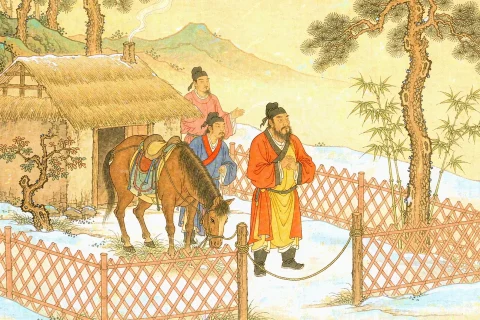
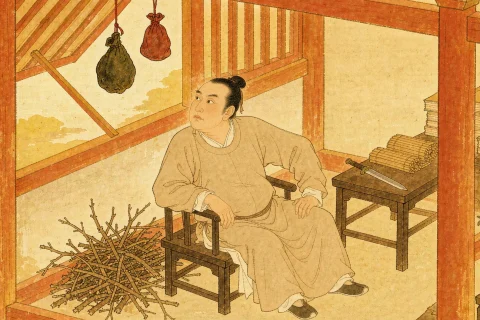
Han Xin had a hard life behind him. In Huaiyin he was so poor that he went hungry. He had crawled between a butcher’s legs to escape a beating. He had worn out his welcome at a friend’s house. He served Xiang Yu, and Xiang Yu would not use him. He came to Liu Bang, and at first Liu Bang gave him a job counting grain. It took Xiao He riding out after him in the night to bring him back. Only then did Liu Bang build an altar, appoint him general, and put an army in his hands.
He remembered all of it. What he wanted was not merely to win. He wanted to win in a way that forced every man who had ever looked down on him to admit he was wrong.
One of Chen Yu’s officers, Li Zuoche, saw the trap before it was sprung. He advised his lord: Han Xin has come a long way, and his supply line is stretched thin. The Jingxing road is too narrow for carts, too tight for cavalry to form up. Give me thirty thousand men to cut his supply line by the back paths, and you hold the pass and refuse to come out. In ten days, you can hang Han Xin’s head from a pole.
Chen Yu refused. He said: Han Xin has few men and they are tired. I have two hundred thousand. Why should I hide? Besides, if the other states see me sitting still, they will think I am afraid of him.
Li Zuoche’s plan was the safe, patient road. Chen Yu did not take it, and not only out of pride. He honestly believed that when you have the numbers, you should line up and press the attack. That belief would kill him.
Han Xin sent scouts to learn what Chen Yu had decided. When he found that Li Zuoche’s plan had been thrown out, a weight came off his chest. Only then did he dare to march toward Jingxing.
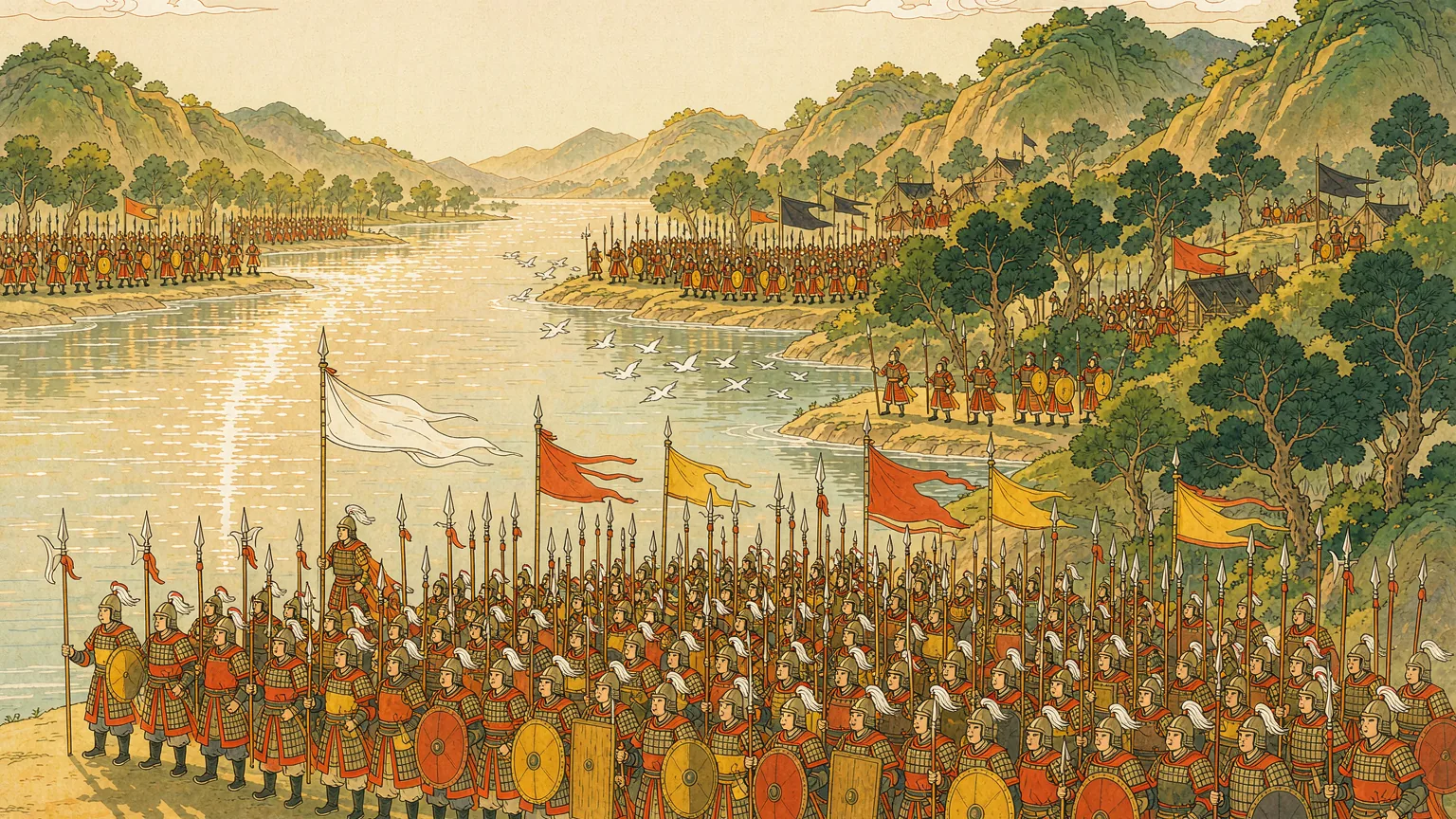
On the day of the camp, Han Xin gave a strange order. Send ten thousand men out through the pass and form them up with their backs to the river.
His officers stared. Water behind, enemy in front. What kind of formation was that? If the line broke, where would anyone retreat to? There was not a handspan of room to maneuver. But an order was an order, and no one dared say a word.
When the camp was set, the Zhao army looked down from the hills and laughed.
The men on the heights pointed at the camp by the river and doubled over. Someone said Han Xin had read his military manuals and gone foolish. Someone else said the Han army had cut its own retreat and was waiting to be cooked in one pot.
Han Xin had laid one more piece earlier still.
The night before, he had picked two thousand light cavalry. Each man carried a red Han banner. Under cover of dark they slipped by back paths onto the hill beside the Zhao camp and hid among the trees.
His orders were simple. When the battle begins, and the whole Zhao army pours out to chase us, charge into their empty camp. Tear down every Zhao flag and raise ours in their place.
At dawn, Han Xin raised the great general’s banner and drum and marched out of the pass in plain view.
The Zhao gates opened, and their army came on. The two sides fought for a long time. Then Han Xin and his comrade Zhang Er deliberately dropped their banners and drums, as if losing, and fell back toward the river.
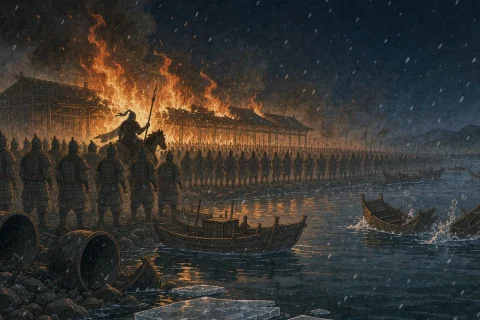
At the water’s edge, the ten thousand men in the river formation opened their lines and took the retreating soldiers in. And that closed the door. Now every man among them had the river behind him and no road left.
The Han soldiers fought like men possessed. The Zhao army pushed and pushed and could not break them.
Then the Zhao commanders thought: the Han are falling back, and their camp is empty. Why not go and seize their camp, and their banners and drums with it? So the whole Zhao army left its own camp and chased Han Xin and Zhang Er.
That was the moment the two thousand horsemen hidden in the hills moved.
They rode into the empty Zhao camp, tore down the Zhao flags, and raised two thousand red Han banners.
The Zhao army fought on, could not kill Han Xin and Zhang Er, and finally turned back to rest. They looked up, and every banner over their own camp was a Han banner.
Confusion went through them like a shock.
A moment before, they had been winning, driving the Han army across the hills. The next moment, their home camp had changed flags, and home and retreat were both gone. That fall hurts more than a blade.
They believed the Han must have already taken the king of Zhao and their own commanders. Why else would their camp be full of Han flags? Discipline broke, and men began to run.
Zhao officers drew swords to cut down the deserters and could not stop them. The army came apart like water through a broken bank.
Han Xin’s river line and the horsemen on the hill closed in from both sides and destroyed them. Chen Yu fell back to the Zhi River and was killed there. The king of Zhao was taken alive.
After the battle, his officers came to congratulate him, and finally asked what they had been afraid to ask. The manuals say to form up with a hill on your right and water on your left. Today you did the opposite and told us we would breakfast with the enemy. We did not believe it. How did it work?
Han Xin said: It is in the manuals too. You simply did not notice. Does it not say, place a man in a death ground and he will live; put him in a ground of no escape and he will survive? My men are not the veterans I trained. They are a crowd thrown together. Put them where there is a way out, and they run at the first clash. Put them where there is no way out, and every one of them fights for his own life. That is what held.
With one answer he laid bare the whole battle. He had not failed to see how dangerous the river was. He had turned the danger into a weapon. Take away the retreat, and men stop thinking about retreating.
People use the Chinese proverb bei shui yi zhan for being pushed to the end of the road, with nothing left but to fight. But what made Han Xin great was not that he dared. It was that he knew exactly when men run, and when men fight to the death.
Later Han Xin fought many more battles, and in the end he did not die well. But the day at Jingxing went into the books on war. When later ages met a spot with no way back, what they remembered was this river, this camp, and these ten thousand men standing with the water behind them. The moment they staked their lives, one man’s sums had already been done.