Think of a lemon, and your mouth waters. That small betrayal of the body is real. Your tongue does not wait to check whether the fruit is there. Say the word often enough and hard enough, and a whole army can be marched on nothing but a sour memory.
The Chinese idiom is 望梅止渴, in pinyin *wang mei zhi ke*. Word for word: look at plums to stop thirst. It means comfort taken from something imaginary. It began as high praise for a clever trick. It ended as a warning about wishful thinking.
This Chinese fable is also counted among the Chinese proverbs, and it comes from a book called A New Account of Tales of the World, compiled in the fifth century. The tale sits in a chapter reserved for clever deceptions. The man in it is Cao Cao.
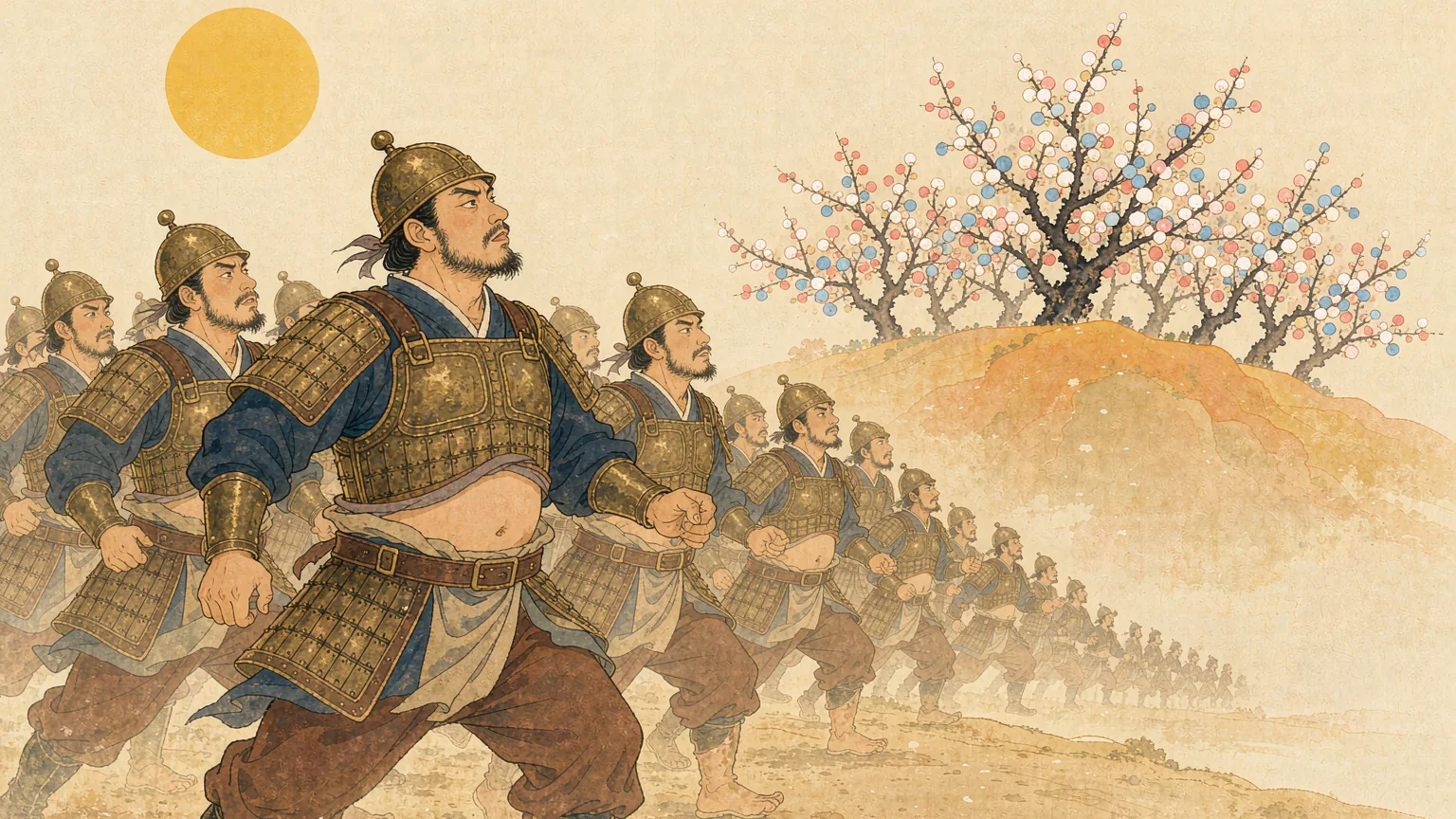
It was summer.
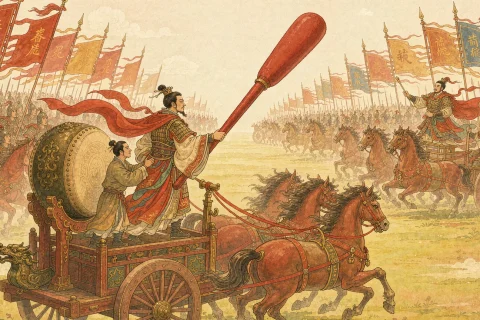
Cao Cao was leading a large army along a dry road.
Cao Cao had his share of victories and defeats in his life, but his skill at moving troops was never in doubt. He was not yet the Emperor Wu of Wei. That title came later, granted by his son after his death. To the men of his own day, he was a warlord with a real army and a tight grip on it. Most of his soldiers were northern men, used to flat country, and afraid of exactly one thing. Running out of water.
How hot it was that day, and where the march was going, the old records do not say. They leave only one line. On the march, the wells could not be found, and the whole army grew thirsty.
A road without water is worse than a road without food. Men can last for days without eating. They cannot last a day without drinking.
The sun pressed down from above. The dirt under their feet was hot, and their boots kicked up a layer of dust. At first the soldiers held the last mouthful of water in their cheeks and would not swallow it. When the skins were empty, they licked their cracked lips with dry tongues.
There was no water anywhere ahead.
The column began to slow.
Nobody was mutinous. They simply could not walk. A person’s legs run on water, and when the water is gone, the legs grow heavy. Men squatted at the roadside. Men took off their helmets and fanned their faces. March them much further, and this army would come apart on its own, without a single enemy.
Thirst is the most wearing of all things. Hunger can be borne. Thirst cannot. Once the lips split and the tongue dries, the spirit leaks out of a man, and his eyes begin to swim. This is why commanders of old camps always looked for water first, and counted water before they counted miles. Lose the water count, and you lose the battle before it starts.
The order came down to push on. The column still dragged.
Anyone who has led troops knows that a column cut off from water will not last the day. It is not that they will not fight. It is that they cannot walk. This, Cao Cao knew better than anyone.
So he made a decision.
He did not send riders out to hunt for water. There was none to find. He did not halt and wait for water to arrive. None was coming. He did something else. He sent a messenger galloping up the line with a single sentence.
The sentence was this. There is a grove of plum trees ahead, loaded with fruit, sweet and sour, the best thing in the world for thirst. Move faster.
The words passed from man to man, up and down the column.
The riders shouted as they went, and the sound drifted back along the line. The men at the front turned and told the men behind them. The men behind told the men further back. One false sentence travelled a few miles on foot, and grew more convincing at every step.
By the time it reached the rear, the column had changed.
The soldiers heard the word plum, and something moved in their mouths. Then a thin sourness rose from both sides of the tongue, and kept rising. Now there was something in the mouth. The dryness in the throat loosened by a notch. And the legs that had gone soft a moment ago found a little strength again.
The sourness was something they could taste. They had not seen a single plum. But every man who had ever eaten one remembered the taste. Once that memory was called up, the body answered it.
So the column moved again.
The men at the very front were truly looking for the grove. Most of the men behind had stopped looking. They were only following the men in front. One false sentence was holding up several thousand pairs of legs.
Cao Cao watched from horseback. He did not add a second lie, and he did not use his whip. He knew exactly how long one sentence could last. It would last until they reached water, or it would not.
The trick was not a clever one. It worked.
What Cao Cao wanted was never to make his men believe they had drunk. He wanted to move them from cannot walk back to can still walk. One more mile was one more mile.
The false plums could not last long. But the stretch they bought was enough. The army came to a place where there was water. The old record is blunt about it. On the strength of that, they reached the water ahead.
At the water, the soldiers dropped down and drank their fill.
Nobody mentioned the plum grove again. Nobody in that column turned around to see whether the trees had ever been there.
The book that kept this story is A New Account of Tales of the World, a collection of anecdotes about famous men from the late Han through the Eastern Jin. The compilers filed this one under a heading for cunning tricks. So even in its own time, this was not remembered as a warm story. It was remembered as a maneuver.
People use 望梅止渴 now in two ways. The first is praise. A commander with no water used one sentence to give his army half a life. The second is mockery. To console yourself with a fantasy. However sweet the picture, it does not quench a real thirst. Chinese keeps a companion phrase for that one: drawing a pancake to fill your hunger. A painted pancake is round, but nobody can eat it.
There is a second layer hidden in these four characters.
The first belongs to Cao Cao. A person’s mind can be borrowed and put to work. When the road truly runs out, what carries a man a little further may not be water. It may be a sentence that gives him something to hope for.
Later people came to understand this as suggestion. A single thought can make the body change, for real. Cao Cao may not have known the theory. He used it more precisely than anyone. He never wanted his men to stop being thirsty. He wanted them to walk a little further, until they reached the water.
The second layer was added by later generations. Living on hope as if it were water always shows through in the end. A sour taste in the mouth does not shorten the road. No matter how loudly you shout the word plum, the well still has to be dug.
Cao Cao won because he knew the plums were fake, and because he knew the trick only had to hold until the water. A false thing has its uses and its limits. Use it like a tool, and it can save a man for an hour. Believe it like a truth, and you will die of thirst in front of a grove that is not there.