English talks about a runaway bestseller, a book that sells so fast the shops cannot keep it on the shelves. Chinese has a picture of the same thing, fifteen hundred years old, and what ran out was not books. It was the paper they were copied on.
The Chinese idiom is 洛阳纸贵, in pinyin *luo yang zhi gui*. Word for word: in Luoyang, paper became expensive. It is used for writing so good that a whole city rushes to copy it.
This Chinese fable is not about a battle or a king. It is about a quiet, awkward man who wrote for ten years, and about the day a capital city could not copy fast enough.
Zuo Si, whose courtesy name was Taichong, came from Linzi in the state of Qi.
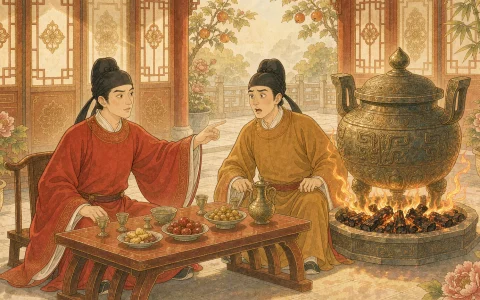
He was plain-looking and slow of speech, and his mouth could never keep up with his mind. The History of Jin says of him, bluntly, that his looks were poor and his speech halting. When his father, Zuo Yong, took him out, the father was not especially proud. Once his father said to a friend: this boy of mine does not even match what I knew when I was young.
Those words reached Zuo Si.
He did not shout or argue. He simply could not swallow it. People said he was no good, and he decided to produce something that would close their mouths.
Zuo Si had a sister, Zuo Fen, who was later taken into the palace and became known for her learning. Between the two of them, one was plain and one was famous. When the family spoke of the children, they mentioned the sister more and the brother less. There were whispers in the lane as well. The Zuo boy, people said, will never make anything of himself.
Zuo Si did not argue. He was holding a piece of writing inside him, not yet set down. He did not dare make it known. The more he was looked down on, the more he wanted to finish it.
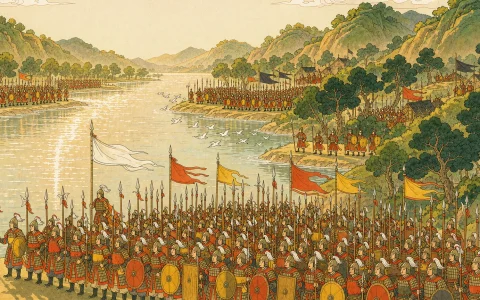
At that time the Three Kingdoms had just been unified. Wei, Shu, and Wu had had their capitals at Ye, Chengdu, and Jianye. What mountains and rivers were there, what goods, how each capital was laid out, how its palaces were arranged. These things were scattered through books, and no one had written them up properly. What Zuo Si wanted to write was a rhapsody, a long formal poem in prose, on all three capitals.
One rhapsody on three cities. To the writers of his day, the subject was huge and clumsy, a bone too hard to chew.
Where was the difficulty? There was nothing to copy from. The three cities had to be researched one by one, asked for, pieced together. The scenery had to be true, the institutions correct, the products accurate. Get one word wrong, and an expert would see it at a glance. Writing like that cannot be rushed.
Zuo Si did not care. He shut his door and polished it word by word.
He had a clumsy method. All through the house and courtyard, at his gate, even by the privy, he kept paper and brush. Whenever a line came to him, a word, an image, he wrote it down at once. His gate and his door were covered in paper.
He wrote like that not for a day or two, but for ten whole years.
When he needed material, he went and asked. He heard that an official named Zhang Zai had traveled to Shu. He called at his door more than once and asked about the mountains, the towns, the lanes of Chengdu, and wrote it all down. He did not mind being laughed at for asking even that. He only feared writing something false.
He did not ask for promotion. He asked for a place name, for a river, for the sake of his text. Others thought him foolish. He knew that one wrong word would bring the whole rhapsody down.
Ten years passed, and the Rhapsody on the Three Capitals was finished.
Ten years is neither long nor short. Zuo Si wrote from youth into middle age. The men who had started out writing beside him had risen in office, or made their names, and only he was still shut in his room, wrestling with the mountains, palaces, and products of three cities.
Finished did not mean anyone read it.
At that time, the loudest voice in the literary world of Luoyang belonged to Lu Ji. Lu Ji came from a great family, wrote beautifully, and was at the height of his fame. When he heard that a man named Zuo Si was shut in a room writing a Rhapsody on the Three Capitals, he clapped his hands and laughed.
He wrote to his brother Lu Yun: there is a country bumpkin here who also wants to write a Rhapsody on the Three Capitals. When he finishes, we can use it to cover my wine jar.
To cover a wine jar was the last word in contempt. Before Zuo Si’s rhapsody had even appeared, it had been assigned the use of waste paper.
What color a man’s face turns, having just finished ten years of work and hearing that, the history does not say. But anyone can imagine that those words cut deeper than an insult.
Zuo Si did not answer. He carried his scroll and knocked at the doors of people who would actually understand it.
His first stop was the famous scholar Huangfu Mi. Huangfu Mi read it, praised it highly, and wrote a preface for it. Then Zhang Zai wrote a commentary on the section about the Wei capital, and several other noted men wrote commentaries of their own.
With those names attached, the Rhapsody on the Three Capitals found its footing among the literati. No one mentioned the wine jar again.
Then the rhapsody spread through Luoyang.
The Minister of Works, Zhang Hua, read it and let out a long breath. He said: This is the rank of Ban Gu and Zhang Heng. You finish it, and there is still more left over. The more you read it, the newer it is.
The moment that sentence was spoken, Luoyang erupted.
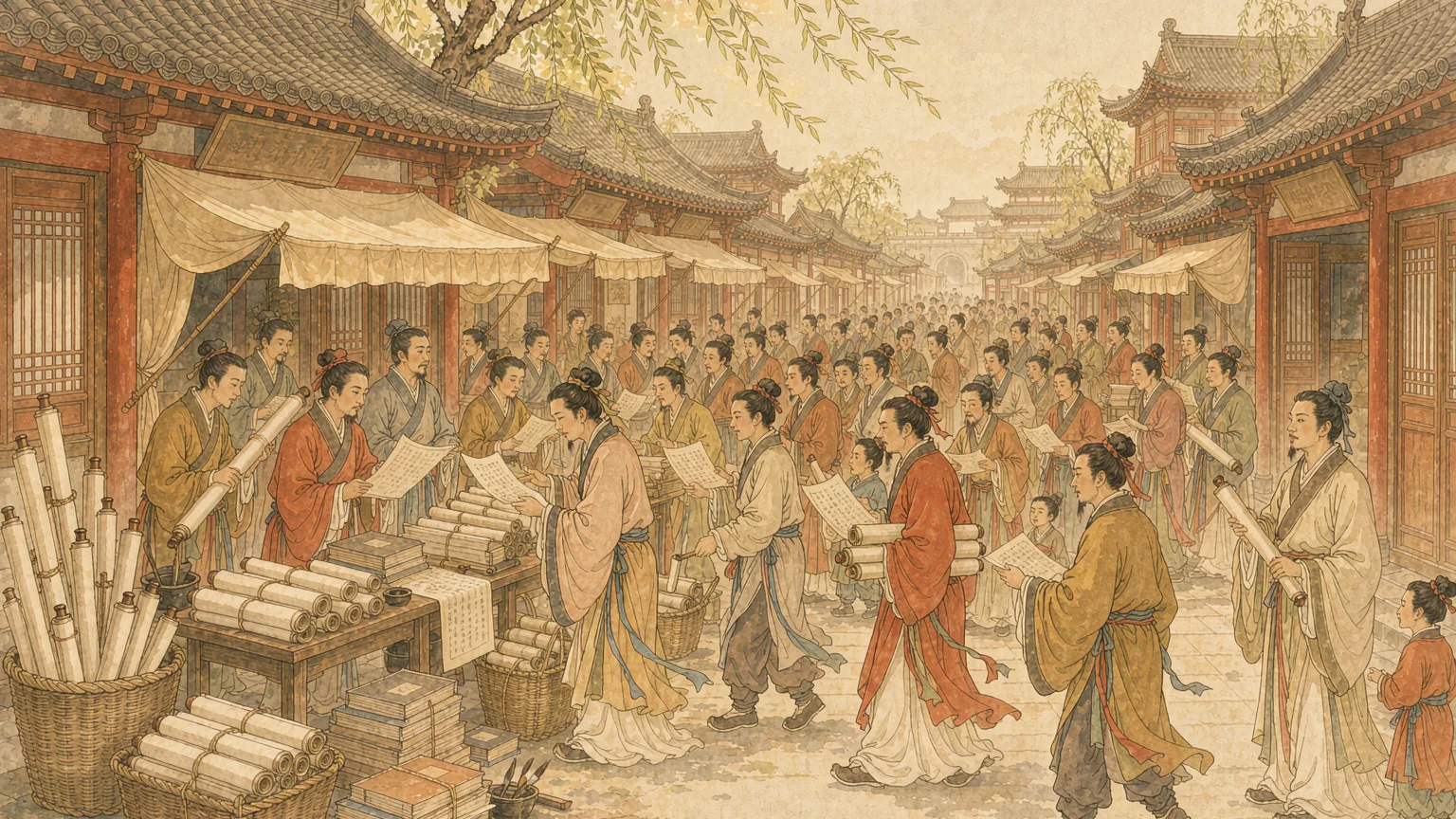
The great families rushed to have it copied. You copied a set, I copied a set, and the copiers crowded the doors. Copying a rhapsody takes paper. As soon as enough people were copying, the price of paper climbed. In Luoyang, paper suddenly became expensive.
In those days, anyone in Luoyang with any standing who did not own a copy of the Rhapsody on the Three Capitals seemed to have fallen behind. Rich families hired copyists. Poor ones copied it themselves. When they finished, they passed it around and argued over which lines were best. Paper shops hauled out stack after stack, and before the shopkeepers understood what was happening, buyers had bid the price up.
Word reached Lu Ji.
He took back what he had said. He found Zuo Si’s rhapsody and read it carefully, all the way through, and let out a long sigh. He said: There is nothing I could add to this.
He had meant to write a Rhapsody on the Three Capitals himself. Now he laid down his brush and gave it up.
Giving way is the hardest thing. No writer easily admits that another is better. Lu Ji could take back his own joke and set aside his own pen. That gesture weighs more than the first laugh ever did.
One rhapsody, polished for ten years. In the end, even the man who had laughed at it bowed.
Later Zuo Si became famous too, but he remained a man of few words. When people asked him to lecture on the History of Han, he lectured. When people praised him, it did not lift him off the ground. The excitement belonged to others. The brush was his own. His single hottest season was probably those days of expensive paper in Luoyang. A man once written off as a bumpkin had made a whole capital stand in line with one piece of writing.
People remember the Chinese idiom luo yang zhi gui by its ending: the paper got expensive. But the weight of the story is at the front. Those ten years, a man wrote on paper, on his gate, by the privy, stopping and starting, with no one cheering and no promise it would come to anything. He simply never stopped.
Paper gets cheap again, and taste changes. What makes a whole city fight for paper is never luck. It is grinding a thing down to a place no one else will reach. That is the bet Zuo Si made. Whether the writing was good, others would decide. Whether it was finished enough, only he could know.