English has a phrase for such a person: once bitten, twice shy. Someone was hurt once, and now they flinch at things that cannot hurt them at all.
Chinese has a gentler picture for the same wound. Chinese shows you a wild goose in the sky, and a bow that has no arrow on it.
The Chinese idiom is 惊弓之鸟, in pinyin *jīng gōng zhī niǎo*. It means, word for word, a bird startled by the bow. In everyday use it describes a person whose nerves have already been broken by an old hard blow, so that any small echo of it sends them running.
This one comes from a book of political arguments, the *Intrigues of the Warring States*. The story inside it is about archery. But it was told to change a ruler’s mind about a war.
That is worth remembering as you read.
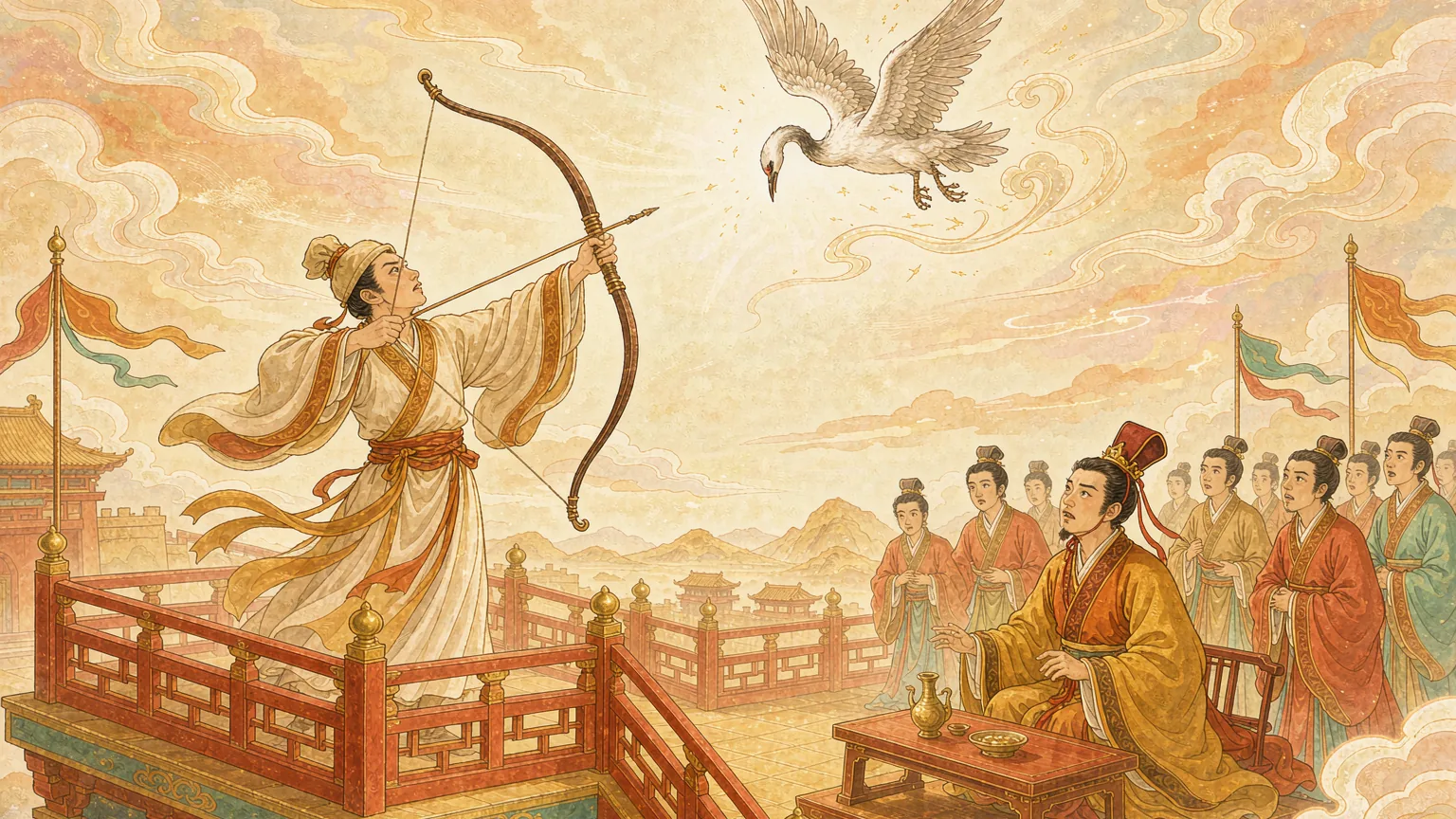
The day was fine.
The King of Wei had left his palace and stopped to rest below a high terrace. The terrace had long stairs, and the wind came down along them, lifting the corners of everyone’s robes.
The king looked up and happened to see a few birds crossing the sky. He turned to the man beside him.
The man was Geng Lei, the finest archer in Wei. When he drew a bow, he hit whatever he aimed at, and he had never once missed. As a young man he had shot a crow out of the air from a hundred paces, and no one standing nearby even saw him release the string.
The king had heard about him for years and had always wanted to watch him work.
Geng Lei raised his own eyes and followed the birds for a while. Then he spoke.
I will not use an arrow, he said. I will only pull the string, and I will bring one bird down for you.
The king blinked.
No arrow? Only the string? Could archery really reach such a level?
He took it half as a joke. Can your skill truly be that great?
Geng Lei did not explain. He only said, watch.
After a moment, a single goose appeared out of the east.
It was not flying fast. Its wings beat slowly, and each stroke looked like effort. It trailed behind, alone, the rest of its flock already far ahead. When it called, the sound was long and low, and it went on and on, like crying.
Behind the king, someone in the crowd pointed and said this goose must have fallen out of formation. That was why it flew so slowly, and cried so sadly.
Geng Lei stayed calm. He picked up his bow, and he did not take an arrow. He laid his fingers on the string, and let his wrist sink.
The string cracked. One small sound. There was nothing on it but the sound itself.
The goose jolted in the air.
It was as if something had struck it hard. It fought upward with all its strength, beat its wings twice, and could not hold. It dropped straight down and landed on the ground in front of them.
Everything under the terrace went quiet.
Someone knelt down and picked the goose up to look. Beneath the wing there was an old wound, dark and crusted over.
The king’s eyes were wide. He stared at the bird, then at Geng Lei, and it took him a moment to find his voice.
How can your skill truly reach such a level?
Geng Lei put the bow down and said the last thing the king expected to hear.
This was not my skill, my lord. This bird was already carrying a wound.
How could you know that, the king asked.
Geng Lei pointed at the goose and explained it, piece by piece.
It flew slowly because its old wound still hurt, and it did not dare to use its wings with force. It cried so sadly because it had been apart from its flock for too long, and could not find them.
Those two things together make a bird that has already been frightened.
Its old wound had not healed, and the fear in its heart had not passed. The moment it heard the bowstring, it thought the arrow was coming again, and it threw its whole body upward to escape. That effort tore the wound open. And when the wound tore, the bird fell.
It was not my arrow that brought it down, said Geng Lei. It was the arrow in its own heart.
The king looked down at the goose and said nothing for a long time.
The bird still struggled on the ground. Its wings moved twice and could not lift it. The wound was left over from an earlier day. But what actually brought it down was that one small sound.
Some days later, the king found he could not stop thinking about it. He did not put the lesson onto people right away. But he wondered, quietly, whether a man whose courage had been broken was not a little like that goose. Long before anyone raised a hand against him, he had already gone soft in the legs.
Later, this crack of a bowstring was written down and remembered, along with the man who made it.
The clever part is who used the story. It was not told first as a lesson about archery. It was told by a man named Wei Jia, to a powerful minister of the state of Chu, whose name was Lord Chunshen.
The states were trying to join forces against the growing power of Qin, and Lord Chunshen wanted to put a general named Linwujun in charge of the army. Wei Jia stopped him. Let me make a comparison from archery, he said. Linwujun is a man Qin has already beaten. He is like that goose. The moment he hears the wind from Qin, his heart will go first, and a man like that cannot lead an army.
Lord Chunshen listened, and he changed his mind.
One small picture from an archer’s terrace had done what ten speeches of argument could not.
This is how the Chinese proverb works, and why it has lasted so long. A person who has been hurt once is often not healed just because the wound has closed. Later, they meet the same kind of scene, or the same tone of voice, or the same small noise. And the old hurt wakes up again. Nothing dangerous is anywhere in sight, and already they have frightened themselves badly.
It is not cowardice. It is injury. The wound is not healed, and the person has surrendered on its behalf.
Geng Lei’s real gift was not his aim. It was that he saw, at a glance, that this bird had already lost the battle inside itself. All he had to do was pull one string, and the string inside the bird pulled with him.
Bring another archer, just as good, and he might not have brought that bird down at all. It was never the arrow that felled it.
It was the fear it had never managed to put down.