In war, backing up usually looks like losing. This Chinese proverb is about a man who backed up on purpose — ninety miles of it — and won everything.
The idiom is 退避三舍, in pinyin *tuì bì sān shè*. Word for word: “retreat and avoid by three *she*.” A *she* was an ancient measure of distance for armies, about thirty *li*, and a *li* is roughly a third of a mile. Three of them came to ninety li — a long, deliberate walk backwards.
Today, if a Chinese speaker says someone has “retreated three she,” they mean that person chose not to fight, gave ground on purpose, and refused to be dragged into a quarrel. It sounds like weakness. It almost never is.
The story is told in the *Zuo Zhuan*, an ancient Chinese chronicle of the Spring and Autumn period, and it turns on a promise made at a dinner table — and kept, many years later, on a battlefield.
The man who made the promise was a fugitive. His name was Chong’er.
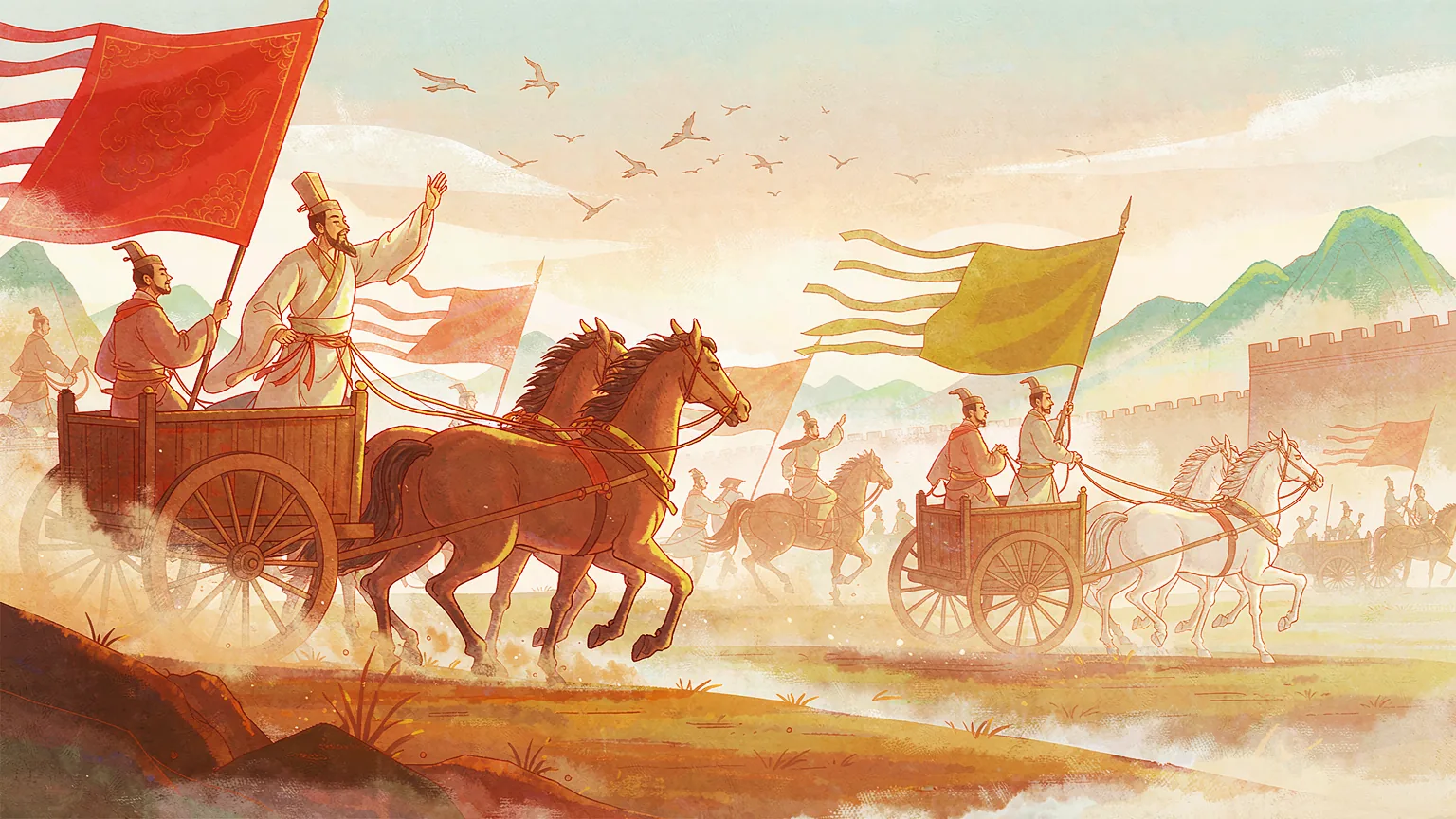
In those days, China was not one country. It was a crowd of states ruled by dukes and lords, all technically under a king who no longer had any real power. To be a prince in that world was to be a target.
A civil war tore through the state of Jin, and Chong’er, a prince of Jin, had to run for his life.
He ran for nineteen years.
He crossed from state to state, and most of them treated him badly. Some rulers fed him for two days and then showed him the door. Some would not open the city gate at all.
At one stop, in the state of Wei, the lord decided this penniless refugee was not worth feeding, and gave him nothing.
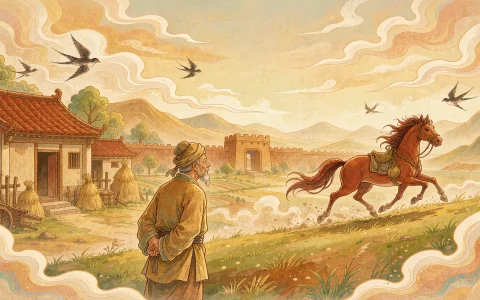
Chong’er’s party was starving. They came across a farmer working in a field and asked him for food.
The farmer looked at this ragged group of men who called themselves princes. He said nothing. Then he bent down, picked up a clod of earth, and held it out to them.
Chong’er froze.
He was a king’s son. He had never been handed dirt in his life. His face went dark and his hand moved toward his whip.
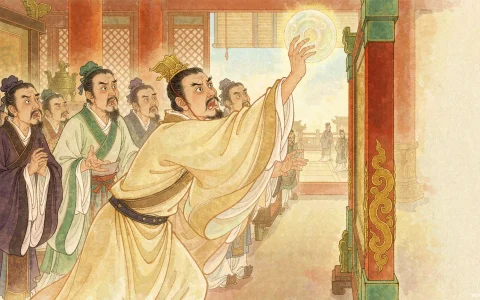
One of his ministers, Hu Yan, caught his arm. He took the clod of earth, held it up in both hands, and said, very seriously: My lord, this is a gift of land from Heaven.
Chong’er stared at him. Then something in his face changed. He climbed down from the cart, bowed to the clod of earth, and put it away. Then they walked on.
That was the kind of life it was. Hunger, insult, and the occasional joke of fate.
There was also a soft stretch, in the state of Qi. He was given a wife and a comfortable house, and stayed there five easy years — until his own followers got him drunk, loaded him onto a cart, and carried him away before he could settle down and forget who he was.
Eventually, he went south, to Chu.
Chu was big, rich, and far from the fighting. Its ruler, King Cheng of Chu, was a man of real confidence. He took Chong’er in, gave him good quarters and good food, and treated him as an equal at his own table.
For the first time in half a lifetime, Chong’er was treated like a human being.
One evening the king held a banquet for him. The lamps were lit, the music played, and the wine went around. After the third round, King Cheng put down his cup and asked, half joking: If you ever get back to Jin and become its ruler, what will you give me in return?
Chong’er thought about it. Gold and jewels — Chu had them. Land and people — Chu had those too. He raised his cup and gave an honest answer.
Beauties, fine jade, silk, feathers, ivory, leather — all of these come from Chu. Jin has nothing worth offering you.
The king laughed. Fair enough. But you must give me something.
Chong’er looked up. He was completely serious now.
If I am lucky enough to return to Jin, and if one day our two armies should meet on a field of battle — I will retreat three *she*. Ninety li of open ground. That will be my thanks for what you have done for me today.
Everyone at the table heard it as good manners. A nice thing to say to a generous host. Nothing more.
Except for one man. The Chu general Ziyu, the finest soldier in the state and a hard, proud man, remembered every word.
Privately, he went to the king. Chong’er is ambitious, he said, and the men around him are all capable. Kill him now, before he becomes a danger to Chu.
The king shook his head. Chong’er is a worthy man, and his followers are the pillars of a state. Heaven is lifting him up. I will not kill him.
Ziyu was not convinced. But there was nothing he could do.
A few years later, Chong’er did return to Jin. The chaos at home had finally cleared, and he came back to take the throne as Duke Wen of Jin.
Nineteen years on the road had turned a hot-headed prince into a patient man. He reformed the government, rewarded the followers who had stayed with him through the worst of it, and rebuilt the army. Jin grew stronger every year.
And to the south, Chu was pushing north. Two great powers, drifting toward each other.
The chance came soon. Chu laid siege to the state of Song, and Song sent riders begging Jin for help.
The Jin general Xian Zhen had an idea. Do not march straight at Chu. Attack Chu’s allies instead — the states of Cao and Wei. Force Chu to come and save them.
It worked. Ziyu pulled his army away from Song and marched north, looking for a fight.
That was exactly what Duke Wen of Jin had been waiting for.
And then, just as the two armies were about to meet, he gave an order that made no sense to anyone.
The whole army would fall back.
Thirty li back. Then thirty more. Then thirty more.
Ninety li. All the way to a place called Chengpu.
The Jin officers were stunned.
My lord, we are a great state. Why are we retreating? Every step back looks like weakness. The Chu will think we are afraid.
A Jin adviser raised his hand and explained it to them, plainly.
Years ago, when our lord was a fugitive in Chu, King Cheng took him in and treated him well. Our lord promised that if the two armies ever met, he would retreat three *she*. If we break that promise now, we are the ones in the wrong, and the Chu soldiers will fight harder. So we fall back ninety li. First, our lord keeps his word. Second, the Chu will grow arrogant — and arrogant armies lose.
Nobody said anything after that.
Duke Wen stood where he could see the dust rising in the south. He said nothing either. He knew the retreat was not simple. Pull back too little, and Chu would not take the bait. Pull back to Chengpu, and you stood on ground you could both defend and attack from. It was a promise. And it was a plan.
On the Chu side, Ziyu came on, chasing.
One of his officers tried to slow him down. The Jin are retreating, he said. That is weakness. But they are retreating in perfect order. This could be a trap. Let us wait.
Ziyu laughed. The Duke of Jin spent nineteen years on the road, begging for food. Men like that are afraid to die. He has run ninety li because he is frightened. Chase him.
The order went down the line, and the whole Chu army pressed forward.
632 BC. Chengpu.
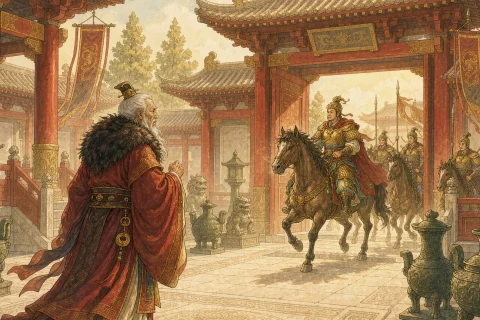
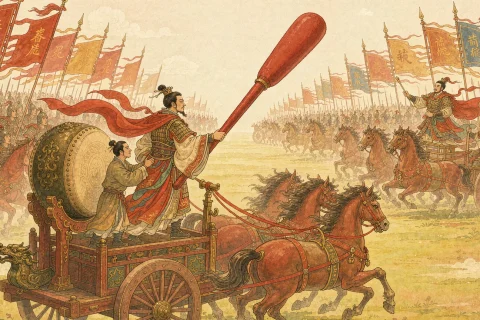
The Jin army was already in position. On the right, the Jin soldiers had draped tiger skins over their horses and charged straight at the Chu right wing. In the centre and rear, they raised two great banners and dragged branches through the dust behind them, so that from a distance it looked like a huge army on the move.
The Chu right wing broke first. Then the left was caught between the Jin centre and the Jin left, and cut apart piece by piece.
In a single day, the Chu army was destroyed.
Ziyu fled with the survivors. He had lost the battle, and he could not bear to face his king. Halfway home, at a place called Liangu, he stopped, drew his sword, and killed himself.
And Duke Wen of Jin stood on the field at Chengpu, looking at the direction the Chu army had gone. For a long time he said nothing.
That victory made him the leading power of the Central Plains. The other lords met him at a place called Jiantu, and the king of Zhou — the old, weakened figurehead of all China — sent his own envoy to recognise him as *Hou Bo*: the chief of all the lords.
Afterward, people asked him the obvious question. Those ninety li — were they a debt repaid, or a trap laid?
He never answered directly.
But everyone could see the shape of it. Those ninety li had begun as a promise made by a hungry prince at a foreign banquet table. And they ended as the first move of a war.
That is where the idiom 退避三舍 comes from.
People hear it and think it means cowardice.
It does not.
Only a man with real confidence can afford to give up ninety li. He stepped back to square a debt. And he stepped back to see, clearly, where his next step should fall.
The wind was strong at Chengpu that day. Duke Wen of Jin stood in it, his robe snapping.
He had retreated ninety li. Now, at last, he could go forward.